How Automated Abstracts Work
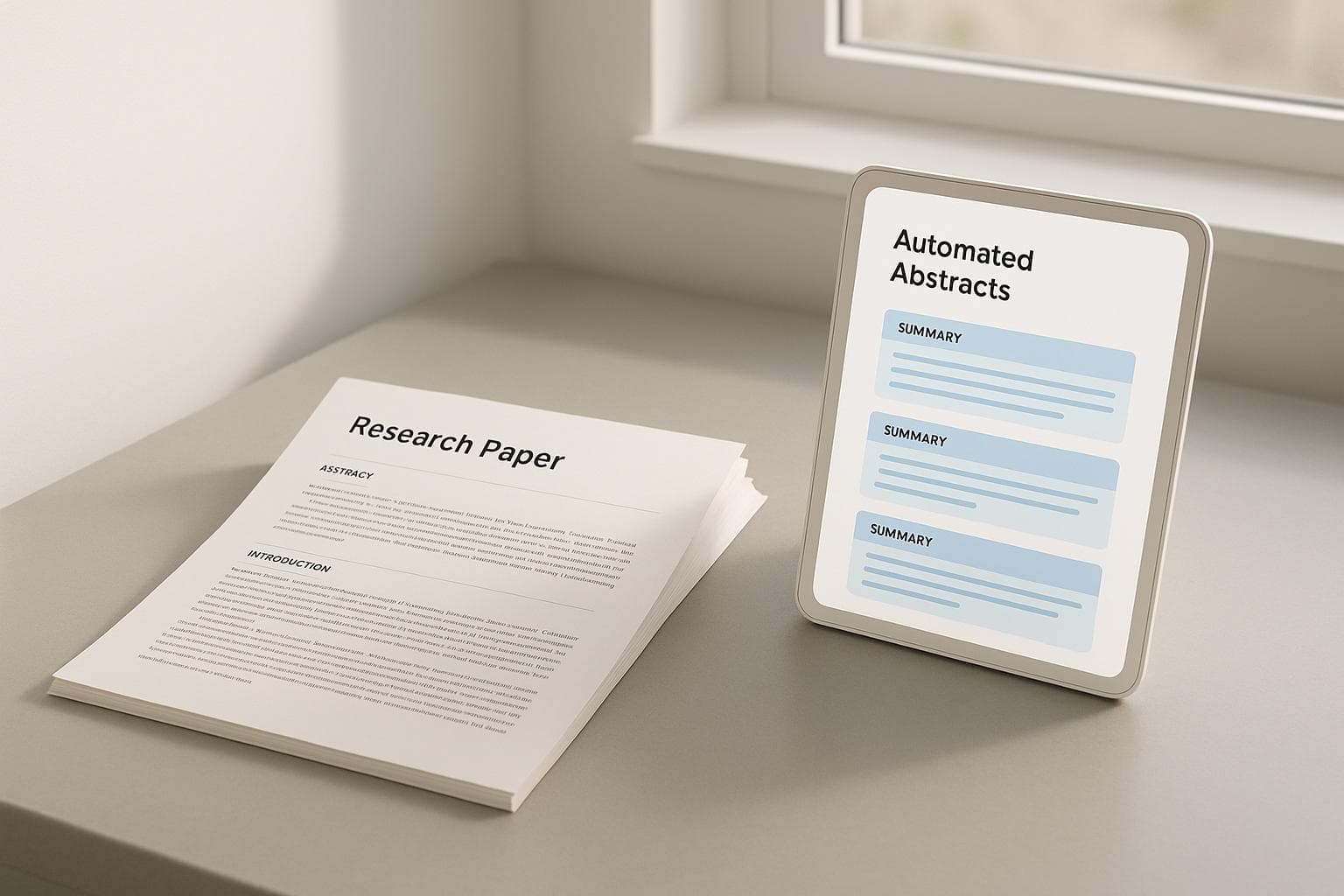
Automated abstract generation uses AI and NLP to create summaries of academic papers or reports. These tools analyze text, identify key concepts, and condense findings into structured abstracts. By leveraging advanced models like Transformers, they produce summaries in seconds, saving researchers time and effort. Here's what you need to know:
- What It Does: Summarizes academic content by extracting key points or rewriting information for clarity.
- Why It Matters: Speeds up literature reviews, grant applications, and academic submissions by providing quick overviews.
- Core Technologies: Combines extractive and abstractive methods using NLP techniques like tokenization and attention mechanisms.
- How It Works: Involves preprocessing, analysis, summary generation, and post-processing for polished abstracts.
- Benefits: Saves time, ensures consistency, and offers customizable outputs.
- Limitations: May misinterpret data, struggle with niche topics, or require human review for accuracy.
Platforms like Sourcely enhance this process by sourcing relevant literature and summarizing it effectively, ensuring abstracts are rooted in quality research. With flexible pricing and access to over 200 million papers, tools like these are reshaping academic workflows.
Core Technologies Behind Automated Abstracts
AI Algorithms and Natural Language Processing
Automated abstract generation relies on two main AI methods: extractive and abstractive. Extractive techniques act like a digital highlighter, pulling key sentences directly from the text. While this ensures precision, the results can sometimes feel disjointed. On the other hand, abstractive methods rewrite and synthesize content, creating summaries that are more fluid and natural to read. These rely on advanced language models to paraphrase and combine information effectively.
Many tools today use hybrid approaches, blending both extractive and abstractive techniques. This combination strikes a balance, ensuring the abstracts are both accurate and easy to read. Key natural language processing (NLP) steps - like tokenization, part-of-speech tagging, and semantic analysis - help these systems understand text structure and relationships.
Transformer-based models, especially those using attention mechanisms, are pivotal in this process. They focus on critical sections, such as a paper's methodology and results, ensuring the generated abstracts emphasize the most relevant information. This technology enables a systematic transformation of dense research papers into clear and concise summaries.
Process: From Input to Output
The process of creating automated abstracts typically involves four stages:
- Preprocessing: Irrelevant sections are removed, and the text is formatted for analysis.
- Analysis: The paper is broken down into segments, identifying key sentences and core concepts.
- Summary Generation: Using extractive, abstractive, or hybrid methods, the AI generates the abstract.
- Post-Processing: The final step ensures coherence, adjusts the length, and formats the output to meet academic standards.
Each stage contributes to producing a polished and professional abstract.
Role of Training Data in Academic Abstracts
The effectiveness of automated abstracts depends heavily on the training data that shapes AI models. Typically, title-abstract pairs from published academic papers are used to teach the system what makes a well-constructed abstract and how it relates to the full text.
Domain-specific datasets are particularly important. Training models on specialized collections, such as papers from specific academic repositories, ensures the output is more accurate and tailored to the field. For example, abstracts generated for medical research will differ significantly from those for engineering studies.
Fine-tuning takes this a step further by helping models adapt to the unique language, structure, and conventions of a specific discipline. A model fine-tuned on computational linguistics papers, for instance, will better handle technical jargon and highlight findings that resonate with experts in that field. This adaptation improves both the quality and relevance of the abstracts.
Finally, the size and diversity of the training datasets play a crucial role. Exposure to thousands of academic papers helps models identify patterns in abstract writing, understand what information to emphasize, and maintain the formal tone expected in scholarly work. This extensive training ensures the system produces reliable and field-appropriate summaries.
Step-by-Step Guide: How Automated Abstracts Work
Preparing Academic Content for Input
The effectiveness of an automated abstract largely depends on how well your research paper or essay is prepared before being fed into the AI tool. A well-organized document makes it easier for the system to extract accurate and meaningful information.
Start by structuring your paper into clear sections with headings like Introduction, Methods, Results, and Conclusion. These headings help the AI follow the flow of your research and pinpoint the most critical details. Remove any elements that might confuse the system, such as reference lists, tables, figures, and footnotes, as most tools focus solely on the main body of text.
Address any formatting issues before submission. For example, eliminate LaTeX commands, unusual symbols, or errors that could disrupt the AI's processing. Correcting typos and ensuring clean text helps the system interpret your content more effectively.
Additionally, aim for clarity and precision in your writing. While academic writing often involves technical terms, clear and logically structured sentences improve the AI's ability to understand the relationships between different sections of your work. Once your text is polished and ready, you can move on to setting the parameters for abstract creation.
Setting Parameters for Abstract Generation
Most automated abstract tools allow you to customize the output, tailoring it to suit your specific needs. Understanding these settings is key to producing a summary that aligns with your goals.
One important parameter is the length of the abstract. You can typically specify a word count, character count, or a percentage of the original text. If you're submitting to a journal, check their guidelines for abstract length, as these can vary. Similarly, conference submissions may have unique requirements, so adjust accordingly.
Another useful option is tone selection. You can choose between tones like academic, professional, or scientific, depending on the context. For instance, an academic tone uses formal language and scholarly vocabulary, while a professional tone is slightly more accessible while maintaining credibility.
Many tools also allow you to prioritize specific aspects of your research, such as methodology or results. For example, if your study introduces a new approach, you might want the abstract to focus on methodology. On the other hand, if your findings are the highlight, you can instruct the tool to emphasize results. These settings help align the abstract with the main focus of your research.
By inputting your text, selecting the desired length and tone, and setting focus areas, you can generate a draft abstract that aligns with your research goals and meets academic standards.
Reviewing and Editing Abstracts
Once the AI generates a draft, the next step is to review and refine it. Automated abstracts are a great starting point, but they need human oversight to ensure accuracy and quality.
Start by verifying the abstract's factual accuracy. AI tools can sometimes misinterpret data or draw conclusions that don't match your findings. Compare the draft with your original paper to ensure all claims are accurate and supported, especially when it comes to numerical data or causal relationships.
Edit the draft to improve flow and coherence. Ensure that the abstract includes all the essential components - objective, methods, results, and conclusions - in a concise and unified manner. A strong abstract provides a clear and complete snapshot of your research.
Check that the abstract complies with any formatting or citation requirements set by your institution or the journal you're submitting to. This includes adhering to specific styles or word limits.
Lastly, consider running the abstract through plagiarism detection software. While AI-generated content isn't plagiarized, some tools might inadvertently reproduce phrases from their training data. A quick check ensures originality and upholds academic integrity.
ChatGPT Writes A PERFECT Abstract For A Research Paper (In Less Than 10 Minutes)
sbb-itb-f7d34da
Benefits and Limitations of Automated Abstract Generation
Understanding both the advantages and challenges of automated abstract generation is essential for making the most of these tools in academic settings.
Key Benefits of Automated Abstracts
One of the biggest perks of automated abstract generation tools is how much time they save. Instead of spending hours crafting summaries, researchers can generate professional-quality abstracts in just seconds. This time-saving aspect is especially helpful when dealing with large numbers of research papers, making it a valuable tool for academics juggling multiple tasks.
Another major advantage is the consistency these tools offer. Thanks to AI algorithms that are trained on academic writing conventions, the generated abstracts maintain a uniform quality. Whether summarizing journal articles or conference papers, these tools produce summaries that are well-structured, clear, and formatted to professional standards.
Accessibility is another highlight. These tools make it easy for anyone, regardless of experience, to create high-quality abstracts. They’re particularly useful for students and early-career researchers who might not yet be skilled in crafting academic summaries. With simple interfaces - often just requiring users to paste text, click generate, and review the output - these tools are straightforward and easy to use.
Some advanced tools go a step further by offering customization options. Users can tweak the abstract’s length, tone (academic, professional, scientific), and output format to meet specific requirements for journals or conferences. Many also support multiple formats like Microsoft Word, PDF, plain text, and even LaTeX templates, simplifying the submission process.
For researchers conducting literature reviews or systematic reviews, these tools shine in multi-document synthesis. They can process multiple papers at once, identifying shared themes, methodologies, and findings across a body of research. This capability significantly speeds up the literature review process, even when working with dozens or hundreds of papers.
Limitations and Challenges
Despite their benefits, automated abstract generators aren’t without flaws. One of the biggest concerns is factual accuracy. These tools can sometimes misinterpret data or draw conclusions that don’t fully align with the original findings. This creates a risk of oversimplifying complex ideas or leaving out critical context, making human oversight essential before finalizing any abstract.
Another challenge lies in handling specialized fields. Tools trained on general academic content may struggle with highly specific disciplines like computational linguistics or advanced medical research. Without high-quality training data, these tools can miss important details, particularly in niche or technical areas.
To ensure the abstracts are accurate, coherent, and complete, researchers must carefully review the output. This includes verifying that all key findings are represented and that domain-specific terminology is used correctly. While necessary, this additional layer of human review adds complexity to the process.
Comparison Table: Pros vs. Cons
Here’s a quick breakdown of the benefits and challenges of automated abstract generation:
| Aspect | Benefits | Limitations |
|---|---|---|
| Time Investment | Abstracts generated in seconds | Requires time for human review and validation |
| Consistency | Standardized academic formatting | May overlook specialized terminology |
| Accessibility | Simple, user-friendly interfaces | Quality depends on input text and training data |
| Accuracy | Handles large text volumes efficiently | Risk of factual errors |
| Customization | Adjustable length, tone, and format options | Struggles with highly specialized content |
| Cost Efficiency | Free basic tools available | Advanced features often require paid versions |
| Quality Control | Automated structure and formatting | Needs plagiarism checks and expert review |
Striking the right balance between these advantages and challenges is essential, as we'll explore further in the context of Sourcely's applications.
Using Sourcely for Academic Summarization
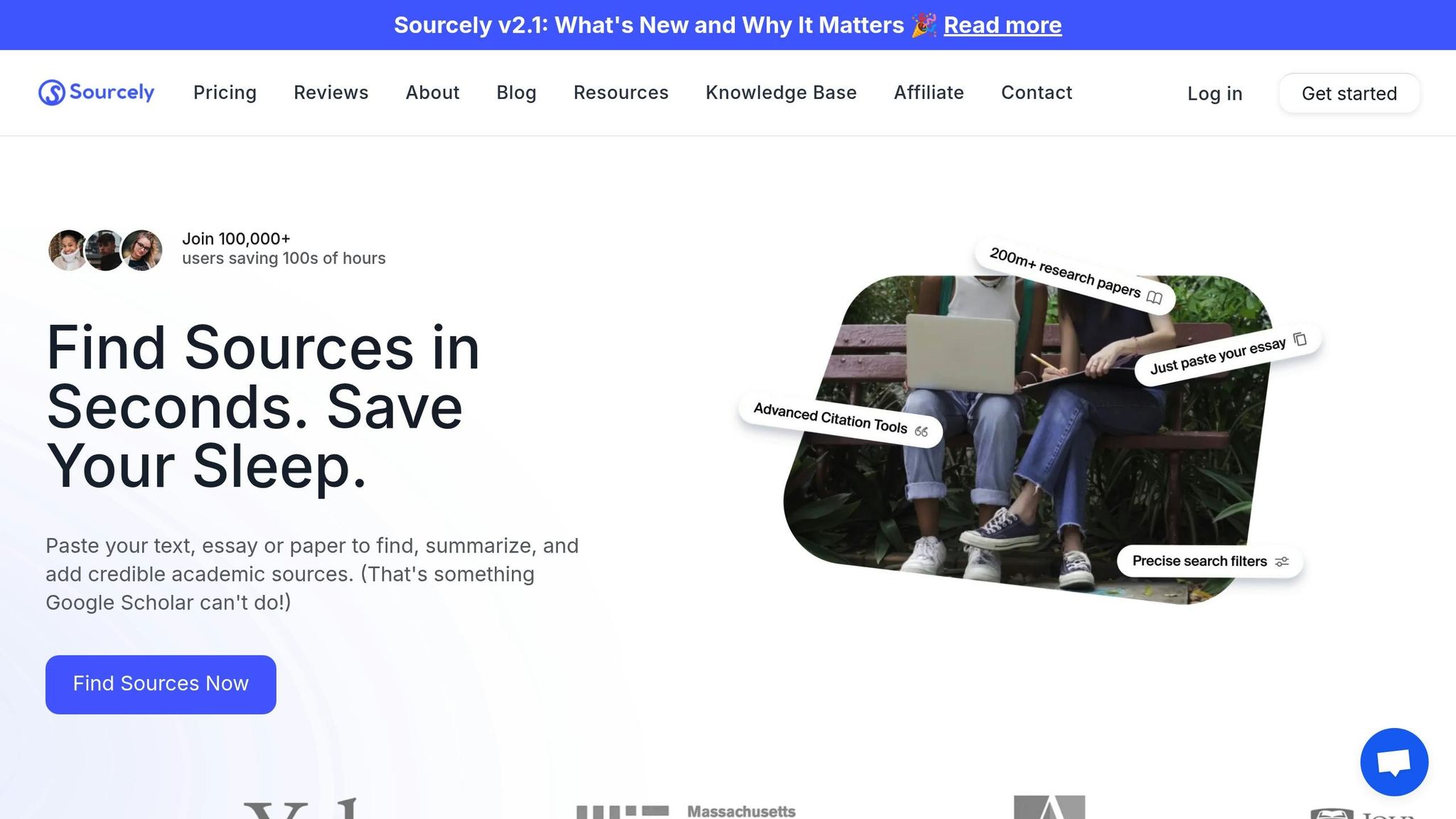
Sourcely takes the process of academic summarization to the next level by helping researchers find and organize high-quality literature. While automated abstract generators are great at summarizing text, they rely heavily on the quality of the material they're working with. This is where Sourcely steps in, addressing the challenge of sourcing relevant and credible literature to support the creation of effective abstracts.
Sourcely's Role in Abstract Generation
Sourcely works as a helpful tool that complements automated abstract generators by tackling the crucial step of identifying what content to summarize. Using AI-powered literature sourcing, it streamlines the process by allowing researchers to upload their essays or research drafts. The platform then analyzes the content and recommends reliable academic sources that align with the research. This creates an efficient two-step workflow: Sourcely identifies and summarizes relevant literature, making it easier to craft precise abstracts while saving significant time - whether you're working on a literature review or a dissertation.
Here’s how you can integrate Sourcely into your workflow for better summarization results.
How to Use Sourcely
Getting started with Sourcely is simple and fits seamlessly into existing workflows. It eliminates the hassle of manually searching for sources by consolidating everything into one easy-to-use platform:
- Step one: Upload your essay, research paper, or dissertation section into Sourcely's input field. Use advanced filters to refine your search by discipline, publication date, methodology type, or other criteria to ensure the results match your focus.
- Step two: Review the academic sources Sourcely recommends. The platform uses AI to match your content with research papers that align with your themes and methods.
- Step three: Download free PDFs of the sources you choose. This feature not only saves time but can also cut down on database subscription costs, which is especially helpful for students and early-career researchers.
- Step four: Read the concise summaries Sourcely generates for each source. These overviews allow you to quickly decide which papers are worth exploring further before moving on to abstract writing.
- Step five: Export the selected sources and their citations in your preferred format - APA, MLA, Chicago, or Harvard - to maintain proper attribution and adhere to academic standards.
With these organized sources and summaries, you’ll have a solid foundation for generating accurate and detailed abstracts.
Pricing and Plans for U.S. Users
Sourcely offers flexible pricing plans tailored to the needs of U.S.-based researchers. Operating on a freemium model, it allows users to explore its basic features for free, making it an excellent choice for students working on smaller projects or anyone testing the platform's capabilities.
For those needing more, the monthly subscription costs $17.00 and includes unlimited document uploads and access to millions of academic sources. An annual plan is available for $167 per year (around $13.92 per month), offering significant savings for graduate students, faculty, and researchers with ongoing needs. For long-term use, a lifetime plan is priced at $347, providing permanent access to all features without recurring fees - ideal for those engaged in continuous academic work.
All paid plans come with added perks such as unlimited uploads, priority support, and full database access. Many researchers in the U.S. find that the time and effort saved more than justify the cost, especially when the platform helps improve the quality of abstracts by grounding them in well-sourced materials.
Conclusion
Automated abstract generation is changing the game for academic research in the U.S., making one of the most time-intensive tasks in scholarly writing faster and more efficient. These AI-driven tools can produce high-quality abstracts in just 90 seconds, allowing researchers to focus more on their core analyses and significantly boosting productivity in academic institutions across the country.
The technology behind these tools - natural language processing, machine learning, and tailored templates - ensures that abstracts meet academic standards and maintain consistent formatting. However, their effectiveness hinges on access to credible, well-researched source material. Platforms like Sourcely play a pivotal role here, streamlining the process by sourcing reliable literature before abstract creation. This not only enhances the quality of abstracts but strengthens the research process as a whole.
For the U.S. academic community, combining automated abstract generation with tools for comprehensive literature sourcing creates a more efficient research workflow. Sourcely, for instance, analyzes research drafts, recommends relevant sources from a database of over 200 million papers, and provides credible summaries - all while keeping abstracts firmly rooted in current scholarship. With pricing options starting at $17.00 per month and a free tier for basic needs, these tools are accessible to students, faculty, and researchers across various budgets.
More than 100,000 users are already saving countless hours with these AI-powered tools, and their adoption continues to grow. Features like plagiarism detection, citation integration, and multi-document synthesis are making these platforms even more indispensable. As the technology behind automated abstract generation advances, researchers who integrate these tools into their workflow will be better equipped to produce high-quality work while keeping up with the fast-paced demands of modern academia.
The ability to deliver speed, precision, and accessibility makes automated abstract generation a core element of efficient research practices in U.S. academia today.
FAQs
How do automated tools create accurate and relevant abstracts for specialized academic fields?
Automated abstract generation tools leverage AI-driven algorithms to scan through academic content, pinpoint essential ideas, and transform them into clear, concise summaries. These tools are designed to emphasize the most critical details, ensuring the abstract captures the main themes of the original work.
In highly specialized academic fields, these tools often utilize domain-specific training data alongside natural language processing (NLP) techniques. This combination allows them to interpret complex terminology and nuanced concepts, ensuring the abstracts remain accurate and relevant, even for technical or niche topics.
Platforms like Sourcely take this a step further by combining reliable summaries with precise search filters. This approach helps researchers quickly locate and grasp the academic sources most pertinent to their work.
What’s the difference between extractive and abstractive summarization in AI-generated abstracts?
Extractive summarization works by picking out key sentences or phrases straight from the original text. It zeroes in on the most critical parts without changing the original wording.
Abstractive summarization, however, takes a different approach. It creates brand-new sentences to express the main ideas of the content. This technique relies on advanced AI to understand the material and rewrite it in a more concise and natural way, much like how a person might summarize.
Both methods play a big role in AI-powered tools. Extractive summarization is known for its precision and simplicity, while abstractive summarization provides more creative and flexible results.
How can researchers use Sourcely to create better abstracts more efficiently?
Researchers can rely on Sourcely to refine their abstracts by seamlessly locating and incorporating trusted academic sources. By simply pasting their text or essay into the platform, they gain access to concise summaries, advanced search filters, and downloadable research papers.
This efficient approach not only saves valuable time but also guarantees that abstracts are backed by dependable references, allowing researchers to dedicate more energy to producing well-crafted, high-quality work.