How to Write a Strong Thesis Statement Backed by Credible Sources
A strong thesis statement is the foundation of any effective academic paper. It clearly presents your argument, sets the focus, and guides your writing. To ensure your thesis holds up, it must be specific, debatable, and supported by trustworthy sources. Here's how to craft one:
- Be Clear and Direct: Avoid vague or overly broad statements. Instead, focus on a specific claim that is easy to understand.
- Stay Focused: Narrow your topic to ensure your argument remains relevant and manageable.
- Make It Arguable: A thesis should present a position that others can challenge or debate.
- Back It with Evidence: Use academic research to support your claim and strengthen your argument.
When researching, tools like Sourcely can help you quickly find and organize academic sources that align with your thesis. This ensures you have the evidence needed to build a persuasive and well-structured paper.
Mistakes to avoid:
- Writing overly broad or unclear statements.
- Making claims without sufficient evidence.
- Failing to take a clear stance on the issue.
A well-crafted thesis is your roadmap to a focused, impactful paper. Start with a specific topic, take a strong position, and support it with reliable research.
How to Write a STRONG Thesis Statement | Scribbr 🎓

What Makes a Strong Thesis Statement
A well-supported thesis is the backbone of any solid academic work. To craft one, focus on three essential traits.
Clear and Concise Language
A strong thesis delivers your argument in simple, direct terms, leaving no room for ambiguity. As Vanderbilt University puts it:
A thesis statement is a specific argument that guides your paper.
Avoid vague language that weakens your point. Instead, use assertive and precise wording. For example, steer clear of uncertain phrases like "might be" or "could possibly." Commit to your argument with confidence, clearly stating your topic and your stance.
Specific and Focused
Purdue University emphasizes the importance of narrowing your thesis:
Generally the narrower the thesis the more effective your argument will be.
A focused thesis defines clear boundaries for your discussion, helping you stick to the topic without veering off course. It also clarifies what your paper will NOT address, keeping your argument sharp and relevant.
For instance:
- Too broad: "Drugs have an impact on society."
- Focused: "Prescription opioid misuse has contributed to the rise of addiction in rural U.S. communities."
The second example zeroes in on a specific issue and its context, making it easier to build a compelling argument. Using qualifiers like "typically" or "on average" can also help refine your scope while acknowledging exceptions.
Finally, ensure your thesis is not only specific but also grounded in evidence and open to debate.
Arguable and Supported by Evidence
A thesis must go beyond stating facts; it should present a claim that invites discussion. If everyone would agree with your statement, it’s not a thesis - it’s just a summary. As Purdue University explains:
Your thesis must present a debatable claim.
The goal is to interpret, not just describe. Rather than summarizing what sources say, your thesis should make an analytical claim backed by evidence. The broader your claim, the more credible evidence you'll need to support it effectively. A strong thesis also acknowledges opposing views while firmly establishing your position and the reasoning behind it.
How to Write a Strong Thesis Statement
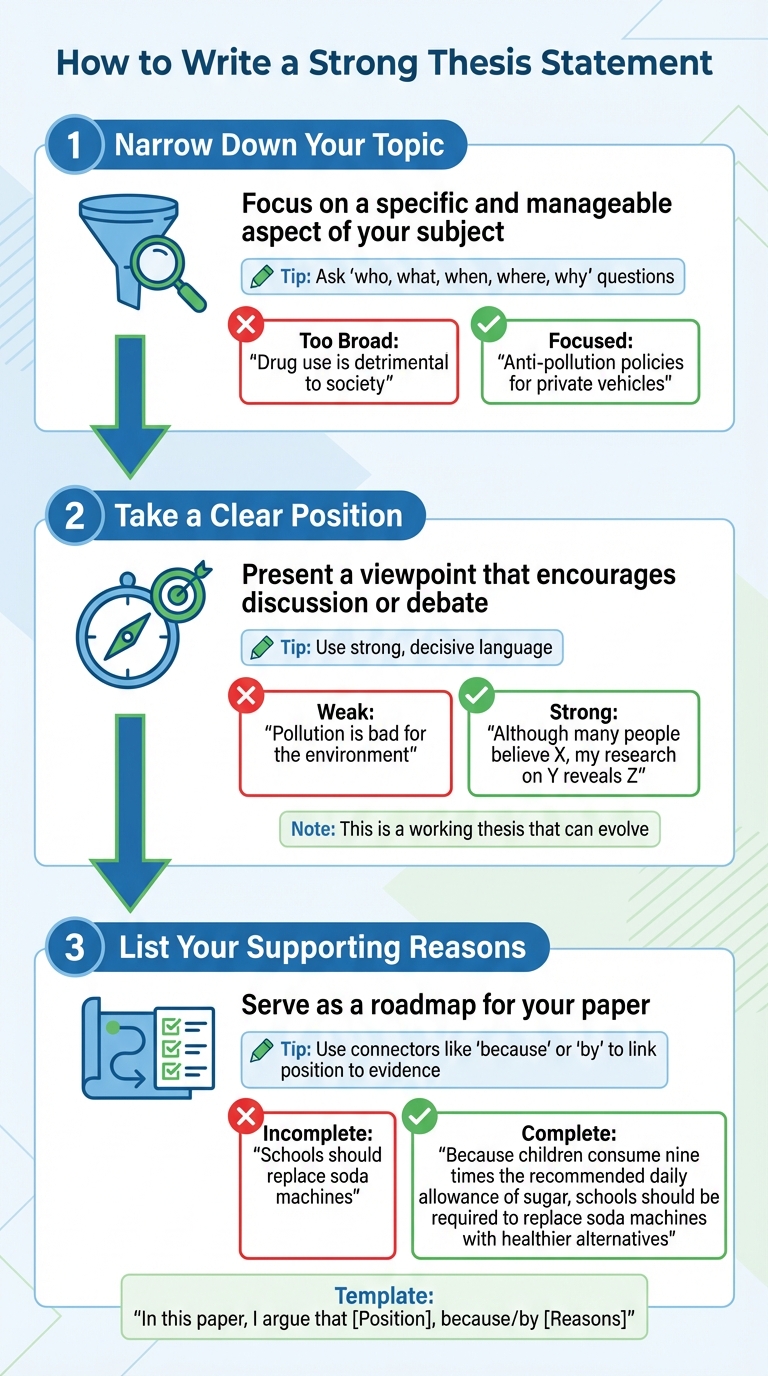
3-Step Process to Write a Strong Thesis Statement
Crafting a solid thesis statement can be broken down into three straightforward steps.
Step 1: Narrow Down Your Topic
Start by focusing on a specific and manageable aspect of your subject. Broad claims like "Drug use is detrimental to society" can be overwhelming to support and may make your argument feel scattered. Instead, ask targeted "who, what, when, where, why" questions to zero in on your topic. For example, rather than tackling a massive subject, you could focus on narrower issues like anti-pollution policies for private vehicles or government funding for clean technology upgrades.
A helpful strategy is the question-and-answer method: pose a specific question and then craft a concise answer to guide your thesis.
Once you've refined your topic, the next step is to take a clear stance.
Step 2: Take a Clear Position
Your thesis should present a viewpoint that encourages discussion or debate. If your statement merely highlights an accepted fact (e.g., "Pollution is bad for the environment"), it won’t inspire much interest or persuasion.
Use strong, decisive language to clearly express your position. You might frame your thesis to acknowledge other perspectives while emphasizing your argument. For instance, you could write something like, "Although many people believe X, my research on Y reveals Z". Keep in mind, this is a working thesis, so it can evolve as you continue your research and writing.
Once your position is clear, outline the reasons that back it up.
Step 3: List Your Supporting Reasons
A well-crafted thesis serves as a roadmap for your paper, guiding readers through your argument and evidence. Clearly list the reasons supporting your stance, using connectors like "because" or "by" to link your position to your evidence.
For example, instead of simply stating, "Schools should replace soda machines", you could expand your thesis to say: "Because children consume nine times the recommended daily allowance of sugar, schools should be required to replace soda machines with healthier alternatives". If you’re stuck, try using a simple template like: "In this paper, I argue that [Position], because/by [Reasons]." Just ensure that every reason you include can be supported with credible evidence throughout your paper.
sbb-itb-f7d34da
Finding Academic Sources with Sourcely

Once you've nailed down your thesis statement, the next step is finding reliable academic sources to support your argument. Sourcely simplifies this process by automatically connecting your thesis to peer-reviewed materials.
Locating Relevant Sources
Sourcely makes it easy to match your thesis with the right scholarly research. Its system evaluates the main arguments in your thesis and searches through extensive databases to pull up journal articles, peer-reviewed papers, and other academic publications that align with your topic. Instead of spending hours sifting through search engines, Sourcely does the heavy lifting, finding the evidence you need to back up your claims.
It’s a good idea to test your thesis early using Sourcely. This helps ensure there’s enough academic research to support your position. If you find gaps in the evidence, you can adjust your argument or refine your focus before diving deeper into the writing process.
Once Sourcely provides a list of potential sources, you can fine-tune the results using its advanced search filters.
Using Filters for Better Results
Sourcely’s filtering tools help you zero in on the most relevant and trustworthy studies. For example, you can toggle the peer-review filter to ensure your sources meet strict academic standards. You can also limit results by publication date - focusing on research from the last 5–10 years keeps your paper rooted in current academic discussions. These filters save you from relying on outdated or less credible materials that could weaken your argument.
Exporting and Adding Citations
Managing citations is a breeze with Sourcely. You can export references in popular formats like APA, MLA, or Chicago. It also supports BibTeX and RIS files, making it easy to integrate with citation management tools. To stay organized, export citations as you go - this ensures you won’t lose track of your sources while writing.
Sourcely offers a free version for basic searches, but upgrading to the Pro plan ($17/month or $167/year) unlocks unlimited searches, advanced filtering, and even lets you paste entire essays to pinpoint where citations are needed.
Common Mistakes When Writing Thesis Statements
Even seasoned writers can trip up when crafting a strong thesis statement. Spotting these common mistakes can help you avoid weakening your argument. Let’s break down the major pitfalls and how to sidestep them.
Vague or Broad Statements
A thesis like "pollution is bad for the environment" might seem meaningful at first glance, but it’s far too broad to be effective. The broader your claim, the more evidence you’ll need to support it, which can dilute your argument. Overly general topics make it harder to maintain focus and clarity.
Instead, narrow your focus. For instance, instead of saying "drug use", specify something like "illegal drug use is harmful because it fuels gang violence". A helpful trick is to apply the "So What?" test: if your reader is left asking "So what?", you need to clarify the bigger picture. Replace vague terms with precise ones. For example, instead of "society", identify the specific group you’re discussing, and rather than "drugs", specify whether you mean prescription medications, illegal substances, or something else entirely.
Not Taking a Clear Stance
A thesis without a clear stance fails to persuade. Your statement needs to take a strong, debatable position - much like a lawyer presenting a case.
For example, "there are pros and cons to social media" isn’t a thesis; it’s just a neutral observation. A strong thesis makes a case for one side of the debate. If your thesis is something everyone already agrees on, it won’t spark meaningful discussion. Ask yourself: Could someone reasonably disagree with this claim? If not, you’re likely stating a fact rather than making an argument. A clear stance is essential for building a compelling and well-structured academic paper.
Making Claims Without Evidence
Claims without evidence undermine the credibility of your thesis. Before locking in your thesis statement, check if there’s enough reliable, scholarly material to support your argument. The purpose of an argumentative paper is to convince readers that your claim is valid, using strong evidence as your foundation.
Think of your thesis as a filter - it determines what information belongs in your paper and what doesn’t. If you can’t find solid academic sources to back up your argument, it’s time to refine your focus or rethink your approach. A thesis without evidence confuses readers and disrupts the logical flow of your paper. Always ensure your claims are grounded in credible research to maintain the strength of your argument.
Conclusion
Main Points to Remember
A solid thesis is built on claims that are clear, focused, and supported by evidence. Using the "So What?" and "How and Why?" tests early on can help ensure your thesis is both relevant and detailed. Think of your thesis as a flexible roadmap - one that evolves as you uncover new evidence. Replace vague wording with precise, research-backed language to strengthen your argument.
The strategies discussed - from narrowing your topic to taking a firm stance - are designed to help you create a thesis that holds up under academic scrutiny. Once your thesis is refined and well-supported, the next step is finding the right academic sources to back it up.
How Sourcely Supports Academic Writing
Sourcely makes it easy to find the scholarly research you need to support your thesis. The platform connects you with materials that align with your topic, offering advanced filters to ensure the evidence is both credible and relevant. With features like streamlined citation management and access to millions of academic sources, Sourcely simplifies the research process. Whether you use a free account or upgrade to the Pro plan for $17 per month, the platform handles the technical side of research so you can focus on building an evidence-based argument.
FAQs
How can I create a thesis statement that is clear, focused, and open to debate?
To create a strong thesis statement, aim for it to be both clear and open to debate. Begin by narrowing your topic to something focused and manageable, then clearly outline the stance or argument you plan to present. To make it debatable, phrase your thesis as a claim that others might reasonably challenge or contest. This not only makes your thesis more engaging but also lays the groundwork for a well-argued and persuasive essay.
A solid thesis is the foundation of your work, so invest time in refining it and ensuring it aligns with reliable evidence to bolster your argument.
What are the best ways to find credible sources for my thesis?
To gather trustworthy sources for your thesis, begin with background research to get a clear understanding of the main conversations around your topic and spot any gaps worth exploring. Use well-regarded academic databases like Google Scholar, JSTOR, or PubMed to find peer-reviewed articles, government publications, and scholarly books. These platforms often let you filter results by publication date or type, helping you zero in on high-quality, relevant material.
When assessing sources, pay attention to the author’s qualifications, the publisher’s reputation, and whether the work has undergone peer review. Focus on more recent publications - ideally from the last five years - and use citation chaining, which involves reviewing the references in a strong article to discover additional credible sources. To refine your search and avoid irrelevant results, use Boolean operators like AND, OR, and NOT, along with targeted keywords.
Staying organized is crucial. Keep track of your sources and evaluate their reliability as you go. Tools like Sourcely can help manage citations and ensure your references meet academic standards. By combining thorough research, thoughtful evaluation, and smart organization, you’ll create a solid base for your thesis.
How can Sourcely make organizing and managing academic citations easier?
Sourcely streamlines the often tedious task of managing academic citations by offering tools to collect, store, and format references with ease. It acts as a centralized hub for all your sources, making it simple to access and integrate them into your writing.
Equipped with features that prioritize accuracy and consistency, Sourcely enables you to generate perfectly formatted citations in multiple academic styles. This not only saves you time but also ensures your thesis or academic paper aligns with professional standards, enhancing its credibility and polish.