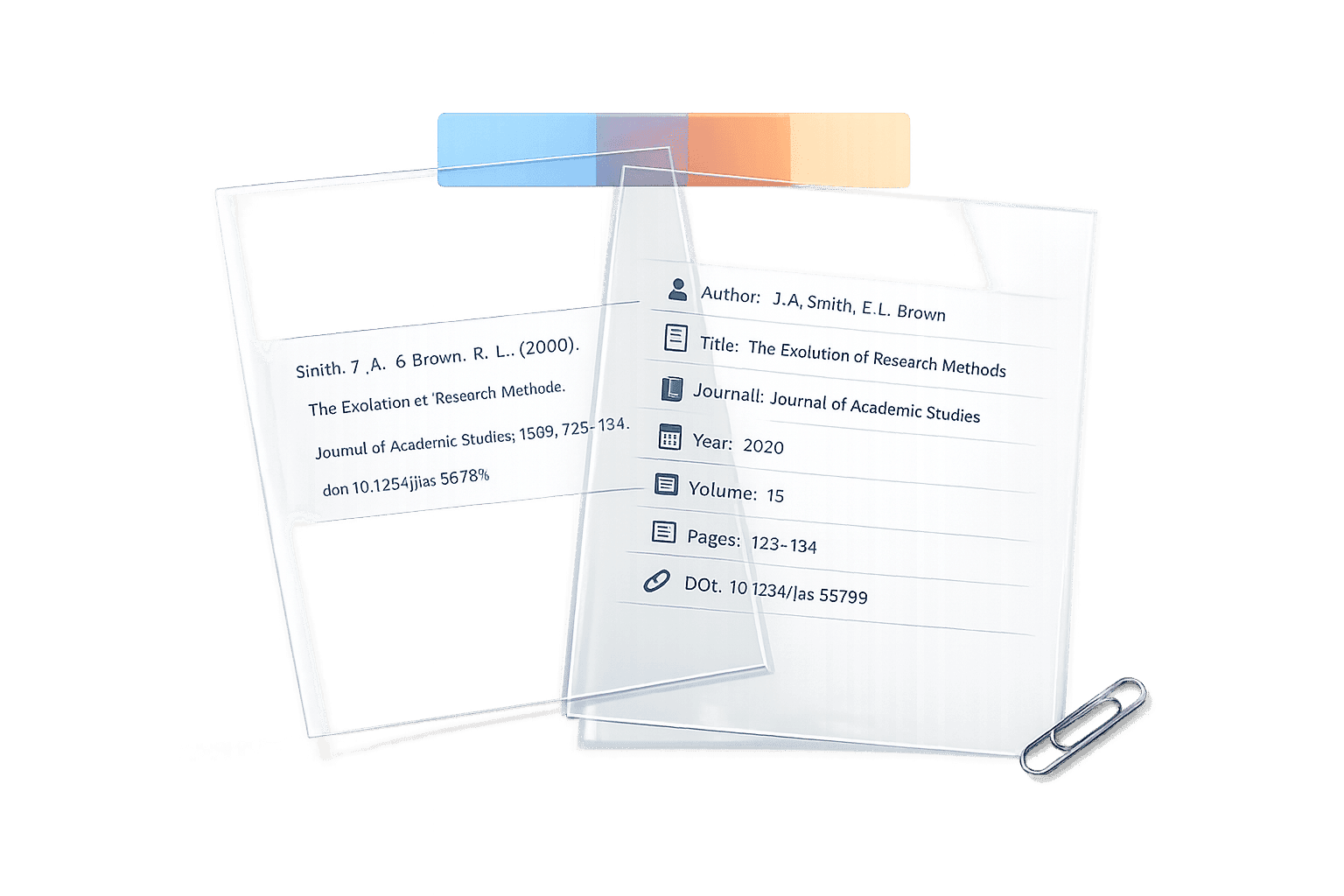
Platform-Agnostic Citation Standards vs. Traditional Formats
Citations ensure academic credibility and help verify sources. But when it comes to formatting, researchers face two main options:
- Platform-agnostic standards like Citation Style Language (CSL) automate citation formatting using XML, making it easier to manage, update, and transfer citations across tools like Zotero or Mendeley.
- Traditional formats (APA, MLA, Chicago) rely on manual rules tailored to specific disciplines, offering familiarity but requiring more effort.
Key differences include:
- Automation: Platform-agnostic tools save time by auto-formatting and updating citations, reducing errors.
- Flexibility: They work across tools and platforms, unlike rigid traditional formats that often require reformatting.
- Accuracy: Automated systems depend on metadata quality, while manual methods risk human error.
While platform-agnostic tools simplify workflows, traditional formats remain essential for final submissions. A hybrid approach - using automation for drafting and manual tweaks for compliance - offers the best of both worlds.

Platform-Agnostic vs Traditional Citation Formats: Key Differences Comparison
AI Research & Citation Tools Compared: Zotero, Mendeley, EndNote, Scite & More (Part 1)
Key Differences Between Platform-Agnostic and Traditional Formats
Both platform-agnostic and traditional citation formats aim to ensure accurate referencing, but they differ significantly in terms of process and user experience. Understanding these distinctions can help researchers select the best option for their needs.
Usability and Accessibility
One of the biggest differences lies in how much manual effort is required. Traditional formats, such as APA or MLA, rely on researchers memorizing detailed rules for punctuation, capitalization, and order. As Rintze M. Zelle, PhD, Principal Author of CSL, points out:
"Manually formatting references can become very time-consuming, especially when you're dealing with multiple journals that each have their own citation style."
In contrast, platform-agnostic standards simplify this process through automation. Tools like Zotero and Mendeley use CSL to generate citations instantly. Researchers just select their sources and preferred style, and the software takes care of the rest. This method is not only faster but also more accurate. Citation expert Daniel Elias highlights this benefit:
"By using a citation generator... you will save a considerable amount of time [and] ensure that your citations are consistent and formatted correctly."
Another major advantage is dynamic updating. When using platform-agnostic standards integrated with word processors, citations are treated as field codes instead of static text. This means if you add or remove a source, the numbering updates automatically, and terms like "ibid." adjust accordingly. With traditional manual formatting, you’d need to manually locate and revise every affected citation.
Beyond ease of use, these approaches also differ in their ability to adapt across different platforms.
Flexibility Across Platforms
Traditional formats often struggle when researchers need to transfer their work between tools or adapt it for submission to different journals. The global cost of manually reformatting manuscripts is estimated at $1 billion annually, with researchers spending 1 to 3 days reformatting a single paper for resubmission. Dr. Sidhartha Sinha from Stanford University describes the frustration:
"All researchers have wasted an inordinate amount of time reformatting papers to another journal's specific requirements for things like word count, font and figure limits, which is entirely separate from improving the scientific content."
Platform-agnostic standards address this issue through interoperability. For example, Lars Willighagen developed Citation.js in 2019, which uses CSL-JSON as a universal core for converting between formats like BibTeX, RIS, and Wikidata. Updates to this tool have improved the mapping of CSL-JSON properties to Wikidata from 31% to 59%, reducing data loss during cross-platform exchanges. This allows researchers to move their citation libraries seamlessly between tools like Zotero and Mendeley without losing data.
However, there’s a limitation: collaboration between different word processors can be problematic. For instance, Microsoft Word uses proprietary field codes that LibreOffice cannot interpret, and vice versa. If a Word user opens a LibreOffice document with Reference Marks, citation metadata may disappear entirely. For platform-agnostic standards to work effectively, all collaborators need to use compatible tools.
The efficiency of cross-platform use also impacts the accuracy of citations.
Error Rates in Manual vs. Automated Citation
The difference in process has a direct impact on citation accuracy. Studies show that about 20% of citations in published academic papers contain errors. These mistakes - such as incorrect publication years, misspelled author names, or missing page numbers - are often the result of the tedious nature of manual entry. When formatting hundreds of references, human error becomes almost inevitable.
Automated systems using platform-agnostic standards significantly reduce these errors. Once metadata is correctly entered into a reference manager, the software applies formatting rules consistently. There’s no risk of mixing up punctuation or forgetting to italicize a journal title. In one study, AI-assisted auditing of citation data achieved a 91.7% average verification rate across 2,581 references, processing a 916-reference doctoral thesis in just 90 minutes - a task that would take months for manual review.
With traditional formats, errors often occur during the formatting process itself. In automated systems, mistakes usually stem from incorrect metadata imported from databases. However, researchers can fix these issues once in their reference manager, and the corrections automatically apply wherever the source is used. Manual formatting lacks this efficiency, requiring every instance to be updated individually.
| Feature | Traditional Manual Formats | Platform-Agnostic Standards (CSL) |
|---|---|---|
| Error Source | Human typos, style misinterpretation | Metadata inaccuracies in source database |
| Update Speed | Manual retyping of every entry | Instant update throughout the document |
| Consistency | Variable (depends on author diligence) | Absolute (governed by XML/JSON schema) |
| Verification | Manual spot-checking | Automated database cross-referencing |
Advantages and Disadvantages of Each Approach
Advantages of Platform-Agnostic Standards
Platform-agnostic standards shine when it comes to compatibility. Unlike traditional plugins tied to specific software, these standards work effortlessly across browsers, servers, and command-line tools. Take Citation.js, for example - it uses CSL-JSON as a "central format" to convert between various metadata formats like BibTeX, RIS, and Wikidata, eliminating the need for individual crosswalks for every combination. This minimizes information loss during data transfers.
Another major advantage is their ability to "future-proof" citations. By focusing on persistent identifiers such as DOIs and ORCIDs, these standards link to centralized, machine-readable databases like Crossref and DataCite. This reduces manual work by utilizing formats like YAML or JSON, which are easy for machines to process. Even if platforms change, citations remain accessible and identifiable. Additionally, platform-agnostic formats offer unique features, like redirecting credit from a software repository to a peer-reviewed paper using a "preferred-citation" field. Crossref underscores this sentiment:
"Metadata must be as open, interoperable, parsable, machine actionable, human readable as possible"
The automation provided by these standards allows researchers to focus more on their work and less on formatting details.
Disadvantages of Platform-Agnostic Standards
Despite their benefits, platform-agnostic standards come with challenges. One significant hurdle is the steep technical learning curve. Strict standards like YAML 1.2 can be unforgiving - small mistakes, such as unquoted strings or type mismatches, can render a citation file invalid. Even file naming is rigid; for example, Citation File Format files must be named CITATION.cff with exact capitalization to be recognized by platforms like GitHub.
Another issue is the reliance on metadata quality. If the source metadata is flawed, the tools built on these standards will inherit those errors. Librarian Brianna Buljung highlights this problem:
"The importer often accesses inaccurate or incomplete metadata"
This means researchers must spend time reviewing and correcting imported data, which can offset the time saved by automation. Additionally, automated systems often falter when dealing with non-Western naming conventions, leading to errors in final citations.
Lastly, information loss during conversion is a persistent issue. Crosswalks between formats don't always have perfect mappings. For example, only 59% of CSL-JSON properties align with Wikidata, and just 27% map to BibTeX. Lars Willighagen, the lead developer of Citation.js, explains:
"Since the last two aspects [data type differences and lack of one-to-one mapping] can lead to information loss, crosswalks often need to be one-directional converters between two formats"
Advantages and Disadvantages of Traditional Formats
To better understand the trade-offs, it's helpful to compare platform-agnostic standards with traditional formats. Established citation styles like APA and MLA are familiar and provide discipline-specific consistency, which adds credibility. They also help maintain clarity in academic writing by clearly distinguishing the author's voice from cited sources through footnotes or in-text markers.
However, traditional formats can be labor-intensive, especially for large projects. They also struggle to accommodate digital objects like software or datasets, which require persistent identifiers to remain accessible. Moreover, traditional formats lack cross-platform flexibility, often requiring reformatting when switching between journals or word processors.
The table below highlights key differences between the two approaches:
| Feature | Platform-Agnostic Standards | Traditional Formats |
|---|---|---|
| Learning Curve | Steep; requires knowledge of schemas | Lower; based on familiar interfaces |
| Interoperability | High; works across various tools | Low; tied to specific software |
| Manual Effort | Low; automated with persistent IDs | High; requires manual reformatting |
| Future-Proofing | High; relies on persistent identifiers | Moderate; links can break, errors may occur |
| Metadata Dependency | High; accuracy depends on source quality | Moderate; relies on manual input by the researcher |
sbb-itb-f7d34da
Practical Applications and Tool Integration
Using Platform-Agnostic Standards in Research Tools
Platform-agnostic standards have reshaped how researchers use digital tools, making workflows faster and more accurate. Take Sourcely, for example. This modern citation manager uses these standards to streamline research tasks - from finding sources to exporting references in multiple formats. Persistent Identifiers (PIDs) like DOIs and ISBNs play a big role here, linking directly to machine-readable databases. This eliminates the need for tedious manual entry and minimizes errors.
What sets Sourcely apart is its AI-powered source discovery. With access to over 200 million research papers, its semantic search goes beyond keywords. It analyzes the content of your writing to find relevant literature. Just paste your draft text, and the AI generates citations in formats like BibTeX for LaTeX, RIS for EndNote, or CSL-JSON for web-based tools. This "reverse literature review" approach saves countless hours. As PhD student jasthephdstudent puts it:
"Sourcely is a game-changer for academic writing. It's like a reverse search engine - you input your uncited text, and it finds relevant articles across various disciplines."
Exporting references is another area where Sourcely shines. You can download citations in the exact format required by your word processor or publishing platform. Tools like Citation.js help convert between formats like BibTeX and RIS while maintaining up to 89% data accuracy.
Browser extensions make things even easier. They can pull metadata and PDFs straight from web pages into your library. That said, always double-check metadata at import - automated systems rely on the quality of the original data. This extra step ensures your citations will be correct, no matter the format you need.
These advancements in automation and interoperability stand in stark contrast to the manual effort still required for final academic publishing.
Traditional Formats in Academic Publishing
Even with all the efficiency brought by platform-agnostic standards, traditional citation formats remain crucial when submitting to academic journals. Each discipline has its preferred style - APA for psychology, MLA for the humanities, Chicago for history - all to meet peer review and editorial standards.
While tools like Sourcely speed up research and preparation, final submissions often depend on these traditional formats. A practical workflow blends both approaches: researchers manage their sources using platform-agnostic tools and then use plugins to generate citations in the required style for publication. This hybrid model ensures both efficiency and compliance. With its export options tailored for journal requirements, Sourcely bridges the gap between modern automation and traditional publishing needs, whether for print or digital platforms.
The rise of collaborative, cloud-based writing tools has made this integration even more valuable. Researchers can maintain a single, synced metadata library across platforms like Google Docs and Microsoft Word, with citations auto-reformatted as needed. By combining automation with traditional standards, Sourcely simplifies the transition from research to publication, making the process smoother and more efficient.
Conclusion: Choosing the Right Citation Approach
The way you handle citations should align with the specific needs of your project. For large-scale endeavors like dissertations, where managing hundreds of sources can feel overwhelming, tools and platform-independent standards that automate citation tasks are invaluable. Simpler projects, on the other hand, might not require the same level of complexity.
Workflow compatibility plays a major role. For instance, if you're working in LaTeX or Overleaf, BibTeX is a natural choice. Meanwhile, tools with plugins integrate well with Microsoft Word or Google Docs, offering a smoother experience.
Another critical factor is data portability. Standards like CSL (Citation Style Language) and CFF (Citation File Format) ensure your citation data remains accessible, even if you switch software later on. CSL, for example, supports thousands of citation styles through a single XML-based system. This adaptability makes it easier to meet the requirements of different journals without starting from scratch. By considering these factors, you can strike a balance between efficiency and flexibility.
For larger projects, automated tools can save time and effort, while manual methods might be more practical for smaller tasks. A hybrid approach often combines the best of both worlds.
Key Takeaways
The most effective researchers often embrace a hybrid approach. Using platform-independent tools like Sourcely during the research and drafting stages allows for streamlined workflows. When it's time to submit, exporting to traditional formats ensures compliance with academic standards. As Daniel Felix from Sourcely explains:
"A well-organized citation system doesn't just save you time - it helps you think more clearly about your research, identify connections between sources, and maintain the momentum of your writing process."
This dual strategy emphasizes both flexibility and precision. For added reliability, use persistent identifiers like DOIs instead of browser URLs - they ensure your citations remain accessible across platforms. Also, double-check metadata accuracy when importing sources; automated tools are only as effective as the data they retrieve. Whether you opt for platform-agnostic tools, traditional formats, or a mix of both, maintaining consistency is the key to a polished and effective citation system.
FAQs
What are the advantages of using platform-agnostic citation standards over traditional formats?
Platform-independent citation standards, such as Citation Style Language (CSL), are designed to work effortlessly across a variety of tools and platforms. Unlike traditional formats that are tied to specific software, these standards allow researchers to move bibliographies between word processors, online editors, and other tools without worrying about reformatting or losing important data. This eliminates the restrictions of proprietary systems and provides much-needed adaptability.
Another major benefit is how these standards simplify workflows by enabling automation. For instance, tools using CSL can automatically generate citations in different formats - like APA, MLA, or Chicago - directly from source metadata. This not only saves time but also minimizes the need for manual adjustments. With thousands of styles supported, these standards ensure citations are consistently accurate and meet the requirements of journals or institutions.
For Sourcely users, this means the platform can export references in any citation style required, without additional tweaks. This versatility makes drafting, collaborating, and publishing easier, allowing researchers to focus on their work rather than getting bogged down by formatting issues.
How do platform-agnostic citation tools manage errors in citation metadata?
Platform-neutral citation tools tackle metadata errors by relying on standardized, machine-readable formats and automated checks. For example, tools that use structured schemas like JSON or YAML can detect missing or incorrect details - such as an author's name or a publication date - and flag these issues before creating citations.
These tools are designed to work with various formats, like BibTeX or RIS, applying consistent error-checking methods across the board. Many also include backup options, such as using a DOI to fill in missing information, ensuring the final bibliography is both accurate and usable.
Sourcely makes this process even easier by scanning your manuscript, comparing citation details against recognized metadata standards, and pointing out incomplete or incorrect entries. Once errors are fixed, Sourcely seamlessly generates a polished reference list in your chosen citation style, all without interrupting your workflow.
Can platform-agnostic citation standards be used for academic submissions?
Platform-agnostic citation standards like CSL (Citation Style Language) and Crossref’s universal metadata offer a practical solution for academic submissions. They take the hassle out of formatting by ensuring consistency and meeting the guidelines of most journals and institutions.
One of the biggest advantages of these standards is their flexibility. They seamlessly adjust to different platforms and citation styles without requiring manual tweaks. This not only simplifies the citation process but also saves time and minimizes errors, making them an efficient and dependable choice for academic papers.