AI Tools for Faster Literature Summaries
Drowning in research papers? AI tools now offer three-minute summaries, cutting review time in half. With over 3 million new academic papers published yearly, researchers struggle to keep up. Tools like Elicit, Semantic Scholar, Scholarcy, Undermind, and Sourcely simplify the process by summarizing findings, extracting key data, and improving discovery speed.
Key Highlights:
- Elicit: Synthesizes multiple papers, extracts data tables, and offers sentence-level citations with 94% accuracy.
- Semantic Scholar: Provides one-sentence TLDRs for 60M+ papers, ideal for quick skimming.
- Scholarcy: Breaks papers into structured "flashcards" for faster understanding.
- Undermind: Tracks citation trails and adjusts searches dynamically for complex queries.
- Sourcely: Matches sources to your writing context and supports paragraph-based searches.
Quick Comparison:
| Tool | Key Feature | Database Coverage | Pricing |
|---|---|---|---|
| Elicit | Multi-paper synthesis, data tables | 138M+ papers, 545K trials | Free to $79/month |
| Semantic Scholar | One-sentence TLDRs, free API | 200M+ papers, 2.49B citations | Free |
| Scholarcy | Structured flashcards, fast summaries | 400K+ users | Free to $90/year |
| Undermind | Citation tracking, iterative search | 225M+ citations | Contact for pricing |
| Sourcely | Contextual searches, "Deep Search" | 200M+ papers | $7 trial, $17/month |
These tools save time but require human oversight to ensure accuracy. Use them together for discovery, data extraction, and structured reviews to speed up your workflow without missing critical insights.
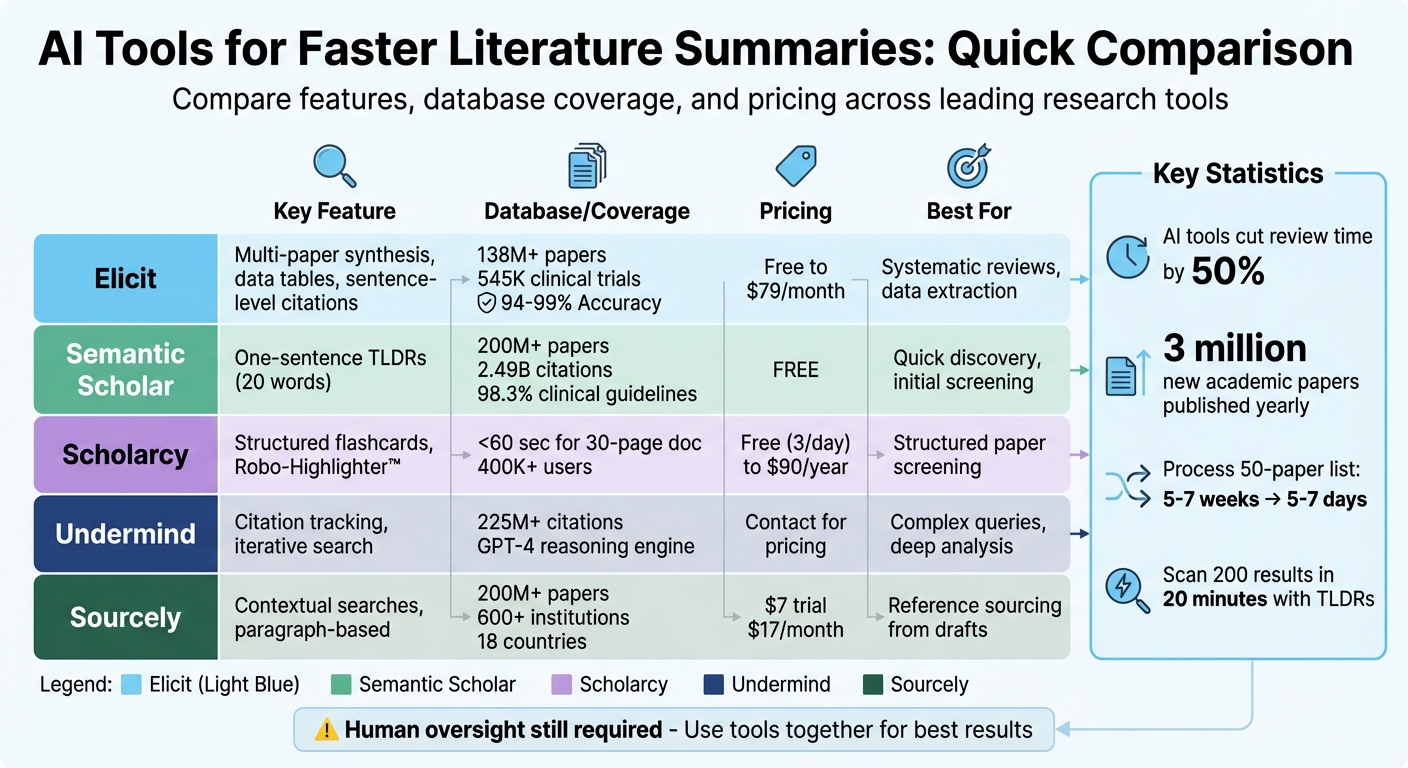
AI Literature Summary Tools Comparison: Features, Coverage & Pricing
1. Elicit
Summarization Approach
Elicit takes a structured approach to systematic reviews, breaking the process into steps like automated search, screening, and data extraction. Instead of creating generic summaries, the tool focuses on extracting both quantitative and qualitative data - pulling even from tables - to ensure summaries are grounded in evidence.
Using advanced models such as Claude Opus 4.5, Sonnet 4.5, Google Gemini 3 Pro, and OpenAI GPT-5, Elicit synthesizes findings from multiple studies. As of December 2025, it can condense up to 80 papers into a single, detailed research report. These reports often include methods sections, mini-PRISMA diagrams, and frequency counts across study types.
One of Elicit's standout features is its sentence-level citations. Unlike tools that link to general references, Elicit includes the exact supporting quote inline with each claim. Internal evaluations suggest a 94% accuracy rate for these summaries, though users are encouraged to verify critical data. Overall performance is estimated at around 90%.
"Elicit is a step above other tools I've tried. I prefer Elicit when it comes to actually interpreting evidence. It doesn't make things up like ChatGPT."
- James Compagno, Director of Marketing, MicroGenDX
In early 2025, VDI/VDE Innovation + Technik GmbH used Elicit to expand a systematic review from 50 to 550 papers. The tool successfully extracted 1,502 out of 1,511 data points, achieving a 99.4% accuracy rate. This allowed the team to analyze 11 times more evidence compared to manual methods.
These capabilities are further strengthened by Elicit's extensive database coverage.
Database Coverage
Elicit's database spans over 138 million academic papers and 545,000 clinical trials registered on ClinicalTrials.gov. Its main source is Semantic Scholar, which covers a wide range of academic disciplines, and it is further enriched by PubMed and clinical trial registries. While the platform supports diverse fields, it is particularly well-suited for empirical areas like biomedicine and machine learning, which rely heavily on experimental data. Users can also enhance the database by uploading PDFs or importing libraries from tools like Zotero, EndNote, and Mendeley.
Export/Integration Options
Elicit supports exporting in RIS, CSV, and BIB formats and integrates seamlessly with Zotero. These features are available on its Plus, Pro, and Team plans. Since March 3, 2026, an API has been available, enabling users to programmatically search the database of over 138 million papers and create reports. Additionally, users can share links to their research process and intermediate results with colleagues, even if those colleagues don't have an Elicit account.
Pricing
| Plan | Price | Key Features |
|---|---|---|
| Basic | Free | Unlimited search, 4-paper summaries, 20 extractions/month, Zotero import |
| Plus | $10/month (annual) or $12/month | 8-paper summaries, 600 extractions/year, RIS/CSV/BIB export |
| Pro | $42/month (annual) or $49/month | Systematic review workflows, 2,400 extractions/year, 10 research alerts |
| Team | $65/user/month (annual) or $79/month | 3,600 extractions/user/year, admin panel, live editing |
sbb-itb-f7d34da
2. Semantic Scholar
Summarization Approach
Semantic Scholar employs an "ultra-concise summarization" technique to create single-sentence summaries, called TLDRs (Too Long; Didn't Read). These summaries are crafted using GPT-3-like natural language processing, pulling key points from a paper's abstract, introduction, and conclusion.
The platform uses a training method called CATTS (Control Admission of Titles to Summarization), which leverages paper titles as guiding signals during the learning process. The model powering this feature was trained on the SCITLDR dataset, which contains thousands of TLDRs from scientific papers.
Typically, TLDRs are just 20 words long, making them ideal for quick skimming. Semantic Scholar has generated these summaries for 60 million papers spanning fields like computer science, biology, and medicine. This feature is particularly helpful for mobile users, who make up about 25% of the platform's audience.
"Since TLDRs are 20 words instead of 200, they are much faster to skim."
- Daniel S. Weld, General Manager, Semantic Scholar
Beyond TLDRs, the platform also offers an "Ask This Paper" feature for supported English-language papers. This tool allows users to ask specific questions about a paper's methodology or results and receive AI-generated responses.
Database Coverage
Semantic Scholar indexes over 200 million publications and 2.49 billion citations from diverse scientific disciplines, including computer science, geoscience, neuroscience, and biomedicine. Its database includes peer-reviewed journal articles, conference proceedings, and preprints sourced from more than 50 major publishers and over 500 publishing partners, such as Springer Nature, Elsevier, Wiley, and the University of Chicago Press.
A 2025 peer-reviewed study highlighted the platform's 98.3% coverage of international clinical guideline papers, surpassing PubMed's 93.0%. As of 2020, it attracted around 7 million users monthly and included metadata for over 79 million authors.
Export/Integration Options
Semantic Scholar makes it easy to export citations in formats like BibTeX, MLA, APA, Chicago, and EndNote (.enw). It also integrates with Zotero through a browser extension, enabling users to save papers, URLs, PDFs, and AI-generated TLDRs directly to their library.
For developers, TLDR summaries are accessible via the Semantic Scholar Academic Graph (S2AG) API. The API offers a free tier with rate limits for unauthenticated users, and higher usage limits can be unlocked with a private API key.
Pricing
Semantic Scholar is entirely free for all users, including full access to its API.
3. Scholarcy
Summarization Approach
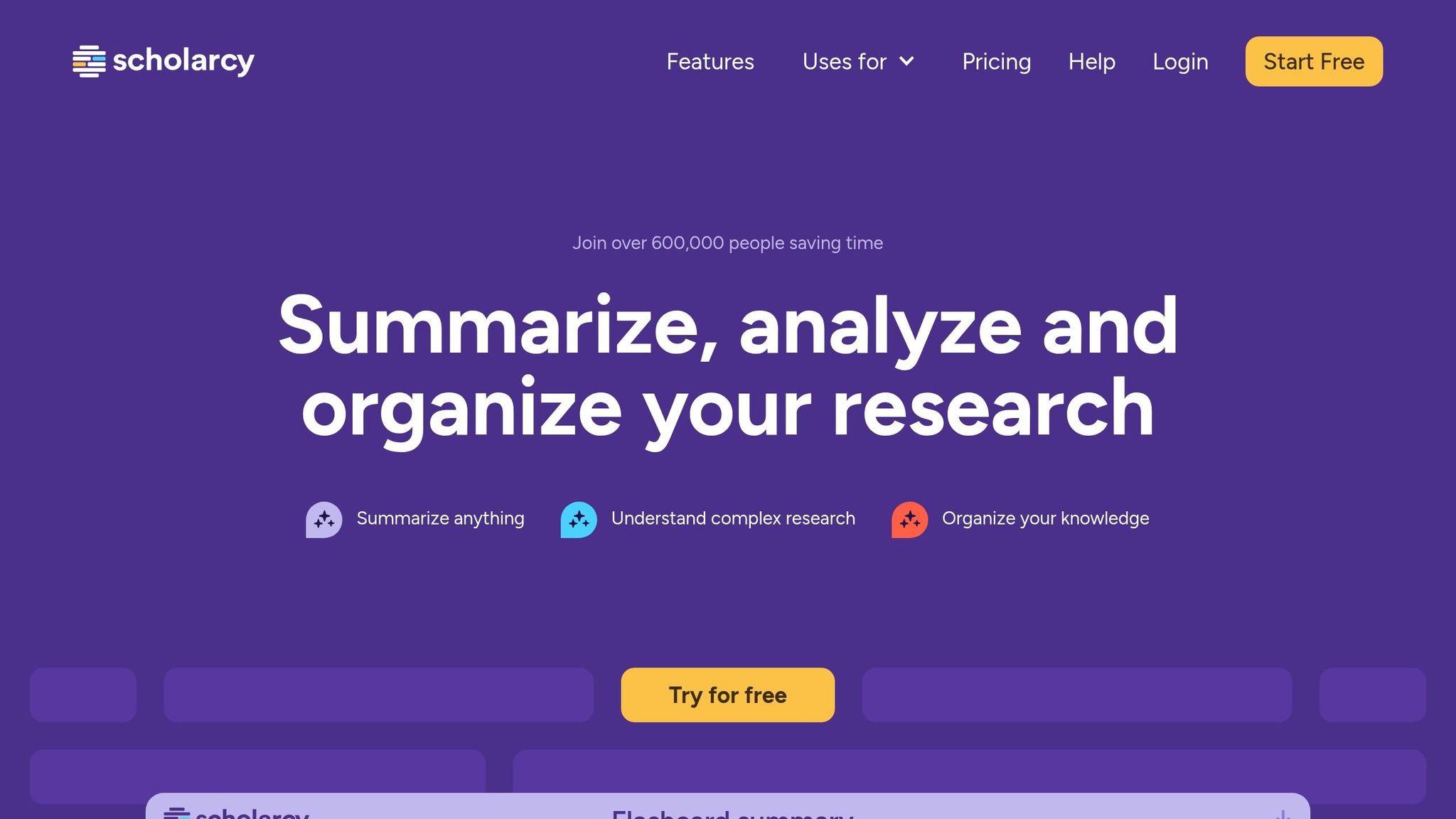
Scholarcy takes a unique approach to summarization by creating structured "Summary Flashcards" that break down academic papers into digestible sections. Using machine learning models, the tool identifies key terms, claims, and findings, making it easier for researchers to quickly grasp the essence of a paper. Its proprietary Robo-Highlighter™ pinpoints critical passages and terminology, helping users zero in on important information without wasting time.
The summaries are organized into clear sections such as key facts, background, methodology, findings, and references. This layout allows researchers to jump straight to the information they need. Users can also customize the format of these summaries, choosing between bulleted lists, concise one-liners, or more detailed overviews. Scholarcy places a strong emphasis on factual accuracy, ensuring all summarized content is traceable back to the original source text.
"The knowledge extraction and summarization methods we use focus on accuracy. This ensures what you read is factually correct, and can always be traced back to the original source." - Scholarcy
With over 400,000 users, Scholarcy claims to cut down skim-reading time to just 5 minutes. The tool is also impressively fast, capable of processing a 30-page technical document in under 60 seconds.
Export/Integration Options
Scholarcy offers a wide range of export options, including Word, Markdown, PowerPoint, Excel, RIS, and BibTeX formats. It integrates seamlessly with tools like Zotero, EndNote, Google Drive, and Dropbox. For researchers handling multiple papers, the platform can generate a literature matrix in Excel, making it easy to compare findings side by side. Additionally, it creates annotated bibliographies when exporting multiple flashcards at once.
For users of personal knowledge management systems like Obsidian, Notion, or Roam Research, Scholarcy provides Markdown exports. Browser extensions for Chrome and Firefox further streamline the process by enabling one-click summarization directly from search results.
Pricing
Scholarcy offers a free plan that allows up to 3 summaries per day along with basic flashcard exports. For those needing more features, Scholarcy Plus is available at $9.99/month or $90/year (a 25% discount). This plan includes unlimited summarization, flashcard saving, note-taking, and literature matrix capabilities. Institutions like universities and research centers can opt for licenses starting at $8,000+ per year.
Next, we’ll take a closer look at how Undermind simplifies literature reviews.
4. Undermind
Database Coverage
Undermind taps into a massive database of over 225 million citations via the Semantic Scholar API. This includes content from key repositories like PubMed and arXiv, making it a versatile tool for researchers across numerous disciplines. This extensive database forms the backbone of its advanced summarization capabilities.
Summarization Approach
Undermind is designed to streamline the often time-consuming process of literature reviews. What sets it apart is its dynamic and iterative search process. Using AI agents, the tool adjusts its search strategies based on the results it retrieves, following citation trails to uncover deeper insights within the literature. By integrating GPT-4 as a reasoning engine and classifier, Undermind systematically tracks citation pathways and extracts relevant information from hundreds of academic papers, making it well-suited for tackling complex research questions.
Pricing
Currently, there’s no publicly available information about Undermind’s pricing. Researchers interested in using the platform should contact the service directly to learn about subscription plans and associated costs.
Next, we'll take a closer look at how Sourcely combines literature sourcing with summarization tools.
5. Sourcely
Summarization Approach
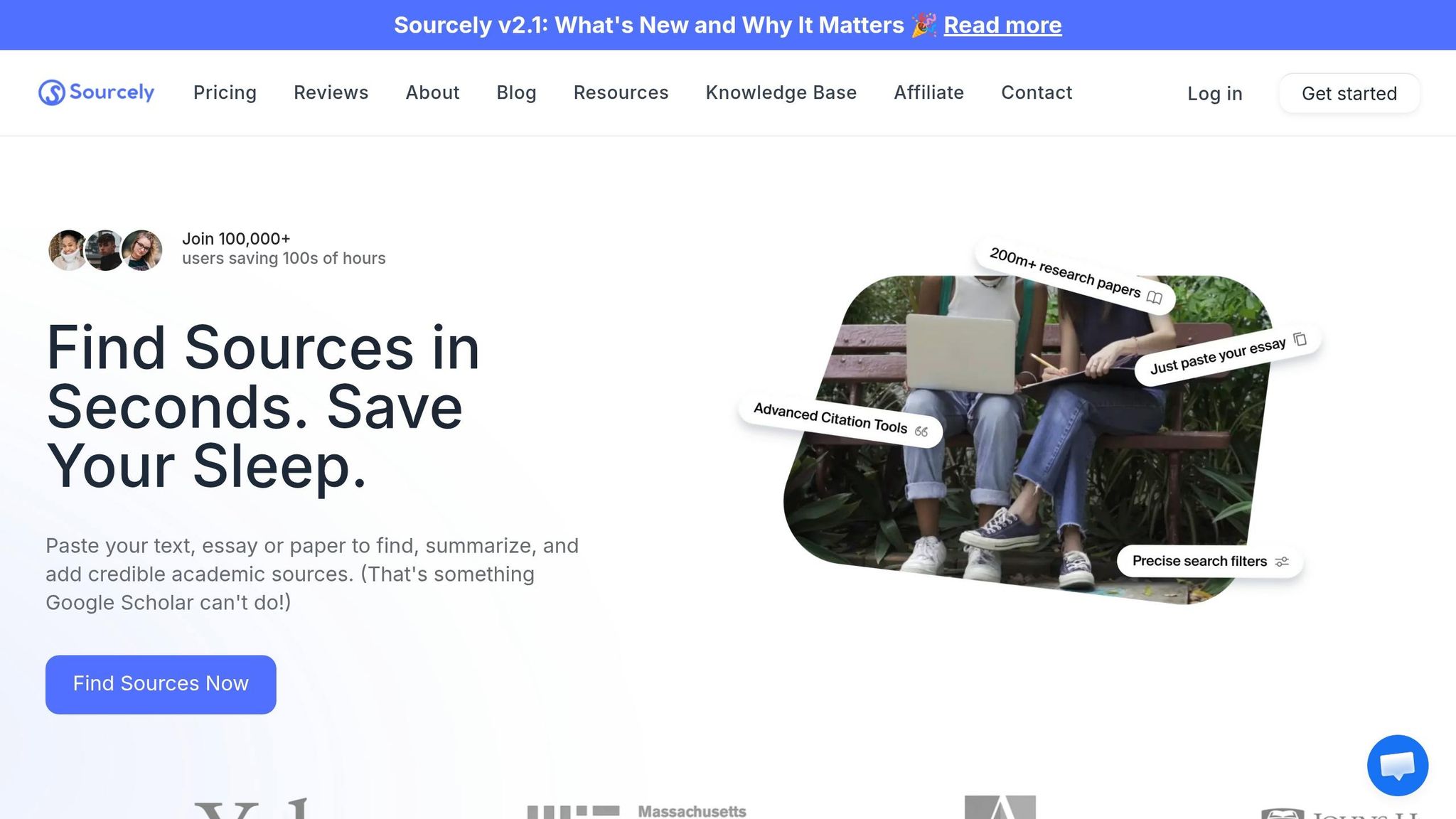
Sourcely takes a unique approach to summarization by analyzing entire paragraphs or essays, rather than just focusing on keywords. This allows it to locate academic literature that aligns closely with the context of your work. Once connected to its database, the platform generates AI-driven overviews that highlight key insights instead of merely condensing text. This helps researchers quickly decide whether a paper is worth diving into.
Mushtaq Bilal, PhD and Postdoctoral Researcher, explains:
"One of the limitations of databases like Google Scholar is that they let you search using only keywords. But what if you want to search using whole paragraphs or your notes? Sourcely is an AI-powered app that will let you do that."
Database Coverage
Sourcely's database includes more than 200 million research papers spanning a wide range of disciplines. Researchers from over 600 institutions across 18 countries use the platform. Its "Deep Search" feature digs deeper than standard search results, pinpointing academic sources that match the specific context of your writing. Users can fine-tune their searches with filters for publication year, citation counts, keywords, and even article types like review papers.
Export and Integration Options
Sourcely makes citation management easy by supporting multiple academic styles, such as APA, MLA, and IEEE. Researchers can export citations directly into their documents or as bibliography files in formats like EndNote XML, RIS, and BibTeX. The platform also includes reference parsing, which extracts bibliographic details from PDFs or existing databases. Plus, integration with Yomu AI ensures a smooth transition from research to writing, making the entire process more efficient.
Pricing
Sourcely offers a trial option for newcomers, allowing access to Sourcely Pro with a one-time payment of $7 for 2,000 characters of input. For ongoing use, subscriptions are available at $17 per month or $167 annually. For those seeking a long-term solution, the "Believer" lifetime plan is priced at $347. These flexible pricing options make Sourcely an accessible tool for AI-powered academic research.
AI Just Made Literature Review a Piece of Cake
Strengths and Weaknesses
AI summarization tools each have their own perks and drawbacks. Let’s break down how some of the leading tools compare in their strengths and limitations.
Elicit is particularly good at organizing data into customizable tables, making it a strong choice for systematic reviews. However, it falls short in fully replacing traditional literature searches due to its limited sensitivity. While it performs well with empirical papers, its inconsistent recall means you’ll likely need to rely on additional traditional search methods.
Semantic Scholar stands out for being completely free and offering access to a massive database of over 220 million papers. Features like TLDR summaries and personalized research feeds simplify the discovery process. That said, its database can feel limited in more specialized fields, providing fewer relevant results in niche areas.
Scholarcy takes a structural approach to summarization, breaking down PDFs into clear sections like objectives, methods, and findings. This makes it a handy tool for speeding up the screening process. However, the free version only allows three uploads, and its summaries may miss subtle details, requiring human verification to ensure accuracy.
Undermind is designed to handle complex queries by thoroughly analyzing hundreds of papers to find information that standard searches might overlook. The tradeoff is that this depth often comes with longer processing times.
Sourcely carves out a unique role by sourcing credible references and extracting insights directly from existing drafts. Its performance, however, heavily depends on the quality of the initial text provided.
While these tools can reduce review time by as much as 50%, they’re not yet a substitute for human oversight. Current evidence suggests that relying solely on generative AI for evidence synthesis isn’t advisable. The key takeaway? These tools are great for speeding up literature reviews, but they work best as a complement to human analysis rather than a replacement.
Conclusion
No single AI tool can cover every research need perfectly, which is why a hybrid workflow is so effective. For quick discovery and initial screening, Semantic Scholar shines with its free access to over 220 million papers and one-sentence TLDR summaries. These features allow you to scan through 200 search results in just about 20 minutes. When it comes to systematic reviews that need structured data extraction, Elicit is a standout, delivering an impressive 94–99% accuracy rate on empirical papers. And if your focus is breaking down papers into clear, manageable sections, Scholarcy's Summary Flashcards provide the structure you need.
Each of these tools plays a specific role in the research workflow. To get the most out of them, align each tool with the appropriate task: Semantic Scholar for discovery, Elicit for detailed data extraction, and Sourcely to source reliable references straight from your drafts.
Manual verification is still essential. While AI-assisted workflows can cut the time needed to process a 50-paper reading list from 5–7 weeks to just 5–7 days, remember that AI tools aren’t flawless. In 2026 testing, some general AI tools fabricated 20% of their cited papers. However, specialized tools like Elicit and Consensus maintained a 0% error rate in this area.
To work efficiently without losing accuracy, combine these strategies: use Semantic Scholar for discovery, Elicit for systematic data extraction, and Scholarcy for structured paper screening. This three-tool method provides speed while ensuring precision. AI summaries can help prioritize which papers deserve your attention, but they’re no substitute for the careful, thorough review required in academic research.
FAQs
How can I verify an AI summary is accurate?
To ensure an AI-generated summary is trustworthy, verify that its citations lead to credible and reliable sources. Make sure the references directly support the claims made and are backed by solid documentation. Inline citations should make it simple to cross-check the information for accuracy.
Which tool is best for systematic reviews vs. quick skimming?
Scholara is designed to simplify and speed up systematic reviews. It handles time-consuming tasks like literature searches, screening, data extraction, and even meta-analysis. Plus, it ensures your reviews align with PRISMA guidelines, cutting down the process from months to just hours.
SciSummary: Fast and Clear Paper Summaries
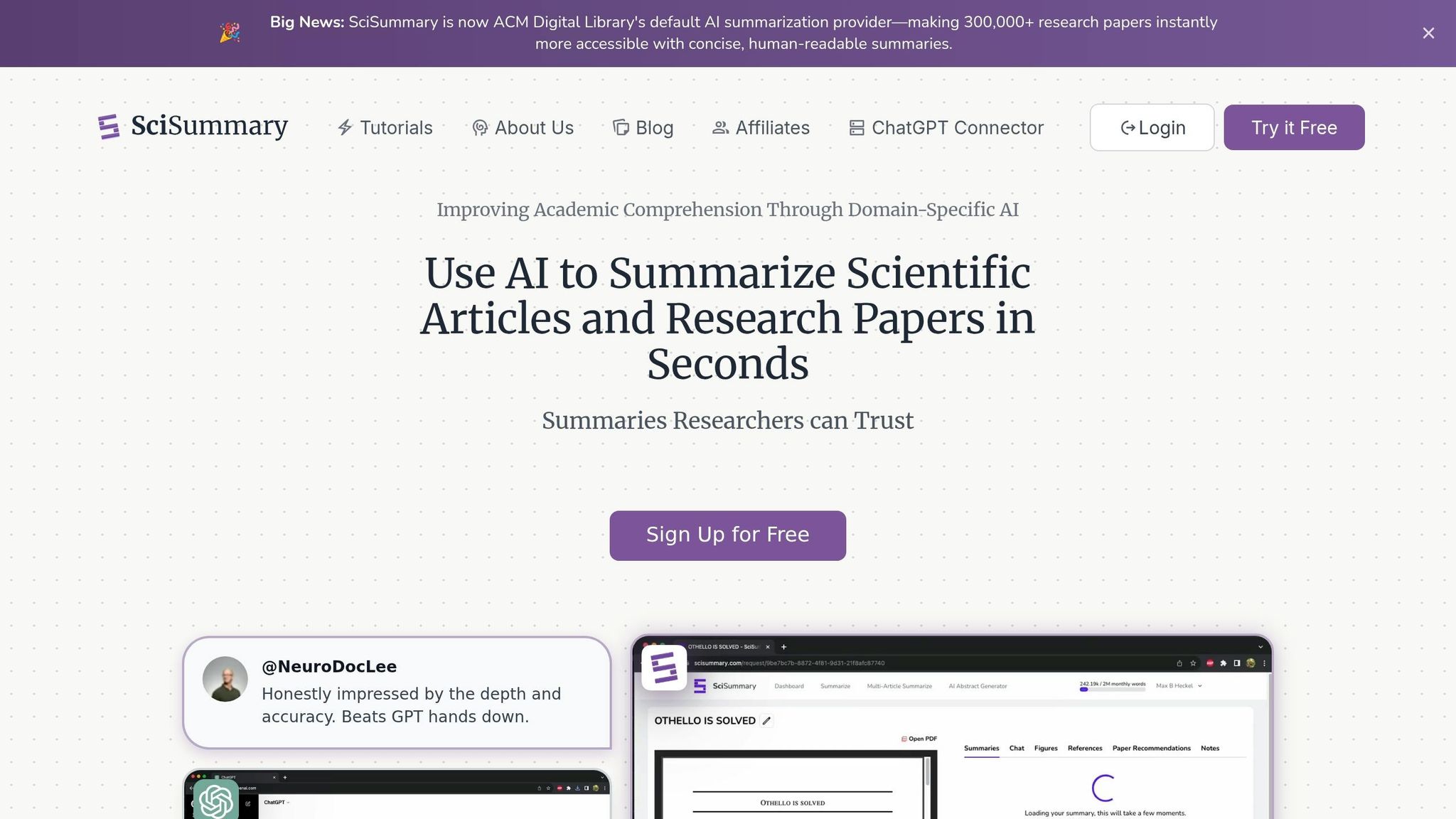
When you need quick insights, SciSummary steps in. This tool uses AI to create short, easy-to-read summaries of scientific papers in seconds. It focuses on breaking down section-level details and allows for cross-paper comparisons, making it easier to grasp complex research quickly.
Can Sourcely find sources from my draft instead of keywords?
Sourcely can evaluate your draft and pinpoint relevant academic sources without depending entirely on keywords. This approach simplifies research by leveraging your text to locate credible references efficiently.