AI Tools for Literature Reviews: Top 7 Options
AI tools can drastically reduce the time and effort required for literature reviews. Instead of spending weeks or months manually searching, screening, and synthesizing research, these tools streamline the process by leveraging semantic search, automated summarization, and citation management. Here's a quick rundown of the top options:
- Sourcely: Upload drafts or notes, and it finds relevant sources. Pricing starts at $7.
- Elicit: Great for systematic reviews, with features like data extraction and semantic search. Free plan available; paid plans start at $10/month.
- Scite: Focuses on citation context, categorizing references as supporting, contrasting, or neutral. Free and paid options starting at $12/month.
- Research Rabbit: Visualizes citation networks for easier discovery. Free to use.
- Semantic Scholar: Free tool with AI-powered search and summaries for over 214 million papers.
- SciSpace: Simplifies understanding papers with tools like "Chat with PDF." Free and paid plans from $12/month.
- Consensus: Provides evidence-based answers and consensus analysis. Free and Pro plans starting at $15/month.
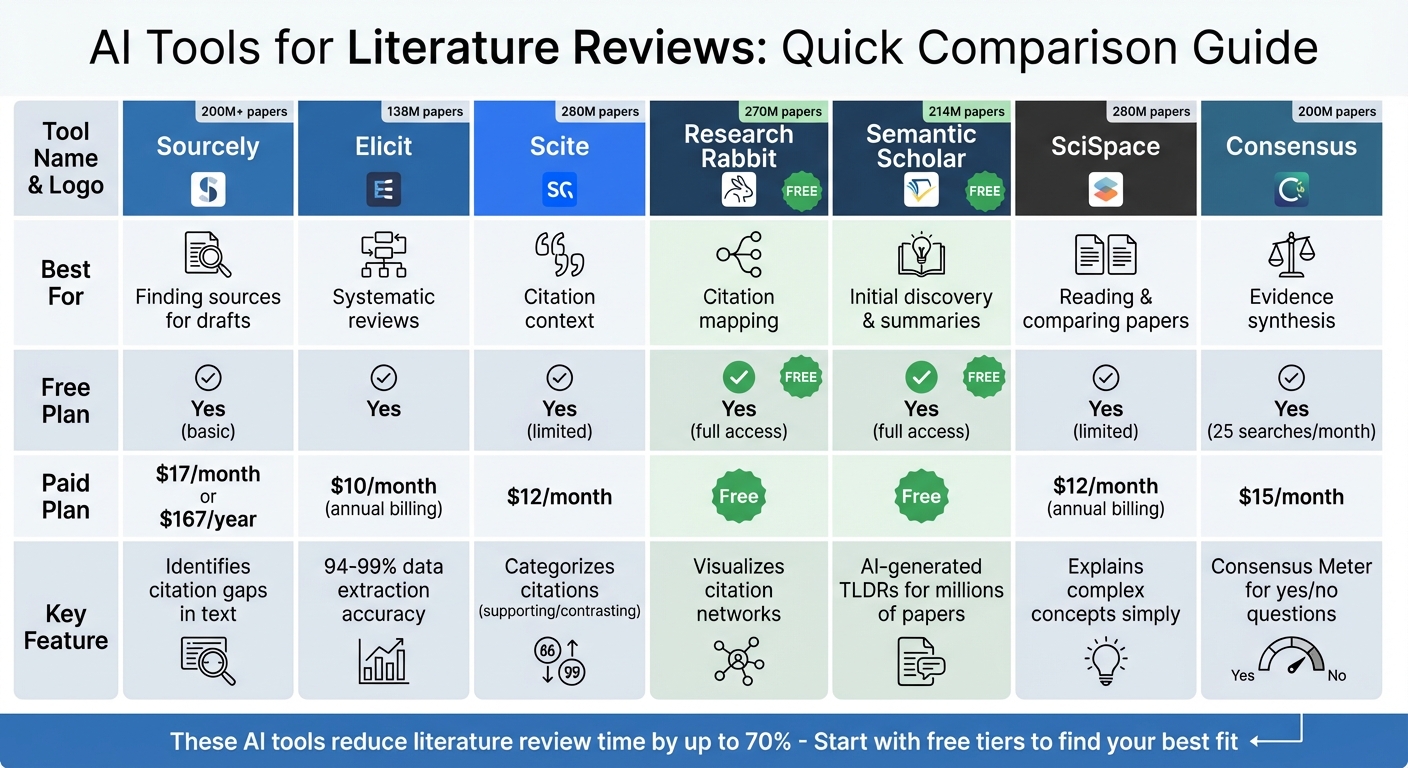
These tools save time by automating repetitive tasks, helping you focus on analysis and synthesis. Choose based on your needs - whether it's discovering papers, summarizing findings, or managing citations. Below is a quick comparison for easy reference.
Quick Comparison
| Tool | Best For | Free Plan | Paid Plan | Key Feature |
|---|---|---|---|---|
| Sourcely | Finding sources for drafts | Yes (basic) | $17/month or $167/year | Identifies citation gaps in your text |
| Elicit | Systematic reviews | Yes | $10/month (annual billing) | Extracts data with 94–99% accuracy |
| Scite | Citation context | Yes (limited) | $12/month | Categorizes citations (supporting, contrasting) |
| Research Rabbit | Citation mapping | Yes | Free | Visualizes citation networks |
| Semantic Scholar | Initial discovery and summaries | Yes | Free | AI-generated TLDRs for millions of papers |
| SciSpace | Reading and comparing papers | Yes (limited) | $12/month (annual billing) | Explains complex concepts in simple terms |
| Consensus | Evidence synthesis | Yes (limited) | $15/month | Consensus Meter for yes/no questions |
These AI tools are transforming academic research by reducing discovery and review times by up to 70%. Start with the free tiers to see what works best for your workflow.
AI Literature Review Tools Comparison: Features, Pricing & Best Use Cases
I Compared Every Popular AI Literature Review Tool So You Don't Have To
sbb-itb-f7d34da
1. Sourcely
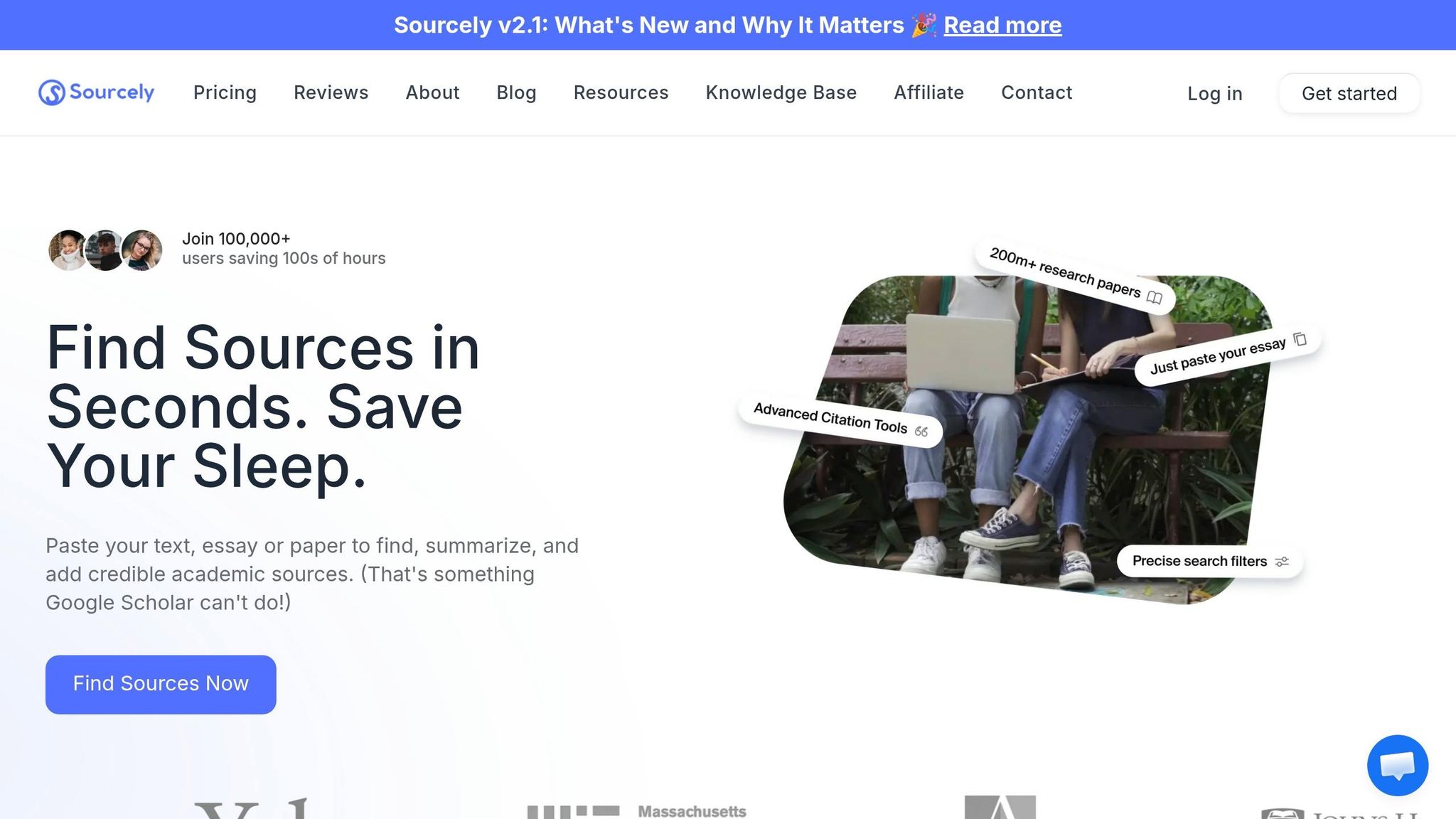
Sourcely is changing how academic research is done. Instead of sticking to traditional keyword searches, it allows users to paste entire paragraphs, essays, or even uncited drafts directly into the platform. The AI behind Sourcely then scans a massive database of over 200 million research papers to find the most relevant sources for your content. Dr. Mushtaq Bilal, a postdoctoral researcher, highlights its value:
"One of the limitations of databases like Google Scholar is that they let you search using only keywords. But what if you want to search using whole paragraphs or your notes? Sourcely is an AI-powered app that will let you do that."
Here’s a closer look at how its features simplify academic research.
Search and Discovery Capabilities
Sourcely’s Deep Search feature is a game-changer for finding niche academic papers that keyword searches often overlook. You can fine-tune your results using filters for publication year, specific authors, relevance, or by including/excluding certain keywords. It also identifies which parts of your text need citations and suggests appropriate sources for those sections. Plus, its "Chat with Sources" feature allows you to explore complex topics conversationally, saving you from having to read entire papers upfront.
Summarization and Synthesis Features
To make research even easier, Sourcely provides "Credible Summaries" for each result. These concise overviews help you quickly assess whether a source is relevant, eliminating the need to skim through full articles. Additionally, the Citations Library feature lets you store and organize your sources efficiently, and you can export references in various academic formats.
Pricing and Accessibility
Sourcely’s pricing is designed with academics in mind. The platform offers a $7 introductory plan for up to 2,000 characters. For more frequent use, you can subscribe for $17 per month or $167 annually. If you’re looking for a one-time investment, the Believer plan is available for $347. With these options, Sourcely has already attracted over 100,000 users, helping them meet tight academic deadlines with ease.
2. Elicit
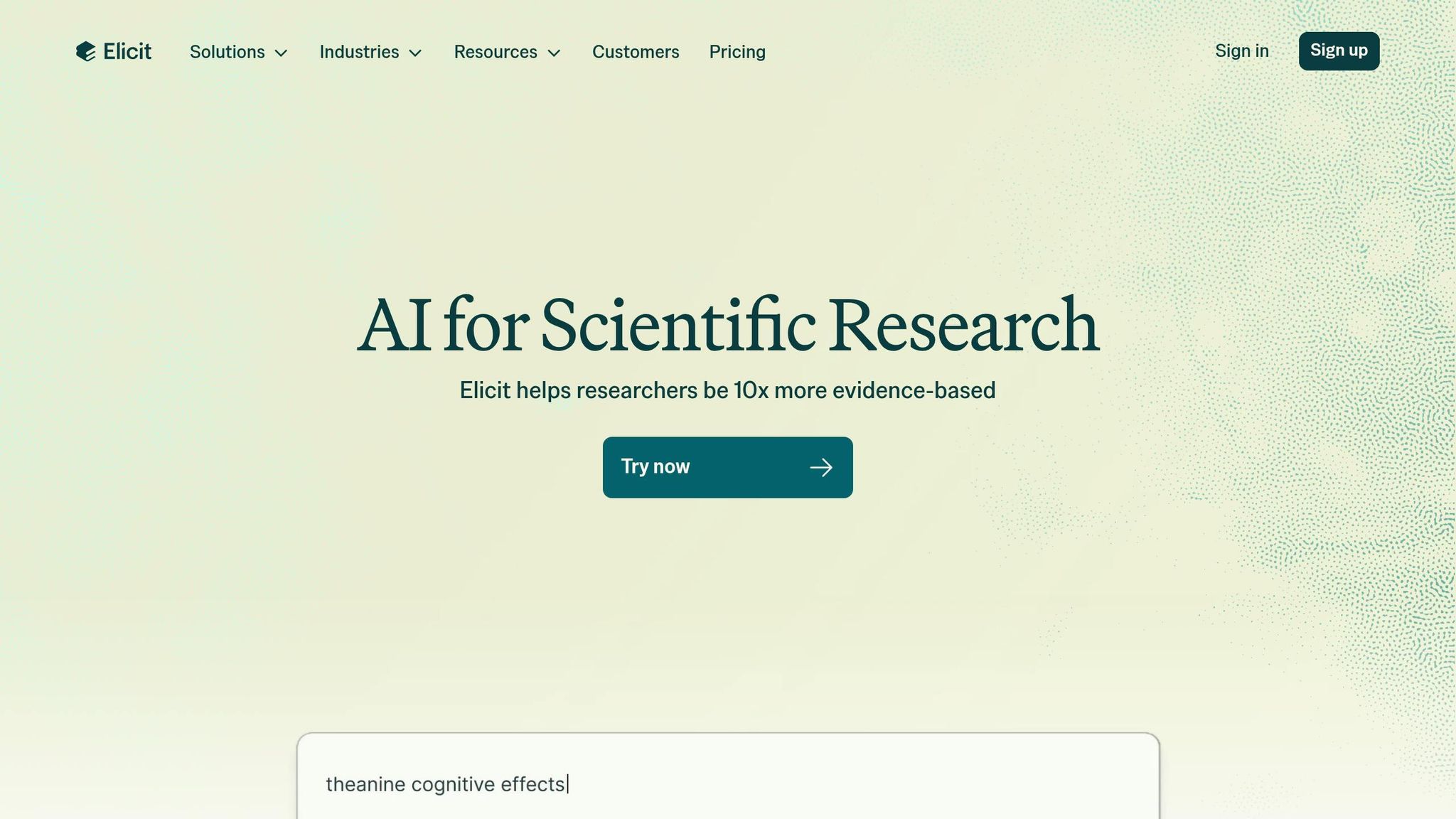
Elicit takes a fresh approach to literature reviews by transforming them into structured research workflows. Using semantic search, it combs through a massive database of 138 million academic papers and 545,000 clinical trials. This allows users to pose complete research questions rather than relying solely on scattered keywords [13,14]. For instance, instead of searching for "social media adolescents", you can ask, "What are the effects of social media use on adolescent mental health outcomes?". This method blends discovery with actionable, data-driven insights.
Search and Discovery Capabilities
Elicit's Research Agents, introduced in late 2025, simplify the exploration of broad topics and competitive landscapes. The tool can identify up to 1,000 relevant papers and analyze 20,000 data points. Its automated screening process evaluates titles and abstracts based on custom criteria, providing clear explanations for why certain studies are included or excluded. Impressively, the screening recall rate hits as high as 96.4%.
Summarization and Synthesis Features
Elicit excels at summarizing background, methods, and limitations from as many as 80 papers. It can also extract specific details - such as sample sizes, methodologies, and outcomes - with accuracy rates ranging between 94% and 99.4% [14,18]. A notable example is Formation Bio, which used Elicit to analyze definitions of end-stage knee osteoarthritis across 1,600 papers, completing the task at a pace 10 times faster than traditional methods [13,19].
Citation Analysis and Management
Elicit's screening capabilities extend to citation management, ensuring that every AI-generated claim is backed by sentence-level citations and direct quotes from source materials. This eliminates the tedious task of manually searching PDFs for verification [14,15]. James Compagno, Director of Marketing at MicroGenDX, shared his experience:
"Elicit is a step above other tools I've tried. I prefer Elicit when it comes to actually interpreting evidence. It doesn't make things up like ChatGPT".
The platform also features an AI-powered reference manager that supports semantic deduplication and allows users to export references in formats like RIS, CSV, and BibTeX [16,20].
Pricing and Accessibility
Elicit offers tools that save time while maintaining high research standards. The Basic plan is free and includes unlimited searches and data extraction from up to 20 papers per month. The Plus plan, priced at $10 per month (billed annually) or $12 per month, increases the limit to 50 papers monthly. For more extensive needs, the Pro plan costs $42 per month (annual billing) or $49 per month, providing workflows for systematic reviews and extraction from 200 papers per month. On average, researchers save up to 80% of review time, equating to about 5 hours per week.
3. Scite
Scite stands out among AI tools by categorizing citations in a way that reveals whether sources support, challenge, or simply mention research findings. Instead of just counting citations, Scite’s deep learning model classifies them as supporting, contrasting, or mentioning the original study. This unique feature allows researchers to quickly evaluate whether a study's conclusions have been validated or questioned.
Search and Discovery Capabilities
Scite’s database includes over 1.6 billion citations from more than 280 million articles, preprints, books, patents, and datasets. Its full-text search goes beyond abstract-level indexing, helping researchers pinpoint specific methods or findings buried within papers. The platform even provides exact excerpts from citing papers, showing how references are used without requiring users to sift through multiple PDFs. Each citation classification also comes with a confidence score. For example, a 2018 analysis demonstrated Scite’s ability to identify a "supporting" citation with 93% confidence and locate it within the "Results" section of the citing paper. This level of precision makes it easier to generate concise research summaries.
Summarization and Synthesis Features
Scite Assistant creates research summaries backed by verified citations from its extensive database of over 280 million articles. Every claim it makes is directly linked to a credible source. Researchers can track shifts in scientific consensus by analyzing the ratio of supporting versus contrasting citations over time, shedding light on emerging debates. The platform also integrates with AI tools like ChatGPT and Claude through its Scite MCP feature, ensuring that outputs are grounded in real, indexed literature.
Citation Analysis and Management
Scite takes citation management a step further with its Smart Citations feature, which is already used by more than 2 million researchers worldwide. This tool reveals where in a paper each citation appears, helping users gauge its relevance. Kathleen C. McCormick, a Ph.D. student at Cornell, shared:
"Being able to assess what is disputed or affirmed in the literature is how the scientific process is supposed to work, and Scite helps me do this more efficiently".
Mark Mikkelsen, Ph.D., from Johns Hopkins University School of Medicine, also praised the platform:
"Scite is such an awesome tool! It's never been easier to place a scientific paper in the context of the wider literature".
Pricing and Accessibility
Scite operates on a subscription model and requires users to log in for full access to its search results and Assistant tool. It offers institutional demos for universities and organizations and has partnered with over 30 major publishers, including Wiley and SAGE. Institutions like Cornell, Johns Hopkins, and the University of Toronto provide access to Scite for their researchers through subscriptions.
Next, let’s explore another tool that can simplify your literature review process even further.
4. Research Rabbit
Research Rabbit adds a fresh spin to AI-driven search and summarization tools by offering a visual, network-based approach to discovering academic literature. Think of it as a personalized recommendation engine for research. Instead of relying solely on keyword searches, you start by selecting a handful of "seed papers" (usually 3–7). These papers guide the platform in finding related studies. From there, Research Rabbit creates an interactive visual map that shows how papers are interconnected through citations. With access to over 270 million academic papers, it’s a powerful tool for diving deep into research topics.
Search and Discovery Capabilities
The platform's visual mapping feature is a standout. It represents papers as nodes in a network, where their position reflects their relevance. Papers higher on the map tend to have more citations, while those on the right are more recent. This layout makes it easier to spot foundational work and track emerging trends. You can explore papers through three main perspectives:
- Similar Work: Highlights studies on related topics.
- References: Points to earlier research cited by your seed papers.
- Cited By: Shows newer studies that reference your seed papers.
Research Rabbit also integrates with Zotero, allowing you to sync your library and import new discoveries seamlessly. For those who opt for the premium ResearchRabbit+ subscription, priced at $12.50 per month or $120 annually, there are additional perks. The Extended Search feature scans up to 300 articles and includes advanced filters for journal quality, open access status, and retractions.
Karthik Balachandrand, an endocrinologist, shared his thoughts on the tool:
"ResearchRabbit is a cool web app... It allows you to see the citations of the paper you are reading as a map with author names and year, see the connections between citations and visually sort by year of publication".
Citation Analysis and Management
One of Research Rabbit's strengths is its ability to handle citation chasing. It automates both backward citation chasing (finding references cited in a paper) and forward citation chasing (locating newer studies that cite your seed papers). The platform’s recommendation model becomes smarter as you add papers, refining your feed to match your research interests. Impressively, flagged papers - over 80 in some cases - naturally group into distinct research clusters, making it easier to organize and analyze your findings.
Pricing and Accessibility
Research Rabbit offers a free tier with unlimited searches, visual mapping, and essential discovery tools - all without cost. For those in lower-income countries, the premium tier includes region-specific discounts to ensure broader accessibility. It’s worth noting that Research Rabbit isn’t meant to replace traditional citation managers. Instead, the team emphasizes its role as a complementary tool, stating, "ResearchRabbit is designed to work with traditional library resources, not replace them".
5. Semantic Scholar
Semantic Scholar, a free academic search engine developed by the Allen Institute for AI, indexes over 214 million academic papers. Unlike conventional keyword-based search tools, it uses AI-powered relevance ranking to grasp the context and meaning of your queries. By 2020, the platform had grown to serve seven million users each month. It also offers features like one-sentence TLDR summaries for around 60 million papers in fields like computer science, biology, and medicine.
Search and Discovery Capabilities
Semantic Scholar takes research discovery to the next level with its Research Feeds feature. Using advanced SPECTER2 paper embeddings, it creates a personalized recommendation system that gets smarter as you use it. By analyzing your saved papers and ratings, it suggests research tailored to your interests. For the best results, it’s recommended to save at least five relevant papers and mark three as "not relevant".
The platform also assigns up to three fields of study to each paper with the help of a machine learning classifier called S2FOS, which evaluates titles and abstracts. To refine your search, you can filter results by criteria like journal, conference, author, publication type, and date range. For computer science topics, there are even dedicated pages featuring AI-generated definitions, key papers, and related themes.
Summarization and Synthesis Features
The Semantic Reader revolutionizes how you read academic papers. It provides inline citation cards and highlights key sections - like the Goal, Method, and Result - directly within the PDF.
"Semantic Reader's ability to show citation context without leaving the page is the best innovation in academic reading in years".
Another standout feature is the Ask This Paper tool, which uses GPT-3.5 to answer specific questions about a paper’s methods or results. However, this feature is currently available only for a limited selection of English-language papers.
"The TLDR feature is a lifesaver for literature reviews. I can scan 50 papers in the time it used to take for 5. It's my first stop before Google Scholar now".
Citation Analysis and Management
Semantic Scholar enhances citation analysis by identifying Highly Influential Citations through deeper contextual understanding. It categorizes citations into three types: Background (providing context), Method (describing procedures), and Result Extension (building on findings).
The platform also tracks citation trends with metrics like Citation Velocity (a weighted average of citations over the last three years) and Citation Acceleration (the change in velocity over the past two years).
"On my lab website, I link to my Semantic Scholar author page... because the TLDR and influential citations encourage understanding and impact, rather than just blindly counting up articles".
For organization, you can save papers to custom folders, collaborate with others, and export citations in formats like BibTeX, MLA, APA, or Chicago. Additionally, its Chrome extension helps locate open-access versions of paywalled papers and saves them directly to Zotero, complete with metadata, URLs, PDFs, and AI-generated TLDRs.
Pricing and Accessibility
Semantic Scholar is entirely free to use, with no premium tiers or hidden costs. It also offers a free REST API for researchers and developers. Public access is rate-limited to one request per second, but authenticated users can request higher limits for production purposes at no charge. The platform integrates with tools like GetFTR and LibKey, giving users seamless access to subscription-based full-text articles via institutional sign-ins such as Open Athens, eduGAIN, and InCommon.
6. SciSpace
SciSpace transforms the way researchers approach literature reviews by combining semantic search with tools for summarization and citation management. With access to a database of over 280 million academic papers, it’s a go-to platform for more than 1 million researchers worldwide. Unlike traditional keyword searches, SciSpace uses natural language processing, allowing users to ask full questions and discover papers that might otherwise be overlooked. The platform also supports research in over 75 languages.
Search and Discovery Capabilities
SciSpace’s semantic search feature allows you to phrase research queries in plain English, eliminating the need for exact keyword matching. Each result is accompanied by a relevance score, and the "Show more like selected" option refines your search by suggesting related papers. The Deep Review tool acts as a virtual assistant, analyzing up to 1,750 papers to identify key themes, research gaps, and conflicting findings. This feature can reduce the time spent filtering through studies from hours to just 15–20 minutes.
Summarization and Synthesis Features
The Chat with PDF (Copilot) tool simplifies complex research. It allows users to highlight sections of a paper and instantly receive plain-language explanations or bullet-point summaries.
"The Copilot feature is a lifesaver for my literature review. It explains complex formulas in seconds and saves me from constant Googling." - AcademicMind, Researcher
For comparative research, SciSpace lets you upload multiple PDFs and generate side-by-side comparison tables with up to 50 customizable columns. These could include details like methodology, limitations, or sample size, making it easier to analyze multiple papers at once. Additionally, any AI-generated insights are linked to specific sections in the source PDFs, ensuring transparency and easy verification. These tools, combined with its citation management features, make SciSpace invaluable for academic writing.
Citation Analysis and Management
SciSpace simplifies citation tasks with cite-while-you-write functionality and automatic formatting in thousands of styles. Its paraphrasing tool offers over 20 modes, and the Academic AI Detector helps identify AI-generated content. The platform integrates seamlessly with popular reference managers like Zotero, Mendeley, and Google Scholar, and provides access to more than 100,000 verified journal templates for manuscript formatting. A Chrome extension further enhances productivity by allowing users to summarize and interact with research articles directly on websites. These features, combined with flexible pricing, make SciSpace an efficient solution for both research and writing.
Pricing and Accessibility
SciSpace offers a free Basic plan, which includes 100 monthly credits, summaries of up to 10 papers, and limited literature search capabilities. The Premium plan, priced at $12/month (billed annually), provides 1,200 credits, summaries for 30 papers, and unlimited literature searches. For more advanced needs, the Advanced plan costs $70/month (billed annually) and includes 10,000 credits along with access to the Deep Review model. Teams can also subscribe for $8/user/month, which includes collaboration tools.
As of March 2026, SciSpace has earned an impressive 8.95/10 consensus score on Tooliverse, based on 2,807 verified reviews. The platform ensures user data security with SOC 2 compliance and AES-256 encryption while pledging not to use user data for AI model training.
7. Consensus
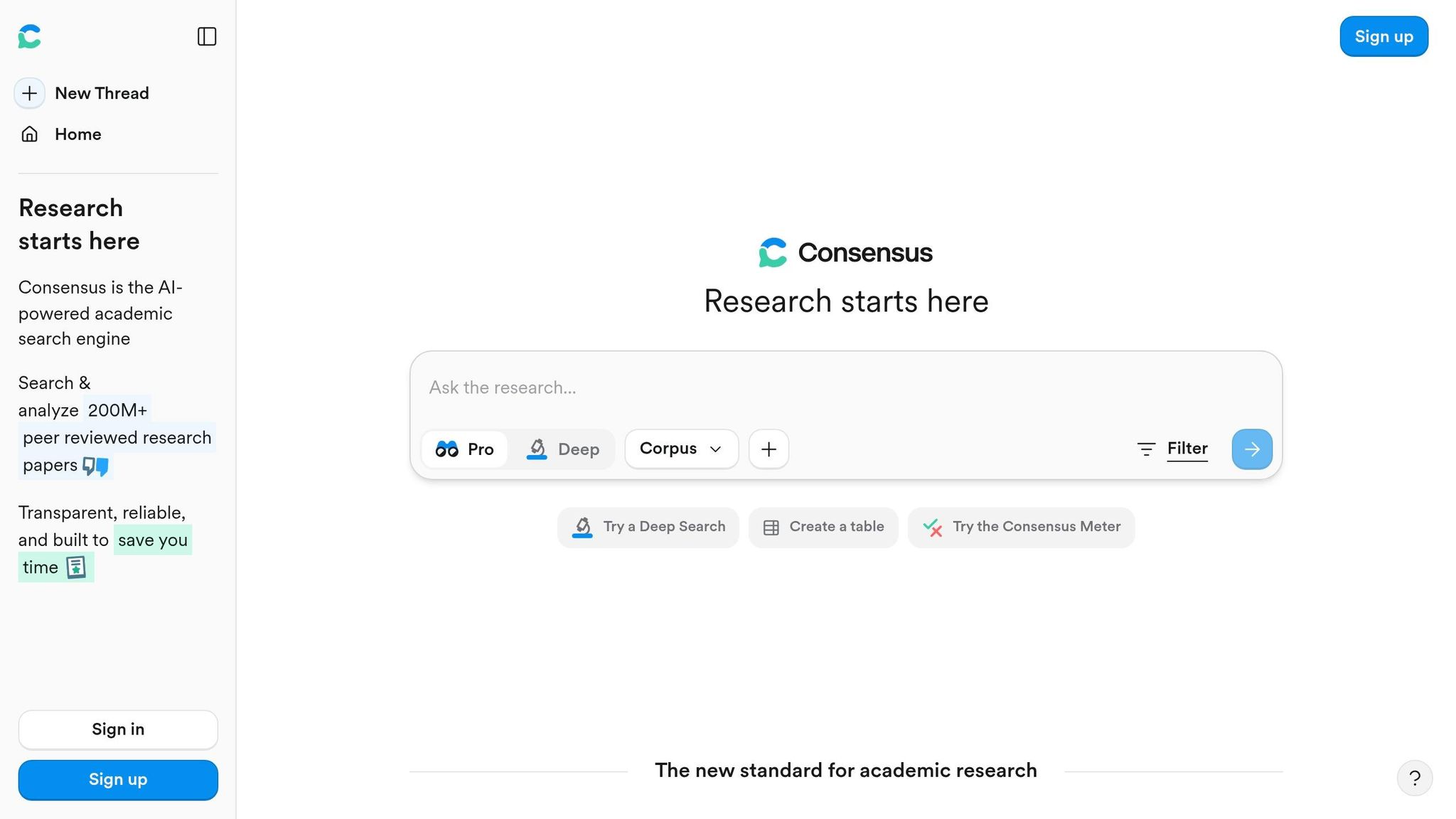
Consensus is a search engine powered by AI, designed to support evidence-based research. It draws from a vast database of over 200 million peer-reviewed papers sourced from Semantic Scholar, OpenAlex, and partnerships with publishers. This tool is used by more than 10 million researchers, students, and clinicians worldwide [50,52].
Search and Discovery Capabilities
Consensus makes research more accessible by allowing users to ask questions in plain language, such as "Does the death penalty reduce crime?" or "Is sauna beneficial for blood pressure?" The Consensus Meter provides immediate insights, showing the percentage of papers that agree, disagree, or present mixed findings on yes/no questions.
For deeper analysis, the Deep Search mode processes up to 50 papers from over 1,000 relevant studies in less than five minutes. It generates a detailed report that includes the search strategy, timeline, and research gaps. This feature significantly cuts down manual screening time - what typically takes 3–5 hours can now be completed in just 45–60 minutes [52,53]. These tools make it easier to synthesize complex research findings efficiently.
Summarization and Synthesis Features
Consensus also excels in summarizing research. Its Study Snapshots extract critical details from individual papers, including population, methodology, outcomes, and results. This is particularly helpful for medical and social science research. The Pro Analysis feature takes it a step further, creating summaries across multiple papers with in-line citations that link directly to the original sources. As Allison Elechko from Consensus notes:
"Every piece of text that is generated by our AI models is tied back to its original source material with a citation. You are always one click away from the underlying source content".
Another useful tool, the Citation Graph (currently in beta), visually maps citation relationships between papers, making it easier to explore how studies are interconnected.
Pricing and Accessibility
Consensus offers a free plan that includes 25 Pro Searches (analyzing 20 papers each) and 3 Deep Searches (analyzing 50 papers each) per month. For users needing more, the Pro plan costs $15/month (or $8.99/month when billed annually) and includes unlimited Pro Searches, a monthly quota of Deep Searches, Study Snapshots, and export features. Students with a verified .edu email can access full Pro features for $9/month (or $5.39/month billed annually).
The platform also integrates with Zotero, allowing users to import libraries and PDFs for semantic searches within their collections. With an overall rating of 4.2/5, users frequently highlight the Consensus Meter as a standout feature, calling it a game-changer for resolving debates with evidence-based insights.
Feature Comparison Table
When selecting an AI tool for your literature review, it’s essential to match the tool’s capabilities with the specific stage of your research. From early discovery to synthesizing findings, each platform offers distinct advantages.
The table below outlines the core features and pricing of the tools mentioned earlier. For example, Sourcely is great for identifying citation gaps in essays, while Semantic Scholar and Research Rabbit stand out by offering full access for free. Elicit is particularly strong in systematic reviews, achieving an impressive 94–99% accuracy rate in extracting data from structured empirical studies. Meanwhile, Consensus shines by delivering evidence-based answers in under 30 seconds.
| Tool | Best For | Free Plan | Paid Plan | Key Feature |
|---|---|---|---|---|
| Sourcely | Finding sources and placement guidance | Yes (basic capabilities) | $17/month or $167/year | Paste essays to identify where citations are needed |
| Elicit | Systematic reviews and data extraction | Yes (10,000 summaries) | $12/month (unlimited) | Automates extraction with 94–99% accuracy |
| Scite | Citation context analysis | Yes (limited) | $12/month | Shows supportive, contrasting, or neutral citations |
| Research Rabbit | Visual citation mapping | Yes (full access) | Free | Interactive citation network visualization |
| Semantic Scholar | Initial discovery and filtering | Yes (full access) | Free | Over 220 million papers and AI-generated TLDRs |
| SciSpace | Reading and understanding papers | Yes (limited) | $12/month | Explains complex concepts in simple language |
| Consensus | Quick evidence synthesis | Yes (25 searches/month) | $15/month (unlimited) | Consensus Meter for yes/no questions |
Many researchers find value in combining these tools. For instance, Elicit can handle data extraction, Semantic Scholar aids with initial discovery, and Scite provides detailed citation context. In February 2026, Elicit was credited with reducing systematic review times from weeks to just days, earning a 9.2/10 for its workflow capabilities. Similarly, Consensus scored an 8.8/10 for its speed in synthesizing evidence.
Conclusion
AI tools have reshaped how literature reviews are conducted, drastically reducing the process from the traditional 67.3 weeks to as little as ten days in some cases. By replacing manual keyword searches with semantic discovery, researchers can avoid overlooking relevant studies due to differences in terminology.
These tools work together to make the review process smoother and more efficient. For example, Sourcely highlights citation gaps in essays, Semantic Scholar helps with initial discovery, Elicit demonstrates 94–99% accuracy in data extraction, and Scite provides valuable context for citations.
AI also slashes discovery and screening time by 50–70%, and automated summarization can reduce preparation time by up to 50%. As Jet New from Atlas aptly puts it:
"AI is a force multiplier for literature reviews, not a shortcut".
It's important to verify AI-generated results against the original sources and document the tools you use for transparency. These platforms handle repetitive tasks, allowing you to focus on deeper analysis and synthesis - whether you're a student tackling your first literature review or a researcher working on systematic reviews.
With such impressive time savings, you can start exploring these tools through their free tiers to find what suits your workflow. When you're ready, consider unlocking advanced features like Sourcely's $17/month plan or Elicit's $12/month subscription for even more functionality.
FAQs
Can I use more than one AI tool in a single literature review workflow?
Yes, it's possible to integrate multiple AI tools into a single literature review workflow. Many tools are designed to excel at specific tasks such as discovery, screening, data extraction, or synthesis. By leveraging the strengths of different tools, you can make each stage more efficient and achieve a thorough and streamlined review process.
How do I verify AI-generated summaries and citations are accurate?
To make sure AI-generated summaries and citations are reliable, choose tools that offer inline, passage-level citations connected to trustworthy sources. This feature lets you verify claims by reviewing the exact sections of the source material. Steer clear of tools that only provide a list of URLs without a way to directly confirm the information. It’s also crucial to double-check important details against original sources, as AI can occasionally produce incorrect or even made-up references.
Which tool should I pick for my stage of the literature review?
When it comes to picking the right AI tool, it all depends on which phase of your review you're tackling:
- Discovery: Focus on tools designed to quickly locate and filter relevant papers.
- Screening and Extraction: Look for platforms that streamline systematic reviews and data extraction.
- Synthesis: Opt for tools that excel at cross-document analysis or provide summaries grounded in original sources.
Matching the right tool to each stage can save you time and boost precision. Often, combining multiple specialized tools delivers the most effective results.