
Beyond the Essay: Using AI for Dissertations and Theses
AI is transforming how dissertations and theses are written by tackling time-consuming tasks like literature reviews, citation management, and source verification. Tools like Sourcely simplify research by:
- Locating relevant sources using full-text searches.
- Highlighting citation gaps and suggesting references.
- Generating summaries for quick source evaluation.
- Managing citations and formatting bibliographies in seconds.
These tools help PhD students focus more on analysis and argument development instead of tedious tasks. However, verifying AI-suggested sources and combining AI insights with critical thinking remain essential for maintaining academic rigor.
The AI Thesis Writing System That Cuts Your Workload in Half
Why Dissertations Need Better Research Tools
Writing a dissertation isn’t just a longer essay - it’s a whole different beast. PhD students often find themselves navigating what experts call a "vast ocean" of academic literature, juggling hundreds of sources to showcase their expertise in the field. Without proper tools, even the most determined scholars can find themselves overwhelmed. The process boils down to three major hurdles: reviewing an enormous amount of literature, managing countless references, and ensuring the quality of every source.
The Challenge of Literature Reviews
The sheer amount of academic material available can be staggering. PhD candidates often spend months combing through databases, only to discover that as little as 5% of the sources they review are directly relevant to their work. This means a lot of time is spent reading material that doesn’t significantly contribute to their research goals. On top of that, they’re tasked with identifying gaps in the research, evaluating methodologies, and constructing theoretical frameworks. Pulling insights together from so many studies is no small feat - and it’s where many students hit a wall.
Managing Large Numbers of References
Misplacing even a single reference can throw your entire project off track. If you can’t pinpoint where a piece of information came from, it’s effectively unusable. Manually managing citations in styles like APA, MLA, or Chicago is not only tedious but also prone to errors. And without some form of automated help, mapping out citation networks - understanding which papers are foundational or how studies connect - can feel like an impossible task.
Verifying Source Quality
Quantity isn’t the only challenge; quality matters just as much. Not all academic sources are created equal. Some tools, like ChatGPT, have been known to fabricate or "hallucinate" references, which can seriously undermine a dissertation’s credibility. Even when sources are legitimate, it’s essential to confirm they haven’t been retracted or contradicted by newer research. Trusted databases like PubMed, Scopus, Web of Science, JSTOR, and ERIC are great starting points for reliable, peer-reviewed material. But the work doesn’t stop there - it’s critical to check whether later studies have supported or challenged the findings of those sources. Skipping this step can leave your dissertation vulnerable to scrutiny, as review committees are quick to spot weak foundations.
How Sourcely Supports Dissertation Research
Sourcely takes academic research to the next level by analyzing entire texts instead of relying solely on keyword searches. You can paste full paragraphs or drafts into the platform, and the AI will locate matching peer-reviewed sources to back your claims. This reverse search approach is especially helpful when parts of your dissertation are already written, but you need credible references to strengthen your arguments. Mushtaq Bilal, PhD and Postdoctoral Researcher at the University of Southern Denmark, explains:
"One of the limitations of databases like Google Scholar is that they let you search using only keywords. But what if you want to search using whole paragraphs or your notes? Sourcely is an AI-powered app that will let you do that."
With access to over 200 million research papers spanning various disciplines, Sourcely goes beyond surface-level results. Its Deep Search feature uncovers academic insights that might be missed in basic searches. Advanced filters, such as publication year, authorship, citation count, and journal type, allow you to fine-tune your results. You can even exclude specific keywords to avoid irrelevant papers. Additionally, the Source Credibility Checker ensures the reliability of URLs before you cite them. Here’s how Sourcely simplifies dissertation research:
Finding Academic Literature
Once you upload your text, Sourcely identifies citation gaps and recommends sources to fill them. It highlights sections of your draft that need references, making it easy to see where citations are required. You can filter results by publication date to ensure you're using the latest research or sort by citation count to locate key studies in your field. If you're just starting out, the Research Topic Finder can help you uncover unique ideas tailored to your area of study.
Creating Summaries and Adding Sources
When you're on a tight deadline, reading through every paper isn't practical. Sourcely generates concise summaries of articles so you can quickly determine their relevance before committing to a full read. The Chat with Sources feature lets you ask targeted questions about a paper without having to review it entirely. Many sources also provide free PDF downloads, granting full-text access when you need more detail. Artem Vysogorets, a Data Science PhD student, shares:
"Sourcely helped me find papers relevant to my current project, and I will definitely use it again when writing the literature review section of my own paper!"
Organizing References
Sourcely's Citations Library lets you store and manage your references in one place, making them easy to access throughout your project. This eliminates the hassle of manually keeping track of numerous citations. When you're ready to compile your bibliography, you can export references in APA, MLA, or Chicago formats with a single click. The platform also supports exporting bibliographic metadata in formats like RIS, BibTeX, or XML, making it compatible with citation managers such as Zotero or Mendeley. If you need to switch citation styles, the Citation Format Converter tool handles it effortlessly, saving you time and effort.
sbb-itb-f7d34da
Step-by-Step Guide: Using Sourcely for Your Dissertation
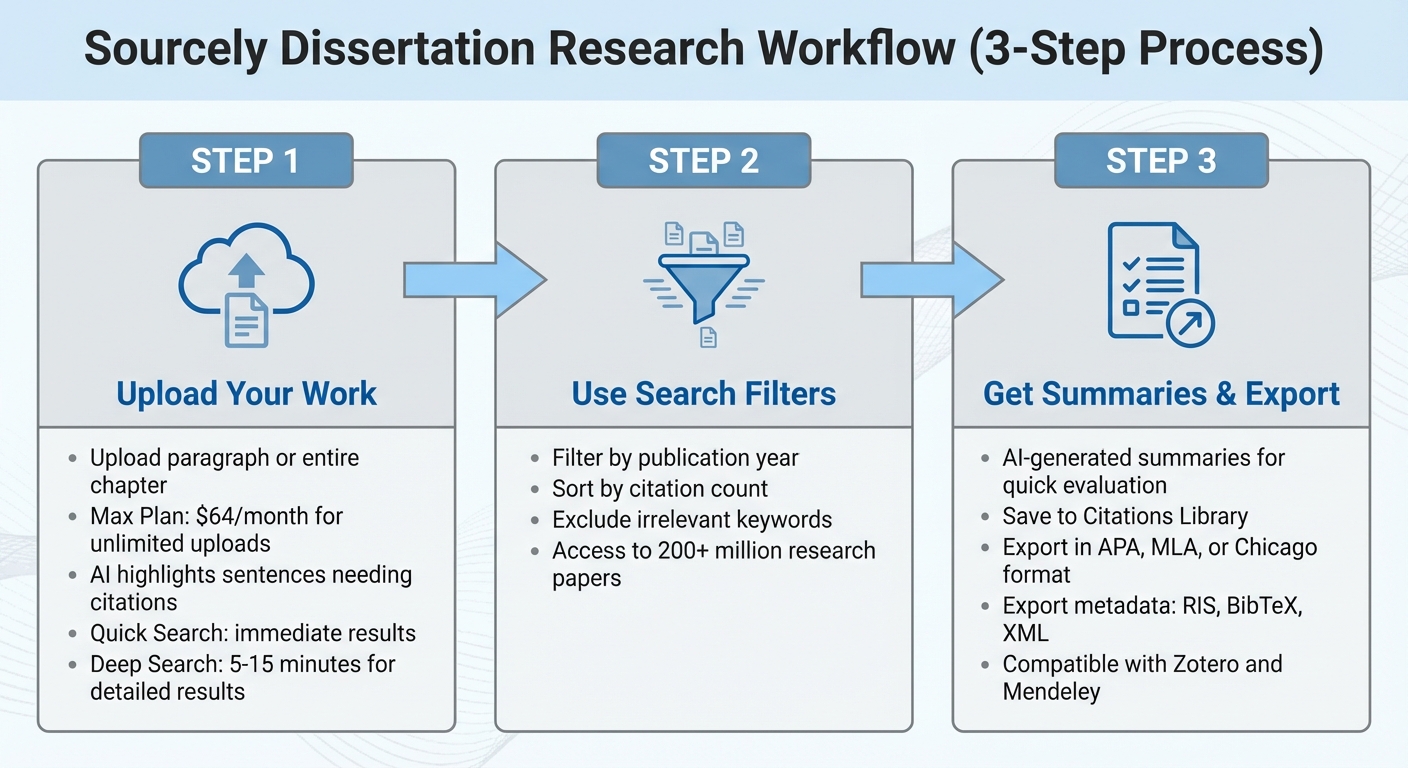
3-Step Process for Using Sourcely in Dissertation Research
Make the most of Sourcely's search and organization tools to streamline your dissertation work. Here's how to get started:
Step 1: Upload Your Work
Start by uploading your text to Sourcely - whether it's a single paragraph or an entire chapter. If you're a Max Plan subscriber ($64/month), you can upload your entire dissertation without any limits. Once your text is uploaded, Sourcely gets to work. It highlights sentences that need citations, flagging areas where supporting or contrasting evidence is required. As Ilya Shabanov, author of The Effortless Academic, puts it:
"Sourcely takes an academic text of any length and provides references (i.e., academic papers or books) that match this text and support or contrast single statements in it."
Start with the Quick Search feature for immediate results. If you need more in-depth findings, switch to Deep Search, which scans full-text PDFs and delivers detailed results in 5–15 minutes.
Once your text is highlighted and ready, move on to fine-tuning your search in Step 2.
Step 2: Use Search Filters
Sourcely offers advanced filtering options to help you refine your search results. You can narrow down by publication year, sort by citation count, and exclude irrelevant keywords. These tools make it easy to sift through Sourcely's massive database of over 200 million research papers and find exactly what you need.
Step 3: Get Summaries and Export Citations
After narrowing down your results, evaluate each source with the help of AI-generated summaries. These summaries give you a quick understanding of a paper's relevance without having to read the entire document. Once you've selected your sources, save them to your Citations Library. From there, you can export citations in APA, MLA, or Chicago format. Need to switch styles? Use the Citation Format Converter for instant updates. You can also export bibliographic metadata in formats like RIS, BibTeX, or XML to integrate with citation managers such as Zotero or Mendeley.
With these tools, Sourcely simplifies the often tedious process of managing citations, leaving you more time to focus on your research and writing.
Best Practices for Using AI in Academic Research
AI tools like Sourcely can speed up your research process, but they’re most effective when paired with thorough verification and critical thinking. Think of AI as a helpful starting point, not the final word. As the Cal State LA University Library wisely notes:
"AI is a starting point, not an end point. Always verify and critically assess before including AI-supported content in your literature review."
Checking AI-Suggested Sources
One of the pitfalls of using AI for research is the risk of fabricated citations. These citations might look legitimate, even referencing real scholars, but the articles themselves may not exist. This happens because AI tools are designed to generate plausible content rather than simply pointing to actual resources.
To avoid this, manually verify every citation before including it in your work. Use tools like Google Scholar or your library database and search for the article title in quotation marks. Cross-check details such as author names, journal titles, publication years, and DOIs. If you can’t find the article, look for other works by the same author to confirm their credibility.
It’s also important to compare AI-generated summaries with the actual article abstracts or full texts. AI can sometimes oversimplify complex debates or misrepresent findings. Harvard Library highlights this concern:
"When researchers are unable to verify the source of the information and contents these tools produce... it can make it difficult to rely on the accuracy of the output."
Once you’ve verified the sources, combine these insights with your own analysis to create a stronger, more accurate review.
Combining AI Tools with Your Own Analysis
Verification is just the first step. To get the most out of AI tools, integrate their insights with your own expertise and critical thinking. Use AI as a brainstorming partner rather than a replacement for your judgment. The Institute for Humane Studies puts it well:
"AI should serve as your brainstorming partner, not your pen."
Over-reliance on AI can hinder your critical thinking and lead to what some researchers call cognitive debt. To counter this, schedule time in your workflow to work independently of AI tools. This helps ensure your arguments are grounded in your own knowledge and perspective.
When you do use AI, focus on asking it for adjustments or explanations rather than having it rewrite your work entirely. Keep detailed records of how and when you use AI tools; many institutions now require such disclosures as part of the research process.
Finally, don’t rely solely on AI-generated results, even if you fact-check them. Doing so can lead to confirmation bias and may cause you to overlook key perspectives in your field. For thorough research, combine AI tools like Sourcely with traditional database searches to ensure you’re covering all relevant literature.
Conclusion: AI Tools for Better Academic Research
Writing dissertations and theses often involves tackling extensive literature reviews, verifying sources, and nailing down precise citations - all tasks that can eat up countless hours. Tools like Sourcely are flipping this script by taking over the tedious work, freeing you up to focus on the core aspects of your research: analysis and argument development. It's a shift that's reshaping how academic research gets done.
For example, AI can cut citation formatting time from hours to mere minutes. Plus, intelligent source discovery digs through massive databases to find connections you might overlook with manual searches. Sourcely also offers automated credibility scoring and reference management, ensuring your work is supported by reliable, properly formatted sources. As Daniel Felix puts it:
"AI is not replacing human intelligence; it's augmenting it, enabling us to be more efficient, accurate, and creative in our academic pursuits".
That said, while AI can streamline your process, maintaining academic rigor still requires careful source verification and independent analysis. Combining AI's efficiency with thorough scholarly practices is the way forward for academic research.
Sourcely offers flexible pricing options: start free with up to 300 characters, or try a one-time trial for $7 (2,000 characters). For unlimited access, subscriptions start at $17 per month. The reality is clear: AI is already transforming academic research. The real question is - are you ready to use these tools to simplify your dissertation process and elevate your final work?
FAQs
How does Sourcely verify the reliability of AI-recommended sources?
Sourcely takes the guesswork out of verifying AI-recommended sources by employing thorough verification processes. Every source undergoes automatic fact-checking and is carefully assessed for accuracy. On top of that, Sourcely leverages the CRAAP framework - a widely respected method that evaluates sources based on currency, relevance, authority, accuracy, and purpose.
With this layered approach, you can feel confident that the sources you rely on for your dissertation or thesis meet rigorous academic standards and are genuinely trustworthy.
How can I verify that AI-generated citations are accurate?
To make sure AI-generated citations hold up to scrutiny, start by cross-referencing each reference with reliable sources like your university library catalog or trusted databases such as JSTOR or PubMed. Double-check that details like the author, title, journal, volume, and DOI align perfectly. If you can’t locate a source, it’s possible it was fabricated and should be excluded.
Next, assess the source’s credibility. Confirm it’s peer-reviewed, scholarly, or published by a well-known organization. Look for respected academic presses, reputable journals, or government publications. Additionally, take a moment to review the citation’s context - read the abstract or the full text to ensure it genuinely supports your argument and hasn’t been misrepresented. Keep track of where you verified each source and fix any discrepancies before wrapping up your bibliography. These steps are essential for preserving the quality and reliability of your research.
Can AI tools like Sourcely replace traditional research methods entirely?
AI tools, such as Sourcely, are great for streamlining tasks like finding reliable sources, creating summaries, and organizing citations. They can save time and make the research process more efficient. But, they’re not a substitute for traditional research methods. Human expertise remains essential for assessing source quality, interpreting data, and ensuring the work meets academic standards.
While AI excels at handling repetitive, time-consuming tasks, it’s up to researchers to apply critical thinking and judgment to produce thorough and accurate academic work.