
From Chaos to Clarity: A Guide to Organizing Your Academic Research
Organizing academic research can feel overwhelming, especially with scattered notes, countless PDFs, and endless browser tabs. Disorganization not only wastes time but also risks missed connections, citation errors, and weaker arguments. The solution? A clear system and the right tools.
This guide offers practical strategies to:
- Streamline digital files with clear folder structures and descriptive names.
- Use tools like Sourcely, an AI-powered platform for source discovery, organization, and citation management.
- Master advanced search techniques to find relevant materials faster.
- Maintain consistent note-taking and integrate research into your writing process.
Workshop: Tips & Tricks to Organizing your Research
Common Problems with Disorganized Research
When research lacks structure, it can quickly spiral into chaos, leading to lost productivity and even jeopardizing the quality of your work. Disorganization doesn’t just waste time - it can derail entire projects. Recognizing these pitfalls highlights why implementing effective strategies, like those offered by Sourcely, is so important.
Let’s look at some common signs of disorganized research and the issues they create.
Too Much Information and Scattered Notes
Researchers today face an avalanche of information. Digital databases offer millions of articles, books, and papers, while the internet floods us with endless streams of potentially useful content. Without a clear system to manage this, it’s easy to feel overwhelmed. You’ve probably experienced this: dozens of browser tabs open, files with generic names like “untitled” or “download(47).pdf” cluttering your desktop, and notes scattered across notebooks, apps, and sticky notes.
This information overload doesn’t just clutter your workspace - it clutters your mind. The disorganization creates an ongoing mental drain, making it harder to focus and analyze effectively.
The problem becomes even worse when juggling multiple projects. Graduate students, for example, often balance research papers, grant proposals, and other initiatives. Without clear boundaries, information from one project bleeds into another, leaving you feeling scattered and unfocused.
Another challenge is inconsistent note-taking. You might start with one method, abandon it halfway through, and switch to another. This lack of consistency creates a patchwork of notes, making it nearly impossible to track your research journey or uncover important insights.
These issues set the stage for deeper productivity challenges, which we’ll explore next.
Problems Caused by Poor Research Organization
The effects of disorganized research go far beyond frustration. One major issue is duplicated effort - reading the same paper multiple times or revisiting research paths you’ve already explored. It’s a huge waste of time and energy.
Citation errors are another common problem. When sources aren’t properly tracked, it’s easy to misattribute quotes, forget citations, or even risk accidental plagiarism.
Perhaps the most damaging consequence is the loss of key findings and connections. Some of the best research insights come from linking ideas across different sources. But if your materials are scattered, those connections are often missed.
As deadlines approach, these problems only get worse. The pressure to meet deadlines can lead to frantic, last-minute searches for evidence or arguments, resulting in weaker papers that fail to reflect the depth of your research.
Disorganization also undermines the quality of analysis. Deep, meaningful analysis requires comparing multiple sources, identifying patterns, and building arguments supported by diverse evidence. When your research materials are hard to navigate, this level of analysis becomes nearly impossible.
There’s also a financial cost: disorganized researchers often repurchase materials they already own or miss opportunities to access free resources.
Finally, poor organization takes a toll on your mental health. The stress and anxiety of worrying about lost sources or incomplete work create an environment where creative thinking struggles to thrive. For collaborative projects, the lack of organization disrupts teamwork, making it harder to share findings or maintain consistent workflows.
Disorganized research doesn’t just slow you down - it undermines the entire research process. Addressing these issues is essential for producing high-quality work and maintaining your sanity.
Using Sourcely to Organize Your Research
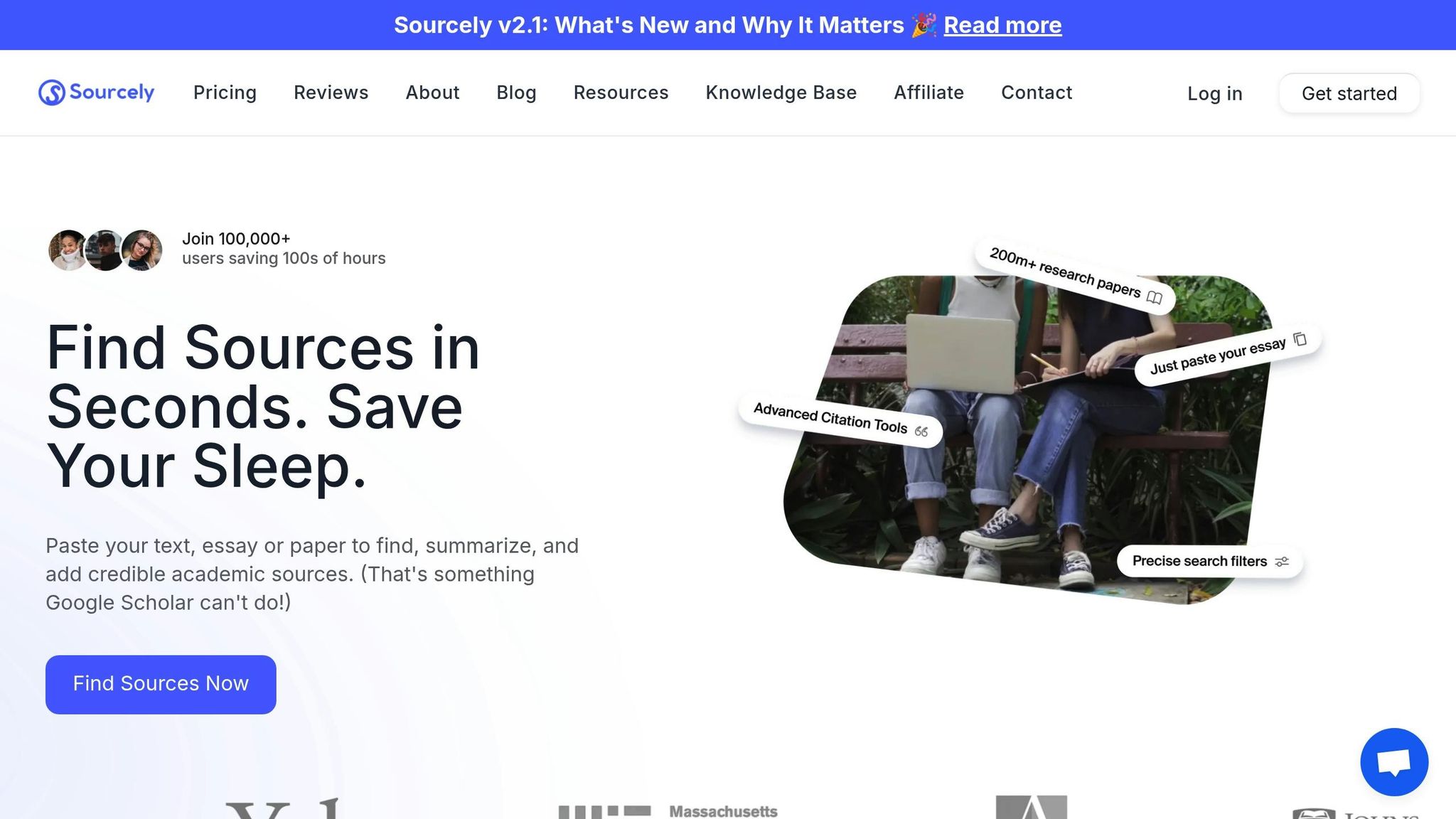
Research doesn't have to feel like you're drowning in scattered notes and endless tabs. Sourcely is here to change that. This AI-powered platform transforms the often chaotic process of academic research into an organized, efficient workflow. It’s your one-stop solution for keeping everything in one place.
Instead of blindly tossing keywords into search engines and hoping for the best, Sourcely uses AI to understand your research context. It analyzes your work and suggests sources that align with your arguments. This means less time sifting through irrelevant results and more time focusing on your ideas. Sourcely tackles the big challenges - overwhelming data, disorganized materials, and clunky workflows - by combining source discovery, organization, and citation management in a single interface. With everything streamlined, you can focus on creating impactful research.
Main Features of Sourcely
Sourcely’s strength lies in its AI-powered search tools. The platform doesn’t just rely on basic keywords; it reads your essay or research draft to understand your topic and arguments, then finds sources that directly support your work. This eliminates the frustration of irrelevant search results.
The essay pasting feature is a game-changer. You can upload your draft, and the AI pinpoints areas where additional sources could strengthen your arguments. Need to refine your search? Use the advanced filtering options to narrow results by publication date, source type, discipline, or credibility level - giving you relevant, manageable results every time.
Citations are no longer a headache, thanks to Sourcely's reference export functionality, which supports formats like APA, MLA, Chicago, and Harvard. It even reduces errors by automating the formatting process. Plus, its PDF download feature gives you direct access to full-text articles, bypassing paywalls.
To save even more time, Sourcely generates AI-powered summaries of each source. These summaries highlight key findings, methodologies, and conclusions, letting you quickly determine a source’s relevance without reading the entire paper.
Making Your Research Workflow Faster
Sourcely doesn’t just organize your research - it speeds it up. Traditional workflows often involve juggling multiple tools for searching, downloading, organizing, citing, and note-taking. Sourcely consolidates all these tasks into one platform, so you’re not constantly switching between apps.
With Sourcely, you can search for sources, generate citations, and create summaries all in one place. Whether you’re working on a single paper or juggling multiple projects, its tagging and filtering features keep everything neatly organized. The AI ensures projects stay separate while also connecting related ideas when relevant.
Pricing is straightforward: choose a $7 trial (2,000 characters), $17 monthly, $167 yearly, or $347 lifetime plan. These options make it accessible whether you’re tackling a short-term project or planning long-term research.
The real payoff? The time and mental energy you save. Instead of wrestling with file management and citation tracking, you can focus on analysis and writing. Sourcely’s seamless integration of tools allows you to craft stronger, more evidence-based arguments without the usual research headaches.
How to Organize Your Research Materials
Keeping your research materials well-organized lays the groundwork for producing strong academic work. A structured system not only saves time but also makes the research process more efficient.
Best Ways to Organize Digital Files
Start by setting up a clear folder hierarchy with descriptive file names to make locating files easier. Begin with broad categories, like your main research topic, and then create subfolders for specific themes, methodologies, or time periods. For instance, if you're researching public policy, you might organize folders by topic and subtopic.
Use detailed file names, such as "Smith2023_CarbonTax_EconomicAnalysis.pdf", so you can quickly identify the content without opening the file.
To enhance your system further, apply consistent tags to your files. Tags can reflect methodologies, theoretical frameworks, or the relevance of the source to your project. This makes it easier to trace connections between different materials.
Consider using color-coding to visually sort your resources. For example, you could mark background materials in green, supporting evidence in yellow, and counterarguments in red. This method provides a quick way to identify the role each source plays in your research.
Finally, create a master spreadsheet to track citation details, key arguments, and methodologies. This overview helps you identify patterns and connections across your entire collection of sources.
Once your digital files are in order, tools like Sourcely can help you seamlessly integrate and manage your research materials.
Using Sourcely's Library and Export Features
Sourcely's library feature acts as a central hub for your research, consolidating all your sources into one searchable database. When you find relevant material through Sourcely's AI-powered search, it automatically populates your library, making it easier to manage your references.
The platform’s export functionality simplifies citation management by supporting various reference styles. Instead of formatting citations manually, you can generate polished bibliographies directly from Sourcely, saving time and reducing errors.
Additionally, the PDF download feature grants direct access to full-text articles, bypassing paywalls or institutional hurdles. This ensures you can quickly retrieve the materials you need without unnecessary delays.
Sourcely also includes a powerful search tool within its library. Whether you're searching by author, keyword, publication year, or even AI-generated summaries, this feature helps you locate sources - even if you only remember a key concept or detail.
Once your materials are centralized, the next step is adding notes and highlights to connect your research to your writing process.
Adding Notes and Highlights to Your Workflow
Develop a consistent note-taking system to distinguish between direct quotes, paraphrased content, and your own thoughts. Linking each note to specific sections of your paper ensures clarity and helps avoid accidental plagiarism.
While AI-generated summaries can provide quick overviews, enhance them with your own analytical notes to explore how different sources align, contrast, or contribute to your arguments.
As your research progresses, use a progressive note-taking approach. Start with basic observations, then revisit and refine your notes to uncover themes, contradictions, or gaps that could shape your paper's direction.
To bring everything together, create synthesis documents that compile insights from multiple sources. These documents can serve as a bridge between research and writing, helping you transition from an intimidating blank page to a well-structured outline.
sbb-itb-f7d34da
Advanced Search and Filter Methods
Advanced search techniques can transform an overwhelming sea of results into a streamlined and precise research process. A well-crafted query can cut through irrelevant information and deliver the exact sources you need.
Building Better Search Queries
Mastering search queries starts with using Boolean operators. These allow you to refine your results: "AND" narrows your search by combining terms, while "OR" broadens it. For instance, searching for "climate change AND agriculture AND drought" will yield more targeted results than simply typing "climate change agriculture drought."
Using quotation marks ensures exact phrase matching. For example, typing "machine learning algorithms" will only return results containing that specific phrase, filtering out unrelated content about machine learning or algorithms on their own.
Wildcards are another powerful tool. By using symbols like the asterisk (*), you can gather all variations of a term in one go. For instance, searching "econom*" will return results for "economy", "economic", "economics", and "economist." This trick is especially useful when dealing with terms that have multiple variations or when accounting for differences like British versus American spellings.
If you remember a specific author but not the paper title, you can refine your search by limiting it to titles, abstracts, or author names. This approach hones in on the exact content you’re looking for.
Also, think carefully about your search scope. Setting time boundaries can improve relevance - newer research is often crucial for fast-moving fields like technology, while historical studies might require sources spanning decades. Similarly, focusing on specific geographic regions can help when researching topics tied to particular countries or areas.
Once you’ve crafted a precise query, Sourcely’s filtering tools can take your search to the next level.
Getting the Most from Sourcely's Filter Tools
Sourcely’s filters are designed to refine your results even further, offering options like date, publication type, and subject area. These tools work seamlessly with a strong query, helping you turn a broad search into a carefully targeted exploration.
- The date range filter is especially useful for staying current. For example, setting a range from 2020 to 2024 ensures you’re accessing the latest findings in rapidly evolving areas. It’s also handy for tracing how ideas have developed over time.
- The publication type filter helps you match sources to your needs. Peer-reviewed journals provide rigorous research, while conference proceedings often showcase emerging ideas not yet widely published. Books and book chapters are great for comprehensive overviews or theoretical frameworks.
- Subject area filtering keeps your results on track. For instance, if you’re researching artificial intelligence in healthcare, you can exclude technical computer science papers to focus on medically relevant studies.
Sourcely also offers AI-powered relevance scoring, which ranks sources based on how closely they align with your research needs. This feature becomes even more powerful when you upload sections of your paper for analysis. Sourcely can identify gaps in your research and suggest sources you might have overlooked.
Other filtering options include:
- Author filtering, which lets you explore all works by a specific researcher or exclude certain perspectives.
- Language filtering, ensuring accessibility if you need papers in a particular language.
- Institutional filtering, which focuses on research from specific universities or centers of expertise.
- The citation count filter, which highlights influential papers. While high citation counts can indicate impact, don’t dismiss newer papers with fewer citations - they could offer fresh insights.
Combining multiple filters creates a highly effective strategy. For example, you might search for peer-reviewed journal articles from the last three years, authored by researchers at top institutions. This method is invaluable for literature reviews or when mapping the current state of knowledge in your field.
Writing Clear and Accurate Academic Papers
After gathering and organizing your research materials, the next step is weaving those sources into a coherent and persuasive academic paper. What often separates a strong paper from a weak one isn’t the quality of the sources themselves but how effectively they’re integrated into your arguments.
Matching Evidence with Your Arguments
The heart of effective academic writing lies in connecting your claims to the evidence in a meaningful way. Every source you include should serve a distinct purpose in advancing your argument - not just filling space or meeting a citation requirement.
To achieve this, align your evidence with the key points of your argument. Think of it as mapping out your sources to specific claims. This approach helps you avoid the common pitfall of shoehorning irrelevant sources into your paper just because they’re available. If a source doesn’t directly support your argument, it’s better to save it for another project rather than force it into your current work.
When introducing evidence, use clear signal phrases to show how the source relates to your argument. Avoid dropping quotes or data into the text without context. Instead, preface them with an explanation that shows their relevance and prepares the reader for your analysis. This not only strengthens your argument but also makes your paper easier to follow.
Consider using tools like Sourcely to organize your evidence. Features like highlighting key passages can help you quickly locate supporting material. You might even develop a system, such as color-coding highlights for different sections of your paper, to streamline the writing process.
Remember, your analysis should always drive the paper, with sources supporting - not overshadowing - your ideas. A good rule of thumb is to follow up every quote or paraphrase with enough explanation to clarify its importance and tie it back to your thesis. This balance ensures your voice remains central while the evidence strengthens your claims.
Finally, as you integrate your sources, keep track of citations to ensure a smooth transition to your reference list later.
Best Practices for Managing References
Once your evidence is aligned with your arguments, managing your references with precision becomes essential. Proper citations not only establish your credibility but also ensure your work adheres to academic standards. Even the most compelling research can lose its impact if citations are inconsistent or incorrectly formatted.
Start by selecting a citation style - whether it’s APA, MLA, or Chicago - and stick to it throughout your paper. Each style has unique rules for in-text citations, reference lists, and formatting details, so consistency is key.
Tools like Sourcely can simplify this process by exporting citations in multiple formats, saving you hours of manual formatting. However, it’s always a good idea to double-check automated citations against the official style guide, as software tools can occasionally miss subtle updates or nuances.
As you conduct your research, document everything meticulously. Note page numbers for quotes, DOI numbers, and access dates for online sources. These details can be surprisingly difficult to retrieve later if overlooked.
To stay organized, consider creating a separate document for your references. In this document, include brief notes on each source’s main arguments and relevance to your paper. This practice not only helps you avoid accidentally citing unread sources but also speeds up the writing process when you need to locate specific information.
For direct quotes, always include page numbers. This demonstrates attention to detail and allows readers to verify your sources easily.
Following Academic Standards
Academic integrity goes beyond avoiding plagiarism; it’s about maintaining accuracy, transparency, and rigor throughout your research and writing process. By adhering to these principles, you not only strengthen your work but also uphold the credibility of your research.
When using tools like Sourcely, verify every source you plan to cite. While these platforms are excellent for finding relevant material, always review the full text of a source instead of relying on abstracts or summaries. This ensures that the information you reference is accurate and relevant.
Understand the distinction between primary and secondary sources. Primary sources provide original data or firsthand accounts, while secondary sources analyze or interpret primary materials. For example, a diary from a historical figure is a primary source, whereas a historian’s analysis of that diary is secondary. Citing these sources correctly is crucial to maintaining academic rigor.
Pay attention to the quality of your sources. Peer-reviewed journal articles generally carry more weight than conference papers, and both are usually more reliable than blog posts or news articles. While a variety of sources can add depth to your work, it’s important to be transparent about their credibility and how they support your argument.
Whenever possible, cross-check key claims against multiple sources. This not only strengthens your argument but also demonstrates the depth of your research. If you encounter conflicting evidence, acknowledge the differences and explain why you find one perspective more convincing.
Finally, document your research process thoroughly. Keep track of your search terms, the databases you used, and the reasoning behind your source selection. This level of detail can be invaluable if you need to revisit your research later or address questions about your methodology.
Conclusion: Building Better Research Habits
Improving your academic research starts with developing habits that make your work more efficient and reliable. The strategies covered in this guide provide a strong foundation that can benefit you well beyond a single project.
The secret to consistent research success lies in establishing reliable workflows from the outset. By organizing your digital files systematically, mastering advanced search techniques, and maintaining precise citation practices, these actions become second nature over time. This consistency saves you from the last-minute panic of hunting for sources or fixing citations under pressure.
Tools like Sourcely can play a crucial role in supporting these habits. Its AI-driven search features help you find targeted and relevant sources, moving beyond scattered Google searches. Plus, its ability to export citations in formats like APA, MLA, or Chicago style eliminates the time-consuming task of manual formatting. For those interested, Sourcely Pro offers a trial starting at $7.
The library and export tools mentioned earlier create a smooth connection between research and writing. This is especially helpful for students tackling larger projects, such as dissertations or in-depth research papers, where managing sources can quickly become overwhelming.
Incorporating even a few of these techniques can lead to lasting improvements. When you build effective systems today, they’ll serve you well throughout your academic journey and beyond. Students who adopt these habits often find research more enjoyable and far less stressful. Instead of worrying about disorganized notes or missing citations, you’ll feel confident in your methods and results.
Start small - choose one or two strategies from this guide to implement, and watch as better habits lead to better outcomes in every project. Confidence and efficiency are just a few steps away.
FAQs
How does Sourcely help simplify and organize my academic research?
Sourcely streamlines academic research by helping you locate reliable sources fast, summarizing essential details, and creating precise citations in just seconds. It’s a time-saver that ensures your work stays polished and well-supported.
Its advanced search filters make it simple to refine results, allowing you to pinpoint the most relevant materials for your research. Sourcely takes the hassle out of the process, letting you concentrate on crafting clear and accurate scholarly work.
What are some common mistakes researchers make when organizing digital files, and how can they avoid them?
Researchers often find themselves tangled in the chaos of digital file management. Problems like inconsistent file naming, saving files in the wrong locations, or skipping metadata organization are all-too-common. The good news? These issues are entirely avoidable. By sticking to clear and consistent naming conventions, using descriptive file names, and setting up a logical folder structure that mirrors your research process, you can keep things under control.
Another common misstep is overcomplicating folder systems, forgetting to back up crucial files, or letting unnecessary documents pile up. To sidestep these headaches, try reviewing your files regularly, backing up your work with cloud storage, and keeping your folder hierarchy straightforward and easy to navigate. A streamlined system not only saves time but also ensures your research remains accessible and hassle-free.
How can advanced search techniques and filters improve the quality of my academic research?
Advanced search techniques and filtering tools are game-changers when it comes to finding the most relevant and reliable resources for your research. By narrowing down your search criteria, you can cut out the noise and focus solely on the information that aligns with your objectives.
This approach not only saves you valuable time but also ensures your research is both detailed and accurate. Tools with robust filtering options simplify the process of organizing your findings, keeping you focused and minimizing the overwhelm that comes with sorting through endless data.