
How Advanced Filters Improve Literature Searches
Academic research often feels overwhelming due to the sheer volume of information available. Basic searches generate thousands of results, many of which are irrelevant or outdated. Advanced filters simplify this process by helping you focus on the most relevant and reliable studies. These tools let you:
- Narrow results by peer-review status, publication date, or specific fields.
- Search within titles, abstracts, or use specialized tags like MeSH terms.
- Filter by study type (e.g., clinical trials) or demographics (e.g., age group).
Without advanced filters, researchers risk wasting time, missing key studies, or relying on low-quality sources. Tools like Sourcely take this further with options like custom filters, citation management, and free PDF access, making searches faster and more precise. Whether you're searching for recent studies or conducting a systematic review, advanced filters are essential for staying focused and efficient.
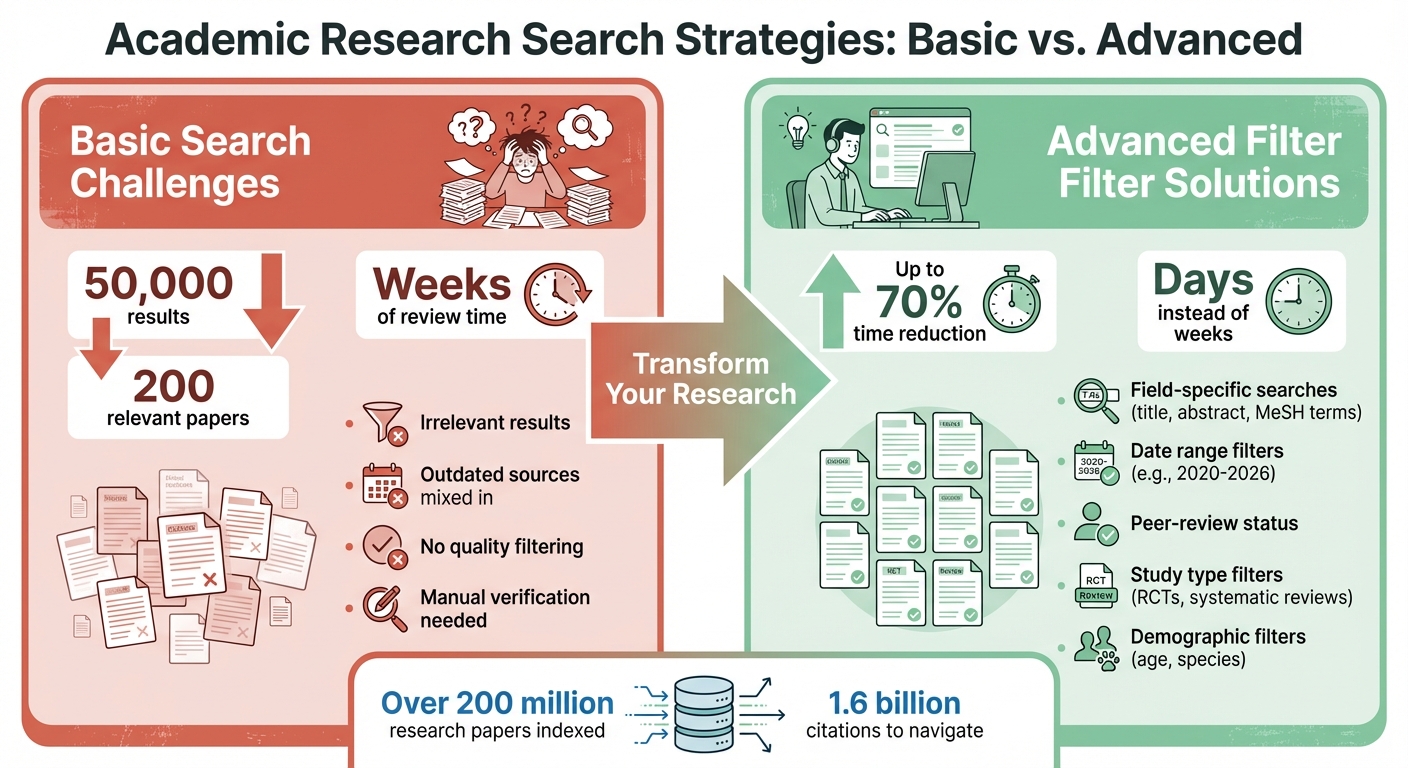
Basic vs Advanced Search Filters: Impact on Research Efficiency
Problems Researchers Face Without Advanced Filters
Too Many Irrelevant Results from Basic Searches
When you rely on basic keyword searches, you’re casting a net so wide it often pulls in far more than you need. These searches scan entire records, picking up even the most fleeting mentions of your term. The result? A flood of unrelated papers where your keyword might appear only once, and often without real relevance.
The problem gets worse with ambiguous terms - words that have multiple meanings or names that overlap with people, places, or concepts. Without tools to narrow things down, you're left wading through a sea of irrelevant results. This lack of focus can push the research you actually need far down the list. As Norfolk State University explains, "Keyword searches can vary in quality due to the wide spectrum of sources and can often produce an enormous results list that would be impractical to read through". The sheer volume of unrelated material makes it harder to zero in on what truly matters.
Too Many Sources to Review
The size of modern academic databases is staggering. For example, Scite has indexed over 100 million publications and 1.6 billion citations. That’s great in theory, but in practice, it means researchers face thousands of results for even a simple query.
Most search engines default to scanning "all fields", which maximizes the number of results but minimizes their relevance. You might end up with 5,000 hits, only to find that just a handful are useful. This inefficiency not only wastes time but also increases the risk of overlooking key studies or gaps in the field. Southern Cross University Library emphasizes the importance of a more focused approach: "Advanced searching usually means searching the literature of a specific subject area, in a carefully pre-planned and structured format... structured searching can minimise the risk of reproducing research, while helping identify relevant gaps in existing research". Beyond just finding relevant material, researchers also need to ensure that sources are both credible and up-to-date - a challenge in itself.
Hard to Find Reliable and Current Sources
Without advanced filters, separating high-quality, peer-reviewed articles from preprints or even retracted studies becomes a tedious, manual process. Academic search engines don’t always make it clear which sources meet rigorous academic standards, leaving researchers to do the heavy lifting.
Another issue is how search engines prioritize results. Many rank papers by keyword frequency rather than publication date, which means older, heavily cited studies often dominate the top results. Meanwhile, newer research - potentially more relevant - gets buried. As Columbia University points out, "Making large sets of search results manageable - whether that is Google Scholar, PubMed, Web of Science, or any other large database - can seem overwhelming, mostly due to the sheer amount of information stored in these databases". This makes it harder to find the latest insights, putting researchers at a disadvantage when time and accuracy are critical.
sbb-itb-f7d34da
How Advanced Filters Solve Research Problems
Finding Better Matches with Field-Specific Filters
Advanced filters make it easier to focus on the most relevant research. For example, searching within the title field ensures you’re finding papers where your term is a key concept, not just a passing mention. Tools like MeSH terms (Medical Subject Headings) take this a step further by using standardized tags to narrow your search to core topics.
Here’s why this matters: searching for "diabetes" as a MeSH term will surface studies specifically about diabetes, while a basic keyword search might include papers that only mention diabetic patients in a footnote. These filters not only improve topic-specific accuracy but also help manage the sheer volume of results, making your search more efficient.
Reducing Information Overload with Quality and Date Filters
Advanced filters also help cut through the noise by letting you refine results based on quality and recency. Date range filters are particularly useful for focusing on recent research or specific time periods. For example, setting a publication window like 2020–2026 ensures you’re only looking at the latest findings, avoiding outdated studies.
Peer-review filters add another layer of reliability, ensuring that your results have undergone rigorous academic scrutiny. Combine this with publication type filters - which let you limit results to Randomized Controlled Trials, Systematic Reviews, or Clinical Trials - and you’ll not only reduce the number of irrelevant results but also ensure the quality of the studies you’re reviewing. These tools make it easier to zero in on evidence-based research that truly matters.
Better Accuracy for Systematic Reviews
Systematic reviews benefit greatly from the precision offered by advanced filters. Pre-built search strategies, often called "hedges" or "blocks", are specially designed by information specialists to target specific types of research. These strategies can help you find studies based on geographic region or complex study designs, saving hours of manual sorting.
You can also refine your search with demographic filters, which allow you to narrow results by factors like age group (e.g., adolescents or infants), sex, or species (humans versus animals). For instance, to exclude animal studies, you can use a detailed filter like "exp animals/ not humans.sh." This approach avoids accidentally removing relevant human studies, which might happen if you rely on a simple checkbox. These filters give you the precision needed to ensure your systematic review includes exactly the studies you need.
Sourcely's Advanced Filters for Better Literature Searches
Custom Filters for Precise Results
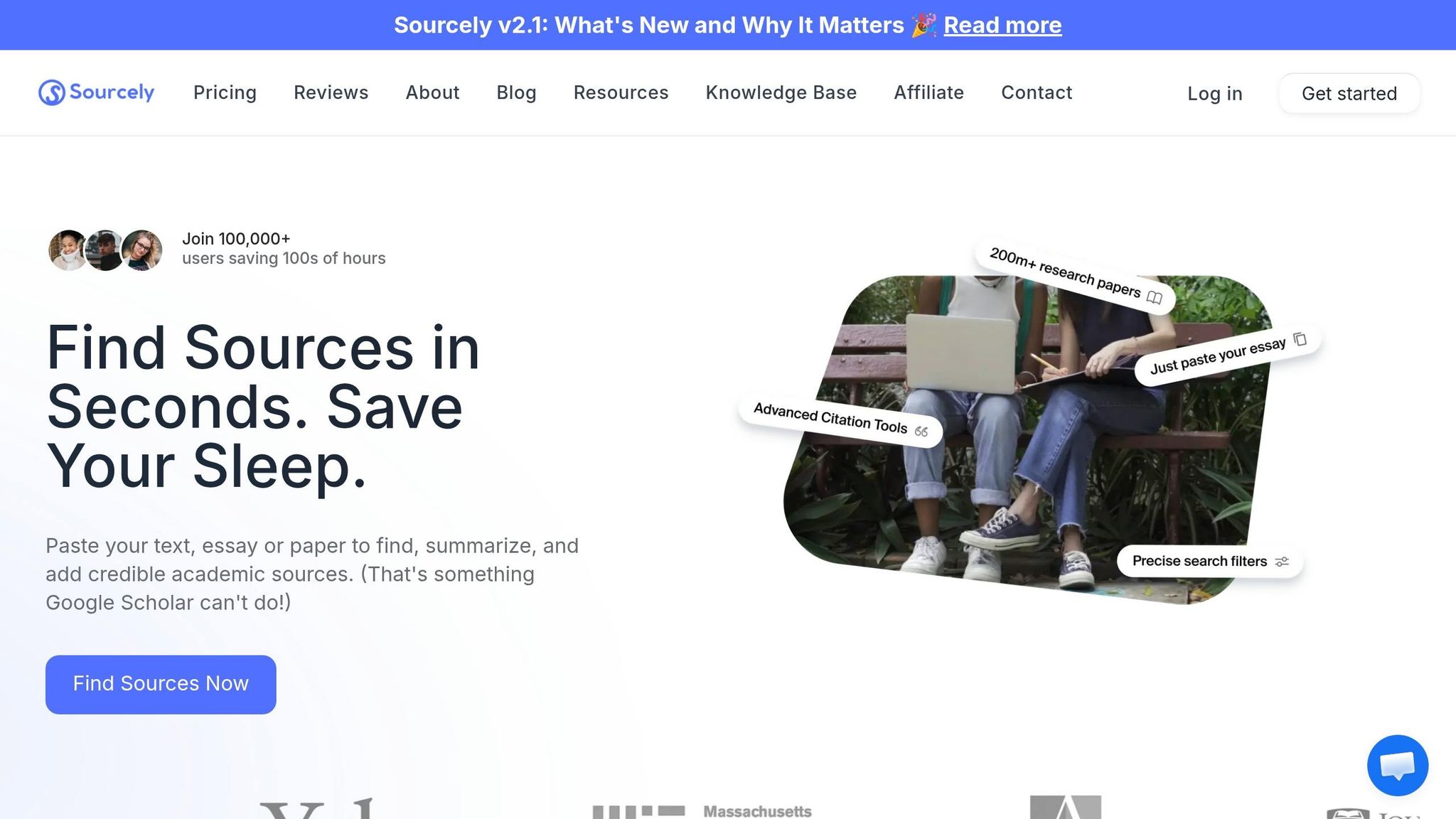
Sourcely tackles the challenge of information overload by allowing users to paste entire paragraphs for targeted searches. Simply input the exact section you need a citation for, and the AI scans its database of over 200 million research papers to find semantically relevant sources.
What makes Sourcely stand out is its granular filtering options, which go beyond standard search tools. You can narrow down results by publication year, citation count, or article type. The include/exclude keywords feature adds another layer of precision, helping you eliminate irrelevant terms. For instance, if you're exploring climate policy but want to avoid economic models, you can filter those out effortlessly.
"What sets Sourcely apart is its advanced filtering system. Not only can you filter by publications and citations, but you can also include or exclude specific keywords to refine your search." - Science Grad School Coach
The Deep Search function digs even further, uncovering highly relevant papers in just minutes. Integrated summaries and free PDF downloads let you quickly assess a source's value without committing to a full read. These tools streamline the research process, making it easier to access trustworthy academic material.
Easy Access to Reliable Sources
With a database of over 200 million research papers, Sourcely has become an essential tool for more than 100,000 researchers who report saving countless hours on literature searches. The platform provides direct article links and free PDF downloads, giving you the ability to verify sources firsthand rather than relying solely on AI-generated summaries.
Users across various fields, from STEM to the social sciences, praise Sourcely for its time-saving capabilities. Its citation management tools include a personal library for organizing references and instant export options in multiple formats, simplifying bibliography creation. The Chat with Sources feature takes it a step further, allowing you to interact directly with source material for deeper insights.
"Sourcely.net has been a game-changer for my research... It consistently provides me with the latest and most relevant peer-reviewed articles, ensuring that I am always up-to-date with the current trends and findings in my field." - SY, Researcher
Pricing Options for Different Budgets
Sourcely offers flexible pricing plans tailored to meet diverse research needs:
- Free version: Explore up to 300 characters at no cost
- One-time payment: $7.00 for 2,000 characters
- Monthly subscription: $17.00 per month
- Annual billing: $167.00 per year (approximately 18% savings)
- Lifetime access: $347.00 for unlimited access with no recurring fees
Whether you're a student working on a single assignment or a professional conducting ongoing research, Sourcely has a plan to suit your budget and timeline.
Part 3: Advanced Searching for Systematic Reviews (2023)
Conclusion
Advanced filters have transformed the way academic research is conducted, tackling challenges like information overload and irrelevant search results. By using field-specific criteria, date ranges, and quality restrictions, researchers can sift through thousands of sources to find only the most relevant and reliable ones. Studies indicate that this method can reduce review time by up to 70% during systematic reviews, freeing up researchers to focus on analysis rather than tedious sorting.
For instance, advanced filters can narrow a massive pool of 50,000 results down to about 200 high-quality papers, cutting review time from weeks to just days. This level of precision not only saves time but also enhances the reliability of research by emphasizing high-impact journals and recent studies, while steering clear of outdated or questionable sources.
Sourcely takes this efficiency a step further with custom filters. Users can paste entire essays, set specific criteria, and search millions of sources to instantly access free PDFs. Whether you opt for the free version or the $17.00 monthly subscription for unlimited searches, Sourcely helps streamline your research process, saving you valuable hours.
Switching from basic searches to advanced filters is no longer a luxury but a necessity in today’s data-heavy world. Tools like Sourcely make this shift simple and accessible, empowering researchers of all experience levels to conduct credible and efficient research without breaking the bank.
FAQs
Which filters should I use first to cut irrelevant results fast?
To narrow down irrelevant results quickly, use filters such as Content Type (like peer-reviewed journals), Publication Date (to highlight newer studies), and Relevance. These tools help weed out outdated or unrelated materials right away, making it easier to concentrate on the academic sources that matter most.
How do MeSH terms improve search accuracy compared to keywords?
MeSH terms improve search accuracy by providing a standardized, controlled vocabulary to describe the content of articles. Unlike keywords, which can differ widely in terminology, MeSH terms are carefully assigned by experts, ensuring both consistency and precision. Their hierarchical structure organizes concepts into broader and narrower categories, which helps filter out irrelevant results and minimizes information overload. This structure makes it much easier to locate relevant research quickly and efficiently.
How can I avoid filtering out key studies in a systematic review?
To ensure you don't miss important studies, be careful when using database limiters like publication date or language. These filters can sometimes exclude newer or incompletely indexed research. A better approach is to create well-thought-out search strategies. Use pre-defined filters or "search blocks" that incorporate synonyms and variations of key terms to cast a wider net.
Beyond automated searches, take the time to manually review results and critically evaluate studies. This extra step helps ensure that valuable research doesn't slip through the cracks.