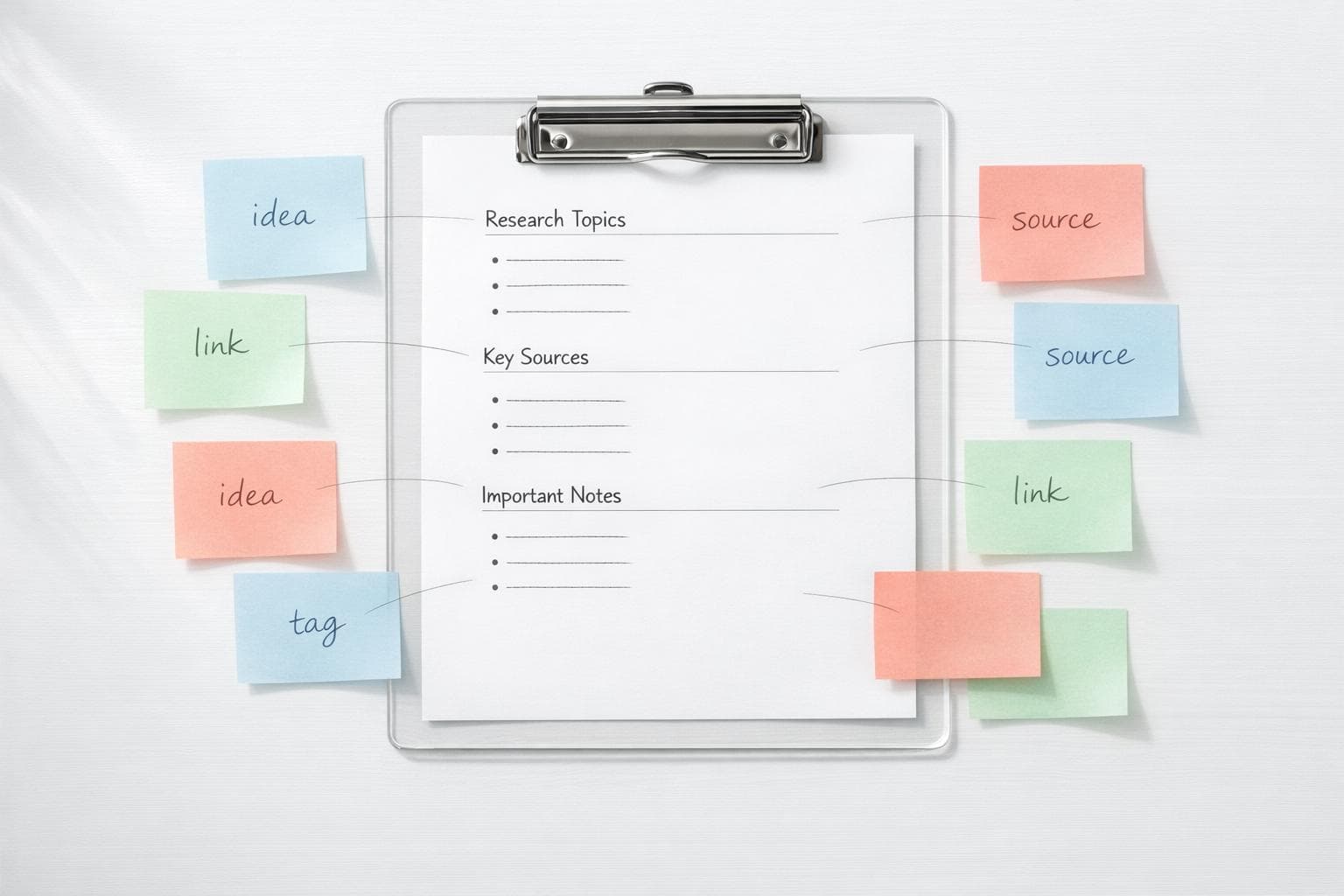
How to Organize Notes for Research Papers
Struggling to keep your research notes organized? Here's the solution: a streamlined system that saves time, boosts retention, and makes writing easier.
Managing notes for research papers can be overwhelming, but with the right approach, you can turn chaos into clarity. Start by choosing between physical or digital note-taking, use tags and themes for organization, and ensure every note has proper bibliographic details. Tools like Sourcely can simplify citation management and source tracking.
Key tips:
- Choose a method: Physical (handwriting improves recall) or digital (faster searches, cross-device syncing).
- Organize effectively: Use tags, categories, and themes to group notes logically.
- Take clear notes: Distinguish between quotes, paraphrases, and summaries.
- Link ideas: Connect related notes to uncover patterns and strengthen your argument.
- Prepare for writing: Sort notes by subtopics and build a structured outline.
A well-organized system not only saves time but also lays the groundwork for a strong research paper. Let’s dive into the details.

5-Step Research Note Organization System for Academic Papers
How to take notes and organize your research paper - tutorial
Choosing Your Note-Taking Method
When deciding on a note-taking method, you'll need to choose between physical and digital approaches. Each has its own strengths, which can influence how well you absorb and organize information. Let’s break down the advantages of both to help you decide.
Physical vs. Digital Note-Taking
Physical methods, like using notebooks or index cards, can boost cognitive engagement. Research suggests that handwriting notes and reading from print materials can improve recall compared to digital-only interactions. For example, index cards are handy for rearranging ideas, helping you visualize the structure of your paper more effectively. The act of writing by hand also aids in grasping complex ideas on a deeper level.
Digital tools, however, focus on speed and convenience. They allow you to search for quotes or notes instantly, eliminating the need to flip through pages. Features like copy-paste make reorganizing ideas effortless, and many tools include automated citation management. You can also use AI-powered literature sourcing to find relevant papers quickly. If you're juggling numerous sources or need access across multiple devices, digital tools are the clear choice for efficiency.
Your choice will impact how clear and organized your notes are later. Many researchers blend both methods: they take handwritten notes to aid retention and then scan them using OCR for digital searchability. Others track physical resources with digital spreadsheets. The most important factor is consistency - switching between methods mid-project can make it harder to connect ideas across your readings.
Once you’ve settled on a method, it’s time to consider the digital features that can make your research process even smoother.
Key Features to Look for in Digital Tools
If you opt for digital tools, look for features that simplify your workflow. Centralization is key - choose tools that let you store notes, PDFs, and sources in one place. Flexible tagging for thematic filtering and cross-device syncing ensures you can access your work anywhere. Metadata capabilities can save you hours by making searches faster and more precise.
Another must-have is bi-directional linking. This feature allows you to connect related ideas, effectively creating a personal knowledge network instead of burying notes in folders. AI-powered search tools can also surface relevant information without requiring manual digging, and built-in annotation tools let you highlight and comment directly on PDFs. To keep your files organized, use a consistent naming system (e.g., Author_Title_Date) for easy identification. These features not only streamline note organization but also lay the groundwork for a well-structured research paper outline.
Taking Clear and Useful Notes
Good notes make the writing process smoother, help avoid plagiarism, and clearly separate your thoughts from the ideas of others.
Quotations, Paraphrases, and Summaries
Different types of notes serve different purposes. Use direct quotations sparingly, reserving them for moments when the author's exact wording is particularly striking or necessary. Be sure to enclose these in quotation marks and include the author’s name and page number for proper citation.
Paraphrasing involves rephrasing the original idea in your own words while still giving credit to the source. This approach not only helps with understanding but also allows you to engage more deeply with the material. Summaries, on the other hand, condense the main ideas into a brief overview without diving into specific details.
"Some cases of unintentional plagiarism are due to poor note-taking from sources. For example, students sometimes copy down an author's exact words and forget to put quotation marks around them." - Emory University
To avoid such mistakes, read the material first without taking notes. Then, summarize what you’ve read from memory before cross-checking it with the original text. A simple visual coding system can also help: mark direct quotes with "Q", paraphrases with "P", and summaries with "S" at the start of each note. Stick to one idea per note so you can easily organize them by theme later.
Finally, make sure to include full bibliographic details with each note to provide context and ensure everything is ready when it’s time to write.
Recording Source Information
Once your notes are categorized, it’s time to document and find relevant sources thoroughly. Keeping detailed bibliographic information from the start saves you from scrambling later. As soon as you reference a source, add it to a working bibliography with all the necessary details. For books, this includes the author(s), title and subtitle, publisher, city of publication, and year. For journal articles, note the author(s), article title, journal name, date, volume, issue, and page numbers.
Tag each note with the author’s last name, a shortened title, and the specific page number. If you’re using physical note cards, assign each source a number in your master list and write only the source number and page number on individual cards (e.g., #5, p. 22). For online sources, be sure to record the URL and the date you accessed it, as web content can change or disappear. When downloading PDFs from databases, rename them using a consistent format like "Author_ShortTitle_Year" to avoid confusion.
Set aside space in your notes for your own reactions and questions. This not only keeps your thoughts separate from the source material but also prevents the common mistake of writing directly from open browser tabs, which often leads to losing track of critical source details.
Organized and detailed notes make it much easier to create a structured outline when you’re ready to start writing.
Organizing Notes with Tags, Categories, and Themes
Once you've gathered your notes and sources, the next step is to create a system for organizing them. A well-structured tagging and categorization system can cut your search time by as much as 40–50%. The key is to design a structure that aligns with the way your paper is organized.
Using Tags and Labels
Tags are like searchable labels that allow you to group and filter notes without locking them into a single folder. Unlike folders, which restrict a note to one location, tags let the same note appear in multiple searches at once. For instance, a note on customer behavior could be tagged with #market-research (a general category) and #customer-surveys (a more specific topic), giving you multiple ways to find it later.
To keep things manageable, try a dual-tagging system: Category Tags for broader topics and Content Tags for specific details. This approach avoids the chaos of over-tagging, where too many similar tags can overwhelm your system. Stick to 3–5 meaningful tags per note, which strikes a balance between precision and simplicity. Maintain a master list of your primary tags with short descriptions to ensure consistency. Use your tool’s suggestions to pick from existing tags, avoiding duplicates like #leadership and #management that can clutter your system.
You can also use status-based tags to track your progress. Tags like #to-read, #in-progress, or #complete provide a quick snapshot of where each source stands. Just be diligent about updating these tags as you go - otherwise, they can create confusion rather than clarity.
Creating Theme-Based Categories
Once you've tagged individual notes, the next step is to group them into broader themes that reflect the structure of your paper. While tags handle the finer details, theme-based categories help you organize notes into larger conceptual groups that mirror your paper’s outline. Before diving deep into your research, draft a basic outline of the topics and subtopics you plan to cover. This outline will guide your categorization and help you identify gaps in your research early on by using AI-generated sources.
A topic matrix can be especially helpful here. This is a simple table that shows which sources address which subtopics in your outline. It not only highlights thematic overlaps but also pinpoints areas where more research is needed. As your thesis develops, adjust your categories to stay aligned with your evolving structure. The goal is to keep your workspace focused on what’s immediately relevant while archiving completed sections to avoid digital clutter. Set aside 30 minutes each week to update your tags and archive finished notes - it’s a small habit that keeps your system running smoothly.
sbb-itb-f7d34da
Turning Notes into Paper Outlines
Once you've tagged and organized your notes, it's time to shift gears from gathering information to building the framework for your paper.
Grouping Notes by Subtopics
Start by sorting your notes into categories that represent the main sections of your paper. If you're working with physical notes, group them into piles based on these sections. For digital notes, consider using a table where each row includes the note, its source, and a Q/P/S label. This setup allows you to easily copy and paste notes into your outline as you write.
"Sorting research into piles, forming sub-topics... Assigning a letter to each segment or 'pile'... Numbering and coding the pieces in each pile." - Grace Fleming, Education Expert
To keep things organized, assign a letter and number code to each group. For example, label each subtopic pile with a letter (A, B, C) and number each note within that pile (A-1, A-2, A-3). This system helps you track which relevant sources belong to which sections, even if you rearrange content later. If a note fits multiple subtopics, place it in the group that aligns with your initial writing plan - you can always revisit it for other sections as needed.
As you go through this process, be flexible. Your understanding of the material might shift, and your categories may need to evolve.
Adjusting Organization as Research Develops
It's normal for your outline to change as your research progresses. Diving deeper into your sources might lead you to refine your thesis or adjust the focus of your paper. This evolution is a natural part of learning and writing.
"After studying your sources in detail, your original thesis statement may work fine... However, you may find you need to adjust the focus of your paper and, as a result, your thesis statement. This is OK! It means you learned something from your research!" - Kansas State University Libraries
If your research takes a new direction, update your outline to reflect these changes. Begin with broad categories and narrow them into more detailed subtopics as patterns and connections become clearer. A topic matrix can help you spot gaps - if a subtopic has only one or two notes, you’ll know where to dig deeper by finding credible sources to strengthen your argument. On the other hand, if your focus shifts, you can set aside sources that no longer align with your revised thesis.
Take time every few days to reorganize your notes. Whether you're dragging rows in a digital table or reshuffling index cards, aim for a flow that feels logical. And don’t feel pressured to write your paper in order - tackle the sections that come easiest, like the methodology or literature review, while your overall structure continues to take shape.
Using Sourcely for Citation and Source Management

After organizing your notes, Sourcely can help you track sources and format citations with ease. This tool simplifies the process during the research and citation phases of your paper. Plus, its advanced search features make finding reliable sources quick and straightforward.
Finding Sources with Sourcely
Sourcely uses AI-driven search technology to locate trustworthy academic sources. Simply paste a draft paragraph, and the platform will suggest sources from a database of over 200 million research papers. It works like a reverse search engine, identifying sentences that need citations and recommending relevant materials. With advanced filters - like publication year, author, relevance, or specific keywords - you can refine your search to find exactly what you need. The Deep Search feature even provides direct links to free PDFs from academic databases, saving you time and effort.
Once you've gathered your sources, managing citations becomes just as seamless.
Managing Citations and Bibliographies
Sourcely takes the hassle out of citation formatting by generating references in various academic styles, including APA, MLA, Chicago, IEEE, and CSE. All your collected sources are stored in a Citations Library, making them easily accessible as you write. When it's time to finalize your bibliography, you can export all your references in formats like RIS, BibTeX, or XML. These can then be imported into reference managers such as Zotero or Mendeley. Just be sure to double-check metadata - like author names, publication dates, and page numbers - before submitting your paper.
For those interested in trying Sourcely, there's a trial option available for a one-time payment of $7, allowing up to 2,000 characters. Subscription plans include $17/month, $167/year, or a lifetime plan for $347.
Linking Notes to Build Connections
Once you've organized your research into categories, the next step is linking your notes. This process helps uncover patterns and strengthens your overall argument. Connecting related notes transforms scattered information into a unified narrative, making the writing process much smoother.
Creating Connections Between Ideas
Start by spotting recurring themes across your sources. For example, if several studies touch on "urban sustainability", those notes naturally align, even if they come from different fields. Revisiting your topic matrix can also help you identify overlapping themes. This method not only highlights research gaps but also shows where your evidence clusters.
To deepen these connections, link notes in both directions. For instance, if Note A references an idea found in Note B, create a two-way link between them. This builds a "knowledge graph", allowing you to trace ideas both backward and forward in your research. These connections often reveal relationships you might have missed otherwise. Many digital note-taking tools include this feature, making it easier to track how earlier studies influenced later findings.
"A systematic organization of key information and notes will equip you to perform a sound analysis of your sources." - OISE Academic Skills Hub
Regularly reviewing your notes strengthens these links. Research shows that reviewing notes within 24 hours boosts retention by 40% compared to waiting a week or more. Use these review sessions to refine tags, merge overlapping ideas, and discover new patterns. This process not only improves your understanding but also helps shape your notes into a cohesive narrative that supports your argument.
Building a Logical Argument
Once your notes are interconnected, it's easier to build a persuasive argument. Start by mapping out how each piece of evidence supports your thesis. Visualize the relationships between findings - some will confirm existing theories, while others may challenge them. Rearrange your notes until a clear and compelling structure emerges. Think of it like solving a puzzle: each study is a piece that fits into the bigger picture.
To systematically evaluate your sources, try creating a table that compares methodologies, findings, and interpretations. This side-by-side view highlights which sources provide the strongest support for your claims and where additional evidence is needed. Agreements between credible sources strengthen your argument, while disagreements open opportunities for original analysis.
Keep your notes focused - record one idea per note. This makes it easier to rearrange them when outlining your paper. As your argument takes shape, you'll naturally group and regroup notes until the structure feels solid. Thanks to the connections you established earlier, this process becomes intuitive rather than overwhelming. The result is a logical flow that reinforces the structured approach discussed earlier.
Conclusion
Turning a pile of scattered research notes into a well-structured system can feel like a game-changer. By aligning your organizational strategy with your natural habits, you can create a workflow that feels intuitive and sustainable. As Virginia A. Cole, Ph.D., wisely observes: "Acquiring new habits is an enormous, ongoing commitment which tends to crack under stress".
The core of effective note organization rests on three key principles: centralization, consistent tagging, and interlinking. Together, these elements help you build a searchable and efficient knowledge base. Using hierarchical digital systems and consistent metadata ensures that your notes are not only organized but also easy to navigate.
Once you’ve set up the basics, maintaining your system is all about adopting practical habits. Start with broad categories and allow your organization to evolve naturally as your research grows. Standardizing file names (e.g., "AuthorYear_CoreConcept"), keeping a tag dictionary, and dedicating 15–20 minutes each week to reviewing your notes can make a huge difference. These small, regular efforts can save you hours of frustration by turning endless searching into mere seconds.
With a solid note organization system, you can focus less on hunting for information and more on what really matters - analysis and building strong arguments. Tools like Sourcely can further streamline the process by helping you manage citations and quickly locate sources. This approach doesn’t just simplify your writing process; it helps you create a smoother, more systematic research workflow overall.
FAQs
What’s the best way to choose between physical and digital note-taking for research papers?
Deciding whether to take notes physically or digitally depends on your personal workflow, preferences, and the tools you rely on for your research. Physical notes, like index cards or notebooks, work well for brainstorming, sketching out diagrams, or working offline. They’re especially helpful if you enjoy the hands-on process of writing or need to visually organize your thoughts - like spreading out cards on a desk to group ideas.
On the flip side, digital notes shine when it comes to convenience and efficiency. They make it easy to search for specific information, back up your data, and integrate with citation tools. Plus, you can tag, link, and sync your notes across devices, which is great for staying organized and collaborating with others.
Not sure which to choose? Try a hybrid approach. Use physical notes for brainstorming and creative tasks, then transfer your key ideas into a digital platform for long-term storage and citation management. This method combines the strengths of both systems, keeping your research process both flexible and efficient.
What’s the best way to organize and tag notes for research papers?
Organizing and tagging notes efficiently begins with establishing a clear structure. Start by grouping your notes into broad categories that align with the main sections of your research paper, like Introduction, Literature Review, or Conclusions. Within these larger categories, create smaller subcategories to neatly arrange specific topics. This setup makes it much easier to locate the information you need without wasting time.
Tagging adds another layer of organization by letting you label notes with keywords that highlight key concepts, methods, or ideas. Stick to concise and consistent tags - use singular forms and lowercase for uniformity. Apply multiple tags to notes that touch on various topics to make cross-referencing simpler. To keep things tidy, stick to a short, predefined list of tags to avoid duplicates or confusing overlaps.
If you’re looking to simplify the process further, tools like Sourcely can be a game-changer. Its AI can suggest relevant tags based on your content, ensure your notes remain searchable, and even help integrate them into the appropriate sections of your draft. By following these strategies, you’ll keep your notes well-organized, easy to access, and ready to use in your research paper.
What’s the best way to connect and organize notes to build a strong argument for a research paper?
To organize and connect your notes effectively, start by including essential details for each note, such as the author, title, year, and page number. These details make it easier to reference the original source later. Add a concise tag to each note summarizing its theme (like motivation theory or counter-argument) and indicate whether it supports or challenges your thesis. Group your notes by these tags to uncover relationships and patterns.
Next, draft an outline that follows the structure of your paper - introduction, main arguments, supporting evidence, and conclusion. Assign each note to the appropriate section and add brief transitions to clarify how each piece of evidence backs up your argument. If you encounter conflicting notes, mark these areas for further exploration or rebuttal to enhance your analysis.
Finally, go through your outline to check for missing information or weak links. Make sure every claim is backed by at least one note and that all notes work together to form a cohesive argument. Tools like Sourcely can make this process more efficient by helping you organize references, manage citations, and identify connections, ultimately simplifying the task of creating a convincing, well-supported paper.