Impact Factor vs. SJR: Key Differences
When choosing where to publish or finding relevant sources for a literature review or evaluating credible sources, Impact Factor (IF) and SCImago Journal Rank (SJR) are two widely used metrics, but they measure different aspects:
- Impact Factor (by Clarivate): Focuses on citation quantity over a 2-year period using Web of Science data. It treats all citations equally and is commonly used in life sciences and medicine.
- SJR (by SCImago): Evaluates citation quality using a 3-year window and Scopus data. It gives more weight to citations from respected journals and includes a broader range of publications, such as conference proceedings.
Key Differences:
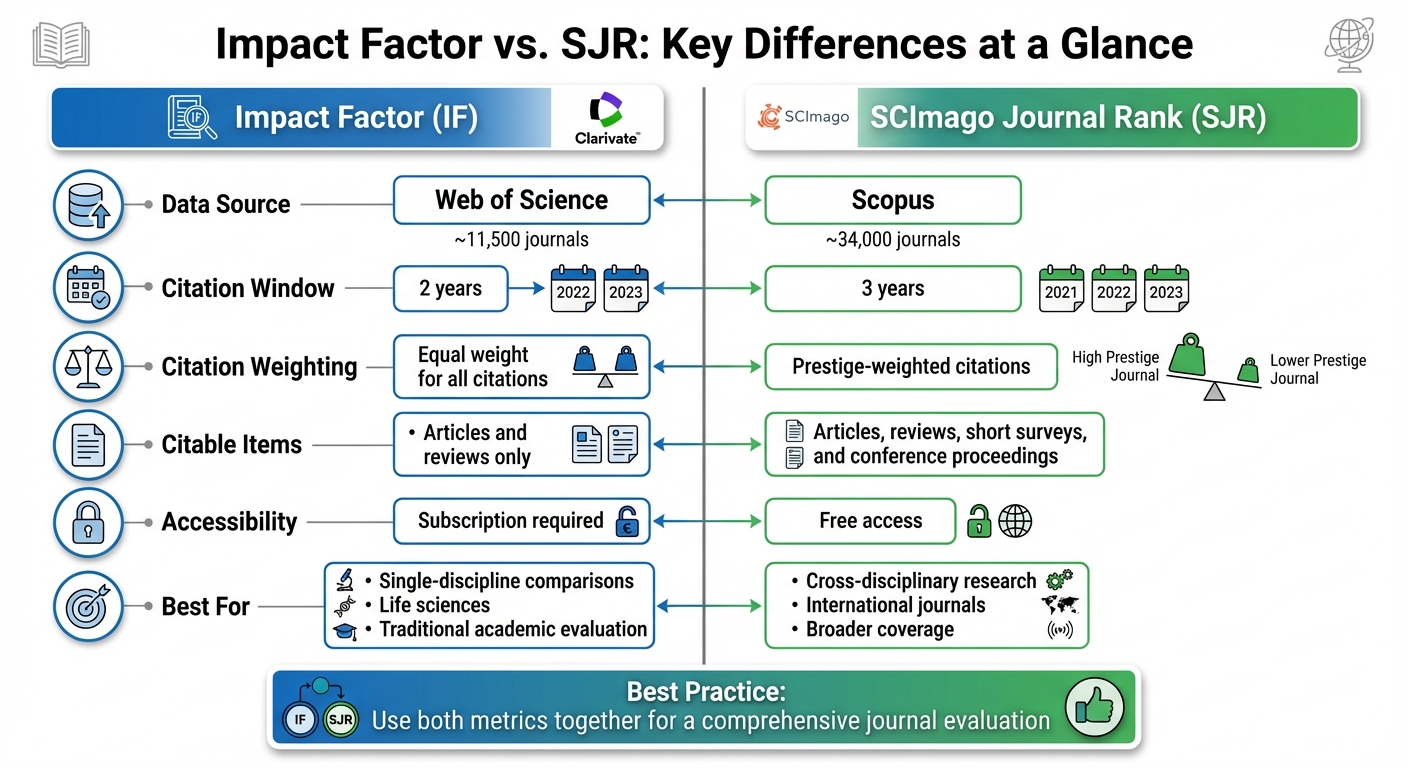
- Data Source: IF uses Web of Science (~11,500 journals); SJR uses Scopus (~34,000 journals).
- Citation Window: IF calculates citations over 2 years; SJR uses 3 years.
- Weighting: IF treats all citations equally; SJR weighs citations based on journal prestige.
- Accessibility: IF requires a subscription; SJR is free to access.
Both metrics have strengths and weaknesses. IF is simple and widely recognized but struggles with cross-disciplinary comparisons and relies on a smaller database. SJR uses a broader dataset and accounts for citation quality but is harder to interpret due to its complex algorithm. Depending on your field and goals, one may suit your needs better - or you can use both for a balanced evaluation.
Quick Comparison
| Aspect | Impact Factor (IF) | SJR |
|---|---|---|
| Data Source | Web of Science (~11,500) | Scopus (~34,000) |
| Citation Window | 2 years | 3 years |
| Weighting | Equal for all citations | Prestige-weighted |
| Citable Items | Articles, reviews | Articles, reviews, proceedings |
| Accessibility | Subscription required | Free |
Use these metrics together for a clearer picture of journal quality, and always consider additional factors like editorial standards and field-specific citation habits.
Impact Factor vs SJR: Side-by-Side Comparison of Journal Metrics
✅ Journal Performance Metrics Explained | Impact Factor, CiteScore, SJR & H-Index Made Easy
sbb-itb-f7d34da
What is Impact Factor?
The Impact Factor (IF) is a metric that evaluates the average number of citations a journal's articles receive over a two-year period. Managed by Clarivate, it is published annually in the Journal Citation Reports (JCR) and is based solely on data from the Web of Science.
Initially designed to help libraries decide which journals to subscribe to, the metric has grown into a key benchmark for academic prestige.
Take the journal Nature, for example. In 2017, it boasted an Impact Factor of 41.577. This means that, on average, articles published in Nature during 2015 and 2016 were cited around 42 times each in 2017. Such a score cements Nature's reputation as one of the leading journals in the scientific world.
But the Impact Factor has its critics. Citation data can be uneven. For instance, in 2004, 90% of Nature's Impact Factor came from just 25% of its articles. This shows how a small number of highly cited papers can artificially inflate a journal's score, while most articles contribute far less than the average suggests.
How Impact Factor is Calculated
The formula for calculating Impact Factor is simple: divide the number of citations a journal receives in the current year by the number of "citable items" it published in the previous two years.
- The numerator includes all citations to the journal, regardless of document type - this even covers citations to editorials or letters.
- The denominator, however, is limited to "citable items", which Clarivate defines as research articles and reviews.
To ensure accuracy, Clarivate uses a "variant dictionary" with over 250,000 title variations for nearly 30,000 journals, both current and historical. This system ensures that citations with errors or title abbreviations are still counted. As a result, the Impact Factor captures nearly all citations, even when referencing mistakes occur.
While the standard Impact Factor uses a two-year citation window, Clarivate also offers a five-year Impact Factor. This extended timeframe is especially helpful for disciplines where research impact develops more slowly, such as mathematics and the humanities.
Citation trends vary widely across fields. For example, in mathematics and physical sciences, only 1–3% of citations occur within the first two years, compared to 5–8% in biological sciences. This variability explains why the two-year window is more suitable for some disciplines than others.
What is SJR?
The SCImago Journal Rank (SJR) is a tool designed to measure the quality of academic journals by considering the prestige of the journals that cite them. In simple terms, a citation from a highly regarded journal carries more weight than one from a less prominent source.
Developed by SCImago, SJR relies on data from the Scopus database, which includes over 34,000 journal titles. This is about three times the number of journals indexed by the Web of Science database, which is used for calculating the Impact Factor and covers around 11,500 journals. Thanks to its broader reach, SJR can account for a more diverse array of international journals and research areas. Here's a closer look at how SJR evaluates and quantifies journal prestige.
"SJR2 looks deeper. It evaluates who is citing the journal and how closely related the citing and cited journals are in subject matter. This provides a richer, more accurate picture of a journal's influence." - SCImago Methodology
In this system, an SJR score of 1.0 reflects the average prestige per document within the database. A journal scoring 2.0, for example, indicates that its documents hold twice the scientific influence compared to the average.
One of SJR’s strengths is its accessibility. Researchers can access this metric for free through the SCImago Journal & Country Rank website. This open-access approach makes it easier for anyone to explore journal rankings without needing a subscription.
How SJR is Calculated
SJR uses a calculation method inspired by the PageRank algorithm. It applies cosine similarity to give more weight to citations from journals that are thematically related. The metric is based on a three-year citation window, during which initial prestige scores are calculated and then adjusted by the number of citable documents. This adjustment prevents larger journals from dominating the rankings purely because of their higher publication output.
To maintain fairness, SJR includes safeguards to prevent manipulation. For instance, a journal can pass on no more than 50% of its own prestige, and no single citation can account for more than 10% of its total prestige. These measures help curb practices like citation cartels and artificially inflated rankings.
Key Differences Between Impact Factor and SJR
The Impact Factor and SJR (SCImago Journal Rank) differ in how they evaluate and rank academic journals, starting with their approach to citations. Impact Factor treats all citations equally, assigning the same value regardless of the source. On the other hand, SJR weighs citations based on the prestige of the citing journal and how closely its subject aligns with the journal being cited. This distinction means that SJR places greater emphasis on the quality and relevance of citations, while Impact Factor focuses purely on quantity.
Another major difference lies in their data sources. Impact Factor relies on Web of Science, which indexes around 11,500 journals. In contrast, SJR uses Scopus, a database with broader coverage, indexing over 34,000 journals. Scopus's wider scope allows SJR to include more international and non-English journals, providing a more diverse representation of academic research.
Their calculation methods also set them apart. Impact Factor uses a straightforward arithmetic formula: dividing the total number of citations by the number of citable items (like articles and reviews) over a 2-year period. SJR, however, takes a more complex approach, using a 3-year citation window and assigning weight to citations based on the prestige of the source. Additionally, SJR includes a broader range of document types, such as short surveys and conference proceedings, while Impact Factor limits its scope to articles and reviews. To prevent manipulation, SJR caps self-citations at 33% and restricts the prestige transferred by a single citation to 10%, safeguards not present in the Impact Factor system.
Comparison Table of Key Differences
| Aspect | Impact Factor | SJR |
|---|---|---|
| Data Source | Web of Science | Scopus |
| Citation Window | 2 years | 3 years |
| Citable Items | Articles and reviews | Articles, reviews, short surveys, and conference proceedings |
| Weighting | Equal weight for all citations | Prestige-weighted |
| Journal Coverage | ~11,500 journals | ~34,000 journals |
Pros and Cons of Impact Factor and SJR
Let’s dive into the strengths and weaknesses of both Impact Factor and SJR, expanding on how they’re calculated and applied. Each metric has its perks and challenges, making them suitable for different purposes.
Impact Factor stands out for its simplicity and widespread use. Its calculation is straightforward, making it easy to grasp, and it avoids size bias by using a ratio instead of raw citation counts. This simplicity, however, is also its Achilles' heel. A single highly cited article can cause dramatic fluctuations in a journal's score. For example, there was a case where a single article led to a sudden spike in Impact Factor. Additionally, it struggles with cross-disciplinary comparisons since citation habits vary greatly between fields like mathematics and biology. Plus, it focuses on journal-level performance rather than the quality of individual articles.
On the other hand, SJR tackles some of these limitations by introducing a weighted system that considers the prestige of citing journals. With its broader Scopus database (covering over 34,000 journals), it offers a wider lens and caps self-citations at 33%, reducing the risk of metric inflation. Its subject normalization feature also makes cross-disciplinary comparisons more feasible, and its three-year citation window provides a steadier measure of influence compared to Impact Factor’s two-year frame. Another big plus? SJR is free to access, unlike Impact Factor, which requires a subscription to Journal Citation Reports. However, SJR’s complexity is a drawback. Its PageRank-based algorithm is harder to understand and less transparent compared to the simpler arithmetic behind Impact Factor.
Comparison Table of Pros and Cons
| Metric | Advantages | Limitations |
|---|---|---|
| Impact Factor | Easy to calculate, widely recognized, avoids size bias | Limited to Web of Science data, prone to self-citation sensitivity, not suitable for all disciplines, subscription required |
| SJR | Weighs citations by journal prestige, broader database, free access, limits self-citations | Complex algorithm, less intuitive, might overlook niche fields |
This breakdown highlights when and where each metric shines, helping researchers decide which one aligns best with their goals.
When to Use Impact Factor vs. SJR
The Impact Factor focuses on citation counts, while SJR (SCImago Journal Rank) emphasizes journal prestige. Understanding this distinction can help you decide which metric to use in specific contexts.
Your choice between Impact Factor and SJR often depends on your academic field, publication goals, and institutional requirements. For example, in traditional fields like life sciences or medicine - particularly when applying for tenure or research grants - Impact Factor is frequently the go-to metric. In fact, about 40% of research-focused universities in the U.S. and Canada explicitly reference the Journal Impact Factor in their review, promotion, and tenure guidelines. Furthermore, 87% of universities support its use in these evaluations without hesitation.
That said, Impact Factor works best when comparing journals within the same field. Citation behaviors differ significantly across disciplines. For instance, in mathematical sciences, only 1–3% of citations fall within the two-year Impact Factor window, while in biological sciences, the range is higher at 5–8%. This makes it less effective for interdisciplinary research or comparing journals across vastly different subject areas. Fields like computer science and engineering, where conference proceedings are pivotal, often benefit from SJR since it includes these publication types in its calculations. SJR is particularly useful when research spans multiple disciplines.
SJR shines in cross-disciplinary comparisons and assessing journal prestige rather than raw citation counts. As Zendy explains, "SJR ranking takes into consideration variations among disciplines, which facilitates the comparison of publications from various fields of study". Another advantage? SJR is freely accessible online, whereas Impact Factor requires a subscription.
For fast-moving fields, Impact Factor's two-year window effectively captures current relevance. However, for slower-paced disciplines like social sciences or humanities - or for international journals not indexed in Web of Science - SJR's three-year window provides a more accurate representation. Using both metrics together can offer a well-rounded perspective on a journal's impact and reputation.
Ultimately, the best approach is to use these metrics alongside other indicators. Always consult your institution's guidelines and consider the citation habits in your field to make an informed decision.
How Researchers Can Use These Metrics
Using Impact Factor and SJR together provides a broader perspective on journal quality. While Impact Factor focuses on how frequently a journal is cited, SJR adds another layer by weighing citations based on the prestige of the citing journal. This combination helps researchers assess both a journal's popularity and its overall standing in the academic world.
To choose journals effectively, look at their quartile rankings (Q1–Q4) within your subject category. A journal ranked in Q1 for both Impact Factor and SJR is generally a strong indicator of credibility. You can explore free SJR data through the SCImago Journal & Country Rank platform, which allows you to compare journals by subject area without needing a subscription. Tools like Sourcely can simplify this process further by offering advanced filters for targeted searches across millions of sources. These tools also support reference exports in various formats, making it easier to pinpoint the most influential journals for your work.
For research that spans multiple disciplines, SJR tends to be more reliable since it accounts for differences in citation practices across fields. However, always keep an eye on self-citation rates when evaluating journals. A high percentage of self-citations might suggest attempts to artificially boost metrics. Comparing total citations to self-citations can help gauge a journal's genuine influence.
It's essential to remember that metrics alone can't provide the full picture. As Quinn Galbraith and his colleagues point out:
"Simple reliance on metrics in publishing or purchasing decisions is often flawed".
To make well-rounded decisions about where to publish or which sources to cite, consider additional factors like acceptance rates, submission volumes, and your institution's specific guidelines. Metrics like Impact Factor and SJR are valuable tools, but they work best when used alongside other indicators.
Conclusion
Both Impact Factor and SJR shed light on journal quality, but they do so in different ways. Impact Factor focuses on how often a journal is cited within a specific field, making it great for comparisons within a single discipline. On the other hand, SJR evaluates the prestige of citations, enabling comparisons across various fields. Understanding when to apply each metric - whether in fast-evolving fields like life sciences or in interdisciplinary research - can lead to smarter publishing decisions. It's clear that journal evaluation benefits from considering multiple criteria.
As the Ohio State University Health Sciences Library points out:
"Journal metrics were never meant as to be used as a proxy for researcher quality".
These metrics are tools, not definitive judgments. To get a fuller picture of journal quality, consider factors such as the editorial board's reputation, peer-review standards, and acceptance rates alongside these metrics. SJR’s broad coverage and free accessibility make it particularly useful for researchers without institutional access.
For a more streamlined way to evaluate journals, Sourcely offers advanced filters and access to millions of academic sources. Its AI-driven tools let you quickly compare metrics like quartile rankings or export references in various formats, saving you time while ensuring your research rests on credible sources. By using Sourcely, you can apply Impact Factor and SJR effectively to find journals that align with your goals.
When used together, Impact Factor, SJR, and tools like Sourcely provide a well-rounded framework for assessing journal quality. By focusing on multiple aspects of journal evaluation, you can prioritize research quality over reliance on any single metric.
FAQs
Which metric matters more for my field: Impact Factor or SJR?
When deciding between the two, it comes down to what you're evaluating. Impact Factor highlights citation impact by calculating the average number of citations per article in a journal over two years. On the other hand, SJR (Scimago Journal Rank) emphasizes a journal's prestige, factoring in the influence of the journals that provide citations.
If you're looking to assess citation volume, Impact Factor is the better choice. But if you're more concerned with the prestige and influence of a journal, SJR is the way to go. Ultimately, the relevance of each metric depends on your specific field and objectives.
Why does a journal’s Impact Factor vary significantly each year?
A journal's Impact Factor isn't set in stone - it can swing significantly from one year to the next. These changes often come down to shifts in the number of citations a journal's articles receive or the total number of articles it publishes. For example, a single paper that garners an unusually high number of citations can heavily influence the metric. Similarly, changes in the volume of published articles can skew the calculation, making it sensitive to even small variations.
How can I check a journal’s SJR and quartile ranking for free?
You can look up a journal's SJR (SCImago Journal Rank) and quartile ranking for free on the SCImago Journal & Country Rank portal. This platform ranks journals using the SJR indicator, which evaluates a journal's influence through citation analysis. Additionally, it sorts journals into quartiles (Q1 to Q4) based on subject areas. Best of all, the service is completely free and doesn’t require any subscription.