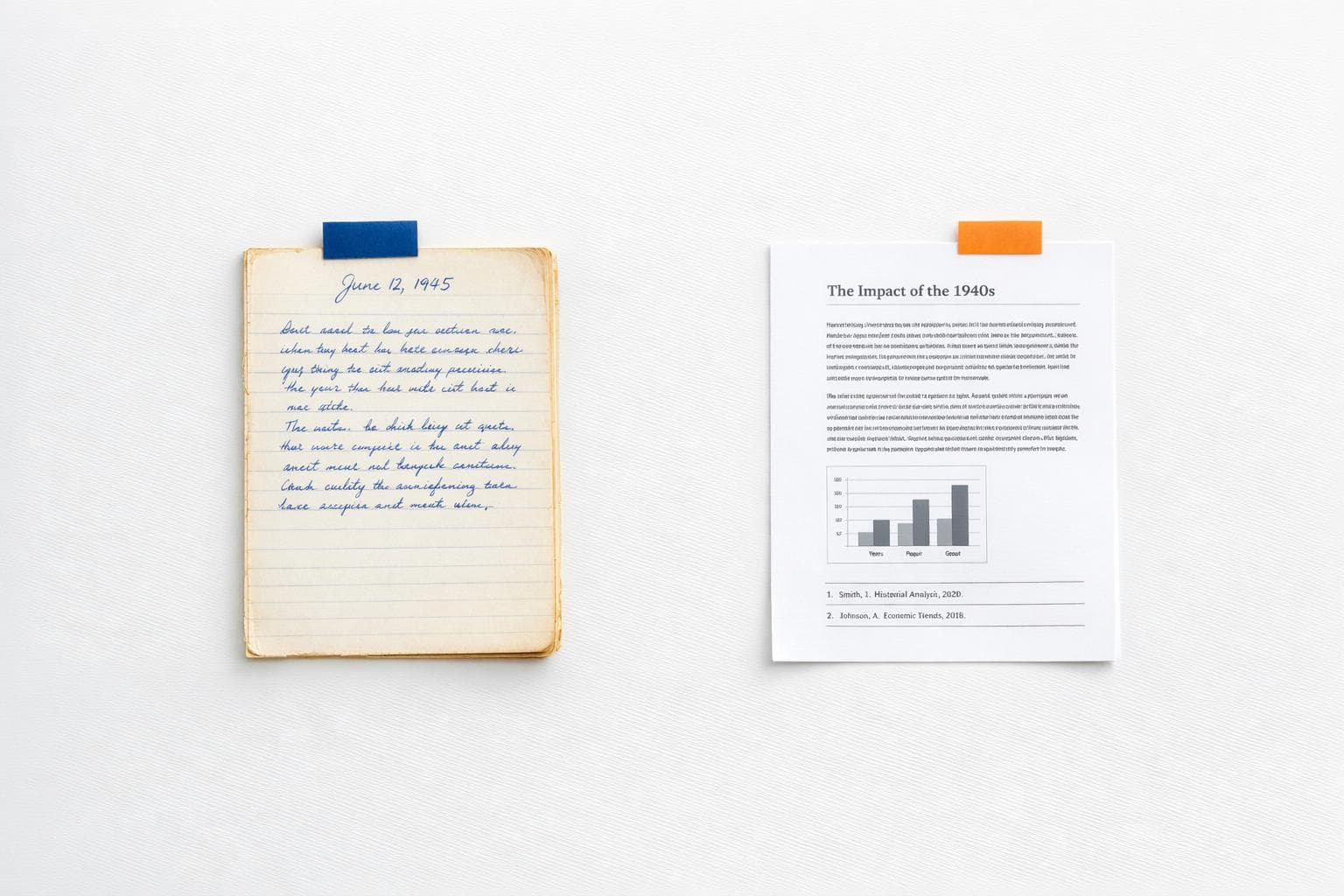
Primary Sources vs Secondary Sources: How to Tell the Difference Fast
When doing research, understanding whether a source is primary or secondary is essential. Here's the key takeaway:
- Primary sources are original, firsthand accounts or direct evidence of an event, study, or creative work.
- Secondary sources analyze, interpret, or summarize primary sources.
Quick examples:
- Primary: Diaries, raw data, original research articles, speeches.
- Secondary: Textbooks, biographies, review articles, documentaries.
Why it matters: Primary sources let you work with raw evidence, while secondary sources provide context and analysis. Both are crucial for strong research, but misclassifying them can weaken your argument.
Pro tip: Ask yourself, “Did the author directly experience or create this?” If yes, it’s primary. If it interprets or evaluates something else, it’s secondary.
For a clear comparison, see the table below.
Quick Comparison
| Feature | Primary Sources | Secondary Sources |
|---|---|---|
| Origin | Created during the event or study | Created after the event, analyzing it |
| Content | Firsthand evidence | Interpretation or analysis |
| Purpose | Provide direct evidence | Offer context or commentary |
| Examples | Diaries, raw data, lab results | Textbooks, reviews, historical analyses |
Knowing the difference helps you build stronger, more credible research.
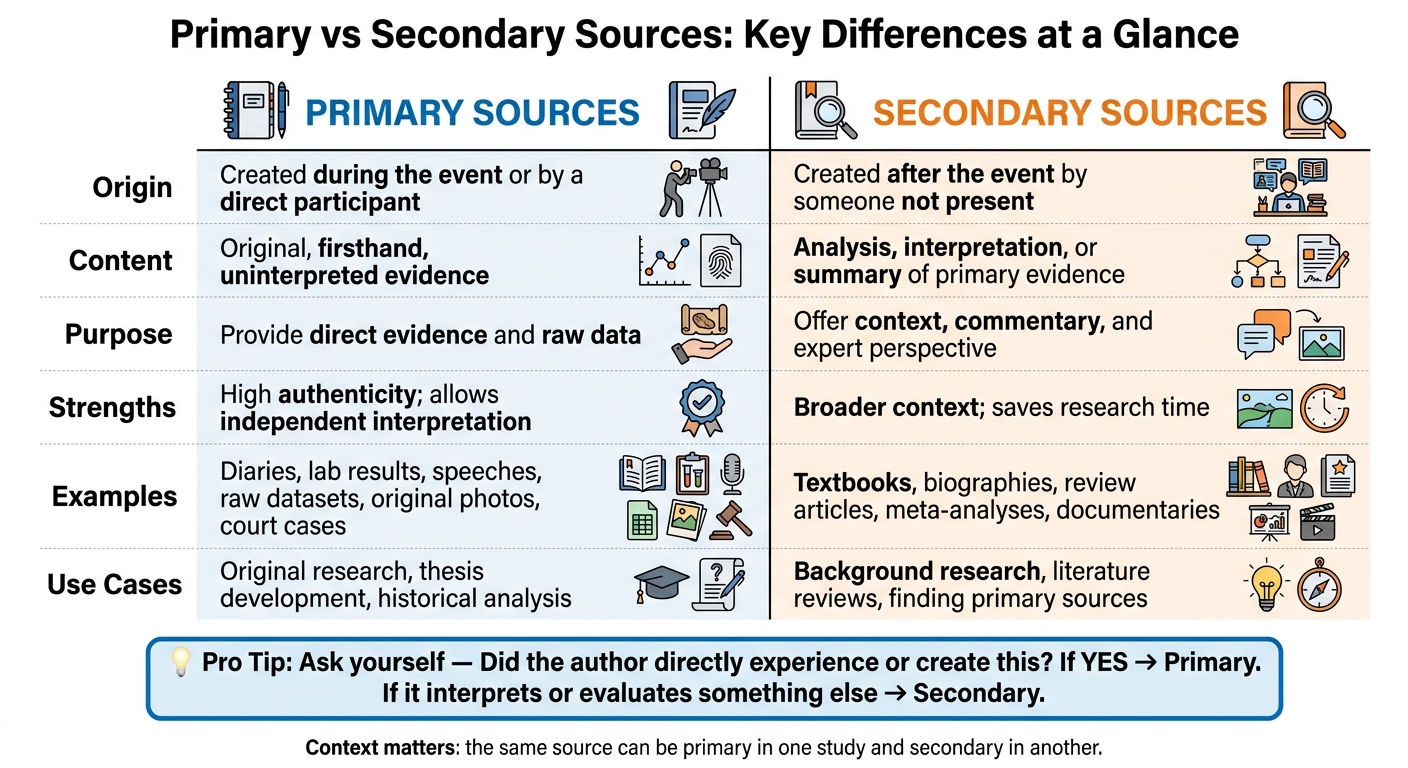
Primary vs Secondary Sources: Key Differences at a Glance
What Are Primary Sources?
Definition of Primary Sources
A primary source is any original piece of evidence directly tied to the topic you're studying. It represents firsthand information that hasn't been altered or interpreted by others.
"Primary sources are records of events or evidence as they are first described or actually happened without any interpretation or commentary." - University of Minnesota Crookston
The defining feature of a primary source is its content, not its format. For instance, a scanned image of a 19th-century diary is still a primary source because it reflects the creator's direct experience or observations.
Examples of Primary Sources
Primary sources can vary depending on the field of study. Here's a quick look:
| Discipline | Examples |
|---|---|
| History | Diaries, letters, government documents, census data, photographs, oral histories |
| Science | Peer-reviewed original research articles, lab notes, raw data sets, experiment results |
| Literature | Novels, poems, plays, original manuscripts |
| Social Sciences | Survey data, interview transcripts, field notes, public opinion polls |
| Law & Politics | Court cases, legislative hearing records, speeches, laws |
For example, Alexander Gardner's 1862 photograph of Abraham Lincoln and General McClellan at Antietam, Maryland, serves as a direct piece of evidence from the Civil War era.
When to Use Primary Sources
Primary sources are invaluable when you want to engage directly with the original evidence. They are particularly useful for analyzing historical events, presenting original research, or studying creative works in their unaltered form.
As Cornell University explains, "The definition of a primary source only makes sense in the context of a specific discipline or field of inquiry."
sbb-itb-f7d34da
What Are Secondary Sources?
Definition of Secondary Sources
A secondary source refers to any material that interprets, analyzes, or summarizes information gathered from primary sources. Instead of presenting original evidence, it provides a perspective or commentary on that evidence.
"Any published or unpublished work that is one step removed from the original source, usually describing, summarizing, analyzing, evaluating, derived from, or based on primary source materials." - Library of Congress
Think of it this way: if a primary source is raw footage, a secondary source is the documentary that explains and contextualizes it. These sources include the author's interpretation, which adds a layer of separation from the original evidence.
Interestingly, whether a source is primary or secondary can depend on your research focus. For example, a U.S. history textbook from the 1990s is a secondary source when studying the Civil War. However, if your research examines how history was taught in American schools during the 1990s, the same textbook becomes a primary source.
Here’s a closer look at how secondary sources appear in different fields.
Examples of Secondary Sources
Secondary sources exist in every academic discipline, though their forms vary depending on the field.
| Discipline | Secondary Source Examples |
|---|---|
| History | Textbooks, biographies, historical reviews, documentaries |
| Science | Review articles, meta-analyses, systematic reviews |
| Literature | Literary criticism, critical essays, book reviews |
| Political Science | Commentaries on laws, political analysis, encyclopedias of theory |
| Social Sciences | Journal articles interpreting findings, theoretical analyses |
In scientific research, titles or abstracts containing terms like "meta-analysis" or "systematic review" are almost always secondary sources. These works summarize and evaluate existing studies, rather than presenting new experimental results.
When to Use Secondary Sources
Secondary sources are incredibly helpful for getting a broad understanding of a topic, identifying key debates, and finding references to primary evidence.
"Secondary sources are useful to introducing a topic and providing historical or broader context." - University of Washington Libraries
They’re also essential for placing your research within the larger scholarly conversation. As Daniel Felix from Sourcely explains, "Secondary sources are indispensable when you need to understand the broader implications of a topic or place your research within the existing scholarly conversation."
In practical terms, secondary sources lay the groundwork for deeper investigation and can save you time. A well-researched secondary source often includes a bibliography, which can guide you to reliable primary materials.
What are primary and secondary sources?
Primary Sources vs Secondary Sources: Side-by-Side Comparison
The distinction between primary and secondary sources boils down to how close they are to the original event or subject. Primary sources provide firsthand evidence, while secondary sources analyze and interpret that evidence.
The University of California Santa Cruz Library explains it well:
"Secondary source materials... interpret, assign value to, conjecture upon, and draw conclusions about the events reported in primary sources."
Here’s a quick comparison to make the differences clearer:
Comparison Table
| Feature | Primary Sources | Secondary Sources |
|---|---|---|
| Origin | Created by witnesses or participants during the event or study. | Created after the event by someone not present. |
| Content | Original, unfiltered, and uninterpreted information. | Evaluative, analytical, or descriptive commentary. |
| Purpose | To provide direct evidence and raw data for analysis. | To interpret, synthesize, and contextualize primary evidence. |
| Strengths | High authenticity and the opportunity for independent interpretation. | Offers broader context and expert perspectives by summarizing data. |
| Use Cases | Conducting original research or developing a new thesis. | Gaining background information and reviewing existing literature. |
| Examples | Diaries, raw data sets, speeches, lab results, original photos. | Textbooks, biographies, literary criticism, review articles. |
It’s worth noting that how a source is classified often depends on the context. For example, a 1990s U.S. history textbook is secondary when studying the Civil War but becomes primary when examining how history was taught during the 1990s.
Questions to Help You Identify a Source Type Fast
Understanding the difference between primary and secondary sources is one thing, but applying that knowledge quickly during research can be tricky. To make it easier, you can use a few targeted questions as a mental checklist. This can help you decide how to classify and use a source effectively.
Questions to Spot a Primary Source
Here’s a simple yet powerful question shared by Quinnipiac University Libraries:
"Did the person writing the thing do the thing?"
In other words, ask yourself: Did the author personally conduct the work or witness the event? If the answer is yes, then you’re likely dealing with a primary source.
You can also ask: Is this information based on personal experience or direct observation? If it is, it’s primary. Another clue is whether the source includes original records, such as lab notebooks, speeches, diaries, or raw datasets. These questions will help you quickly confirm whether a source is primary.
Questions to Spot a Secondary Source
For secondary sources, focus on their purpose rather than the author’s direct involvement. Ask yourself: Does this source analyze, interpret, or evaluate other documents? The University of California Santa Cruz Library explains that secondary sources "interpret, assign value to, conjecture upon, and draw conclusions about the events reported in primary sources". If this sounds like the source you’re reviewing, it’s secondary.
Two additional checks can help: First, look for a dense bibliography that cites multiple studies - this often signals a secondary source. Second, ask: What is this source about? If it’s primarily discussing another book, event, or person rather than being a firsthand account, it’s secondary.
Using these quick questions will make it easier to classify your sources accurately and save time during your research process.
Primary vs Secondary Sources: Examples from Different Fields
Understanding the difference between primary and secondary sources becomes clearer when looking at real-world examples from history and science.
Example 1: Historical Research
Take the American Civil War as an example. Mary Henry's diary entries from April 15–16, 1865, are considered a primary source because they were written firsthand during that time. On the other hand, a biography or documentary that uses her diary and other historical records to provide context or analysis is a secondary source.
This distinction highlights how a single event can generate both direct accounts and later interpretations. According to the Smithsonian Institution Archives, primary sources are original materials created during the time of the event, while secondary sources summarize or analyze those materials.
For instance, a textbook chapter discussing the Civil War is secondary, but the Emancipation Proclamation itself remains a primary source. Being able to quickly identify these types of sources is crucial for finding credible sources in your research. This concept applies not just to history but also to scientific work.
Example 2: Scientific Research
In scientific studies, the distinction often revolves around the Methods section. A primary source, such as an original journal article reporting on a clinical trial, includes a detailed Methods section that explains the experiment, participants, and data collection process. This level of specificity allows other researchers to replicate the study.
By contrast, a systematic review or meta-analysis is a secondary source. While it may also feature a Methods section, this part typically describes how the authors analyzed existing research rather than conducting a new experiment. Drexel University Libraries explains, "Secondary sources are best identified by their use of primary articles as source material". Titles like "systematic review" or "meta-analysis" often signal secondary sources.
These examples from history and science illustrate the importance of distinguishing between primary and secondary sources, a skill that enhances the quality and credibility of research.
How Sourcely Helps You Classify Sources Quickly
Understanding the difference between primary and secondary sources is one thing; actually sorting through piles of papers to classify them is a whole different challenge. That’s where Sourcely steps in. By automating the process of source identification, Sourcely lets researchers focus on analysis rather than the time-consuming task of manual sorting. Its tools align perfectly with the classification strategies discussed earlier, making the process both faster and more precise.
AI-Powered Source Identification
With Sourcely, you can upload documents directly into the platform. Its AI system scans and categorizes sources as either primary (like original data or firsthand accounts) or secondary (such as interpretations or reviews). This takes the guesswork out of classification. On top of that, the Citation Verification feature ensures each source is credible and properly categorized for academic purposes.
"Our AI-powered source finding tool is built by students for students, allowing us to truly understand the needs of the academic community." - Sourcely
Fast Search and Summarization
Sourcely’s AI Research Assistant can summarize research papers instantly, complete with source classifications. This eliminates the need to manually review each paper’s content. The platform provides access to over 200 million research papers, covering a vast array of academic disciplines - from historical studies to clinical science. Its Deep Search feature makes it even easier to find exactly what you need by allowing you to filter results by publication year, author, or relevance. Whether you're looking for original experimental studies or up-to-date literature reviews, this tool saves you from wading through irrelevant results.
Filtering Options for Targeted Searches
To make searches even more precise, Sourcely offers advanced filtering options tailored to your needs. These tools work seamlessly together to ensure that the sources you select are both accurate and reliable, supporting your research with minimal effort. This targeted approach underscores Sourcely’s mission to simplify and streamline source classification for researchers.
Conclusion: Getting Source Classification Right
Distinguishing between primary and secondary sources is a cornerstone of reliable research. When applied effectively, both types can significantly bolster your arguments.
The key lies in context. A single document might act as a secondary source in one project and a primary source in another, depending on your research question. This flexibility highlights the importance of tailoring your approach to fit the specific needs of your study.
A smart strategy combines both source types: start with secondary sources to understand the broader landscape, then dive into primary sources for deeper insights. To save time, quick tricks like scanning for a methods section in scientific papers or spotting terms like "meta-analysis" or "systematic review" can help you classify sources accurately.
When juggling a large volume of sources, AI tools like Sourcely can step in to automate the classification process. By blending these strategies with AI automation, you can consistently enhance the credibility and authority of your work.
"Secondary sources are accounts that retell, analyze, or interpret events, usually at a distance of time or place." - Library of Congress
Getting source classification right is a skill that will always elevate the quality of your research.