
Research Gap Finder: How to Turn Existing Literature Into a Strong Topic
Want to craft a strong research topic? Start with a clear research gap. A research gap is more than just an unexplored area - it's a specific missing piece in existing knowledge that creates a problem for understanding or application. Identifying and addressing these gaps can make your research more relevant and impactful. Here's how you can find and utilize research gaps effectively:
- What is a research gap? It's an absence in current knowledge that matters - like outdated methods, unstudied populations, or conflicting findings.
- Why does it matter? Studies with well-defined gaps have better chances of acceptance, with some achieving a 94% success rate.
- How to find gaps: Use tools like Sourcely to analyze literature quickly, focusing on limitations and future research suggestions in recent papers.
- Types of gaps: Common ones include knowledge gaps, evidence gaps, methodological gaps, population/context gaps, and theoretical gaps.
- Next steps: Organize findings systematically, refine your research question, and validate your gap using recent studies.
How I Find Research Gaps In Under 5 Minutes (Step-by-Step Tutorial & Strategies)
sbb-itb-f7d34da
Types of Research Gaps and How to Recognize Them
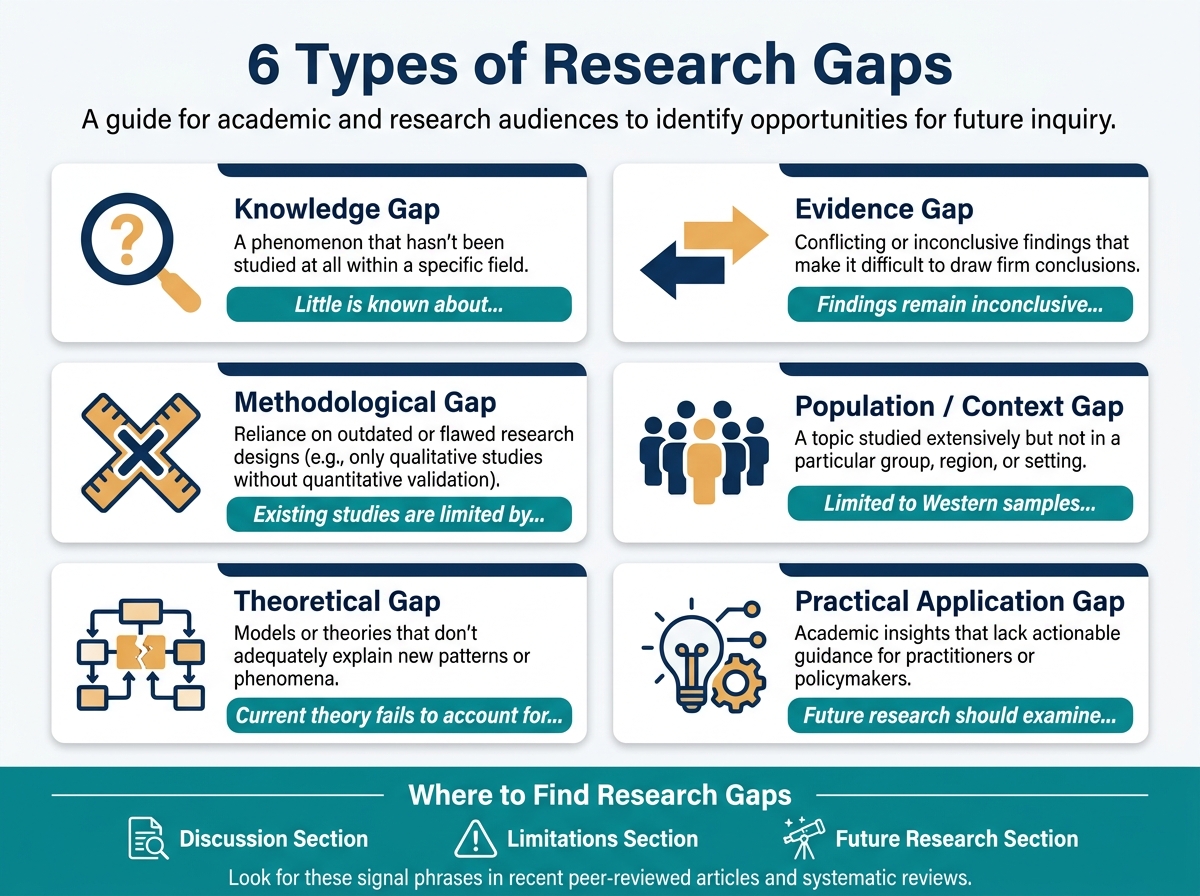
6 Types of Research Gaps: How to Identify & Choose the Right One
Research gaps come in various forms, and understanding these differences helps you focus your efforts and provide a solid justification for addressing a specific gap.
Common Types of Research Gaps
Each type of research gap highlights a different missing piece in the literature. Here's a breakdown:
| Gap Type | Missing Element |
|---|---|
| Knowledge Gap | A phenomenon that hasn't been studied at all within a specific field |
| Evidence Gap | Conflicting or inconclusive findings that make it difficult to draw firm conclusions |
| Methodological Gap | Reliance on outdated or flawed research designs, such as only qualitative studies without quantitative validation |
| Population/Context Gap | A topic studied extensively but not in a particular group, region, or setting |
| Theoretical Gap | Models or theories that don't adequately explain new patterns or phenomena |
| Practical Application Gap | Academic insights that lack actionable guidance for practitioners or policymakers |
How to Spot Research Gaps in the Literature
To identify research gaps, focus on the "Discussion", "Limitations," and "Future Research" sections of recent journal articles.
Certain phrases can clue you in on specific gaps. Look for terms like "little is known about," "findings remain inconclusive," "future research should examine," or "existing studies are limited by." For instance, "inconclusive findings" suggest an evidence gap, while "limited to Western samples" points to a population gap.
"The gap, also considered the missing piece or pieces in the research literature, is the area that has not yet been explored or is under-explored." - National University
Systematic reviews and meta-analyses are particularly helpful because they summarize large volumes of research and often highlight areas where additional work is needed.
Choosing a Gap Type That Fits Your Research Goals
The type of gap you select should align with your academic experience, resources, and timeline. For beginners, population and context gaps are often the most manageable. These gaps allow you to build on existing literature and use established methods to explore new groups or settings.
On the other hand, tackling a knowledge gap means venturing into uncharted territory with little prior research to guide you. This approach can be rewarding but is typically better suited for experienced researchers due to its complexity.
Before committing to a gap, ensure you have access to the necessary tools, datasets, or populations to address it effectively. A gap that’s interesting but unattainable won’t lead to a feasible study.
Once you've identified a clear gap type, you can start building a focused literature base to support your research.
Building a Literature Base With Sourcely
Creating a solid literature base is essential for identifying and validating the research gap you’re aiming to address.
Start With a Clear Research Question
The first step is to define a focused research question. A vague question leads to scattered results, but a clear one keeps your search on track.
Pick 3–5 key terms from your question. For instance, if you’re studying how remote work impacts mental health in Gen Z employees, your key terms might include: remote work, mental health, Gen Z, workplace stress, and employee well-being. These terms will guide your searches and help you avoid veering into unrelated studies. A well-crafted question also simplifies organizing your findings and identifying research gaps.
Using Sourcely's Search Filters
Once you have your key terms, input your research question into Sourcely. This platform scans a database of over 200 million research papers, so using filters is key to narrowing down results.
Focus on studies published within the last 5 years, especially in dynamic fields like technology, medicine, or behavioral science, where older research may highlight gaps. Refine your search further by selecting specific subject areas and study types, prioritizing peer-reviewed articles and systematic reviews. Systematic reviews are particularly helpful because they summarize large volumes of work and often point out areas that need further exploration.
For more nuanced or niche topics, Sourcely's Deep Search feature can uncover papers that go beyond simple keyword matches, finding conceptually related studies.
Once you’ve filtered your results, the next step is to organize your sources systematically for effective analysis.
Organizing Your Sources for Gap Analysis
After narrowing down your search, structure your findings to highlight research gaps clearly.
For an undergraduate project, aim for a core set of 15 to 25 sources; graduate-level research typically requires 50 or more. Save relevant papers to Sourcely's Citations Library to ensure you don’t lose track of anything important.
Use Sourcely’s summary feature to get an overview of each study’s methodology, findings, and limitations. Then, organize this information in a literature matrix with columns like Author/Year, Population, Method, Key Findings, Limitations, and Suggested Research.
"Patterns emerge when you organize information systematically. You'll spot what's missing." - GenPaper
For example, if multiple papers note that "future research should examine non-Western populations", that recurring limitation points to a clear research gap. Documenting these patterns makes it easier to refine your research question and focus on areas that need further investigation.
Turning a Research Gap Into a Researchable Topic
Once you've organized your literature, the next step is turning observed gaps into a focused research question.
From Gap to Research Question
To transform a gap statement into a clear research question, define the population, variables, and context. For instance, a broad observation like "no studies on remote learning for rural students" can be refined into: "How does remote learning impact academic performance among rural high school students in the Midwest?".
Before moving forward, confirm that the topic is feasible. Consider whether you can access the necessary data, collect it ethically, and work within your available resources. A gap that exceeds your constraints may not be a practical choice.
"A well-defined gap becomes the foundation of a high-quality thesis, dissertation, or journal article." - Cosmin Botoroga, Founder, DATA SWEEP
Testing and Refining Your Topic With Sourcely
Evaluate your research question critically using Sourcely. Search for recent studies to ensure the gap is still valid. Focus on papers published in the last 12 to 18 months - a gap identified years ago might already be addressed. Filtering by publication date in Sourcely ensures your research remains relevant and timely.
After refining your question through targeted searches, formalize your findings into a structured research topic.
Writing a Strong, Workable Research Topic
A strong research topic should address a real gap, be achievable with your resources, and align with your expertise. Use the following four-part Gap Statement Formula to craft a clear and researchable topic:
- Acknowledge existing research: "Previous research has established..."
- Highlight what's missing: "However, [specific gap]..."
- Explain its importance: "This gap is significant because..."
- State your contribution: "This study addresses this gap by..."
Consult at least three experts in your field to validate your topic. If uncertainties arise, revisit Sourcely's Citations Library or the "Future Research" sections of key sources. Refine your scope until the gap is both clear and defensible.
Validating and Documenting Your Research Gap
Once you've established your literature base, the next step is to ensure your identified research gap is both valid and well-documented.
Checking That Your Gap Is Still Open
Research moves fast, so it's essential to confirm that your gap remains unaddressed. Start by reviewing recent publications, focusing on works from the last 12 to 24 months. Use tools like Sourcely to perform a targeted search based on your refined research question. Pay special attention to the "Limitations" and "Future Research" sections of recent systematic reviews - if multiple studies highlight the same unresolved issue, it's a strong indicator that your gap is still relevant.
A literature matrix can be a helpful tool here. This involves creating a grid that outlines key study components like population, methods, and outcomes. Any empty cells in this matrix point to unexplored areas, giving you a solid foundation to claim your gap. Once you've confirmed its validity, document the gap concisely to clearly frame how your research will contribute to the field.
Writing a Clear Gap Summary for Academic Work
After verifying your gap, the next step is to clearly articulate it in your academic writing. A gap summary is typically a concise paragraph found in the introduction of a paper or proposal. It should identify what’s missing, explain why this absence matters, and outline how your study will address it. Start by summarizing what existing research has already established, then introduce the gap using specific academic phrases like "...is poorly understood" or "...has not yet been examined in the context of...". Wrap up with a clear statement of your study's intended contribution.
Avoid vague phrases like "more research is needed." Instead, make your gap specific, such as: "Yet whether this relationship holds for first-generation college students in rural U.S. communities remains untested".
"A gap is not 'this has not been studied.' It is 'this has not been studied, and that absence creates a specific problem for our understanding of X, particularly for population Y under condition Z.'" - Prof. John and Dr. Albert, Eldenhall Research
Additionally, clarify the type of gap you're addressing - whether it's related to a specific population, a methodological limitation, or an evidence shortfall. This precision can make your research's value more apparent to reviewers and committee members.
Managing Citations With Sourcely
As you validate your gap, keeping your references well-organized is crucial. Losing track of key sources can weaken your argument. Sourcely’s library management tool can help by allowing you to store abstracts, metadata, and full references in one place. When you're ready to write, you can easily export these references in formats like APA, MLA, or Chicago. This feature is especially helpful for larger projects like theses or dissertations, where your reference list might include over 50 sources.
Conclusion: Using Sourcely to Find and Fill Research Gaps
Finding a solid research topic doesn’t mean starting from scratch. Instead, the key lies in identifying unresolved questions in existing studies. This guide has covered how to spot various types of research gaps - like empirical, population, or methodological gaps - compile a relevant literature base, turn those gaps into focused research questions, and document them in a way that meets academic standards.
The sheer volume of reading required can slow down even the most dedicated researchers. On average, manually identifying research gaps from evidence reports takes 3.5 hours per report. Sourcely simplifies this process with semantic search, which highlights conceptually relevant papers rather than relying solely on keyword matches. It also allows users to extract limitations and suggestions directly from documents in just minutes, saving days of effort.
This streamlined process offers a clear strategic advantage.
"The gap is not 'more research is needed'. It is a precise claim about what the literature has not yet resolved - and why your paper is positioned to address it." - Research Ramp
That level of precision is what transforms an idea into a publishable topic. Whether you’re an undergraduate working on a literature review with 15–25 sources or a graduate student managing a library of 50+ references, Sourcely’s tools - like library management and reference exporting - keep everything organized so you can focus on writing.
FAQs
How do I know if a research gap is still open?
To determine if a research gap still exists, start by examining recent studies for phrases such as "limitations," "further research needed," or "not well studied." These can signal areas where more work is required. Dive into current literature or systematic reviews to see if the issue remains unresolved. Using tools like systematic review frameworks can also highlight topics that are either underexplored or outdated. Always double-check to ensure no recent research has already addressed the gap.
Which type of research gap is best for a beginner to tackle?
An empirical gap is a great starting point for beginners. It focuses on testing a theoretical relationship in a fresh or specific context that hasn’t been examined yet. This method works well for new researchers because it builds on established theories or models, making it easier to contribute fresh evidence without diving into overly complicated challenges. It’s a straightforward way to begin while still making a meaningful contribution to the field.
What’s the fastest way to turn a gap into a clear research question?
To transform a research gap into a precise question, pinpoint an area that hasn't been thoroughly examined in the existing literature. Begin by recognizing what constitutes a gap - this could be unanswered questions, outdated studies, or overlooked perspectives. Next, analyze these gaps by asking yourself, "What’s missing?" or "What requires deeper investigation?" This approach helps you craft a question that directly targets the heart of the gap with clarity and purpose.