Scholarly Sources: What Counts, What Does Not, and Where to Find Them
Scholarly sources are the backbone of academic research, but how do you identify them? Here's the key: scholarly sources are written by experts, follow a structured format (like research papers), and undergo rigorous review processes like peer review. Common examples include journal articles, academic books, and government research reports. On the other hand, non-scholarly sources - like news articles, blogs, and magazines - lack formal review and are aimed at general audiences.
Key Takeaways:
- Scholarly sources include peer-reviewed journals, academic books, and dissertations.
- They are authored by experts, use formal language, and include citations in various styles.
- Non-scholarly sources (e.g., Wikipedia, news sites) are not suitable for academic research.
- Tools like Sourcely help locate scholarly materials quickly, offering AI-powered search and filters for peer-reviewed content.
Understanding these distinctions ensures your research is built on strong, validated evidence.
How to Find Credible Sources for Research | Finding Reliable Sources
sbb-itb-f7d34da
What Makes a Source Scholarly
Not every well-written article qualifies as scholarly. Scholarly sources follow strict guidelines that set them apart from general content.
Key Characteristics of Scholarly Sources
One of the most important features is expert authorship. These sources are written by researchers, professors, or specialists who clearly state their qualifications and institutional ties - like holding a PhD from Stanford or being affiliated with the National Institutes of Health. This level of transparency ensures the author's expertise is credible.
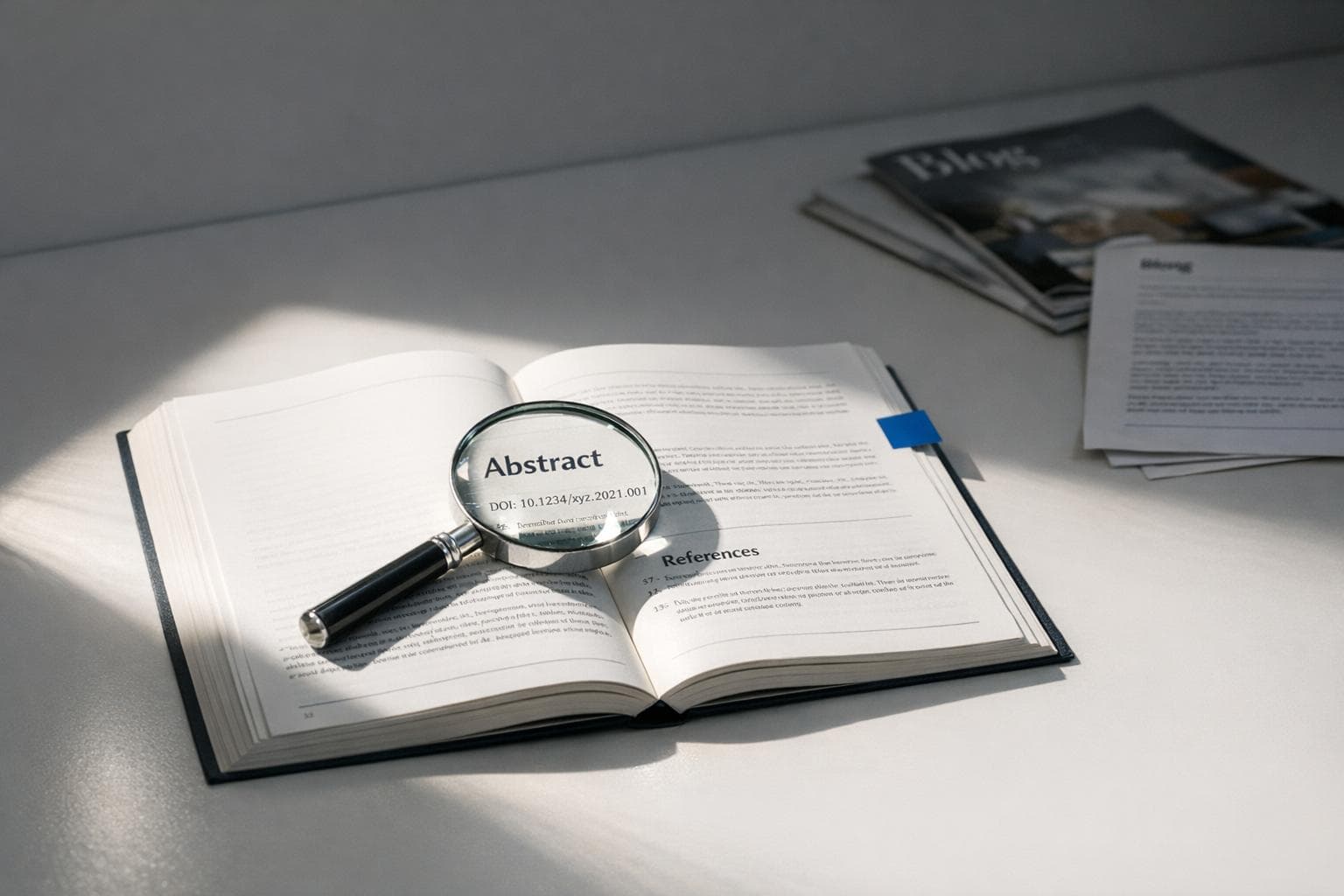
The structure of the article is another giveaway. Scholarly works typically follow a set format: abstract, introduction, methodology, results, discussion, and a full reference list. Articles with this structure are strong candidates for being academic. The writing style is formal and uses technical language, aimed at readers who already have some knowledge in the field.
Pay attention to visual presentation as well. Scholarly journals often have a simple, no-frills design. They may include data tables and graphs but avoid glossy images or advertisements. If a publication looks more like a magazine than a research report, it’s probably not scholarly.
It’s also worth noting that some scholarly sources are reviewed by editors or committees rather than through blind peer review. As Lisa Curtin from Bentley University explains:
"Essentially all peer-reviewed and refereed journals are scholarly, but not all scholarly journals are peer-reviewed or refereed."
For example, academic books from university presses or certain government research reports are considered scholarly, even though they may undergo editorial or committee review instead of the traditional peer-review process.
These characteristics apply across various types of scholarly sources, as outlined below.
Examples of Scholarly Sources
Scholarly materials come in many forms beyond just journal articles:
| Source Type | Example | Review Process |
|---|---|---|
| Peer-reviewed journal article | A study published in Journal of the American Medical Association (JAMA) | External expert review |
| Academic book | A monograph from Oxford University Press or MIT Press | Editorial and faculty review |
| Conference paper | A presentation at the Annual Meeting of the American Psychological Association | Committee or editorial review |
| Government research report | A report from the National Institutes of Health (NIH) or CDC | Internal expert review |
| Thesis or dissertation | A doctoral dissertation approved at a U.S. university | Faculty committee review |
Despite differences in format or review process, all of these sources share key traits: they are authored by experts, grounded in evidence, and include formal citations.
What Does Not Count as a Scholarly Source
Knowing what doesn’t qualify as a scholarly source is just as important as identifying what does. Some sources may seem credible at first glance but fail to meet the rigorous standards required for academic research.
Characteristics of Non-Scholarly Sources
Non-scholarly sources, often referred to as popular sources, are aimed at a general audience. They use a casual tone and straightforward language to inform or entertain rather than to contribute to academic discourse. These are typically written by journalists or bloggers without specialized academic credentials. Examples include general news websites like CNN.com and USA Today, popular magazines such as Time, People, and Vanity Fair, as well as open-access platforms like Wikipedia or personal blogs. These sources are not intended for academic use.
One obvious indicator of a non-scholarly source is the lack of formal citations. As Monash University highlights:
"Lack of references is a red flag."
If a source lacks a bibliography, footnotes, or a reference list, it’s a strong sign that it doesn’t meet scholarly standards. Without these elements, the source’s reliability for academic research is significantly diminished.
Why Non-Scholarly Sources Are Inadequate for Academic Research
Non-scholarly sources fall short because they don’t adhere to the rigorous standards of scholarly work. For one, they lack formal peer review. Scholarly articles are evaluated by independent experts before publication, ensuring accuracy and credibility. In contrast, popular sources are often reviewed only by in-house editors or published without any formal review process. This lack of oversight means there’s no guarantee the information is accurate, unbiased, or thoroughly examined.
Additionally, non-scholarly sources tend to provide only surface-level analysis. This makes them unreliable as evidence in serious academic research, where depth and rigor are essential.
Scholarly vs. Non-Scholarly Sources: Side-by-Side Comparison
Scholarly vs. Non-Scholarly Sources: Key Differences at a Glance
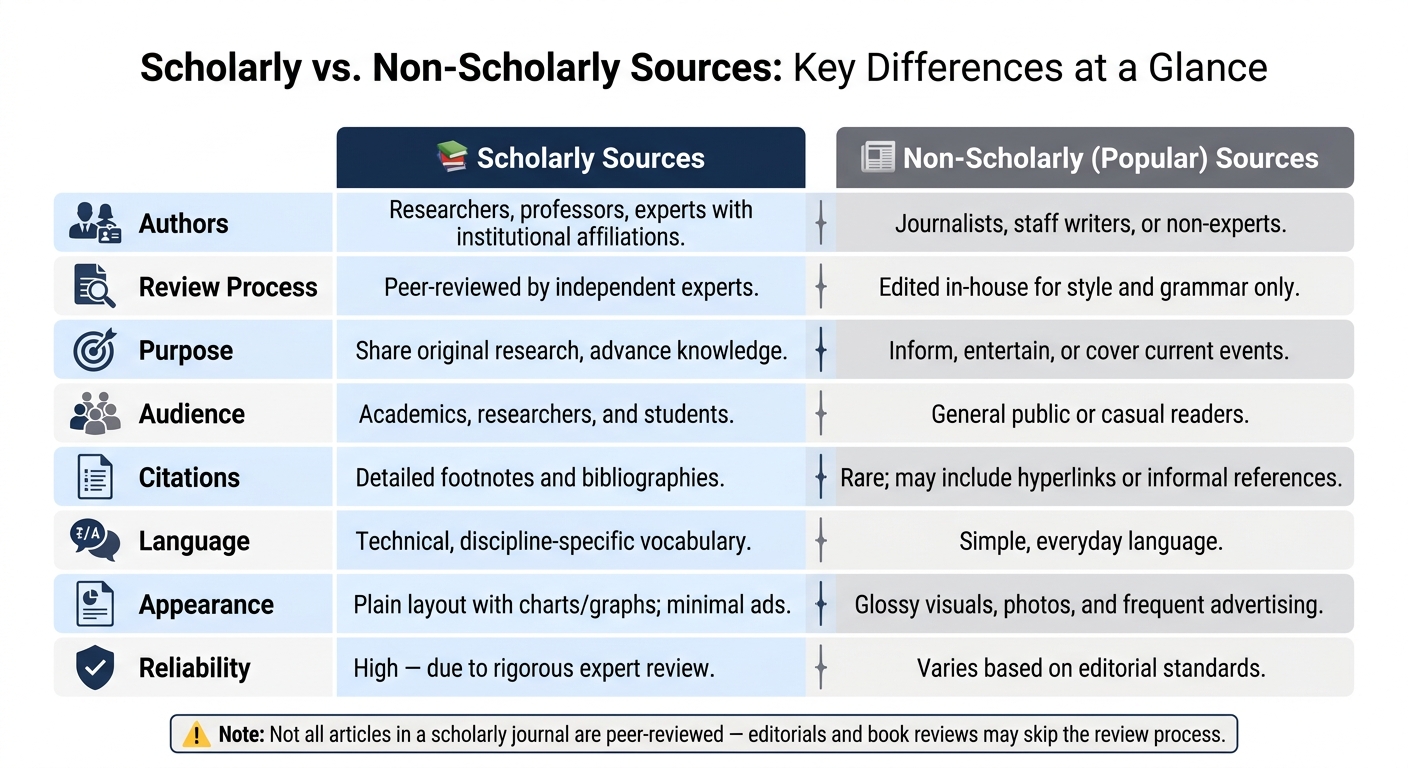
To make informed choices during research, it's essential to understand the clear differences between scholarly and non-scholarly sources. These two types of sources vary in purpose, audience, structure, and how they are reviewed before publication. Recognizing these distinctions can help you avoid unnecessary confusion.
As Lee Shulman from The Carnegie Teaching Academy puts it:
"Scholarship properly communicated and critiqued serves as the building block for knowledge growth in a field."
This rigorous review process is a hallmark of scholarly work, setting it apart from general content.
Comparison Table
| Feature | Scholarly Sources | Non-Scholarly (Popular) Sources |
|---|---|---|
| Authors | Researchers, professors, or experts with affiliations | Journalists, staff writers, or non-experts |
| Review Process | Peer-reviewed by independent experts | Edited in-house for style and grammar |
| Purpose | Share original research and advance knowledge | Inform, entertain, or cover current events |
| Audience | Academics, researchers, and students | General public or casual readers |
| Citations | Detailed footnotes and bibliographies | Rare; may include hyperlinks or informal references |
| Language | Technical, discipline-specific vocabulary | Simple, everyday language |
| Appearance | Plain layout with charts and graphs; minimal ads | Glossy visuals, photos, and frequent advertising |
| Reliability | High, due to rigorous expert review | Varies based on editorial standards |
It's worth noting that not everything in a scholarly journal qualifies as a scholarly article. Sections like book reviews, editorials, and short news pieces often lack the structured, peer-reviewed format typical of research articles.
Common Mistakes When Identifying Scholarly Sources
Even seasoned researchers can find themselves misjudging sources. The problem often isn’t carelessness but the fact that some non-scholarly materials can closely resemble scholarly ones.
Confusing Professional-Looking Sources with Scholarly Ones
Just because a source looks polished doesn’t make it scholarly. Take National Geographic, for instance. While it’s a respected publication with expert contributors, it’s written for a general audience and doesn’t go through peer review.
Similarly, trade publications like Nursing Management or Engineering News-Record may use technical jargon, but their focus is on industry trends and updates, not rigorous academic research.
Cornell University Library offers a helpful distinction:
"Scholarly journals generally have a sober, serious look. They often contain many graphs and charts but few glossy pages or exciting pictures."
To spot a scholarly source, check for a structured reference list. This is a clear indicator of academic standards. Also, look for transparency about the peer-review process to confirm the source’s credibility.
Skipping the Peer-Review Check
Assuming that all scholarly sources are peer-reviewed is another frequent misstep. While many scholarly materials - like government documents, conference proceedings, and academic books - are authored by experts, they don’t always undergo formal peer review.
Even within peer-reviewed journals, not every piece is reviewed. Editorials and book reviews, for example, often skip the peer-review process.
To confirm peer review, use these strategies:
| Verification Method | What to Look For |
|---|---|
| Ulrich's Periodical Directory | A "referee jersey" icon next to the journal title |
| Article's first page | Submission, revision, and acceptance dates |
| Journal's official website | A "Peer Review Policy" or "Instructions for Authors" section |
| Database search filters | A "Peer Reviewed" or "Refereed" checkbox in the search interface |
Be cautious of journals that claim to be peer-reviewed but are actually predatory publishers. These entities charge authors fees while skipping legitimate review processes. To avoid them, cross-check the journal name in Ulrich's Periodicals Directory, which catalogs over 250,000 serials and flags verified peer-reviewed publications.
How to Find Scholarly Sources Using Sourcely
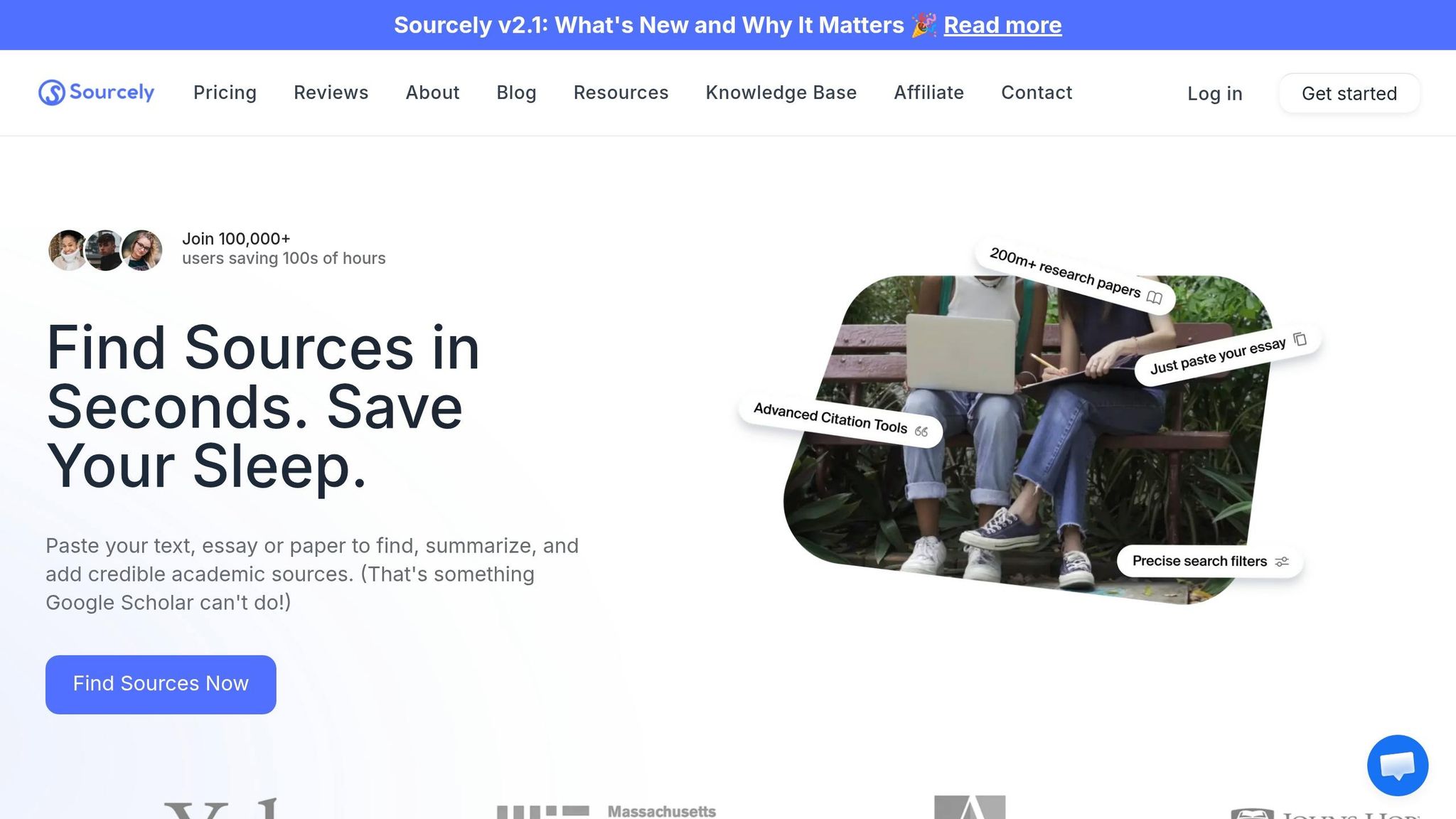
Once you understand what qualifies as a scholarly source, the next step is figuring out how to locate them quickly and effectively. That’s where Sourcely comes into play.
What Sourcely Does and How It Works
Sourcely is an AI-driven academic search tool designed to simplify the process of finding scholarly resources. It taps into a massive database of over 200 million research papers sourced from trusted platforms like Semantic Scholar, PubMed, arXiv, CrossRef, and CORE. This makes it a valuable resource for anyone looking to enhance their academic research.
Here’s how Sourcely describes itself:
"Sourcely is your AI-powered academic search assistant, offering access to over 200 million papers and advanced search filters."
One of its standout features is the Essay Paste tool. With this, you can paste your essay or a section of text, and the AI will identify gaps where citations are needed and recommend relevant scholarly sources. As Sourcely explains:
"Simply paste your essay or paragraph and let Sourcely do the rest!"
Sourcely also offers advanced filtering options to fine-tune your search. You can narrow results by publication year, paper type, or even toggle a "Peer-Reviewed Only" filter. Each search result provides an abstract, a relevance score, and citation counts to help you quickly assess its usefulness. Once you find a paper that meets your needs, you can download it as a free PDF and export citations in formats like APA, MLA, or Chicago.
Sourcely Plans and Pricing
After exploring Sourcely’s powerful search features, you can choose from several subscription options based on your research needs.
| Plan | Cost | Best For |
|---|---|---|
| One-Time Trial | $7 | Testing the platform with up to 2,000 characters of input |
| Monthly Subscription | $17/month | Regular research throughout a semester |
| Yearly Subscription | $167/year | Consistent academic work at a lower monthly cost |
| Lifetime Plan | $347 (one-time) | Long-term researchers who want permanent access |
The $7 trial is a great way to test the platform’s capabilities before committing. For those with ongoing research needs, the yearly plan offers better value, breaking down to about $13.92 per month. Meanwhile, the lifetime plan is ideal for dedicated researchers who want uninterrupted, permanent access.
Conclusion: Using Scholarly Sources to Strengthen Your Research
The backbone of any strong research paper is the use of reliable, well-vetted sources. Peer-reviewed journal articles, academic books from respected university presses, and conference papers from reputable institutions all undergo rigorous scrutiny by experts in their fields. This process ensures their credibility and reliability.
As the Harvard Guide to Using Sources explains:
"The most reliable sources are those that have been vetted by scholars in the field - articles published in peer-reviewed journals and books published by academic publishers."
In addition to their credibility, scholarly sources enhance the integrity of your work by making your arguments traceable. Their detailed citations and bibliographies allow readers to verify the evidence, setting apart thorough academic research from unsupported opinions. Incorporating peer-reviewed and expert-authored materials not only upholds academic standards but also contributes meaningfully to scholarly discussions.
For an efficient research process, tools like Sourcely provide access to a vast collection of academic papers, complete with advanced filters to pinpoint credible, peer-reviewed content. Whether you're tackling a single project or managing extensive research, having a reliable platform at your disposal can save time and effort.
FAQs
Is a .org or .edu website always scholarly?
Not every website with a .org or .edu domain can be considered scholarly. While these domains frequently host reliable information, they may also feature content that isn't academic or peer-reviewed. Simply relying on the domain name isn't enough to guarantee the quality of the material. It's essential to thoroughly assess the source to ensure it's credible and aligns with your research needs.
Can I use a government report as a scholarly source?
Government reports can qualify as scholarly sources, but it depends on a few factors. If the report is written by experts in the field and has undergone peer review or a rigorous evaluation process, it may meet scholarly standards. That said, not all government reports go through such scrutiny. It's essential to assess the report's credibility and the review process behind it to determine if it fits the criteria for being scholarly.
How can I quickly confirm an article is peer-reviewed?
To determine if an article is peer-reviewed, start by looking for a label like "peer-reviewed" or "refereed" in the database where the article is listed. Another option is to use directories like Ulrichsweb, which mark peer-reviewed journals with specific icons. You can also visit the journal's official website and check the About or Instructions for Authors sections to find information about their peer review process.