Citation Chaining: The Fastest Way to Find Better Sources From One Good Paper
Struggling to find credible academic sources? Citation chaining is a simple and effective method to expand your research by using one solid paper to discover related studies. Here's how it works:
- Backward chaining: Explore the references in a paper to find older studies that influenced it.
- Forward chaining: Look for newer work that cites the paper to see how the topic has evolved.
This approach saves time, improves the quality of your sources, and helps you understand the broader academic context. Tools like Google Scholar and Sourcely make the process even easier by organizing citations and providing direct access to relevant papers. Combine this method with regular keyword searches for the best results.
FORWARD and BACKWARD Citation Chasing with FOUR TOOLS | Five Minute Friday
sbb-itb-f7d34da
Citation Chaining Explained
Backward vs. Forward Citation Chaining: A Quick Comparison Guide
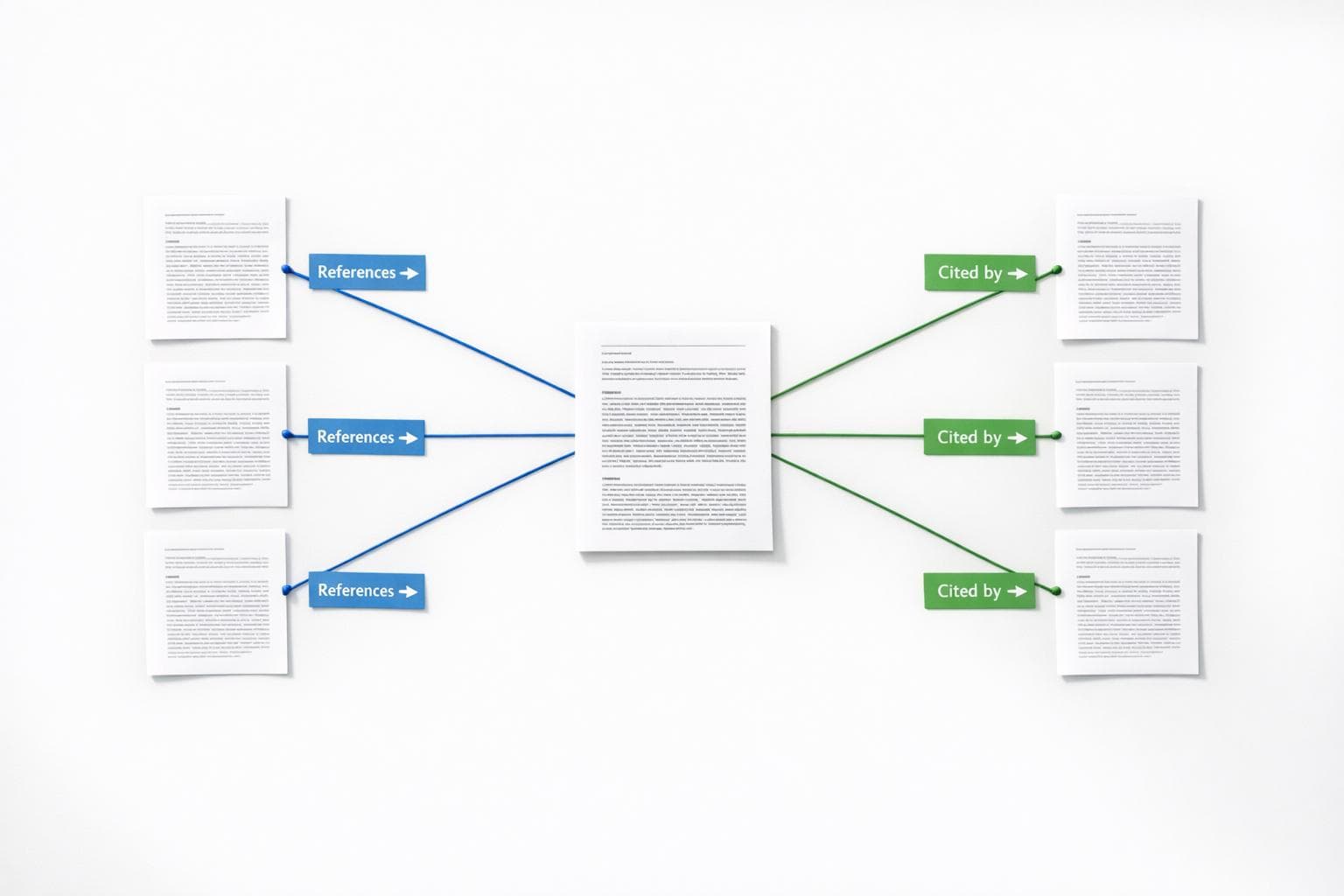
Citation chaining taps into the interconnected web of academic papers. Each study references earlier work and is, in turn, cited by subsequent research. Think of it as following a breadcrumb trail: starting with one solid article, you can uncover both the studies it builds on and the ones that build on it.
David Gill, a Reference Librarian at SFU Library, describes it well:
"Research is a conversation... we read the research to understand the scholarly conversation of the topic, identify the gaps, and conduct our own research in the field to fill them."
This "conversation" is exactly what citation chaining takes advantage of, letting you efficiently navigate through a body of literature by tracking connections between studies.
Backward vs. Forward Citation Chaining
Citation chaining works in two directions, each with its unique purpose.
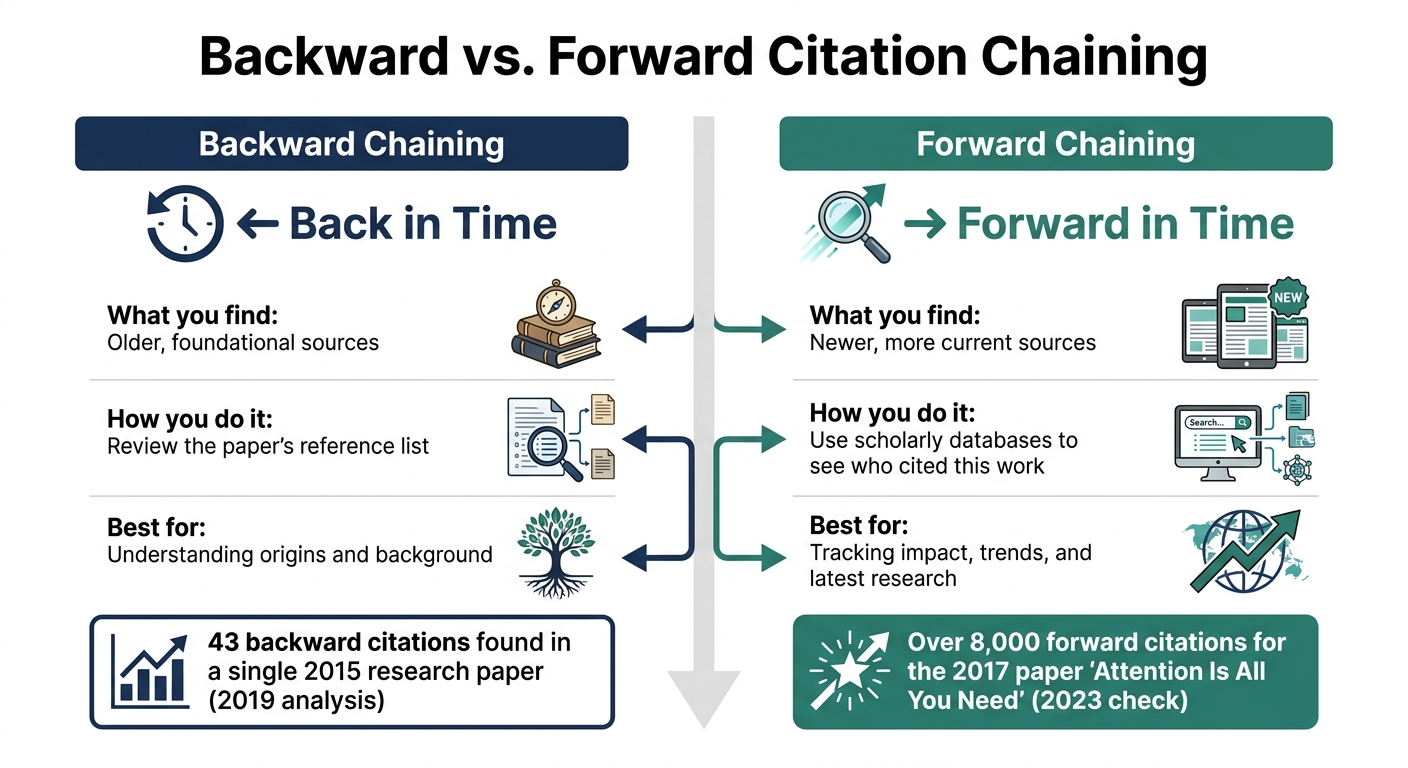
Backward chaining involves exploring the reference list of your seed article. These cited sources were published before the paper, helping you trace ideas back to their origins. This method is ideal for uncovering foundational studies, original theories, and early data that shaped the field.
Forward chaining, on the other hand, looks at who has cited your seed article since it was published. This approach highlights newer research, shows how the original findings have been used or challenged, and reveals the current state of the topic.
| Backward Chaining | Forward Chaining | |
|---|---|---|
| Direction | Back in time | Forward in time |
| What you find | Older, foundational sources | Newer, more current sources |
| How you do it | Review the paper's reference list | Use "Cited by" links in databases |
| Best for | Understanding origins and background | Tracking how a topic has evolved |
By combining these two methods, you get a well-rounded view of how a topic has developed over time. This balance is key to understanding the broader context of your research.
Why Researchers Use Citation Chaining
The main appeal of citation chaining is efficiency. A single strong paper can act as a gateway to dozens of related sources, saving you the effort of running multiple keyword searches. For instance, a 2019 analysis of one 2015 research article revealed that its reference list contained 43 backward citations - 43 potentially valuable sources from just one document.
Another advantage is source quality. Papers that appear repeatedly across multiple reference lists are often highly influential in their field. This method helps you not only find sources but also identify which ones are worth your attention. However, there’s a limitation: citation chaining might miss brand-new research that hasn’t had time to accumulate citations. To avoid blind spots, it’s best to pair this method with traditional keyword searches for a more comprehensive approach.
How to Do Backward Citation Chaining
Start by selecting 2–4 seed articles that are closely aligned with your research question. This keeps the process focused and prevents you from being overwhelmed by too many references at once. A smaller, carefully chosen starting point ensures your efforts stay purposeful. Once you've picked your seed articles, the next step is to evaluate their reference lists effectively.
What to Look for in a Reference List
Pay attention to the most impactful sources. Two types of papers should stand out: older, foundational works that established key theories or methods and recent studies (from the last 3–5 years) that indicate the latest trends in the field. For fast-evolving areas like AI or genomics, newer papers carry more weight. In contrast, in more established fields, foundational works are often the most critical.
The Citely Team offers a helpful tip:
"Stop when you start seeing the same papers cited repeatedly - that's a sign you've covered the core literature."
Once you've identified the most relevant references, it's essential to organize and evaluate them systematically.
How to Organize and Assess the Sources You Find
Before citing any source, make sure to read the full text. Relying solely on how a seed article describes another paper can lead to misinterpretations, as it reflects the original author's perspective rather than the full argument of the cited work.
To ensure quality, confirm that each source is indexed in a reputable database like Scopus or Web of Science, which guarantees peer-reviewed status. Additionally, check Retraction Watch to ensure the research hasn't been discredited. As your list of references grows, use tools like Zotero or Mendeley to manage citations efficiently. Exporting them in formats like RIS or BibTeX can save you significant time when you're ready to write.
| Evaluation Criteria | What to Check | How to Check It |
|---|---|---|
| Peer Review | Is it published in a reputable journal? | Scopus or Web of Science indexing |
| Recency | Is it current enough for your field? | Check the publication date (especially for tech/science) |
| Credibility | Has it been retracted? | Search on Retraction Watch |
| Relevance | Does it directly support your argument? | Read the abstract and conclusion |
For each article you choose, verify its peer-reviewed status, ensure it's recent enough for your field, check for retractions, and evaluate its relevance by skimming the abstract and conclusion before diving into the full text. This method keeps your research thorough and on track.
How to Do Forward Citation Chaining
While backward citation chaining helps you trace the roots of a topic, forward chaining takes you in the opposite direction - toward the latest research. It allows you to find newer studies that cite your original source, giving you a clear view of how the field has developed and where it's heading. Here's how you can efficiently use forward citation chaining with popular tools.
Using Google Scholar's 'Cited by' Feature
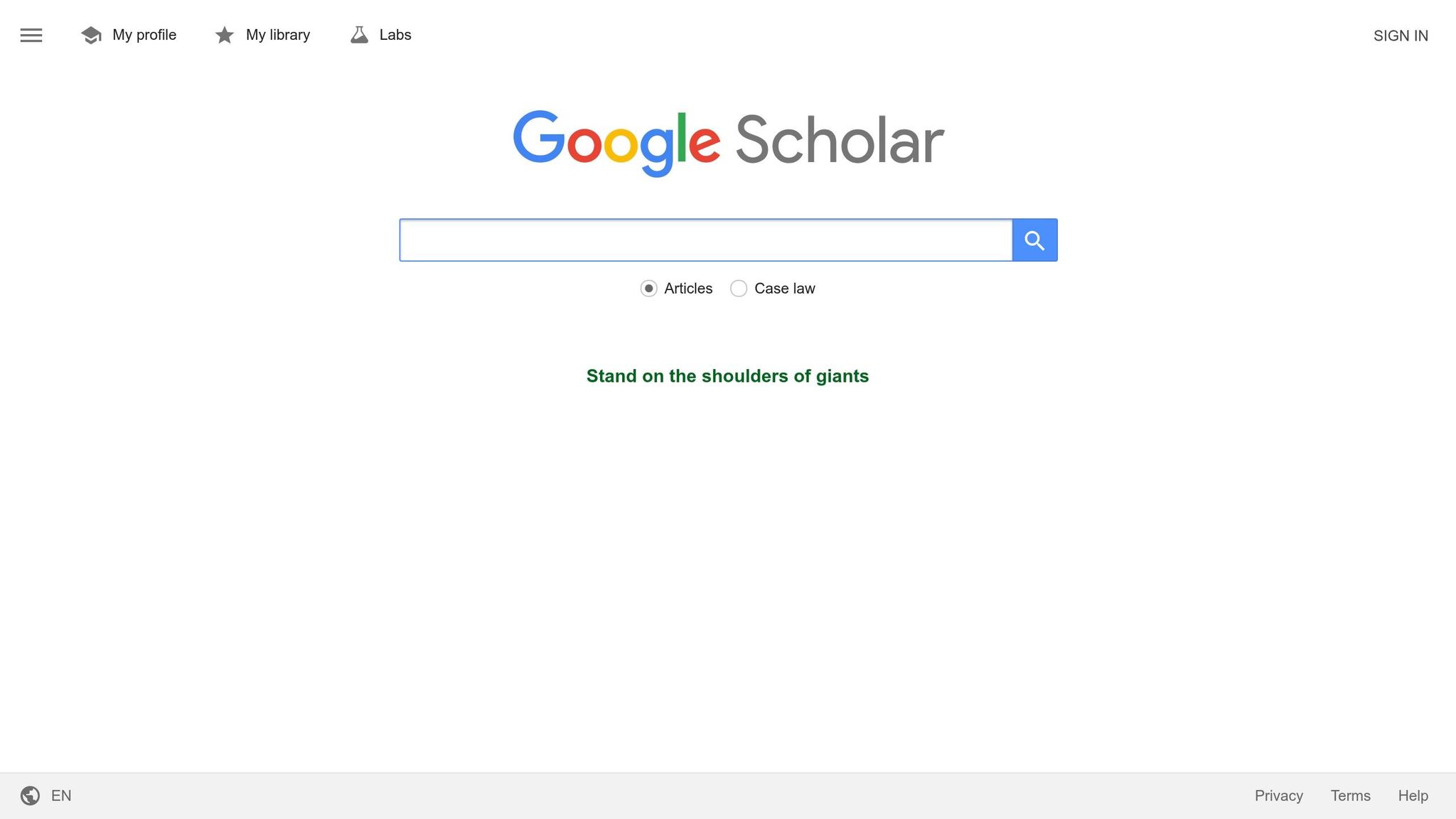
Start by searching for your paper's exact title on Google Scholar. Once you locate it, look for the "Cited by" link below the result. For example, it might say something like "Cited by 142." Clicking this link reveals a list of works that have cited your paper. From there, you can refine your search:
- Use the left sidebar to filter results by publication date. For instance, you can select "Since [Year]" to focus on recent citations.
- Enter specific keywords in the search bar to narrow the list to relevant citing papers.
- To stay updated, click the envelope icon in the sidebar to set up email alerts. This way, you'll know whenever a new study cites your source.
Keep in mind that forward citation chaining works best for papers that are at least a couple of years old. Newly published works often haven’t had enough time to gather citations.
What Forward Citation Chaining Adds to Your Research
Forward chaining does more than just expand your bibliography - it gives you insight into how your topic has evolved. It shows how later researchers have built upon, critiqued, or refined the original ideas. This method helps you map the progression of academic thought, offering a dynamic view of the scholarly conversation.
It’s also a great way to pinpoint the cutting edge of your field. As Dalhousie University Libraries explains:
"When you start finding that your articles aren't cited by many (or even any) other researchers, you've probably caught up to the most recent literature on the topic."
Finally, remember to check the peer-review status of the sources you find. Google Scholar includes a mix of content, such as pre-prints, dissertations, and other types of grey literature, which may not always meet the standards of peer-reviewed research.
How to Use Sourcely for Citation Chaining
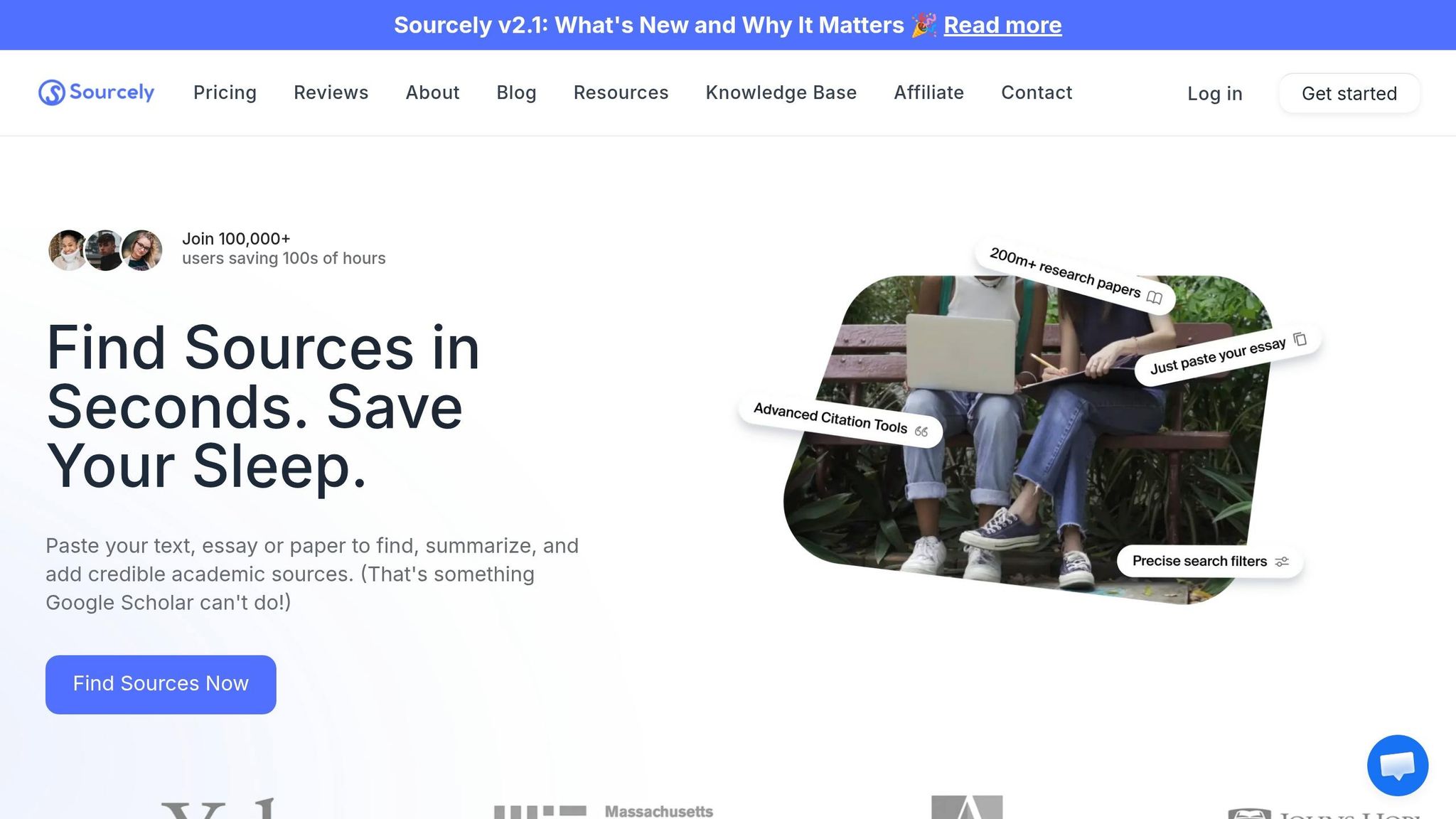
Sourcely takes the hassle out of citation chaining by leveraging advanced AI to simplify the process. If you've ever felt bogged down by manually sifting through endless references across multiple tabs, this tool might be your new best friend. Sourcely taps into a database of over 200 million academic papers, using the actual content of your writing - not just keywords - to surface the most relevant sources.
Step-by-Step: Citation Chaining with Sourcely
Start by pasting your draft into Sourcely. The tool analyzes your text and identifies peer-reviewed seed papers, giving you a strong starting point for your research.
Next, refine your results using the advanced search filters. You can sort by publication year to locate older, foundational studies for backward chaining or focus on newer works for forward chaining. Sourcely also highlights citation counts and journal impact factors, making it easy to spot influential papers that are perfect for anchoring your research.
Once you've pinpointed a paper, take advantage of the free PDF download feature to access the full text. From there, backward chaining becomes straightforward: head to the paper's reference list and pick out the sources that seem most relevant to your work.
These simple steps make it easy to dive deeper into Sourcely’s powerful features.
Key Features of Sourcely
Sourcely is built with citation chaining in mind, offering tools that make the process faster and more effective:
- AI-powered summaries help you quickly decide if a source is worth reading or exploring further.
- The "Chat with Sources" feature (introduced in Sourcely v2.1) lets you ask specific questions about a paper's content, helping you zero in on key ideas to trace through a citation chain.
- Credibility indicators - like citation counts, impact factors, and peer-review status - ensure you’re focusing on reliable and impactful sources.
- Automated citation formatting makes it easy to export your references in styles like APA, MLA, Chicago, Harvard, IEEE, or Vancouver.
With more than 100,000 researchers and students already using it, Sourcely’s extensive database ensures you won’t overlook critical papers that traditional keyword searches might miss.
How Citation Chaining Improves Your Research
How It Saves You Time
Traditional keyword searches can feel like a wild goose chase. You tweak your search terms, sift through countless results, and still end up with sources that don’t quite hit the mark. Citation chaining, on the other hand, eliminates much of that guesswork.
Here’s how it works: instead of starting fresh with every new search, you begin with a paper you already trust and let its references point you to other relevant studies. This method can lead you to dozens of connected sources - both foundational and recent - without needing to run another keyword search.
"For literature research, we read the research to understand the scholarly conversation of the topic, identify the gaps, and conduct our own research in the field to fill them." - David Gill, SFU Reference Librarian
Another major perk? Every source you find through citation chaining has already been vetted by the author of your starting paper. This means you're not just hoping a source is relevant - it’s practically built into the process. The result? A more efficient research workflow that not only saves time but also strengthens your academic foundation.
How It Strengthens Your Academic Work
But citation chaining isn’t just a time-saver. It also elevates the quality of your research by creating a cohesive scholarly narrative. This method helps you connect foundational studies with contemporary research, giving your work a sense of continuity and depth. Instead of collecting scattered sources, you’re building a web of interconnected ideas.
By tracing the evolution of key concepts, backward and forward chaining allow you to demonstrate how ideas in your field have progressed over time. This approach doesn’t just enrich your understanding - it also makes your paper stand out. A well-researched piece that cites influential authors, highly regarded journals, and a clear progression of studies shows that you’ve done more than skim the surface.
As Rowan University aptly puts it, scholarship is a conversation, and citation chaining ensures you’re following that conversation from its origins to its latest developments.
Conclusion: Getting the Most Out of Citation Chaining
Citation chaining is a powerful research technique that often flies under the radar. By starting with a reliable paper, you can work backward to uncover foundational studies or move forward to spot the latest developments. Together, these approaches provide a broader and deeper understanding of any topic than keyword searches alone.
That said, citation chaining works best when paired with traditional search methods. As the UNBC Library Guide wisely notes:
"Citation chaining is one part of the search process and should not be the exclusive method of uncovering additional articles."
Using both approaches ensures you won't miss recent publications or other key resources.
To get the most out of citation chaining, here are a few practical tips:
- Start with review articles - they’re packed with relevant citations, saving you time.
- Check publication dates before forward chaining to ensure enough time has passed for others to cite the paper.
- Always confirm whether a source has been peer-reviewed.
If you want to streamline the process even further, tools like Sourcely can be a game-changer. Instead of manually sifting through reference lists or juggling multiple databases, Sourcely helps you find relevant sources, verify their credibility, and stay organized - all in one place. It’s a smarter way to manage your research workflow.
FAQs
How do I pick the best seed paper?
A strong seed paper should be relevant, credible, and recent. Focus on articles that are widely cited, authored by respected researchers, and published in reputable journals. These attributes make the paper an excellent foundation for citation chaining, allowing you to quickly discover other high-quality sources that align with your research.
When should I stop citation chaining?
When conducting research, it's important to know when to stop citation chaining. You should pause once you've fully explored both the backward and forward directions of the citation network and aren't uncovering any new, relevant, or credible information. Specifically, stop when:
- You've reviewed the reference list from your starting paper (backward chaining) and identified the key foundational sources.
- You've examined the studies that cite your starting paper (forward chaining) and located the most recent and relevant research.
This approach keeps your research efficient and focused, preventing unnecessary repetition or wasted effort.
How can I tell if a source is trustworthy?
When evaluating a source, start by checking if it’s published in a peer-reviewed journal or a reputable publication. Pay attention to the author's credentials - do they have expertise in the subject area? The content should be objective and supported by solid evidence. A high number of citations can also indicate that the work is well-regarded in its field. Additionally, check the publication date to ensure the information is still relevant. You can also use citation chaining - reviewing the references and citations within the paper - to further assess its academic value and relevance.