Forward and Backward Citation Search: How to Follow the Research Trail
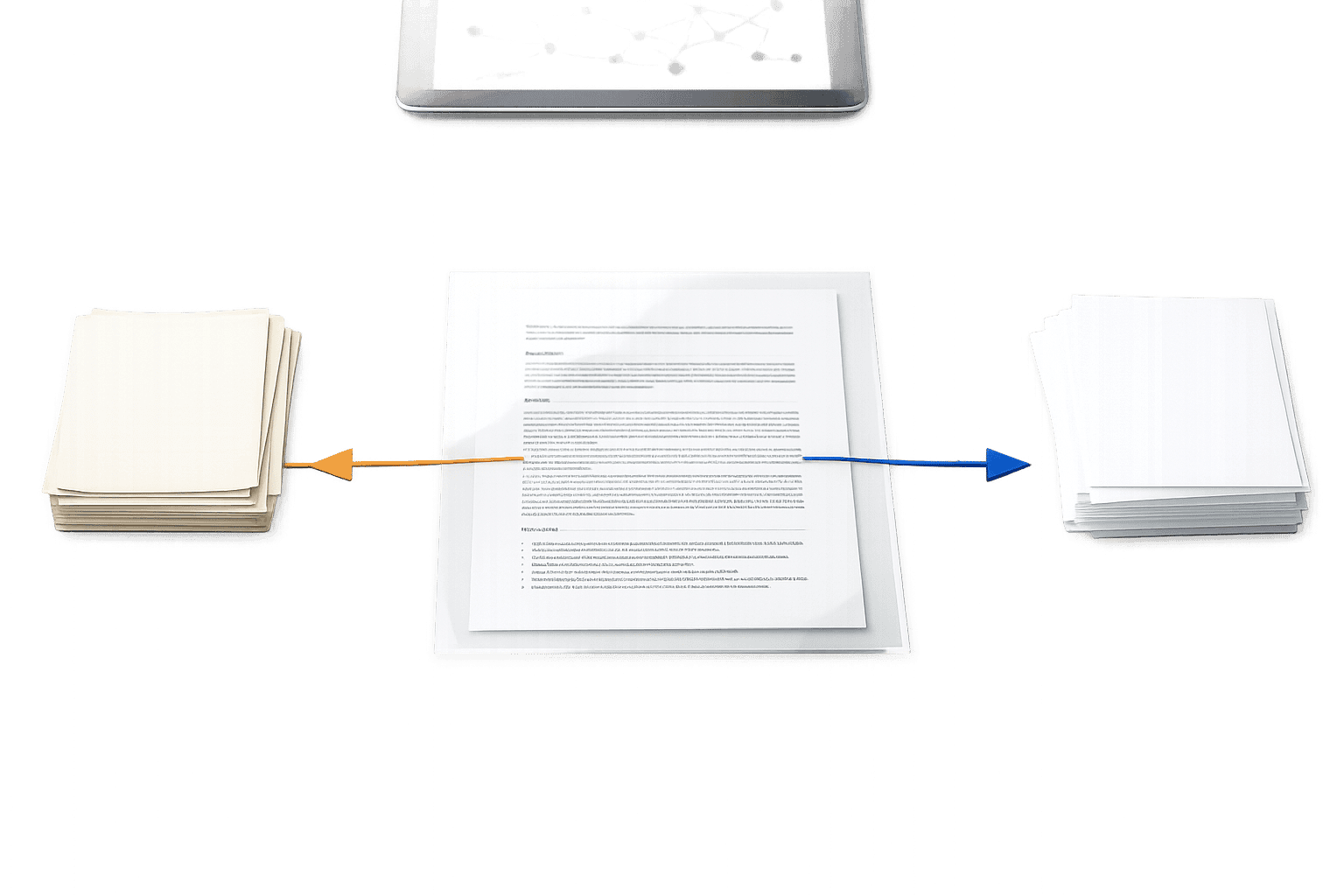
Citation searches help researchers trace the connections between studies, moving beyond keyword searches to uncover the relationships between ideas. There are two main methods:
- Backward Citation Search: Looks at a paper’s references to identify earlier studies it builds upon.
- Forward Citation Search: Finds newer studies that cite the original paper to see how it influenced later research.
Both methods reveal the historical and future context of a topic, helping you understand how ideas evolve. Tools like Google Scholar, Scopus, and Web of Science simplify this process. AI tools like Sourcely further streamline the search by analyzing context and suggesting relevant sources, saving time and effort.
Using these techniques together ensures a thorough exploration of your research topic, providing a full view of the academic conversation.
FORWARD and BACKWARD Citation Chasing with FOUR TOOLS | Five Minute Friday
sbb-itb-f7d34da
What Is Backward Citation Search?
A paper's reference list acts as a guide to the earlier research that influenced its findings. Backward citation search involves diving into this list to uncover the works that laid the groundwork for the paper. By tracing these references, you gain a deeper understanding of the foundational research in a particular field. Let’s break down how this process works and why it’s so useful.
"When you look at the references cited in a particular article, you are looking back in time. All cited articles were, necessarily, published before the current article." - UC Berkeley Library
This approach is often called citation chaining (or snowballing). The idea is simple: start with one strong, relevant paper and use its reference list as a springboard to explore earlier, influential studies.
How Backward Citation Search Works
To begin, you need a peer-reviewed article that’s highly relevant to your research. This article serves as your starting point, or "seed." By reviewing its reference list, you can identify key works that are directly related to your topic. Tools like Scopus and Web of Science make this process easier by offering clickable "References" links, allowing you to quickly access the cited works. For example, one 2015 article led to a chain of 43 cited sources, showcasing how one paper can open the door to a wealth of foundational studies. Each cited source can then become a new seed, creating a continuous trail of research. This method not only helps uncover critical studies but also highlights how ideas and theories have evolved over time.
Benefits of Backward Citation Search
This process offers several clear advantages. One of the biggest is thoroughness. Since you’re working directly from a paper’s reference list, you’re not limited by what a specific database might index.
"For backward citation chasing, it's easy to be sure you have all the references, since you have the original source itself right in front of you." - University of Connecticut Library
Another benefit is the ability to understand the historical development of a research field. According to the University of Illinois at Urbana-Champaign, "Citation chasing can help you become more familiar with themes in your research area that span different time periods, researchers, and disciplines." This broader perspective allows you to build a bibliography that doesn’t just gather sources but also maps the evolution of ideas and highlights where gaps in research may exist. Importantly, backward citation search works hand-in-hand with forward citation search, giving you a complete picture by first establishing a historical foundation before exploring more recent developments.
What Is Forward Citation Search?
Unlike backward citation search, which looks into a paper’s references to uncover earlier studies, forward citation search focuses on identifying newer research that cites a particular paper. Instead of asking, "What did this paper reference?" you’re asking, "Who has referenced this paper?"
"Forward Citation Search... looks forward in time to see how this article contributed to the scholarly conversation." - Brown University Library
This approach, also referred to as cited reference searching or pearl growing, begins with a key "seed" paper. By using a citation database, you can trace all subsequent studies that have cited it, providing a picture of how the idea has evolved over time.
How Forward Citation Search Works
Forward citation search essentially maps the trajectory of an idea by tracking studies that cite a particular paper.
Start with a paper that’s highly relevant to your research. Use platforms like Google Scholar, Web of Science, or Scopus to find its "Cited by" or "Times Cited" count. These tools will list all the works that have cited the paper since its publication.
For best results, choose a seed paper that’s at least two to three years old. This allows enough time for the work to have been cited in follow-up studies.
If the paper has been cited extensively, filtering becomes crucial. Google Scholar’s "Search within citing articles" feature can help you narrow the results by keyword, making it easier to focus on the most relevant studies.
Benefits of Forward Citation Search
The main advantage of forward citation search is its ability to uncover research that keyword searches might miss. It’s particularly effective for identifying new trends, follow-up studies, and ongoing discussions that build upon a foundational idea.
"Finding out whether a work has been cited after its publication will help you assess the importance of that work and how it has shaped subsequent research and scholarship." - Williams College Libraries
This method also provides insight into a study’s influence by showing how often and in what contexts it has been cited. For instance, librarian David Gill from Simon Fraser University demonstrated this in 2019 by conducting a forward search on a 2015 article by Hole et al. His results varied across platforms: 7 citations in the SFU Library Catalogue, 15 in Web of Science, and 36 in Google Scholar. Google Scholar even captured additional sources like graduate theses and ResearchGate papers that other databases missed. This example highlights the importance of leveraging multiple tools to get a comprehensive view.
Tools for Citation Searching
Manually tracking citations can be a tedious and error-prone process. Sorting through hundreds, or even thousands, of references can consume hours before you even start analyzing the content.
Why Use Dedicated Tools for Citation Searches?
Traditional citation searches often struggle with scale. A broad keyword search might return tens of thousands of results, leaving you to comb through countless abstracts. AI-driven tools, however, take a different approach. Instead of relying on basic keyword matching, they analyze the meaning and context of your work to highlight the most relevant and impactful sources.
"Unlike basic keyword search, our AI understands the meaning and context of your writing." - Sourcely
Key Features of Sourcely
Sourcely is a platform specifically tailored for academic research. It draws from an extensive database of over 200 million papers and is trusted by more than 100,000 researchers. By simply pasting a paragraph or thesis statement into the tool, the AI can pinpoint which claims need supporting evidence and suggest relevant sources.
Sourcely offers features designed to make citation searching faster and more effective:
- Citation Counts and Journal Impact Factors: These metrics are displayed alongside every result, helping you quickly assess a paper's influence.
- Deep Search: Available with the Ultra ($19/month, billed annually) and Max ($39/month, billed annually) plans, this feature digs beyond surface-level results to uncover niche foundational papers that might otherwise go unnoticed.
- Instant Citation Export: Export references instantly in popular styles like APA (7th Ed.), MLA (9th Ed.), Chicago, Harvard, IEEE, and Vancouver.
| Feature | What It Does | Why It Matters for Citation Searches |
|---|---|---|
| AI Relevance Scoring | Ranks sources based on how well they support your argument | Helps identify key foundational work for backward citation searches |
| Citation Counts | Displays the number of times a paper has been cited | Highlights influential papers for forward citation tracking |
| Deep Search | Scans deeply into academic literature | Reveals "hidden" connections that standard searches might miss |
| Source Summaries | Provides concise overviews of each paper | Speeds up the process of evaluating whether a source is worth exploring |
Pro Tip: For the best results, paste a specific claim or sentence that needs a citation rather than a broad topic. This allows the AI to focus on the core concept and find sources that directly support your argument.
How to Run Backward and Forward Citation Searches
Understanding the concept of citation searches is just the beginning. Knowing how to actually perform these searches is where the magic happens. Here's a breakdown of how to run both backward and forward citation searches effectively, whether you're doing it manually or with the help of AI tools.
Step-by-Step: Backward Citation Search
A backward citation search helps you uncover the sources a particular paper has referenced. It's like tracing the roots of an idea back to its origin.
-
Start with a relevant paper
Find a study that closely matches your research topic. A recent review article or a highly cited foundational paper is often a great starting point because their reference lists are usually rich with valuable sources. -
Access the reference list
Open the bibliography section of the paper. Since most databases don't offer automated backward search tools, you'll need to review these references manually. -
Spot the key references
Look for titles that directly relate to your research. Papers that appear in the bibliographies of multiple sources are often crucial works in the field. -
Use Sourcely for additional insights
Copy a key claim or sentence from your paper and paste it into Sourcely. This AI tool scans its database to find sources that back up that specific argument, including older foundational works that might not show up in a typical keyword search. -
Retrieve and evaluate the sources
Use your institution's library or Sourcely's PDF feature to access the full text of each reference. Skim abstracts and introductions to confirm their relevance to your research.
By following these steps, you'll gain a clearer picture of the foundational work that has shaped your area of study.
Step-by-Step: Forward Citation Search
A forward citation search flips the process. Instead of looking at a paper's sources, you find newer works that have cited it. This approach helps you see how a study has influenced ongoing research.
"Academic research and publication is a conversation that researchers are having over time." - David Gerstle, Research Services & Liaison Librarian, University of Toronto
Forward searches work best with papers that already have a track record of citations. Here's how to manually perform a forward search on popular platforms:
-
Google Scholar
Search for the full title of the paper. Underneath the result, click the "Cited by [number]" link. To refine your results, use the "Search within citing articles" option. -
Scopus
Locate the article and click "View all citing documents" in the side panel. -
Web of Science
Search by title (set the search field to "Title") and click the "Times Cited" count next to the result.
Each database has its strengths. For example, in a real-world test involving a 2015 article on Aboriginal health care, Google Scholar returned 36 forward citations, while Web of Science only found 15. Google Scholar tends to have higher counts because it includes grey literature, such as dissertations, pre-prints, and institutional repositories, which traditional databases often overlook.
"There's no way to search comprehensively in a forward direction using a single database or other tool." - University of Connecticut Library
To get the most complete results, use multiple platforms. Combining manual searches with tools like Sourcely ensures you don't miss crucial sources that might not appear in keyword-based searches.
Manual vs. AI-Assisted Citation Searches: A Direct Comparison
Manual vs. AI-Assisted Citation Search: Key Differences
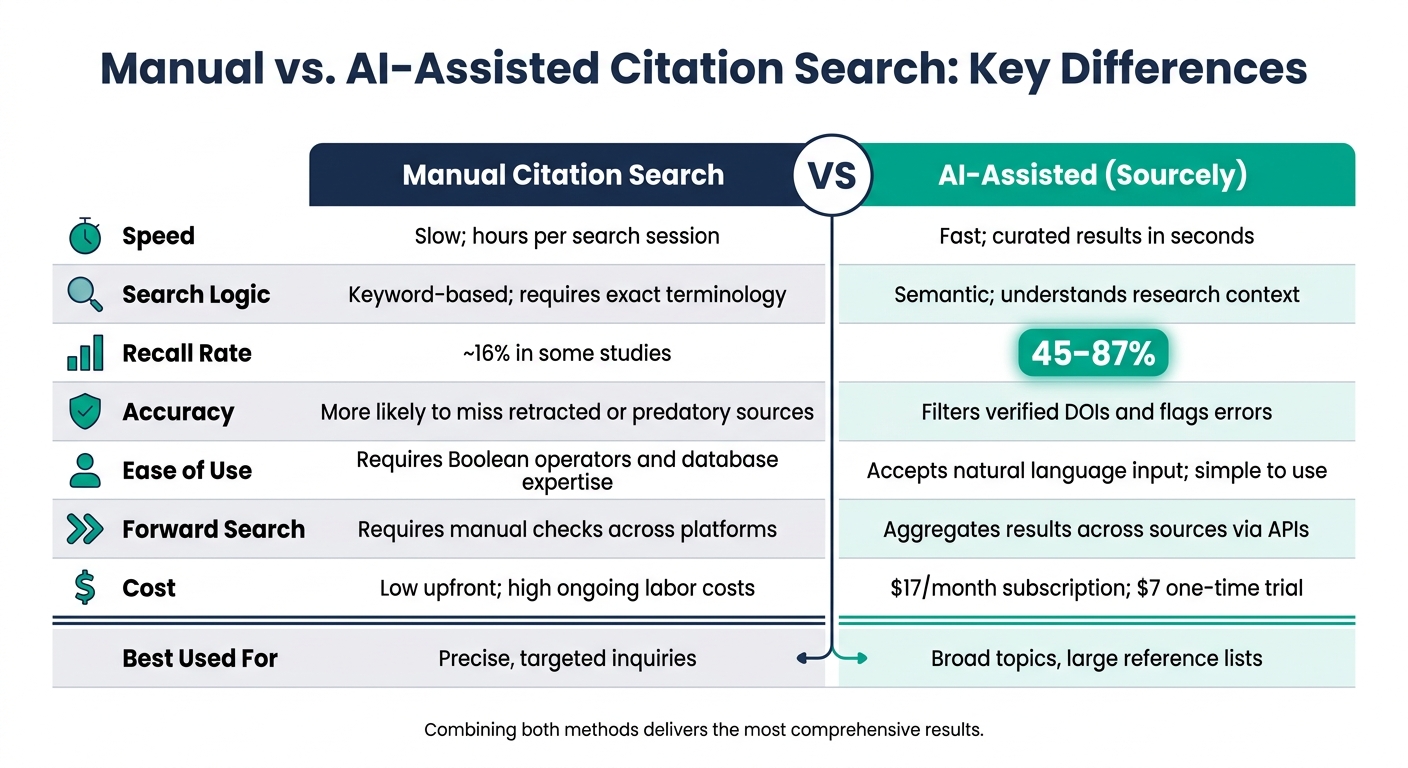
Manual and AI-assisted citation searches differ in terms of speed, scope, and the effort required. Understanding these distinctions can help researchers decide which method suits their needs best for efficient citation searching.
Manual searches rely heavily on exact keyword matches, which can leave out relevant studies that use different terminology. For instance, a study on biomedical literature revealed that manual keyword searches in PubMed retrieved only about 16% of relevant articles. In contrast, citation-based searches improved sensitivity to 45–54%.
AI-assisted tools, on the other hand, employ semantic search to identify conceptually related studies. They also have the added advantage of automatically filtering out retracted or erroneous citations.
While manual searches come with minimal upfront costs, they are time-consuming and labor-intensive. AI tools, though requiring a $17 monthly subscription, save significant time by delivering results almost instantly. Here’s a breakdown of the differences:
Comparison Table
| Factor | Manual Citation Search | AI-Assisted (Sourcely) |
|---|---|---|
| Speed | Slow; hours per search session | Fast; curated results in seconds |
| Search Logic | Keyword-based; requires exact terminology | Semantic; understands research context |
| Recall | Low (~16% in some studies) | Moderate-to-high (45–87%) |
| Accuracy | More likely to miss retracted or predatory sources | Filters for verified DOIs and flags errors |
| Ease of Use | Requires Boolean operators and database expertise | Accepts natural language input; simple to use |
| Forward Search | Requires manual checks across platforms | Aggregates results across sources via APIs |
| Cost | Low upfront; high ongoing labor costs | $17/month subscription; $7 one-time trial |
Each approach has its strengths. Manual searches are ideal for precise, targeted inquiries, especially when you know exactly what you're looking for. Meanwhile, AI-assisted tools shine in their ability to quickly cover broad topics or verify extensive reference lists. Combining both methods can offer the best of both worlds: AI tools can generate a curated shortlist, which researchers can then refine and expand through manual forward and backward searches.
Conclusion: Getting More Out of Your Research with Citation Searches
Citation searching offers a solid foundation for research by uncovering a paper's core ideas and showing how those ideas shape and influence the field over time.
"To understand this conversation, you need to collect what has been said before the point where you joined. You also need to collect what has been said after that same point." - University of Toronto Library
Take, for example, a graduate thesis literature review, which might require 50–100 sources. Relying only on keyword searches can leave out key studies. Using both backward and forward citation searches helps fill in those gaps, ensuring your research reflects the full scope of the academic conversation rather than just fragments.
To make this process easier, tools like Sourcely can be a game-changer. By entering plain-language research questions, you get a curated list of verified papers in seconds. With its budget-friendly subscription model, Sourcely speeds up the early stages of source discovery.
No single method can capture every angle of scholarly research. Combining AI-powered tools with focused citation searches ensures your work is both thorough and efficient. Start with a strong foundational paper, follow the citation trail in both directions, and carefully review your sources to ensure nothing important is missed.
FAQs
When should I use forward vs. backward citation search?
When diving into research, a backward citation search helps you explore the sources that an original publication references. This gives you insight into the foundational ideas and earlier studies that shaped the work. On the other hand, a forward citation search identifies newer studies that cite the original publication. This highlights how the research has been expanded upon or applied since it was published. Simply put, backward tracing looks at the research's roots, while forward tracing examines its ongoing influence.
How do I pick a good “seed” paper to start citation chaining?
When selecting a paper in your research area, aim for one that is recent, widely cited, and impactful. Look for publications that embody core ideas or breakthroughs related to your topic. A well-chosen paper serves as a strong foundation, guiding you to high-quality references through both backward and forward citations. Focus on works that closely align with your research goals to ensure the citation trail leads to relevant and valuable insights.
How can Sourcely speed up citation searching without missing key papers?
Sourcely speeds up the process of citation searching by automating both backward and forward searches. Here's how it works:
- Backward searching: It digs into the references listed in a key article to uncover foundational sources.
- Forward searching: It identifies newer articles that have cited the original work, keeping you updated on recent developments.
This approach not only saves you time but also ensures you cover all relevant materials without the hassle of manual browsing or juggling multiple databases.