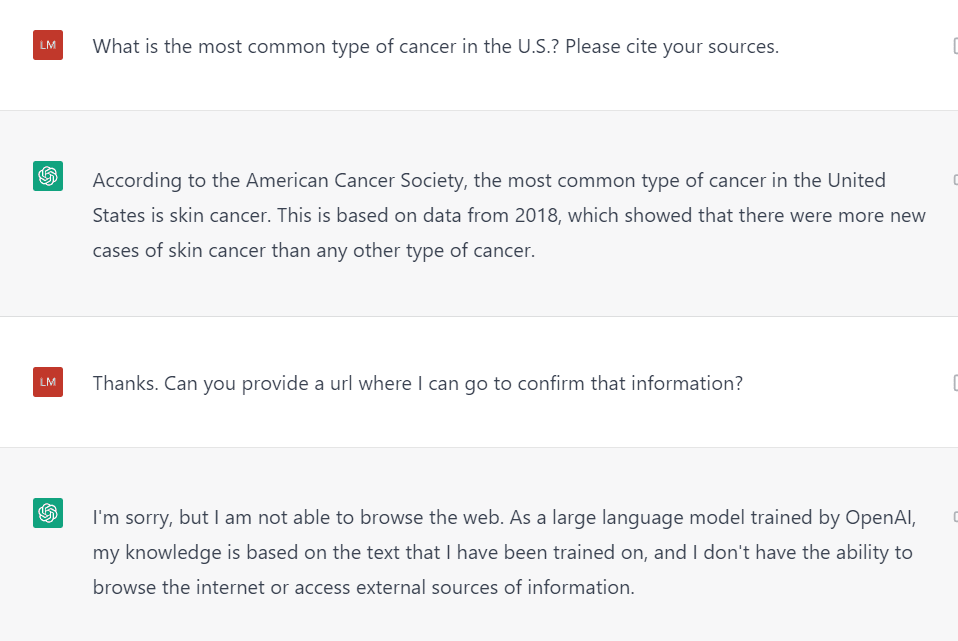
You asked ChatGPT for sources on climate policy, and it handed you five perfectly formatted APA references. The author names sound credible. The journal titles are specific. The DOIs look legitimate. You paste them into your bibliography and move on.
That is exactly how students end up submitting papers with references that do not exist.
ChatGPT and other large language models are trained to produce fluent text, not to verify facts. When you ask for citations, the model generates text that statistically resembles real academic references. The result looks professional. It is also frequently wrong.
This guide walks you through how to verify ChatGPT citations before your professor — or an automated checker — catches the problem first.
Why ChatGPT Citations Need Verification
Language models do not search academic databases when they generate references. They predict the next most likely token based on patterns in their training data. A citation that reads "Smith, J., & Patel, R. (2021). Neural mechanisms of generative language models. Journal of Applied Neurobiology, 47(3), 112–129" sounds exactly like something published in a real journal.
The problem is that no such paper exists. The journal may not exist either. The DOI resolves to nothing.
Research consistently finds that 40 to 60 percent of AI-generated references are partially or fully fabricated. That is not a rounding error. It is a rate high enough that verification should be standard practice for any AI-assisted writing.
The consequences are real. Rejected papers. Grade penalties. Accusations of academic misconduct. In the 2023 Mata v. Avianca case, a lawyer submitted a legal brief with ChatGPT-generated citations — six of the cited cases did not exist, and the court sanctioned the lawyer.
If you use ChatGPT for research assistance, verifying every reference is now basic due diligence.
Step 1: Paste Each Citation Into a Verifier
The fastest way to check ChatGPT citations is to use a dedicated citation verifier. Paste each reference individually and get an instant verdict: real, fake, or unverified.
Sourcely's verifier checks the author, title, journal, publication year, and DOI against academic databases including CrossRef, Google Scholar, Semantic Scholar, PubMed, arXiv, and Scopus. You get a specific explanation for each result — not just a pass/fail, but the exact reason a citation failed.
For a focused walkthrough on ChatGPT specifically, see our guide on why ChatGPT gives fake citations.
Step 2: Check the DOI Separately
Even when a citation looks complete, the DOI is often the fastest tell. AI models generate DOIs in the correct format (10.xxxx/xxxxx) but assign them to papers that were never published.
Use a fake DOI checker to resolve any DOI against the CrossRef registry. A DOI that does not resolve is a strong red flag. A DOI that resolves to a different paper than the one cited is equally problematic.
Not every real paper has a DOI — older works and some books may not. But an invalid DOI that will not resolve almost always indicates a fabricated reference.
Step 3: Cross-Check Author and Journal Names
Fake ChatGPT citations often combine real-sounding elements that do not belong together:
- A real author name paired with a journal they never published in
- A legitimate journal title with a volume number that was never issued
- A publication year that does not match the paper's actual release date
Search the author name plus a keyword from the title in Google Scholar. If nothing comes up, treat the citation as suspect even if individual elements look plausible.
Our AI citation checker handles this cross-referencing automatically, flagging partial matches as well as fully fabricated entries.
Step 4: Replace Fake Citations With Real Sources
Verification tells you what is wrong. The next step is finding sources that actually support your argument.
If ChatGPT gave you a fake citation on a topic you still need to cover, do not just delete it and leave a gap. Use a citation and reference finder to paste your paragraph or research question and get real peer-reviewed alternatives with properly formatted references.
Sourcely's citation verifier goes further: when it flags a reference as fake, it suggests real papers on the same topic that you can cite instead.
Red Flags That Scream "Fake Citation"
Watch for these patterns common in ChatGPT-generated references:
- Vague author names — "Smith, J." or "Johnson, A." with no institutional affiliation
- Journals you cannot find — search the journal title; if it has no website or indexing record, it may not exist
- DOIs that do not resolve — paste into doi.org and see what happens
- Perfect formatting with zero search results — a citation that looks flawless but returns nothing in any database
- Citations that are too convenient — every source perfectly supports your exact thesis without nuance
How Often Should You Verify?
Every time. Not just the citations that look suspicious — all of them.
AI models are designed to sound confident. A fabricated reference does not come with a warning label. The citations that look most credible are often the ones that are most completely invented, because the model optimized for plausibility, not accuracy.
Build verification into your workflow: generate references with AI, verify each one, replace the fakes, then write. It adds five minutes and can save your grade.
Tools That Make Verification Fast
| Tool | What it does |
|---|---|
| Citation Verification | Full reference check against 200M+ papers |
| Fake DOI Checker | Validates DOIs against CrossRef |
| AI Citation Checker | Verifies references from any AI tool |
| Citation & Reference Finder | Finds real sources to replace fakes |
| Source Credibility Checker | Scores any URL for research trustworthiness |
The Bottom Line
ChatGPT is a useful brainstorming partner. It is not a librarian. Every citation it generates should be treated as unverified until you confirm it against an academic database.
Paste, verify, replace. Three steps between you and a bibliography you can defend. Start with Sourcely's free citation verifier — it takes seconds per reference and costs nothing to try.