AI Citation Checkers: Can They Catch Broken, Fake, or Misused References?
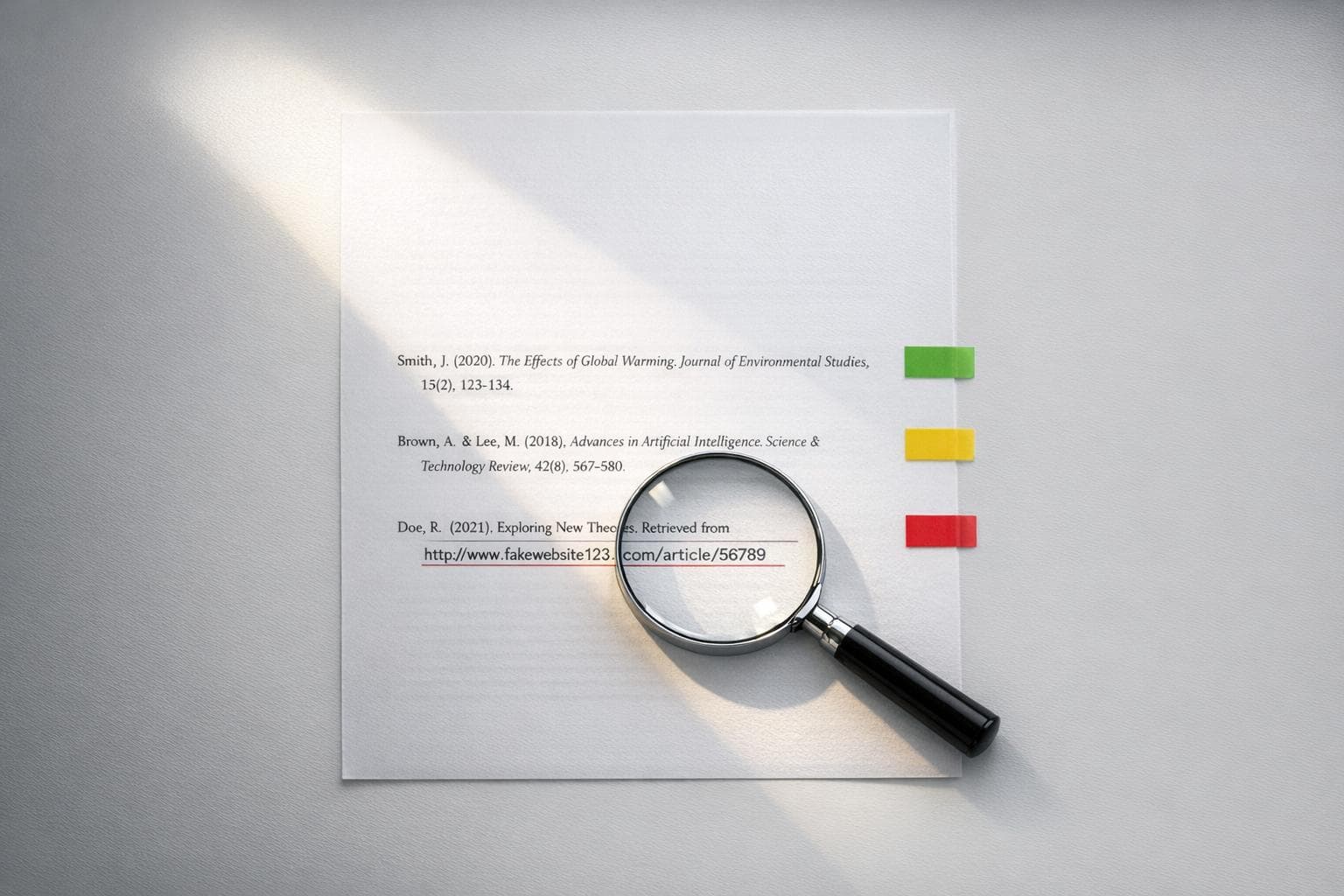
AI citation checkers are tools designed to verify the accuracy of references in academic writing. They address issues like broken links, fabricated citations, and mismatched metadata. With the rise of AI-generated content, these tools are crucial for maintaining research integrity. Here’s what you need to know:
- Broken References: Tools like RefCheckAI and Citely flag DOIs, URLs, or identifiers that don’t resolve or lead to incorrect sources.
- Fake References: AI tools identify fabricated citations by cross-referencing databases like CrossRef, PubMed, and Semantic Scholar.
- Misused References: They detect mismatches where valid citations are paired with incorrect metadata, such as wrong authors or publication details.
Popular tools include:
- RefCheckAI: Open-source, uses APIs and deep web searches for verification.
- NVIDIA's Semantic Validation: Multi-step verification with escalating checks.
- Citely: Matches metadata against 200M+ records from major academic databases.
- Sourcely: Focuses on semantic matching to replace problematic references.
Key takeaway: AI citation checkers are essential for verifying references, but researchers must still ensure proper citation use within their work.
Citation Checker: Spot AI Hallucinations & Find Real Sources
sbb-itb-f7d34da
1. RefCheckAI
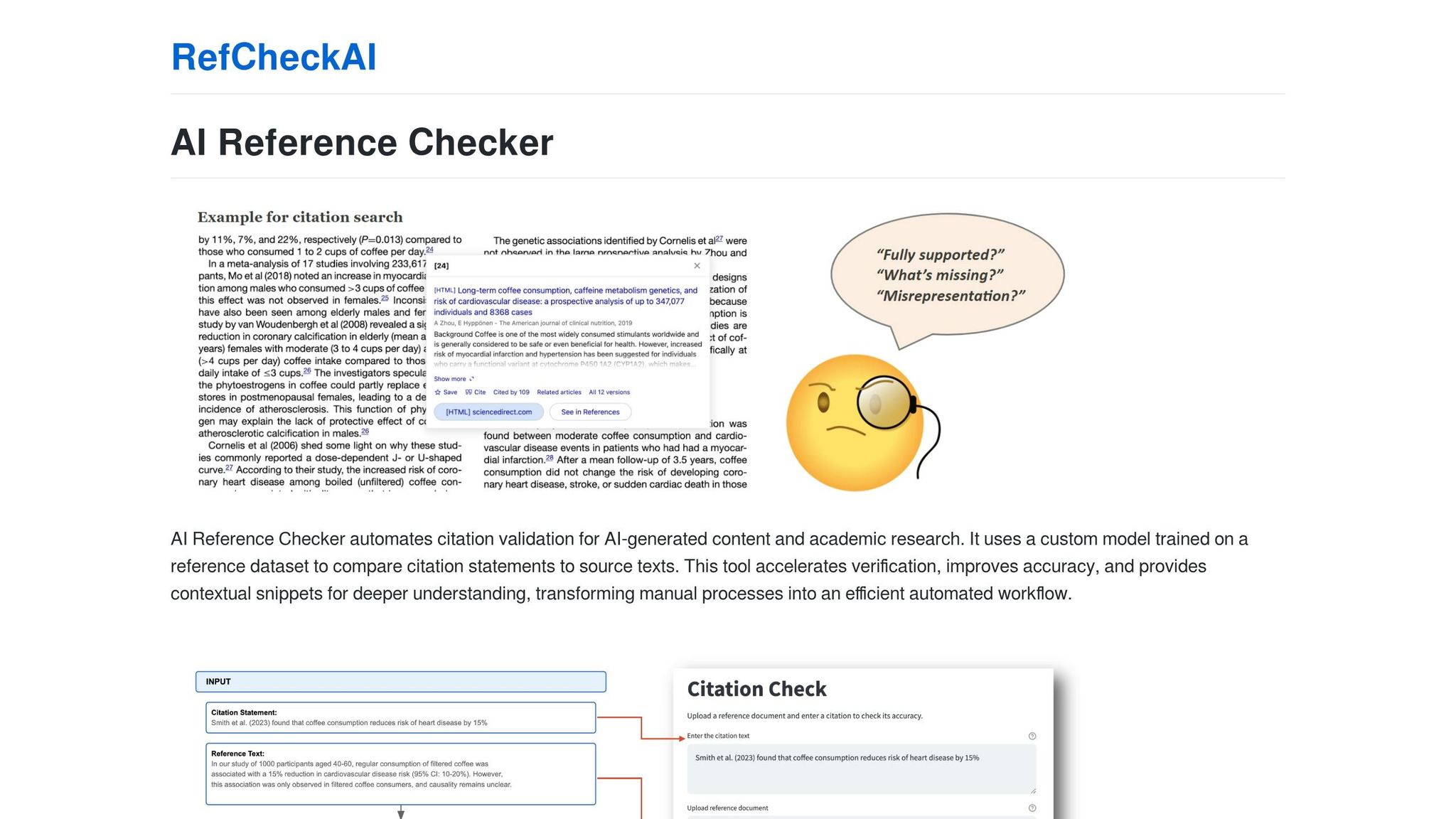
RefCheckAI is an open-source tool available on GitHub designed to verify the existence and accuracy of citation metadata. It can be deployed locally using Docker or pip, though detailed verification requires API keys from providers like OpenAI, Anthropic, or Google.
Detection of Broken References
The tool identifies broken references by resolving DOIs, ArXiv IDs, and URLs. For example, if a DOI leads to a 404 error or points to a different paper, RefCheckAI flags it as an "Identifier conflict." Similarly, broken URLs trigger a "URL verification failure." This ensures that errors are caught when links are followed.
Detection of Fake References
RefCheckAI uses a three-step process to uncover potentially fabricated citations:
- Pre-filtering: References absent from major databases, with identifier conflicts, or with fewer than 60% matching authors (for papers with three or more authors) are flagged.
- Web search: Flagged references are sent to a large language model (e.g., OpenAI, Anthropic, Google, or Azure), which performs a deep web search to find a dedicated page for the work.
- Metadata verification: If a potential match is located, the tool cross-checks the title, author, and year against the retrieved metadata. Based on this, it assigns a verdict: LIKELY (probably fabricated), UNCERTAIN (inconclusive), or UNLIKELY (probably real).
Detection of Misused References
The tool is adept at spotting "chimera" references, where a valid DOI is paired with incorrect or fabricated metadata. It cross-references cited information with databases like Semantic Scholar, OpenAlex, CrossRef, DBLP, and ACL Anthology, flagging mismatches in titles, authors, publication years, or venues. A BERT-based smart matching system accounts for minor formatting differences, ensuring accuracy across various academic formats.
Integration with Academic Tools
RefCheckAI supports inputs such as ArXiv IDs, PDFs, LaTeX files (.tex), BibTeX files (.bib/.bbl), and plain text. It also integrates with OpenReview, enabling users to scan entire conference paper lists with a single command. Using a SEMANTIC_SCHOLAR_API_KEY significantly speeds up the process, reducing verification time from around 10 seconds per reference to just 1–2 seconds.
By addressing broken, fake, and misused citations, RefCheckAI strengthens the reliability of academic research.
"RefChecker verifies citations against Semantic Scholar, OpenAlex, CrossRef, DBLP, and ACL Anthology, and uses LLM-powered deep web search to flag likely fabricated references." - markrussinovich/refchecker
2. NVIDIA's Semantic Citation Validation

NVIDIA's Semantic Citation Validation isn't a standalone product but rather an AI-driven method for auditing citations. It leverages semantic databases in a multi-step verification process. This approach has been explored by NVIDIA and other research-focused organizations to address challenges in large-scale AI systems and document verification.
Detection of Broken References
The system begins with pre-filtering to identify broken references right away. It flags URLs that are broken or misdirected before diving into deeper analysis. This initial step helps eliminate obvious errors quickly and efficiently.
Detection of Fake References
The process includes a Verification Protocol that treats all citations as unverified until they are cross-checked against multiple databases like Semantic Scholar, Google Scholar, and CrossRef. What sets this apart is its multi-stage hallucination detection system. Instead of a single-pass check, the system applies escalating layers of scrutiny. It flags references that fail database lookups, show identifier conflicts, or lack sufficient overlap in authorship details.
Detection of Misused References
The semantic validation method also identifies misused references, where valid papers are cited inaccurately. It does this by comparing details such as titles, authors, publication years, and venues against authoritative sources. This thorough process ensures that even subtle mismatches are caught.
Integration with Academic Tools
Currently, there’s no evidence of integration with external academic platforms like OpenReview or LaTeX-based workflows. This limitation could pose challenges for researchers who depend on seamless, end-to-end research tools.
3. Citely
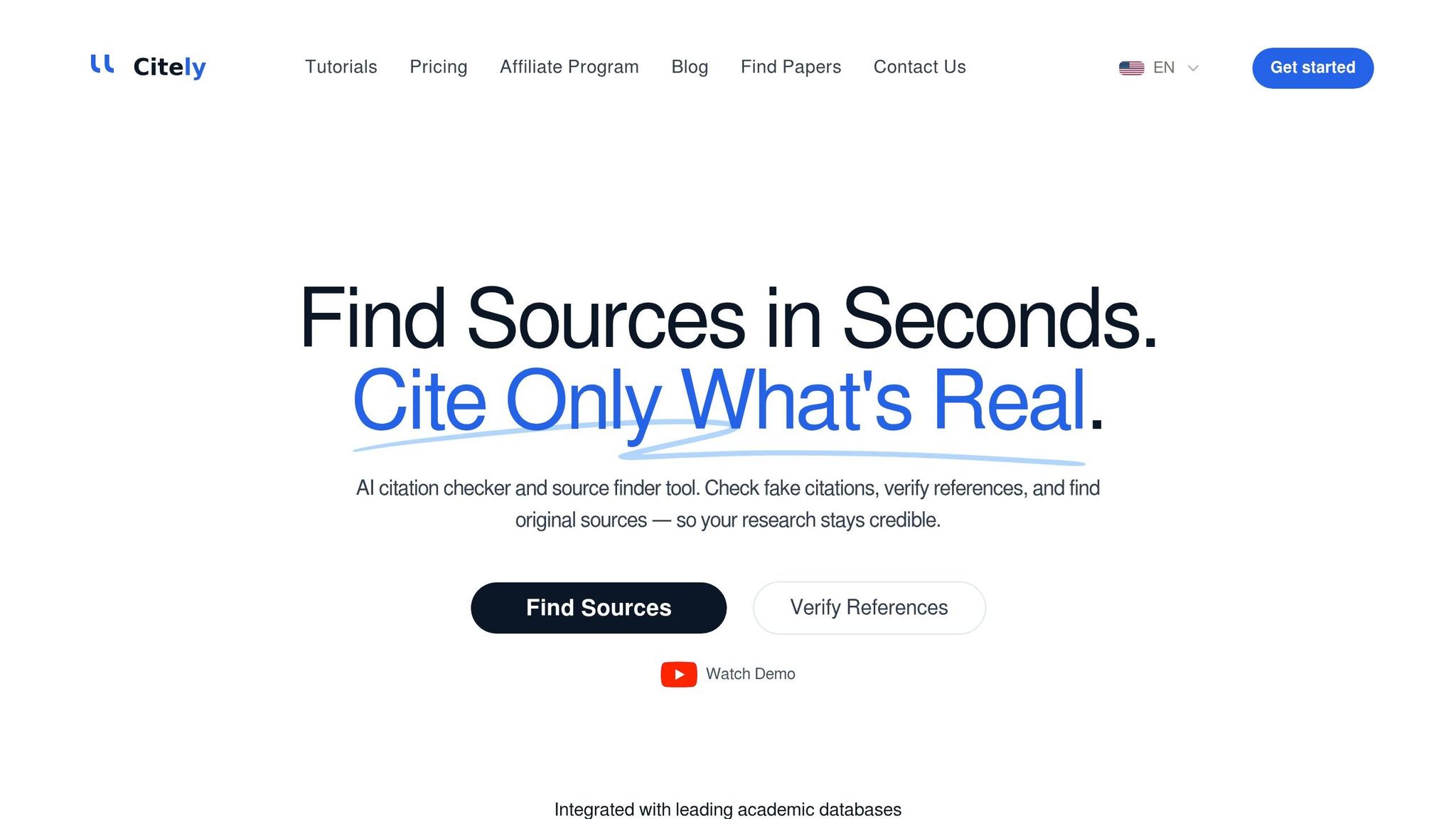
Citely takes a metadata-focused approach to ensure the accuracy of citations, building on earlier methods. It cross-checks eight key metadata fields against a massive database of 200 million records from sources like CrossRef, PubMed, arXiv, OpenAlex, and Google Scholar, all at once.
Detection of Broken References
The first step in Citely's process is checking DOI resolution. By querying the International DOI Foundation and CrossRef, it determines if a DOI is active, deactivated, or contains errors. If a DOI fails this check, the reference is flagged as either "Unverified" or "Metadata Mismatch".
Detection of Fake References
Citely is designed to catch fabricated references, including "chimera references" - entries that look legitimate but point to non-existent or distorted papers. This is particularly important given that large language models often generate fake citations, with estimates showing 25% to 40% of references can be fabricated. By meticulously matching metadata, Citely helps protect the integrity of academic work.
"Large language models produce citations that follow the visual grammar of academic references... without any mechanism to confirm the cited paper exists." - Citely Team
After verification, each reference is assigned one of four confidence statuses:
| Status | Meaning |
|---|---|
| Verified | The DOI resolves, and all metadata fields match the official record. |
| Verified with Warnings | The DOI resolves, but there are minor discrepancies, such as journal name abbreviations. |
| Unverified | No matching record found, meaning the paper might not exist or isn’t indexed. |
| Metadata Mismatch | The DOI resolves, but key fields like the author or title don’t match, indicating a chimera reference. |
Detection of Misused References
While Citely confirms the existence of a paper and checks for metadata accuracy, it does not evaluate whether the paper is cited appropriately within the text. The responsibility of ensuring the citation supports the claim still lies with the researcher. However, Citely provides side-by-side comparisons with authoritative records to help researchers quickly spot discrepancies.
Integration with Academic Tools
Citely works seamlessly with text from Word, Google Docs, LaTeX, and PDFs without requiring special export formats. It also integrates with popular reference managers like Zotero, Mendeley, and EndNote, adding an extra layer of verification. The free version supports DOI verification and metadata checks for up to 10 references at a time, while the Pro version offers unlimited batch processing and retraction checks. This flexibility makes Citely a valuable tool for maintaining academic accuracy and rigor.
4. Sourcely
Sourcely takes a different approach to sourcing academic literature by focusing on meaning rather than keywords. Unlike traditional citation checkers, it acts as an AI-powered tool designed to find credible, peer-reviewed papers through semantic matching.
This tool aims to strengthen academic work by addressing gaps that conventional citation verifiers often overlook.
Detection of Broken References
Sourcely doesn’t just flag broken citations; it fixes them. With its "Source Finder" feature, users can paste a paragraph or claim into the interface, and the tool returns a list of indexed academic papers that align with the content. This ensures that even if a citation is missing or broken, researchers can find reliable alternatives. As noted by Artificial Intelligence Tools for Academics:
"Traditional search tools match words. Sourcely matches meaning." - Artificial Intelligence Tools for Academics
By prioritizing meaning over keywords, Sourcely helps researchers maintain the integrity of their arguments, even when problematic citations need to be replaced.
Detection of Fake References
Sourcely takes a proactive stance against fake citations. Instead of scanning reference lists for fabricated entries, it guides researchers toward authentic sources from the start, reducing the likelihood of fake references appearing in their work.
Detection of Misused References
While it’s up to researchers to ensure citations are used appropriately, Sourcely helps by surfacing papers that semantically match specific claims. This feature naturally steers users toward sources that are more contextually relevant, minimizing the risk of misusing references.
Integration with Academic Tools
Sourcely simplifies the process of finding peer-reviewed sources by searching an extensive academic index that includes journal articles and other scholarly publications. It offers several pricing options:
- A free tier with basic features
- A $7 one-time trial for up to 2,000 characters
- A subscription at $17/month or $167/year
- A lifetime "Believer" plan for $347
With these options, Sourcely caters to a range of budgets while providing valuable tools for academic research.
Pros and Cons of Each Tool
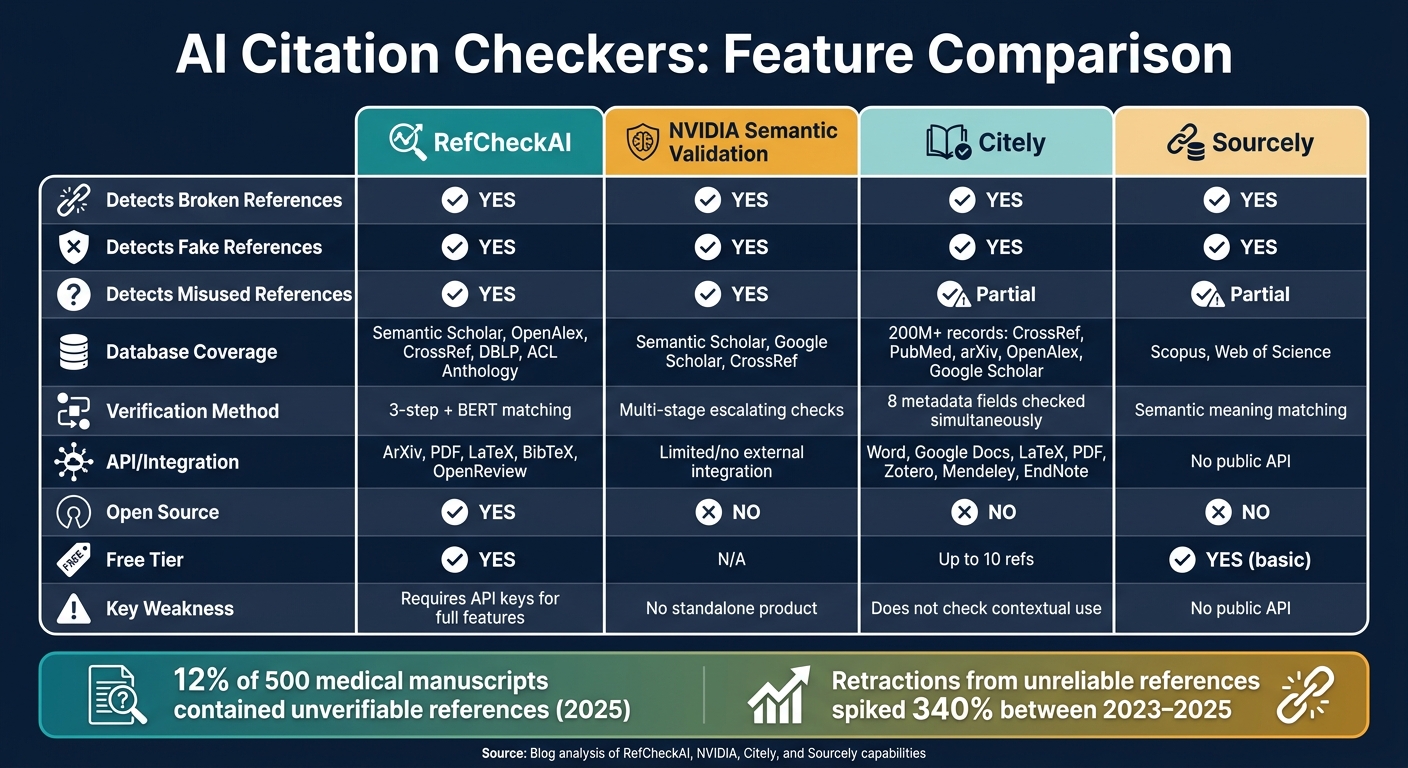
AI Citation Checkers Compared: RefCheckAI vs NVIDIA vs Citely vs Sourcely
Sourcely addresses citation challenges by offering a practical solution: it replaces problematic references with verified alternatives sourced from trusted databases like Scopus and Web of Science. It even provides properly formatted replacement citations for flagged issues. However, one limitation is that Sourcely currently lacks a public API, which restricts its use in automated workflows.
Here’s a quick look at Sourcely’s strengths and weaknesses:
| Tool | Key Strength | Key Weakness |
|---|---|---|
| Sourcely | Provides formatted replacement citations for flagged issues | Lacks a public API for automated workflows |
These tools are most effective when used as part of a broader review process, rather than being relied upon as the sole authority on citation accuracy.
Conclusion
Sourcely introduces a well-structured citation replacement system designed to address the growing concerns around citation accuracy in academic writing.
The problem is real and pressing. A 2025 review of 500 medical manuscripts revealed that 12% included at least one unverifiable reference, while retractions tied to "unreliable references" spiked by 340% between 2023 and 2025. For researchers and students in the U.S., one key takeaway is this: never paste AI-generated citations directly into your bibliography. Instead, use a citation checker to verify their accuracy before submission. Treating citation verification as a non-negotiable step is essential.
In today's landscape of AI-generated references, ensuring accuracy should be as routine as running a spell check.
"In 2026, running a reference verification check before submission is as basic as running a spell checker." - Citely
If a citation is flagged or found to be inaccurate, Sourcely steps in with verified, ready-to-use replacements - providing a crucial final safeguard before you hit "submit."
FAQs
What can an AI citation checker miss?
AI citation checkers are useful but not perfect. They can miss fabricated references that, while looking properly formatted, don't actually exist. Minor metadata mistakes, such as misspelled author names or incorrect publication years, may also slip through the cracks. On top of that, these tools usually can't determine if a citation has been misrepresented or taken out of context. While they can catch certain errors, they often fall short when it comes to spotting more subtle or complex citation issues.
How do I confirm a citation supports my claim?
To make sure a citation backs up your claim, start by confirming the source is real and includes the necessary information. Double-check critical details like the DOI, author names, publication year, and title using reliable databases. Verify that the DOI leads to the correct resource, the title matches results in academic search engines, and the authors and publication specifics align with the cited work. Following these steps ensures your citation is both accurate and credible.
Do these tools work with PDFs and LaTeX?
Some AI citation checkers are capable of analyzing references in both PDFs and LaTeX documents. They work by cross-referencing key details, such as author names, titles, and publication years, while also resolving DOIs. This makes them a practical tool for verifying citation accuracy in these formats.