AI Hallucinated Citations: How to Spot Fake Sources Before You Submit
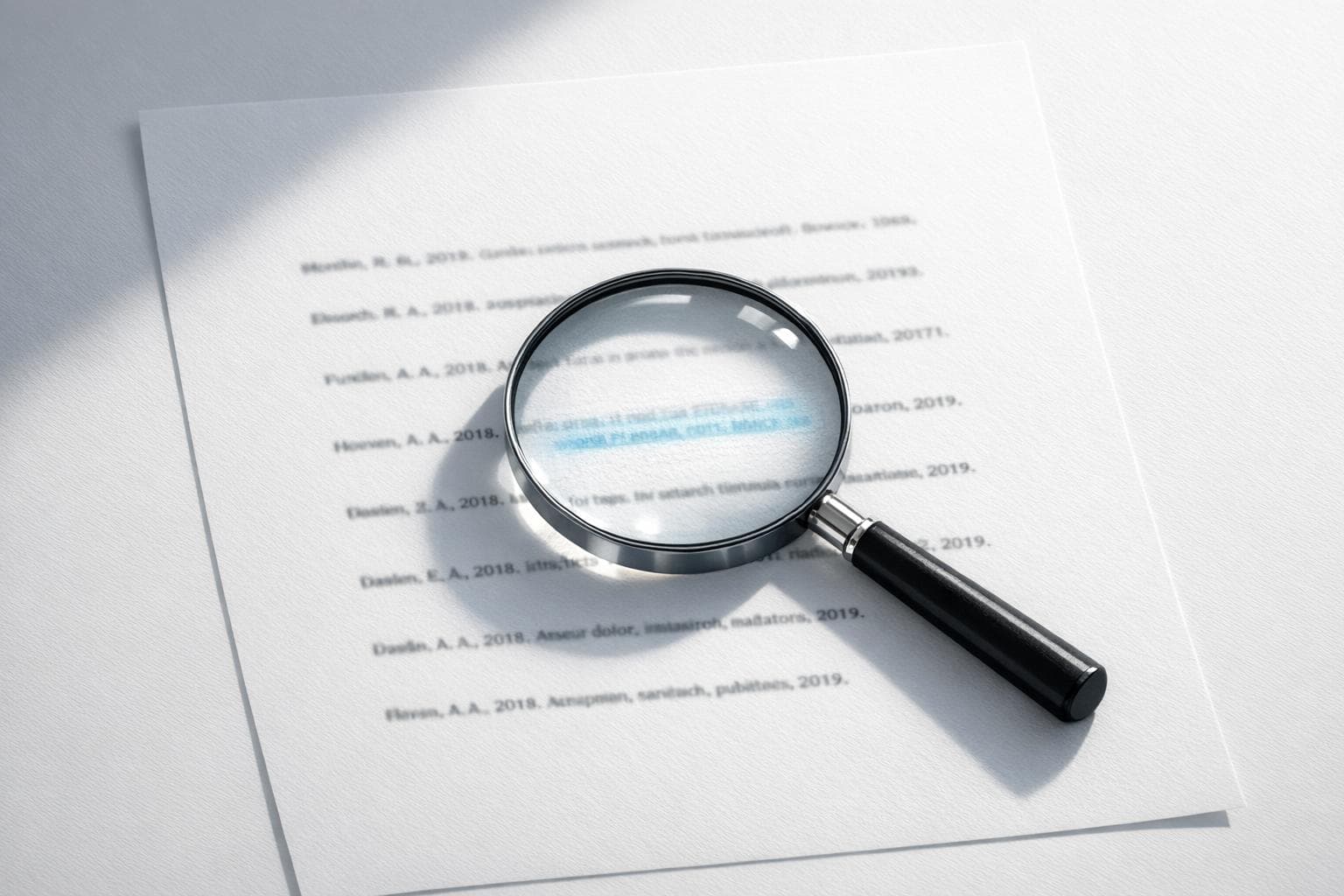
Did you know that up to 93% of AI-generated citations in academic work can be inaccurate or completely fabricated? These fake references - called "AI hallucinated citations" - may look real but often mix legitimate details with false information. Using them can lead to failed assignments, retracted papers, or even academic misconduct charges.
Here’s what you need to know:
- AI tools don’t search databases; they predict text patterns, which can produce fake citations.
- Common issues include made-up articles, distorted details (like wrong years or DOIs), and misattributed claims.
- Quick checks like verifying DOIs, searching for titles in reliable databases, and confirming metadata can help you spot fake sources.
- Tools like Sourcely can suggest real, verified sources to replace fabricated ones.
Bottom line: Never trust AI-generated references without verification. Use trusted databases, double-check claims, and document your process to ensure academic integrity.
How AI Citation Hallucinations Work
Why AI Generates Fake Citations
AI tools create citations by predicting text sequences rather than verifying the existence or accuracy of sources. Essentially, they mimic the structure of academic references without ensuring the details are real. This stems from how these models process language - they aim to generate text that sounds correct rather than pulling verified information.
"AI models like ChatGPT don't 'look up' sources - they predict the most likely sequence of words based on training data. When asked for references, they generate text that mimics academic formatting but has no connection to real publications." - Emily Grant, Academic Researcher
Research shows that 25%–40% of references generated by AI are completely fabricated, and 43% of citations that appear real contain errors.
These hallucinations tend to fall into four distinct patterns, as shown in the table below:
| Type | What It Looks Like | How Hard to Catch |
|---|---|---|
| Fully Invented | Fake title, author, and DOI - nothing exists | Easy (no search results) |
| Chimera | Real author or journal paired with a fake paper title | Moderate (parts check out) |
| Distorted | Real paper with incorrect year, volume, or DOI | Hard (requires metadata check) |
| Ghost | Real paper used inappropriately for unrelated claims | Very hard (requires reading the source) |
When Hallucinated Citations Are Most Likely to Occur
The likelihood of hallucinated citations increases with niche topics, recent publications, or book chapters. These areas often lack sufficient training data, making it easier for AI to fabricate details. The problem worsens when users request open-ended tasks like "generate a bibliography" or "find sources for this topic", giving the model more room to invent.
In early 2026, Guillaume Cabanac, a computer scientist at the University of Toulouse, stumbled upon an example of this issue. A paper in the International Dental Journal cited one of his works, even though his research on identifying fabricated papers had no connection to dentistry. Reflecting on the incident, Cabanac shared:
"I was very surprised to see that I couldn't recognize my own reference." - Guillaume Cabanac, Computer Scientist, University of Toulouse
These risks compound over time, especially when fabricated details are carried forward into related outputs.
How Fake Citations Affect Academic Work
The consequences of fabricated citations are serious, undermining both academic credibility and integrity. For students, fake references can lead to failed assignments, delayed thesis defenses, or even charges of academic misconduct - even if the errors were unintentional. Many U.S. universities classify fabricated citations as academic fraud, regardless of intent.
For researchers and professionals, the stakes are even higher. Journal editors increasingly rely on automated tools to screen reference lists before peer review begins. Papers containing fabricated citations are often desk-rejected immediately. For instance, at NeurIPS 2025, approximately 100 hallucinated citations made it through peer review before being flagged.
"Citing hallucinated references demonstrates 'the author knows nothing about' the claimed source - a severe credibility breach." - Journal Editors via Paper Checker
The damage to an individual’s reputation can be long-lasting.
sbb-itb-f7d34da
How to Verify AI-Generated Citations Step by Step
Quick Checks to Run First
Before diving into databases, there are a few quick checks you can do in under two minutes. Start by testing the DOI (Digital Object Identifier). Copy and paste it into your browser using a URL like https://doi.org/[DOI]. If you get a 404 error or are redirected to an unrelated paper, the citation is almost certainly fake. However, even a properly formatted DOI could still be fabricated.
Next, verify whether the journal exists. Search for its name along with its ISSN in a trusted database. If the journal doesn’t show up or its stated focus has nothing to do with the cited topic, that’s a clear warning sign. Once these basic checks are done, you can move on to more detailed database searches.
How to Search Academic Databases for Verification
To verify a citation, search for the article's exact title in quotation marks on platforms like Google Scholar, CrossRef, or PubMed. Using quotation marks ensures you get an exact-phrase match, helping to filter out irrelevant results. If the article doesn’t appear in two or three databases, it likely doesn’t exist.
For biomedical or clinical sources, PubMed is especially useful because it highlights retraction notices - something Google Scholar might miss. For other disciplines, CrossRef's free metadata search can confirm official publication details quickly. If you still can’t find the article, check the journal’s official website and browse the table of contents for the specific volume and issue cited.
"Use AI to explore. Use libraries to verify. Use your brain to evaluate." - Hana Lee Goldin, Reference Librarian
Using Sourcely to Find Accurate Sources
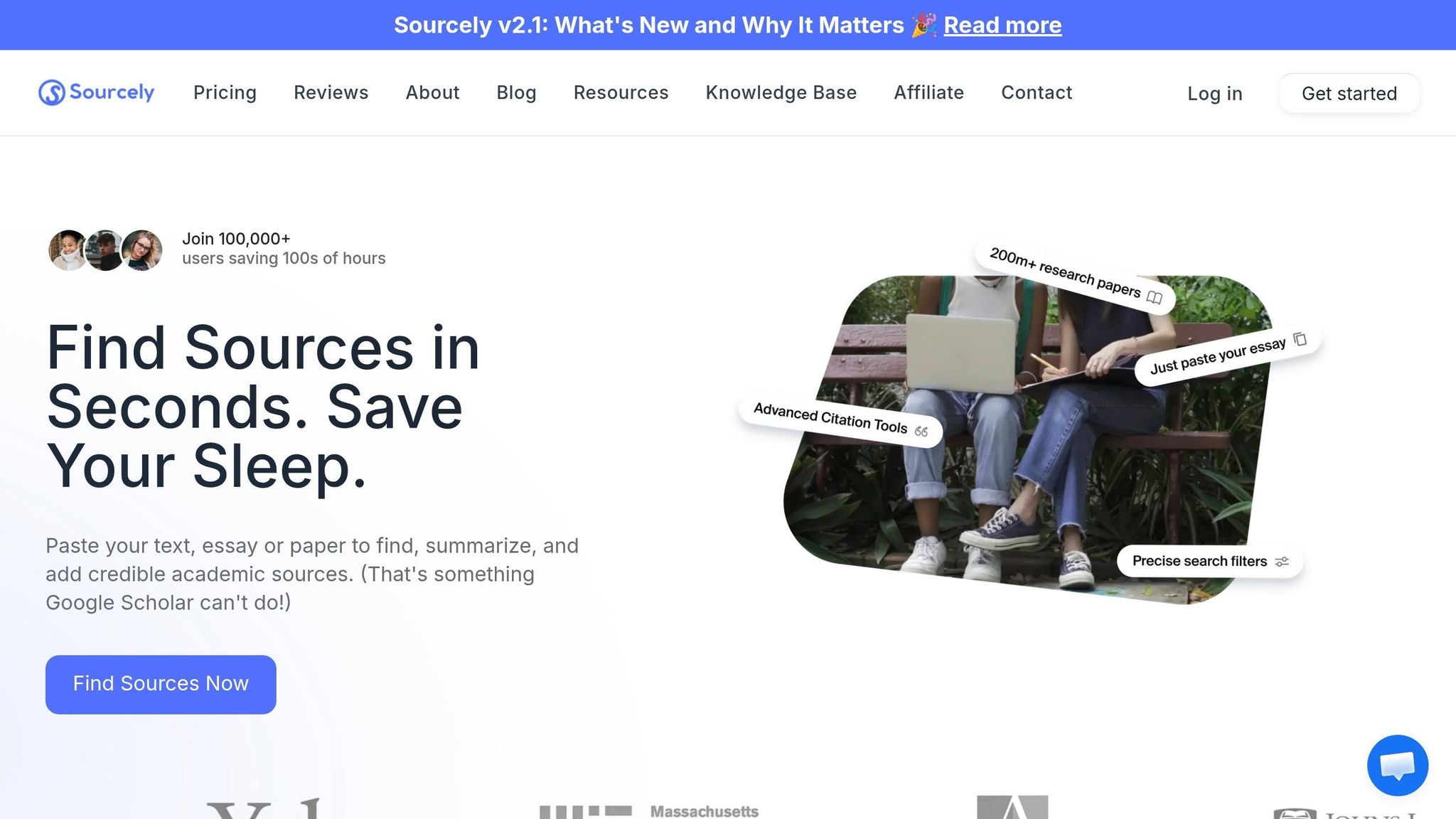
If you discover a fabricated citation, you’ll still need a valid source to back up your argument. This is where Sourcely can help. By pasting your essay or a paragraph into the platform, Sourcely identifies where citations are needed and suggests real, relevant academic sources. It searches through millions of verified papers, allows you to filter results by field or publication type, and even exports references in standard formats. This saves you the hassle of starting from scratch after discarding a fake citation. However, once you find reliable sources with Sourcely, don’t forget to double-check their metadata for accuracy.
How to Check Metadata and DOIs
If the DOI resolves correctly, your work isn’t done yet. Double-check every metadata field - like author names, publication year, volume, issue, and page numbers - against the official record on CrossRef or the publisher’s website. AI can create hybrid citations that combine real names with fake publication details, so this step is essential.
To confirm the legitimacy of the authors, look up the first author on ORCID or their Google Scholar profile. Ensure the cited paper appears in their publication history. If the paper isn’t listed, it’s likely a fabricated reference.
Confirming the Source Supports Your Claim
Even if a citation passes all the metadata checks, it might still be misleading. AI can cite real papers but attribute claims to them that the papers never make. After confirming the source exists, open the PDF and verify that it actually supports your argument. This step is crucial for academic integrity. Skipping it could allow ghost citations to slip through unnoticed, undermining the credibility of your work.
AI Hallucinations: How to Catch Fake Citations | AI-Powered Research
Red Flags in AI-Generated Citations
Spotting red flags is essential to avoid using fabricated citations in academic work.
Citation-Level Warning Signs
The easiest clues to catch are at the structural level - issues you can identify without even opening the cited paper. Problems like broken DOIs or journal names that don't exist are immediate red flags.
Another key sign is mathematical inconsistencies. For instance, if the volume, issue number, or publication dates don't align with a journal's actual history, the citation is likely fake.
"The most dangerous citation error is the one that looks real... references that look complete, sound academic, and pass a quick glance, but still point to the wrong source." - Citely Team
It's important to remember that polished formatting, like perfect APA or MLA styles, doesn't guarantee a citation's accuracy. Even if it looks professional, it might still be fabricated.
Beyond these structural issues, dig into the citation's content. Misattributions or subtle inaccuracies can mask deeper problems.
Content-Level Problems in Fake Sources
Even if a citation passes structural checks, the content itself can still be misleading. AI tools often cite real papers but misrepresent their findings or arguments. This phenomenon, often called hybrid fiction, occurs when the source exists, but the claim attributed to it is entirely made up.
"AI tools often cite real authors and real journals but attribute completely fake claims to them. This 'hybrid fiction' is harder to spot than a totally made-up title." - Edward Ayers, Professor, University of Richmond
Another red flag is when a researcher is cited in a field unrelated to their expertise. For example, a computer scientist cited in a dental journal raises questions about the citation's validity.
Fake Citation Patterns by Academic Field
Patterns of fake citations often vary by discipline. Here's a breakdown of common issues and tools to verify them:
| Academic Field | Common Hallucination Pattern | Primary Verification Tool |
|---|---|---|
| Law | Fabricated case names and docket numbers | Westlaw, LexisNexis, or official reporters |
| Medicine | Fake clinical trials and non-existent journals | PubMed (NLM) |
| Social Sciences | Fake preprint citations | Google Scholar, CrossRef |
| STEM | Author-field mismatches and DOI errors | IEEE Xplore, ACM Digital Library, doi.org |
A clear example of this occurred in the legal field. In June 2023, attorney Steven A. Schwartz submitted a court filing in Mata v. Avianca (Southern District of New York) that included six fake case citations generated by ChatGPT. The AI created plausible-sounding case names, like Varghese v. China Southern Airlines Co., Ltd., and even fabricated full-text judicial opinions when questioned. Judge P. Kevin Castel fined the attorneys $5,000 for failing to verify the sources.
In medicine, the stakes are just as high. Research has found that up to 93% of AI-generated references in medical studies are inaccurate or fabricated. AI also frequently invents PubMed IDs (PMIDs) that either don't exist or link to unrelated articles. Meanwhile, in the social sciences, preprint citations are particularly vulnerable. AI often creates convincing preprint titles that were never actually published on platforms like SSRN or arXiv.
Building a Repeatable Citation Verification Workflow
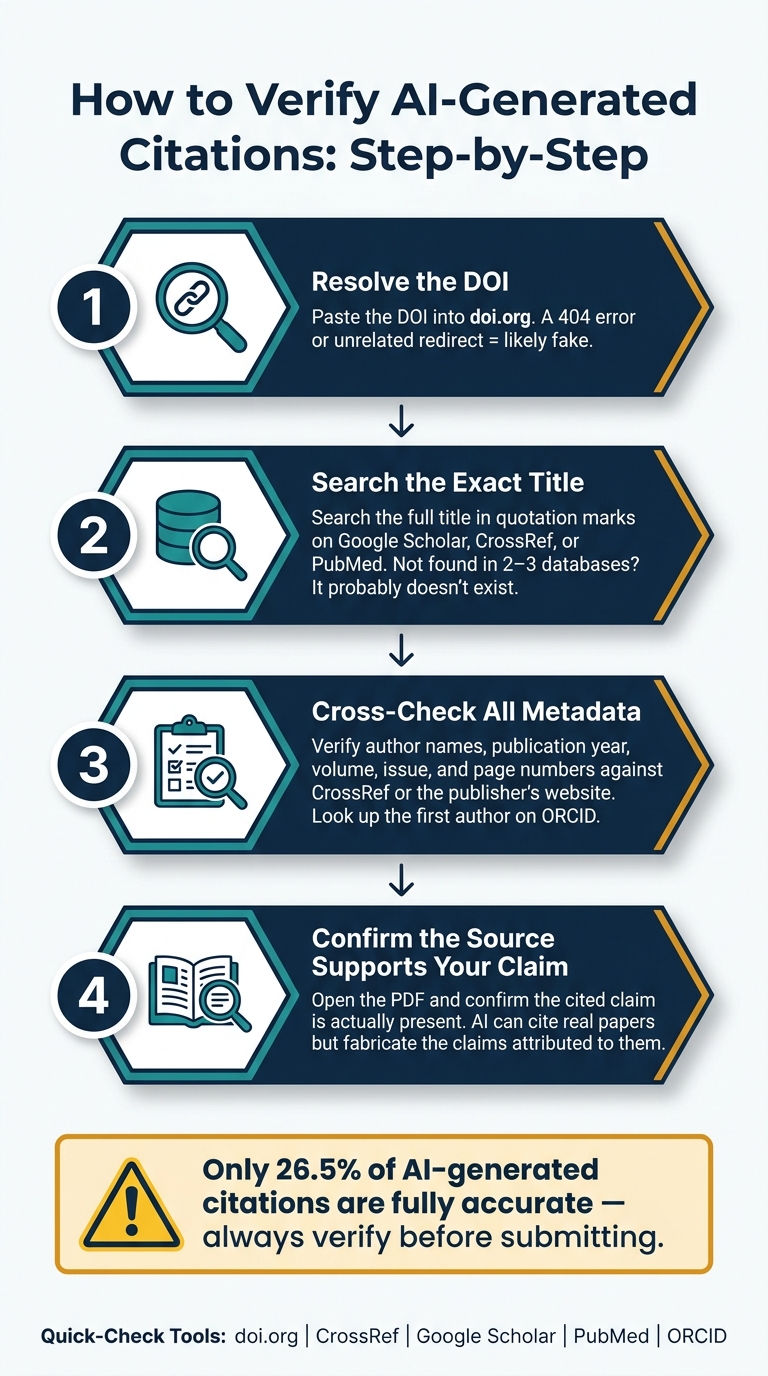
How to Verify AI-Generated Citations: A Step-by-Step Checklist
Knowing the warning signs of inaccurate citations is just the beginning. With the high rate of errors in AI-generated references, having a reliable process for verification is crucial. This workflow turns citation checks into a consistent habit rather than a rushed, last-minute chore.
A Step-by-Step Routine for Checking Citations
Using the red flags discussed earlier, follow this structured approach to verify your citations. Never directly use an AI-generated reference in your manuscript without checking it first. Studies show that only 26.5% of AI-generated references are completely accurate, so the odds of errors are high.
Here’s how to verify citations systematically:
- Resolve the DOI: Use doi.org to confirm the DOI's validity.
- Search the Title: Enclose the exact title in quotation marks and search on Google Scholar or CrossRef.
- Cross-Check Details: Compare the author and publication information with what’s listed in the database.
- Check the Source: Open the PDF to ensure the cited claim is present and accurate.
For larger projects with 30 or more citations, automated tools can speed up initial checks. However, critical references should always be manually verified. Keep a record of each step to create an audit trail that supports the integrity of your research.
Keeping Records of Your Verification Process
"Verification Is a Habit, Not a Task." - ReferenceChecker.org
Documenting your verification process is just as important as the verification itself. Save search histories with timestamps, annotate PDFs to show you’ve reviewed the source, and log the date you accessed each citation. Reference management tools like Zotero can help by automatically tracking when you add sources to your library.
Maintaining version histories of your drafts can also be helpful. These records demonstrate that your research was thorough and methodical, providing clear evidence of your process.
Writing Better AI Prompts to Reduce Hallucinations
Another way to improve your workflow is by crafting better AI prompts. Instead of asking AI for citation lists, focus on strategies that guide your research. Remember, language models don’t retrieve factual information - they generate text that sounds plausible. Requests for specific details like DOIs, volume numbers, or page ranges are especially prone to errors.
For instance, instead of saying, "Provide a bibliography", try asking, "What keywords should I use on Google Scholar to find recent studies on [topic]?" or "Who are the leading researchers in the field of [topic]?" This approach gives you a solid starting point for database searches without relying on potentially fabricated metadata.
"Use AI to explore. Use libraries to verify. Use your brain to evaluate." - University of Victoria Libraries
If you use AI to generate ideas or identify topics, mark any unverified references in your draft immediately. This ensures they don’t accidentally make their way into your final submission. Taking these steps strengthens your citation accuracy and integrates seamlessly with the verification process outlined above.
Conclusion
Key Takeaways
AI-generated references have a serious accuracy problem - just 26.5% of them are correct. That means the majority are either wrong, distorted, or outright fabricated. These fake citations often look polished and convincing, which makes them especially problematic.
The solution? Use AI for exploration, but rely on libraries and databases for verification. Never copy and paste an AI-suggested reference directly into your work. Instead, take these steps: resolve the DOI, search the exact title in trusted databases like Google Scholar or CrossRef, and confirm that the source actually supports your claim. For larger bibliographies, tools like Sourcely can save you time - manually verifying 40 sources can take over two hours. These practices aren’t just helpful; they’re essential for maintaining accuracy and credibility.
Final Thoughts on Academic Integrity
By verifying AI-generated citations, you help protect the integrity of your research. This is no small matter. In 2025, a paper was retracted after investigators found 38 fake references. Universities are catching on, too - many now classify unverified AI citations as a form of academic misconduct.
"Never trust AI-generated citations without verification." - Duke University
Accurate citations are more than just a formality - they’re a reflection of your credibility as a researcher. The habits outlined here, from checking DOIs to keeping a documentation trail, aren’t optional extras. They’re the foundation of responsible academic work.
FAQs
What’s the fastest way to verify a DOI is real?
To check if a DOI is legitimate, simply copy it and paste it into https://doi.org. If it’s valid, the webpage will show the correct article details, including the title, authors, and journal information. This quick method ensures the DOI is properly linked to the intended source.
Which databases should I check to confirm a citation exists?
To confirm the existence of a citation, use trusted academic databases such as Google Scholar, PubMed, CrossRef, and OpenAlex. These platforms are dependable resources for verifying scholarly articles and research papers. You can also check the DOI link directly to ensure it points to a valid and credible publication.
How can I tell if a real source doesn’t actually support my claim?
When evaluating a source, start by confirming its existence and details through reliable academic databases like PubMed, JSTOR, or Google Scholar. This step ensures that the source is legitimate and not fabricated. Once verified, carefully review the content to determine whether it directly supports your claim. Pay close attention to avoid misinterpretations or stretching the source’s findings to fit your argument.
It’s also crucial to check that the context of the source aligns with your argument. Sometimes, citations can seem overly specific or ambitious, especially when drawn from AI-generated references. This mismatch can weaken your argument if the source doesn’t fully back your point. Always double-check for accuracy and relevance to maintain credibility.