
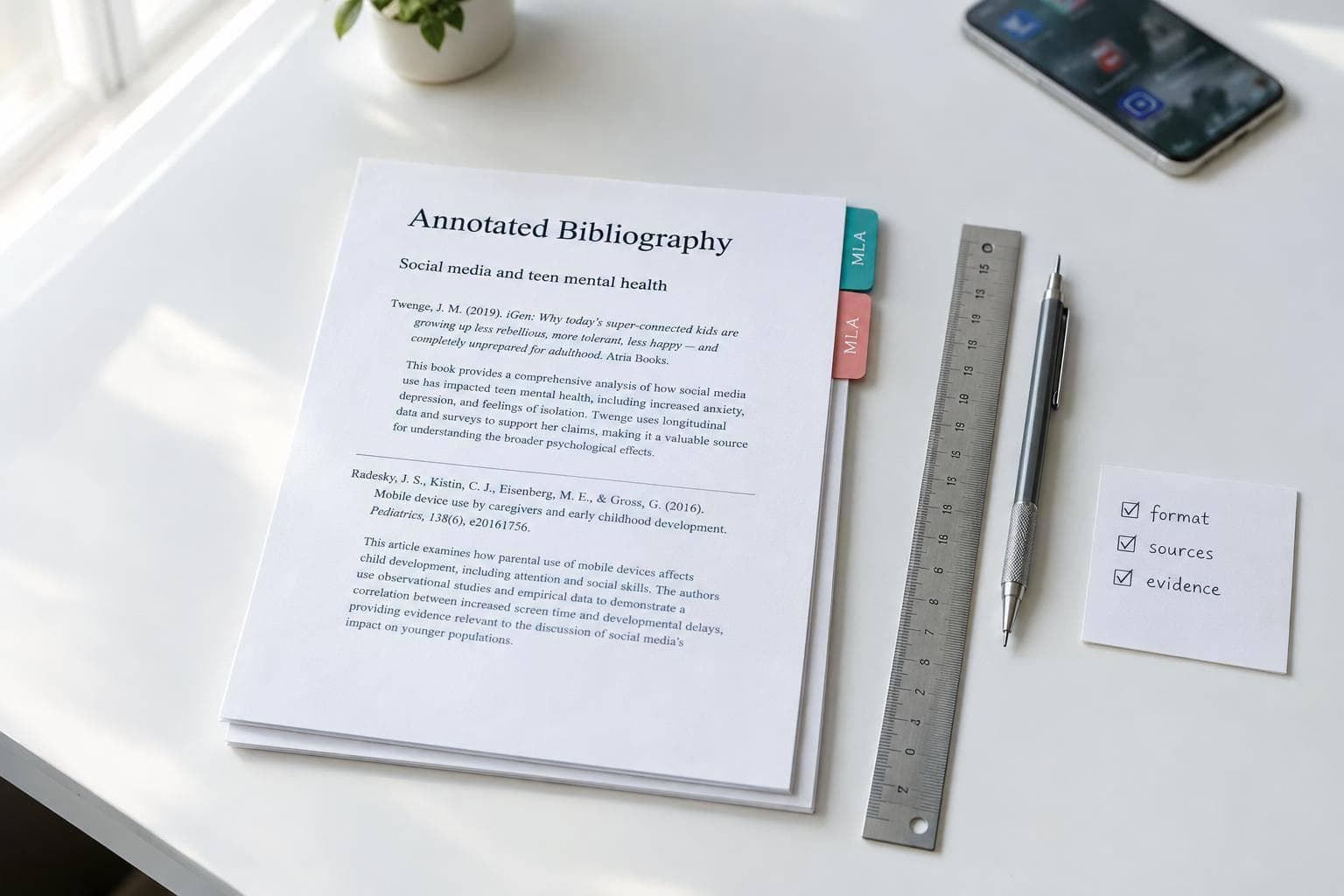
Annotated Bibliography Sample: 5 Complete Examples in APA and MLA
A citation tells readers where a source came from. An annotation explains what it says, where it falls short, and how you’ll use it. I use three checks: summarize the source, assess its methods, and connect it to my research question.
Below, I walk through five sources in both APA 7 and MLA 9 - 10 sample entries about social media use and adolescent depressive symptoms:
- Keles and colleagues: A review of 13 studies on social media and adolescent mental health.
- Sherry Turkle’s Alone Together: A book for background on digital relationships.
- HHS’s youth mental health webpage: A government source for U.S. policy context.
- Orben and Przybylski: A study of broad digital-technology use that helps put harm claims in context.
- Kelly and colleagues: A study linking social media use with depressive symptoms in UK 14-year-olds.
I also cover source checks, annotation structure, and APA–MLA differences in author names, dates, titles, and indentation. My starting rule: <u>follow your assignment first</u>, verify each citation, and don’t treat an association as proof of cause.
How to Create an Annotated Bibliography
sbb-itb-f7d34da
Annotated Bibliography Preparation Checklist
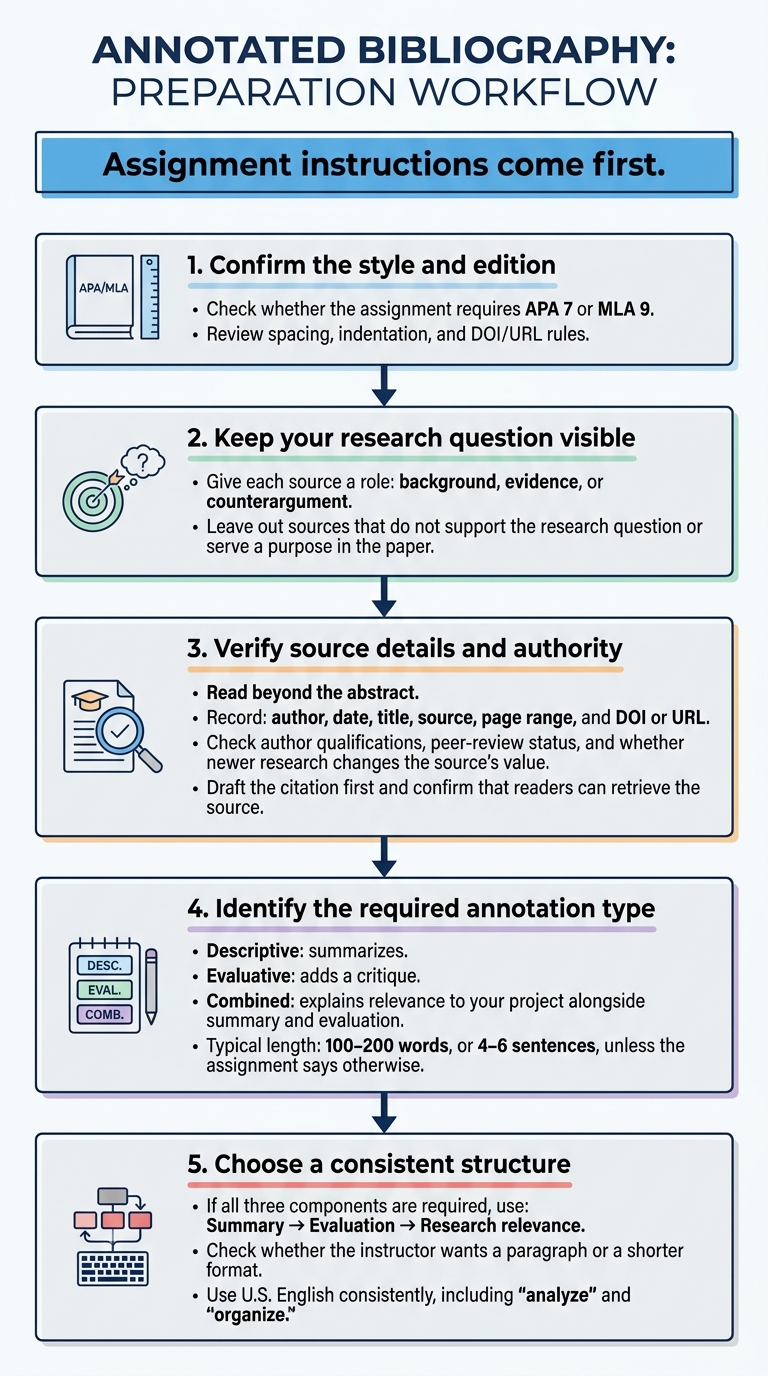
Annotated Bibliography Preparation: 5-Step Checklist
Confirm the style and edition. Check whether your assignment calls for APA 7 or MLA 9. Then review its spacing, indentation, and DOI/URL rules so you can format each entry correctly. Assignment instructions come first.
Keep your research question visible. Give each source a clear role: background, evidence, or counterargument. Leave out sources that don’t support your research question or serve a purpose in your paper.
Verify source details and authority. Read beyond the abstract. Record the author, date, title, source, page range, and DOI or URL. Check the author’s qualifications and the source’s peer-review status, and consider whether newer research changes its value. Draft the citation first, and confirm that readers can retrieve the source.
Identify the required annotation type. A descriptive annotation summarizes; an evaluative annotation adds a critique; a combined annotation explains its relevance to your project. Check the word count as well. Most annotations run 100–200 words, or 4–6 sentences, unless your assignment says otherwise.
Choose a consistent structure. If your assignment requires all three components, keep them in the same order: summary, evaluation, then research relevance. Check whether your instructor wants a paragraph or a shorter format. Use U.S. English spellings throughout, including “analyze” and “organize.” Follow this structure as you review the examples below.
What to Include in Each Annotation
Each annotation should cover three points:
- Summary: Explain the source’s central claim, method, and main finding.
- Evaluation: Assess the evidence, methods, and author’s expertise. Note strengths and limits - such as sample size, self-reported data, or potential bias - and explain how they affect your use of the source.
- Research use: Explain whether the source supports or challenges your argument, provides background, or fills a gap in answering how social media use is associated with depressive symptoms among adolescents.
Use these three checks as you review the five examples below.
1. Journal Article: Keles, McCrae, and Grealish’s “A Systematic Review: The Influence of Social Media on Depression, Anxiety and Psychological Distress in Adolescents”
This example combines summary, evaluation, and research relevance in a short annotation.
APA 7 citation
Keles, B., McCrae, N., & Grealish, A. (2020). A systematic review: The influence of social media on depression, anxiety and psychological distress in adolescents. International Journal of Adolescence and Youth, 25(1), 79–93. https://doi.org/10.1080/02673843.2019.1590851
Annotation
Keles and colleagues reviewed 13 studies examining social media use and depression, anxiety, and psychological distress among adolescents ages 13–18. Their systematic search included PsycINFO and MEDLINE. The review links social media use to poorer mental health, especially when engagement is psychologically invested rather than measured only by time spent online. Its systematic search strengthens its credibility. However, the included studies’ largely cross-sectional designs limit causal conclusions: the review cannot establish whether social media use precedes distress. For research on adolescent depressive symptoms, this source provides background and distinguishes engagement patterns from time spent online.
MLA 9 citation
Keles, Betul, et al. “A Systematic Review: The Influence of Social Media on Depression, Anxiety and Psychological Distress in Adolescents.” International Journal of Adolescence and Youth, vol. 25, no. 1, 2020, pp. 79–93. https://doi.org/10.1080/02673843.2019.1590851.
Annotation
This systematic review brings together 13 studies on adolescent social media use and depression, anxiety, and psychological distress. It considers different dimensions of use, including time and psychological investment. Its systematic search makes it useful for summarizing the evidence, but the underlying studies remain limited by cross-sectional designs. Use this review to frame the question, identify engagement patterns, and avoid claiming that all social media use is harmful.
Formatting notes: APA lists all three authors with initials, followed immediately by the year. MLA uses “Keles, Betul, et al.” and puts the year after the volume and issue. APA uses sentence case for the article title; MLA uses title case and quotation marks. Both styles italicize the journal name, but only APA italicizes the volume number. Give each citation a 0.5-inch hanging indent, and follow your instructor’s indentation rules for annotations.
2. Book: Sherry Turkle’s Alone Together: Why We Expect More from Technology and Less from Each Other
This example shows how to cite a book for conceptual background, rather than direct empirical evidence.
APA 7 citation
Turkle, S. (2011). Alone together: Why we expect more from technology and less from each other. Basic Books.
Annotation
Turkle examines how digital intimacy can displace deeper human connection. The book develops its argument through qualitative accounts of technology-mediated relationships rather than large-scale statistical data. Her MIT expertise strengthens the analysis, but her cautionary lens shapes the interpretation. Interviews and observations show lived experience, but they cannot establish broad patterns. For research on adolescent depressive symptoms, use this as conceptual background, not evidence that social media causes depression.
MLA 9 citation
Turkle, Sherry. Alone Together: Why We Expect More from Technology and Less from Each Other. Basic Books, 2011.
Annotation
In MLA format, the same source can be used to show how a book supports background context rather than causal claims. Turkle argues that constant digital connection can reshape expectations about relationships. Use it to frame why online relationship quality matters, then pair it with adolescent studies that measure adolescent depressive symptoms.
Book-specific formatting notes: Italicize the full title. Use sentence case in APA and title case in MLA. Keep Basic Books as the publisher, leave out the publisher’s city, and omit a page range when citing the whole book.
3. Government Website: HHS’s “Social Media and Youth Mental Health”
APA 7 citation
U.S. Department of Health and Human Services. (2023, May 23). Social media and youth mental health. https://www.hhs.gov/surgeongeneral/priorities/youth-mental-health/social-media/index.html
Annotation
This HHS webpage summarizes youth social media risks and offers guidance for parents, tech companies, and researchers. As an Office of the Surgeon General page, it has public-health authority, but its risk-reduction purpose shapes the evidence it highlights. Use it to establish the U.S. public-health response to adolescent depressive symptoms, not to prove causation. It works best as policy context before the empirical studies below.
MLA 9 citation
“Social Media and Youth Mental Health.” U.S. Department of Health and Human Services, 23 May 2023, www.hhs.gov/surgeongeneral/priorities/youth-mental-health/social-media/index.html.
Annotation
HHS presents social media as a youth mental health concern and recommends protective action. Its federal authority and research links make it useful for policy context, but it is not original research and does not replace the advisory. For adolescent depressive symptoms, it provides policy context, not causal evidence, for the studies that follow.
Webpage-specific formatting notes: These entries cite the HTML landing page, not the linked Surgeon General’s advisory. In APA, leave out the website name because it repeats the organizational author. In MLA, start with the page title and use HHS as the website name.
Before submitting, check whether the page’s displayed publication or update date matches May 23, 2023. The advisory’s date does not confirm the webpage’s date. If you use the PDF’s detailed evidence, cite it using its own citation details.
4. Evidence That Qualifies Harm Claims: Orben and Przybylski’s “The Association Between Adolescent Well-Being and Digital Technology Use”
This example separates research on broad digital-technology use from studies focused specifically on social media. That difference matters when comparing claims about harm.
APA 7 citation
Orben, A., & Przybylski, A. K. (2019). The association between adolescent well-being and digital technology use. Nature Human Behaviour, 3(2), 173–182. https://doi.org/10.1038/s41562-018-0506-1
Annotation
Orben and Przybylski use specification curve analysis to test how different analytic choices affect the association between digital-technology use and adolescent well-being. Their findings suggest that digital technology use accounts for about 0.4% of the variation in adolescent well-being. Its broad measures - including gaming, computers, and television - make it less comparable to studies focused specifically on social media use and depressive symptoms. Use this source to qualify harm claims, not as a direct contradiction of social-media research.
MLA 9 citation
Orben, Amy, and Andrew K. Przybylski. “The Association Between Adolescent Well-Being and Digital Technology Use.” Nature Human Behaviour, vol. 3, no. 2, 2019, pp. 173–82. https://doi.org/10.1038/s41562-018-0506-1.
Annotation
This study shows how analytical choices change the estimated association between technology use and adolescent well-being. Its small overall association helps qualify stronger harm claims. Unlike Keles and colleagues’ review and Kelly and colleagues’ study, it focuses on broad digital-technology use and overall well-being rather than specifically on social media use and depressive symptoms. Compare the measures before treating the findings as conflicting evidence.
Source-specific formatting notes: APA uses author initials and sentence case for the article title. MLA uses full names and title case. Both italicize the journal name - not the article title. APA formats the volume, issue, and pages as 3(2), 173–182; MLA uses vol. 3, no. 2, pp. 173–82. Keep the DOI as a URL.
Before moving to the APA–MLA formatting checklist, use this example to compare broad-technology evidence with the social-media-specific studies above.
5. Evidence Closest to the Research Question: Kelly and Colleagues’ “Social Media Use and Adolescent Mental Health: Findings From the UK Millennium Cohort Study”
APA 7 citation
Kelly, Y., Zilanawala, A., Booker, C., & Sacker, A. (2018). Social media use and adolescent mental health: Findings from the UK Millennium Cohort Study. EClinicalMedicine, 6, 59–68. https://doi.org/10.1016/j.eclinm.2018.12.005
Annotation
Closest to the research question, Kelly and colleagues analyze UK Millennium Cohort Study data for a dose-response link between social media use and depressive symptoms in 14-year-olds. They test sleep, online harassment, body image concerns, and low self-esteem as pathways. The large longitudinal cohort strengthens the study’s credibility, but because the analysis is observational, it cannot show that social media causes depression. The UK sample limits direct application to U.S. adolescents.
MLA 9 citation
Kelly, Yvonne, et al. “Social Media Use and Adolescent Mental Health: Findings From the UK Millennium Cohort Study.” EClinicalMedicine, vol. 6, 2018, pp. 59–68. https://doi.org/10.1016/j.eclinm.2018.12.005.
Annotation
This study examines how social media use relates to depressive symptoms in UK adolescents at age 14. It also looks at sleep problems, online harassment, body image concerns, and low self-esteem as possible explanations for the relationship. Its use of a major longitudinal cohort adds credibility, although the observational design still limits causal claims. The findings are relevant for discussing possible mechanisms, but they should not be treated as proof of harm or as a direct estimate for U.S. teenagers.
Citation note: The article has a volume but no issue number - don’t add one. Keep the DOI as a full link in both entries.
APA 7 vs. MLA 9: Formatting Checklist
Use this checklist to compare the APA and MLA formatting in the sample entries above.
| Feature | APA 7 | MLA 9 |
|---|---|---|
| Author names | Use the surname followed by initials. | Use the surname followed by the full given name. |
| Author lists | List up to 20 authors. For 21 or more, list the first 19, an ellipsis, and the final author. | For 3 or more authors, list the first author followed by “et al.” |
| Publication date | Put the year in parentheses immediately after the authors. | Put the date after the publisher for books and after the volume and issue details for journal articles. |
| Article and book titles | Use sentence case. Don’t put article titles in quotation marks; italicize book titles. | Use title case. Put article titles in quotation marks and italicize book titles. |
| Journal details | Italicize the journal title and volume. Put the issue in parentheses and omit “pp.” | Italicize only the journal title. Use “vol.,” “no.,” and “pp.” |
| Annotations | Start on a new line and indent the entire annotation 0.5 inches from the left margin. | Start on a new line and indent the entire annotation 1 inch from the left margin. |
For both styles, use a 0.5-inch hanging indent for citation lines, double-space all text, and indent each annotation as a full paragraph.
Conclusion: Use the Examples as Models
Treat these examples as templates, but follow your assignment’s required annotation type and word count. Let the source’s evidence - not its wording - guide your annotation.
Read the full source before drafting your entry. Briefly restate its main claim and findings, then assess what its methods and limits actually support. Make that judgment before finalizing the citation.
Before submitting, check every citation detail against the original source. Remove any source that doesn’t help answer your research question.
FAQs
Should I alphabetize my annotated bibliography?
Yes. In both APA and MLA formats, alphabetize entries by the first author’s last name. If a source has no author, alphabetize it by its title.
Check your assignment instructions, though. Some instructors may want entries grouped by theme or subject instead.
Can I use first person in my annotations?
Yes, but it depends on which part of the annotation you’re writing and what your instructor prefers. Use third person for summaries and evaluations. First person is generally acceptable - and often expected - when you reflect on a source or explain how it fits into your research.
If the assignment doesn’t state a preference, keep summaries and evaluations in third person. Save first person for discussing your own work.
Do I need in-text citations in an annotation?
You generally don’t need in-text citations within an annotation because the full citation just before it already identifies the source. However, include page numbers for direct quotes. If you compare the entry with another source, cite that source too.


