
Best AI Research Assistants for Academic Research (2026 Comparison)
My pick depends on the task: Sourcely for finding sources from a draft, Elicit for study extraction tables, Consensus for focused research questions, and Scite for checking citation context.
I compare all four on paper discovery, evidence synthesis, citation support, and cost. The key check: <u>does the original paper support your exact claim?</u> A linked source or an AI summary alone cannot answer that.
Quick Comparison
| Tool | Best fit | Main feature | Listed price | What I’d check |
|---|---|---|---|---|
| Sourcely | Finding sources for academic research | Text-based search, filters, summaries, and reference exports | $17/month or $167/year | Source relevance and plan limits |
| Elicit | Comparing studies | Structured extraction tables and screening for up to 5,000 papers on Pro | Pro: $75/month or $588/year | Extracted figures and full-text access |
| Consensus | Checking focused questions | Cited answers, Study Snapshots, and study-agreement indicators | Pro: $20/month or $144/year | Study quality - not just agreement |
| Scite | Reviewing citation context | Supporting, contrasting, and mentioning labels | Basic: $20/month or $144/year | Citation passages - not labels alone |
Prices are reported in the supplied article, not independently checked. I’d confirm current rates, usage caps, and institutional access before paying - and check original papers before citing any result.
AI Research Assistants: Choose by Research Task
1. Sourcely
Literature Discovery
Sourcely identifies the core concepts in a pasted draft or research statement, then matches them to academic literature. You can filter results by publication year, citation count, and journal requirements. The documentation doesn’t explain what Deep Search adds.
Evidence Synthesis
AI summaries and PDF links help you screen papers faster. They don’t, however, provide a full evidence-synthesis workflow.
Citation Support and Transparency
For academic work, finding relevant sources is only part of the job. You also need a clear way to trace them. Saved citations and reference exports help with organization, but the documentation doesn’t define their limits or confirm whether Sourcely checks citations at the claim level. A relevant match doesn’t prove that a source supports a claim.
Pricing and Limits
Sourcely offers a one-time Pro trial for $7, with 2,000 characters of input. Subscriptions cost $17 per month or $167 per year, while the lifetime believer plan costs $347. These tiers provide access to member-only resources and tutorials for optimizing your workflow.
Current limits for searches, summaries, saved citations, and exports aren’t stated. Check these allowances before choosing a plan for regular literature work.
sbb-itb-f7d34da
2. Elicit
Literature Discovery
Elicit works best when you move beyond finding papers to screening studies and extracting evidence.
Its question-led search finds papers even when they use different terminology. The index covers more than 138 million academic papers, mainly in English. Books and dissertations usually fall outside its coverage.
Evidence Synthesis
Elicit’s extraction tables line up methods, sample sizes, interventions, and outcomes so you can compare studies. On Pro, it screens up to 5,000 papers and records exclusion reasons and per-criterion scores for PRISMA reporting.
That record helps you trace screening decisions, but you still need to check extracted results against the source.
Citation Support and Transparency
Each extraction links to quotes or figures. Still, table cells can leave out context or misread details.
Before citing a result, check the original text for the study design, population, sample size, effect size, and statistical conclusion. Also confirm whether Elicit used the full text. If not, its output relies on the title and abstract.
Pricing and Limits
Basic includes unlimited search, summaries, and paper chat, with limits on Research Agent and Reports.
Pro costs $75 per month or $588 per year. It includes 20 table columns and extraction from up to 135 sources per report. Scale costs $2,028 per year and adds figure extraction, interpretation, and collaboration.
Academic pricing with annual billing is available for institutional email addresses: $11 per month for Plus, $39 per month for Pro, and $89 per month for Scale.
Since June 2026, Research Agent, Reports, and Systematic Literature Reviews have shared one monthly usage pool. Large reviews can use up that allowance quickly, so weigh both the price and usage caps when choosing a plan.
3. Consensus
Literature Discovery
Consensus works best for focused, testable questions. It ranks the first 1,500 results by recency, citation count, and journal quality, then re-ranks the top 20 by relevance. Use it for a fast evidence check - not an exhaustive search. Its corpus excludes industry reports, patents, and gray literature.
Evidence Synthesis
Once you find relevant papers, check how Consensus summarizes their evidence. The Consensus Meter groups findings as supporting, contradicting, or mixed, but it is not a meta-analysis. It does not automatically weight studies by sample size or study design quality. Check whether the studies show an association or support a causal claim.
Citation Support and Transparency
Move from the summary to individual papers to confirm what each study reports. Study Snapshots show findings, methods, and population details. Clickable citations and source quotes link the synthesized answer to its evidence, while RIS, BibTeX, and CSV exports make reference management easier. Use Snapshots to screen papers, then verify the original studies.
Pricing and Limits
As of November 10, 2026, Free includes basic search, 10 Pro messages, 3 Deep reviews, and 10 Study Snapshots per month.
Pro costs $20/month or $144/year. It includes unlimited Pro messages and Study Snapshots, plus 15 Deep reviews per month. Deep costs $65/month or $540/year and includes 200 Deep reviews and 2,000 API uses per month.
Students, faculty, and U.S. clinicians can get up to 40% off with an institutional email.
The Best AI Tools for Academia in 2026 - Stop Searching, Start Using!
4. Scite
Scite works best when you already have papers to review and need citation context, rather than search results alone.
Literature Discovery
Scite tracks how later papers cite earlier work, showing whether they support, challenge, or simply mention its findings. Use it to vet papers you’ve found, not to run an exhaustive search, unlike streamlining research with Google Scholar. Its index includes over 1.6 billion citation statements. Coverage can fall short when full-text citation context is missing, especially in niche fields.
Evidence Synthesis
That citation context also helps speed up evidence screening. Scite Assistant answers research questions and links to source sentences, while AI Tables extract sample sizes, outcomes, and key results across studies. Use these tools to spot disagreements, then check whether differences in populations, methods, or outcomes explain them.
Citation Support and Transparency
Smart Citations labels references as supporting, contrasting, or mentioning. You can read the underlying citation passages to check the exact context. These labels describe how a paper is cited - not whether its research is sound. Before submission, Reference Check can flag retracted or heavily contested references.
Pricing and Limits
Higher tiers matter most if you work with larger collections or use API-based workflows.
Prices depend on the billing cycle. Basic is listed at $20/month or $144/year. Pro costs $50/month, with some annual offers working out to about $40/month. Basic limits collections to 1,000 papers; Pro allows more papers and adds API access. Check institutional access and current checkout terms before subscribing.
The 7-day free trial automatically renews unless you cancel. Scite also reports a free Connect option with 25 monthly credits, though it isn’t a full research plan.
Compare Discovery, Evidence, Citations, and Pricing
These four decision points bring together the trade-offs from the tool-by-tool sections. Compare each tool using the same research task, evidence standard, and pricing terms.
Find Papers: Discovery Inputs and Coverage
Keep the research question, time frame, and eligibility criteria consistent across tools.
| Tool | Best input type | Coverage |
|---|---|---|
| Sourcely | Keywords, text snippets, pasted essays | Academic source discovery with filters. Corpus size is not specified. |
| Elicit | Natural-language questions | Semantic search across more than 138 million papers; suited to empirical research. |
| Consensus | Yes/no questions and broader research questions | Searches indexed research from sources such as Semantic Scholar, OpenAlex, and web crawls. |
| Scite | DOI, title, or claim | Citation-focused discovery using indexed citation statements and context. |
Finding papers is only part of the job. The tool also needs to help you screen and verify the results.
Screen Evidence: Synthesis and Screening
Compare screening results using the same eligible papers and extraction fields. Check which studies each tool missed.
| Tool | Main workflow and use | Main limitation |
|---|---|---|
| Sourcely | Summaries for source-finding | Researchers determine eligibility. |
| Elicit | Structured tables for evidence extraction | Pro screening capacity reaches 5,000 papers; confirm current limits. |
| Consensus | Question-based synthesis for claim checking | Agreement percentages do not assess study quality or risk of bias. |
| Scite | Statement-level citation context for citation vetting | Examines how others cite a claim, not an entire review corpus. |
Next, check whether you can trace each claim to its source - especially when you plan to cite it directly.
Verify Citations: Accuracy and Traceability
A linked paper does not automatically support the sentence citing it. Document searches and eligibility decisions, and keep human review in the process.
| Tool | Traceability offered | Check before using the citation |
|---|---|---|
| Sourcely | Source links and reference exports | Confirm citation details and whether the source supports the claim. |
| Elicit | Linked source passages for extracted information | Check whether extraction used full text or only an abstract. |
| Consensus | Cited summaries and study snapshots | Inspect the evidence behind the summary. |
| Scite | Context surrounding citations | Separate another author’s interpretation from the original findings. |
Check Cost: Pricing, Access, and Quotas
Once a tool fits your workflow, check whether its pricing and quotas work for repeat use. Verify prices on each tool’s official pricing page before publication. The verification dates below come from the supplied research, not an independent check.
| Tool | Supplied pricing | Access and quota considerations | Verification status |
|---|---|---|---|
| Sourcely | Reported: $7 one-time, 2,000-character Pro trial; $17/month; $167/year; $347 lifetime Believer access | Basic free option reported; confirm paid-plan allowances and lifetime terms. | Unverified |
| Elicit | Academic Plus: $19/month or $132/year. | Academic/nonprofit eligibility required. Shared usage allowances mean reruns can affect cost. | Verified 10/31/2026; recheck before publication. |
| Consensus | Pro: $20/month or $144/year. | Free tier includes basic search plus limited Pro messages and Deep reviews; Pro increases those limits. | Verified 10/31/2026; recheck before publication. |
| Scite | Basic: $20/month or $144/year. | Reported MCP limit: 250 monthly credits. | Verified 10/31/2026; recheck before publication. |
Strengths, Limits, and Best-Fit Tasks
Match the tool to the research task, not just the prompt. Choose based on how you work - not just a feature list.
| Research task | Tool fit | Required inputs | Verification step | Main limitation |
|---|---|---|---|---|
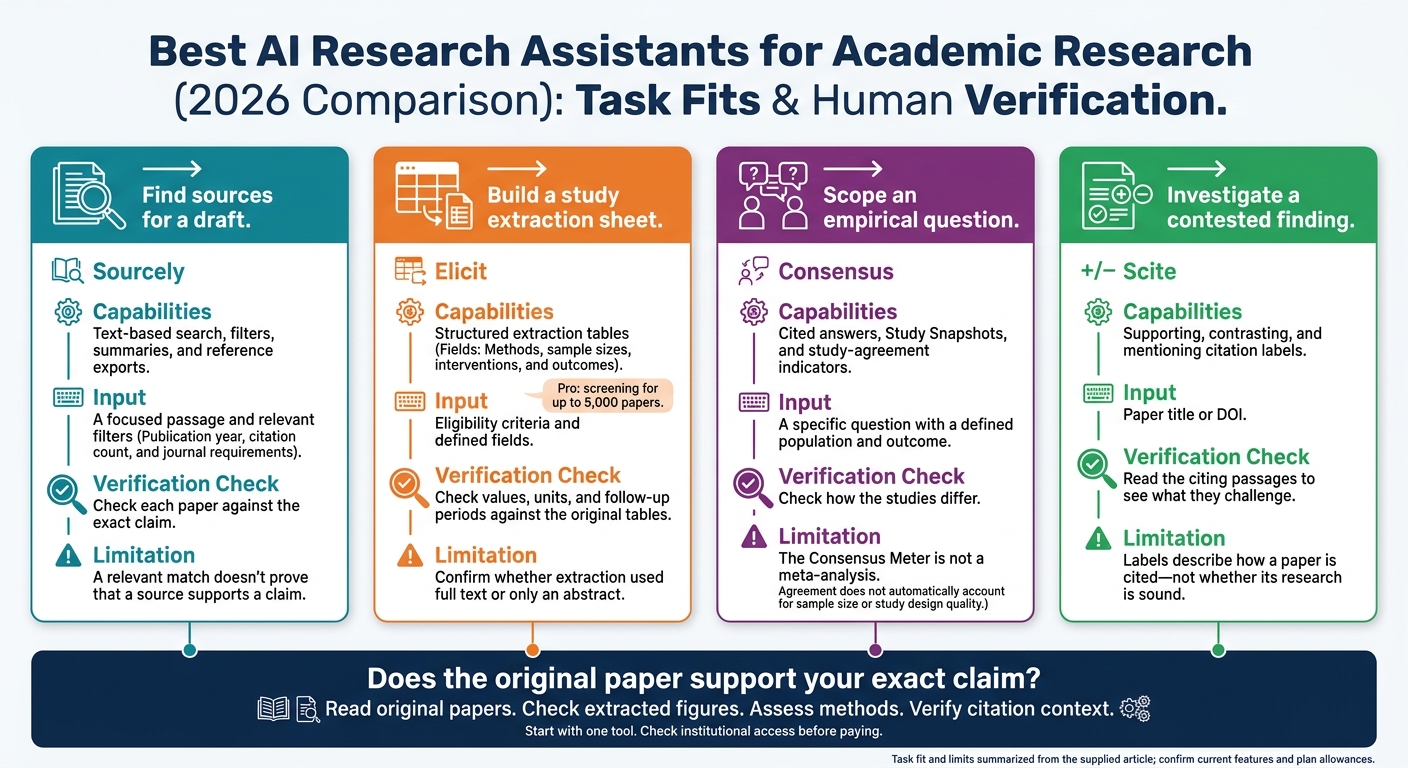
| Find sources for a draft | Sourcely: Matches draft text with possible sources. | A focused passage and relevant filters | Check each paper against the exact claim. | Wording affects results. Rephrase unclear claims and check relevance before using a match. |
| Build a study extraction sheet | Elicit: Organizes study details into tables. | Eligibility criteria and defined fields | Check values, units, and follow-up periods against the original tables. | Extracted values may be incomplete or wrong, especially in complex fields. |
| Scope an empirical question | Consensus: Finds quick answers to focused questions. | A specific question with a defined population and outcome | Check how the studies differ. | The agreement meter can hide disagreement across populations, methods, and outcomes. |
| Investigate a contested finding | Scite: Shows how later papers cite a finding. | Paper title or DOI | Read the citing passages to see what they challenge. | Citation labels can misread context; they do not rate study quality. |
How much you can verify depends on the method and the sources you can access.
Final Recommendations: Choose by Research Task
Match the tool to the task: use Sourcely to find sources from a draft, Elicit to build structured review tables, Consensus for quick evidence checks, and Scite to review citation context. Start with one tool. Add another only when your workflow clearly calls for it.
Pay for multiple subscriptions only if each tool handles a separate step. Check institutional access before paying.
No tool replaces source checking. Read the original papers, check extracted figures, assess the methods, and confirm that each citation supports the exact claim. For systematic reviews, document both the AI-assisted steps and the human checks.
FAQs
How can I test Sourcely’s relevance to my research field?
Upload your research drafts, notes, or paragraphs to Sourcely. It searches over 200 million research papers for sources that match your content.
Narrow the results with filters for publication year, authors, and relevance. Then review the papers to see how well they fit your research topics and where they can fill gaps in your citations.
Is it safe to upload unpublished research to Sourcely?
Before uploading unpublished research to Sourcely, review its terms and privacy policies. Check how it handles your data and whether it uses that data to train models.
Confidential data, peer-review materials, and unpublished manuscripts need strict handling. Keep sensitive material out of the tool unless a clear privacy agreement or institutional account guarantees that your data stays private and won’t be used for training.
How should I disclose AI assistance in a literature review?
Document which AI tools you used and what each one did. Most academic institutions and journals require disclosure, but requirements vary. Check your target journal’s or university’s AI usage policies.
Keep all decisions and verification in your hands. Before adding any AI-generated claim or citation to your manuscript, check it against the original source text. You remain fully responsible for your paper’s accuracy and integrity.


