
Dublin Core Metadata Standards Explained
Dublin Core is a metadata standard with 15 core elements designed to describe digital and physical resources. It simplifies how information like research papers, datasets, and images are cataloged and found online. Originating in 1995, it became an ISO standard in 2003, ensuring global consistency in metadata practices. The core elements include Title, Creator, Subject, and Date, among others, and are used to provide clear, searchable descriptions of resources. Institutions like libraries and repositories rely on Dublin Core for organizing and sharing data efficiently.
Key Points:
- Core Elements: 15 standardized fields for describing resources (e.g., Title, Creator, Subject).
- Purpose: Improves searchability and ensures metadata consistency.
- Applications: Used in institutional repositories, academic tools, and global data-sharing platforms.
- Simple vs. Qualified: Simple Dublin Core uses only the 15 elements, while Qualified adds refinements like "Date Created" or "Abstract" for more precision.
- Interoperability: Designed to work across systems, even with older formats, using the "Dumb-Down Principle."
Dublin Core remains essential for organizing resources, enabling precise searches, and maintaining compatibility across digital platforms.
Dublin Core: An Introduction
The 15 Core Elements
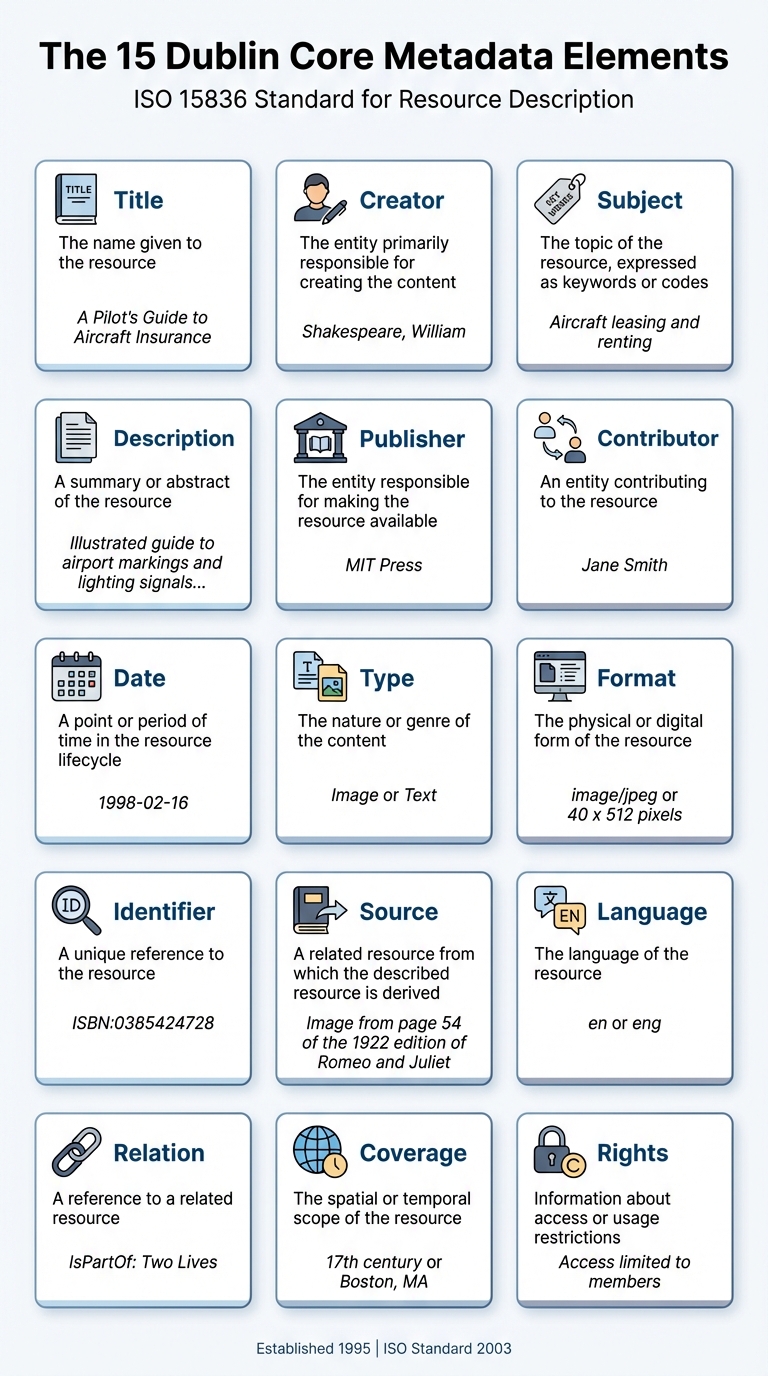
Dublin Core 15 Metadata Elements with Definitions and Examples
The Dublin Core Metadata Element Set consists of 15 standardized properties designed to describe any resource. These properties are internationally recognized (ISO 15836, ANSI/NISO Z39.85, IETF RFC 5791), ensuring consistent cataloging practices across the globe.
Each element plays a role in making resources easier to find and identify. For instance, the Title element records the formal name of a resource, while Creator specifies its author or originator. The Subject element uses keywords or classification codes to describe the resource's topic, and Description provides a brief summary, like an abstract, to help users quickly evaluate its relevance. Other elements focus on administrative details: Publisher identifies the entity responsible for making the resource available, Date marks significant moments in the resource's lifecycle (such as creation or publication), and Rights outlines access restrictions or usage terms.
Some elements deal with technical and relational aspects. Type defines the genre or nature of the content (e.g., "Image" or "Text"), while Format describes its physical or digital characteristics, often using MIME types like "image/jpeg." The Identifier element assigns a unique reference, such as an ISBN or DOI. Language specifies the resource's language using ISO 639 codes, and Coverage details its spatial or temporal scope. Finally, the Source, Relation, and Contributor elements connect the resource to its origins, related works, or additional creators.
List of the 15 Elements
| Element | Definition | Practical Example |
|---|---|---|
| Title | The name given to the resource | "A Pilot's Guide to Aircraft Insurance" |
| Creator | The entity primarily responsible for creating the content | "Shakespeare, William" |
| Subject | The topic of the resource, expressed as keywords or codes | "Aircraft leasing and renting" |
| Description | A summary or abstract of the resource | "Illustrated guide to airport markings and lighting signals..." |
| Publisher | The entity responsible for making the resource available | "MIT Press" |
| Contributor | An entity contributing to the resource | "Jane Smith" |
| Date | A point or period of time in the resource lifecycle | "1998-02-16" |
| Type | The nature or genre of the content | "Image" or "Text" |
| Format | The physical or digital form of the resource | "image/jpeg" or "40 x 512 pixels" |
| Identifier | A unique reference to the resource | "ISBN:0385424728" |
| Source | A related resource from which the described resource is derived | "Image from page 54 of the 1922 edition of Romeo and Juliet" |
| Language | The language of the resource | "en" or "eng" |
| Relation | A reference to a related resource | "IsPartOf: Two Lives" |
| Coverage | The spatial or temporal scope of the resource | "17th century" or "Boston, MA" |
| Rights | Information about access or usage restrictions | "Access limited to members" |
How the Core Elements Are Used
The table above outlines the 15 elements, but how are they applied in practice? Institutional repositories use these elements to maintain consistent metadata across different platforms. For example, when cataloging a research paper, a university library might list the author's name under Creator, record the publication date using the Date element (formatted as YYYY-MM-DD per ISO 8601), and include standardized terms under Subject to describe the paper's topic. This standardization ensures that data can be shared seamlessly using protocols like OAI-PMH.
The elements can be repeated as needed. For example, a resource with multiple authors would list each name in a separate Creator field. To maintain consistency, repositories often rely on controlled vocabularies - like the DCMI Type Vocabulary for Type or MIME types for Format - so that metadata is interpreted uniformly across systems. This alignment allows local metadata to integrate into broader federated searches.
"Most resource discovery metadata standards can be mapped to the Dublin Core Metadata Element Set, enabling basic federated searching across metadata, created using a number of different standards."
Repositories also follow best practices to ensure interoperability. For instance, the Description element should include complete sentences with searchable terms to help users and search engines locate relevant resources. The Date element must use the clear YYYY-MM-DD format to avoid regional misinterpretations (e.g., "02/03/2024" could mean different things depending on the region). For the Identifier element, reliable systems like DOIs, ISBNs, or institutional URLs are used to uniquely reference each resource.
Simple vs. Qualified Dublin Core
Simple Dublin Core sticks to the basics, using just the 15 core elements. It's straightforward and designed for quick, no-fuss cataloging - perfect for users who aren't metadata specialists and need an easy way to organize resources.
Qualified Dublin Core, on the other hand, builds on those 15 elements by adding extras like Audience, Provenance, and RightsHolder. It also introduces "qualifiers" that let you refine and clarify metadata. For instance, instead of a generic Date, you can specify Date Created or Date Modified to pinpoint a resource's timeline more precisely. This added detail is invaluable when managing complex resources or supporting advanced searches that demand specific fields.
However, this precision comes at a cost: complexity. Simple Dublin Core is ideal for broad searches and is easy to implement, even in basic HTML. Qualified Dublin Core, with its refinements and detailed encoding schemes, often requires more advanced formats like RDF/XML and a deeper understanding of metadata. Choosing between the two depends on your needs. For general-purpose repositories or cost-conscious projects, Simple Dublin Core is a smart choice. But if your focus is on specialized collections or detailed tracking of rights and provenance, Qualified Dublin Core is the way to go.
| Feature | Simple Dublin Core | Qualified Dublin Core |
|---|---|---|
| Element Count | 15 core elements | 18+ elements (adds Audience, Provenance, RightsHolder) |
| Refinements | None | Includes qualifiers like "Created" or "Abstract" |
| Complexity | Low; easy for non-specialists | Higher; requires expertise in metadata |
| Primary Use Case | Broad discovery; OAI-PMH | Specialized repositories; precise searches |
| Interoperability | Universal compatibility | High (via Dumb-Down Principle) |
How Refinements and Qualifiers Work
Refinements act like adjectives, adding detail to the "nouns" of metadata elements. They sharpen the meaning without changing the core purpose. For example, Title can be refined to Alternative Title to include abbreviations or alternate names. Similarly, Description can be refined to Abstract to specify a formal summary rather than a general overview.
There are two main types of qualifiers:
- Element Refinements: These make an element more specific. For instance, instead of a generic Date, you might use Date Created to indicate when a resource was first made.
- Encoding Schemes: These define the format or vocabulary for a value. For example, a Subject term might follow the Library of Congress Subject Headings (LCSH), or a date might use the W3CDTF format.
Imagine cataloging a research paper. You could use Date Created for when the author finished writing, Date Issued for the journal's publication date, and Date Modified for any later revisions. Without these refinements, all these dates would fall under the generic Date element, leaving users to guess which is which. Refinements take the guesswork out and make searches more precise.
The Dumb-Down Principle
The Dumb-Down Principle ensures that Qualified Dublin Core stays compatible with simpler systems. Here’s how it works: if a system doesn’t recognize a qualifier, it ignores it and treats the value as unqualified. This means the metadata remains usable, even if it loses some specificity.
"According to this rule [the Dumb-Down Principle], a client should be able to ignore any qualifier and use the value as if it were unqualified. While this may result in some loss of specificity, the remaining element value... must continue to be generally correct."
- DCMI Usage Guide
For example, if you use Date Created: 02/15/2024, a system that doesn’t understand the Created refinement will still interpret it as Date: 02/15/2024. It’s less detailed but still accurate. This backward compatibility means you can adopt Qualified Dublin Core without worrying about breaking older systems that only support the 15 basic elements.
Using Dublin Core in Institutional Repositories
Institutional repositories use Dublin Core to establish a shared framework for metadata, bridging gaps across various systems and academic disciplines. By standardizing resource descriptions, Dublin Core simplifies the process for researchers to locate materials, regardless of storage location or the system managing them. Metadata experts highlight how this consistency significantly improves resource discovery. This uniformity becomes especially critical when repositories share data with global platforms like WorldCat or OAI-PMH harvesters, where alignment across institutions ensures smooth integration. Below, we explore how local metadata conversion and cross-repository sharing benefit from these standardized elements.
Converting Local Metadata to Dublin Core
Most institutions begin with metadata schemas tailored to their specific needs. Converting these schemas to Dublin Core involves mapping local fields to the appropriate standard elements. For example, "Author Affiliation" aligns with dc:contributor, while "Publication Year" corresponds to dc:date.
Using Qualified Dublin Core allows for greater precision. Instead of grouping all dates under a generic Date element, you can specify Date Created for when a document was written and Date Issued for its publication date. This level of detail helps preserve the original meaning of local metadata when shared externally.
To maintain consistency, all records in a set should follow the same semantic and syntactic rules. Dates should be formatted as YYYY-MM-DD using ISO 8601 standards. For subject terms, controlled vocabularies like Library of Congress Subject Headings (LCSH) or Medical Subject Headings (MeSH) are recommended.
If multiple values are required, such as several authors, repeat the metadata element for each value instead of grouping names into a single field. This approach ensures machine-readability and compatibility with external systems. Additionally, decide which fields are essential for external sharing and which are for internal use only. Focus on metadata that enhances discovery and omit unnecessary details.
| Local Element | Dublin Core Mapping | Best Practice |
|---|---|---|
| Title | dc:title | Keep it concise and descriptive; avoid starting with "The" or "A" for better sorting |
| Author Affiliation | dc:contributor | Include institutional affiliations to provide context for the resource |
| Publication Year | dc:date | Use the YYYY-MM-DD format and avoid vague terms like "unknown" |
| File Type | dc:format | Use MIME types, such as image/jpeg or application/pdf, for digital files |
| Original Source | dc:source | Cite the original resource from which the digital item is derived |
These practices streamline metadata integration across systems and improve global discoverability.
Sharing Data Across Repositories
Dublin Core serves as a universal exchange format, enabling repositories to aggregate and share metadata collections seamlessly. This is particularly valuable for the Open Archives Initiative, which relies on Dublin Core as its standard format for metadata harvesting and distribution.
By using Dublin Core, repositories maintain compatibility with simpler systems while ensuring more advanced interoperability. Application Profiles can further enhance this flexibility by combining Dublin Core elements with domain-specific metadata. For instance, a medical repository might integrate MeSH terms alongside standard Dublin Core fields, balancing local customization with global compatibility.
To maximize interoperability, use the dcterms: namespace (e.g., http://purl.org/dc/terms/creator) instead of the older dc: namespace. The modern namespace supports machine processing and aligns with Semantic Web applications. Additionally, encode global identifiers like ISSN, ISBN, and DOI as value URIs (e.g., urn:ISSN:0302-9743) to ensure they are universally recognized and machine-readable. This approach strengthens both the accuracy and accessibility of shared metadata.
sbb-itb-f7d34da
Technical Structure of Dublin Core
Dublin Core uses RDF/XML and URIs as its foundation, creating a machine-readable metadata standard that works seamlessly across different systems. These technologies convert simple descriptive elements into structured data that computers can easily process and share. This technical framework explains why Dublin Core continues to be a trusted choice for institutional repositories and digital libraries around the world.
Using RDF/XML for Metadata
RDF/XML organizes Dublin Core metadata into triples: a subject (the resource), a predicate (the property), and an object (the value). This structure ensures that metadata is consistently machine-readable. For instance, in the case of a digital book, the subject could be the book's URI, the predicate might be dc:title, and the object would be the title itself.
Namespaces play a crucial role in this system, distinguishing Dublin Core elements from others. For example, declaring xmlns:dc="http://purl.org/dc/elements/1.1/" ensures that dc:title is universally recognized and avoids confusion with other metadata standards. This approach became part of the formal framework when the Dublin Core Metadata Element Set was established as IETF standard RFC 2413 in 1998.
One of RDF/XML's strengths lies in its ability to handle refinements using sub-properties. For example, if a system encounters dcterms:abstract, it recognizes this as a refinement of the broader dc:description element through rdfs:subPropertyOf. Even if the receiving system doesn't understand the specific refinement, it can "dumb-down" the metadata to the simpler core element while preserving its essential meaning. This adaptability ensures that metadata remains useful across systems with varying levels of complexity.
"The basic layer of RDF can best be understood as collection of simple sentences (assertions): They have a subject, a predicate and an object." - Stefan Kokkelink and Roland Schwänzl
In addition to structuring metadata, ensuring unique identification is key, which is where URIs come into play.
How URIs Identify Metadata Resources
URIs act as unique identifiers for resources, properties, and values in Dublin Core metadata. Every element, such as dc:creator or dcterms:modified, is assigned a URI within a specific namespace, ensuring that metadata terms are distinct and unambiguous, even when shared across platforms.
To uniquely represent non-literal values like people or concepts, value URIs link directly to external authority files. For example, DCMI's 2008 recommendations demonstrated how a resource like http://example.org/123 could link to a subject identified by http://example.org/taxonomy/D003.53. This allows machines to retrieve detailed information about topics like "Biology" or "Ornithology" from different systems. A practical example from DCMI's 2019 User Guide illustrates this: a digital book (ex:myBook) connects to its creator using gnd:118529501, a URI from the German National Library's authority file that identifies the author Eike von Repgow. This method provides access to rich biographical details instead of relying on plain text.
The dcterms: namespace (http://purl.org/dc/terms/) has become the preferred choice over the older dc: namespace. It supports advanced machine processing and aligns with Semantic Web technologies. To ensure long-term stability, DCMI enforces a strict policy where once a URI is assigned to a term, its meaning remains fixed over time. This guarantees reliability for digital preservation and interoperability across systems.
Dublin Core Compared to Other Metadata Standards
Dublin Core's straightforward design and technical foundation make it a standout choice among metadata standards. Here's how it measures up against others like MODS (Metadata Object Description Schema) and METS, which cater to more complex cataloging requirements.
What sets Dublin Core apart is its simplicity. While MODS and METS dive deep into hierarchical structures and detailed parsing, Dublin Core focuses on ease of use and universal compatibility. As Diane Hillmann, author of the "Using Dublin Core" guide, aptly put it:
"Dublin Core can be seen as a 'metadata pidgin for digital tourists': easily grasped, but not necessarily up to the task of expressing complex relationships or concepts."
In essence, Dublin Core functions as a simplified metadata language.
This simplicity is its strength. It’s perfect for scenarios where general users need to create metadata or when repositories need to share data across different systems. For example, MODS, maintained by the Library of Congress, allows intricate parsing of titles (e.g., <nonSort>, <subTitle>, <partNumber>) and contributor roles. In contrast, Dublin Core consolidates such details into broader categories like Creator or Title, which may lead to some data loss during conversion from MODS.
This trade-off is intentional. As noted earlier with the Dumb-Down Principle, Dublin Core sacrifices granularity for usability. It serves as a universal exchange format, particularly valuable for OAI-PMH harvesting across institutional repositories. Many organizations use detailed MODS records internally but convert them to Dublin Core for external sharing. This ensures compatibility, even if some details are simplified.
Metadata Standards Comparison Table
Here's a quick look at how Dublin Core and MODS compare:
| Feature | Dublin Core (Simple) | MODS |
|---|---|---|
| Complexity | Low (15 core elements) | High (Hierarchical/Parsed) |
| Primary Use Case | General web discovery; cross-domain interoperability | Detailed library cataloging; bibliographic description |
| Target User | General users | Specialists, librarians, and archivists |
| Structure | Flat; optional and repeatable elements | Hierarchical; supports subelements and attributes |
| Compatibility | Universal exchange format (OAI-PMH) | Often mapped to DC for harvesting |
| Granularity | Low (e.g., single "Subject" field) | High (e.g., separate "Topic", "Geographic", "Temporal") |
| Data Integrity | Potential for data loss during conversion from complex sets | High; preserves detailed bibliographic relationships |
If your goal is broad interoperability, ease of use, and minimal maintenance, Dublin Core is the way to go. However, for managing detailed bibliographic records, MODS or METS offers the precision required.
Conclusion
Dublin Core metadata standards have established themselves as a widely recognized framework for describing digital resources. With just 15 core elements, it strikes a balance between being straightforward enough for non-experts to use and robust enough to meet the demands of institutional repositories around the world. Its adoption as ISO 15836 and translation into over 10 languages highlights its global acceptance and utility.
One of Dublin Core's standout features is its adaptability. Whether you’re working with Simple Dublin Core for basic descriptions or Qualified Dublin Core for more detailed cataloging, the Dumb-Down Principle ensures that metadata remains compatible across different systems. This inherent interoperability has made Dublin Core a preferred choice for OAI-PMH harvesting, enabling smooth data exchange between repositories. For researchers, this means easier access to well-organized and consistent data.
This level of integration benefits not only repository managers but also researchers and students navigating academic literature. Understanding metadata standards like Dublin Core can significantly enhance the way sources are discovered and managed. For instance, field-specific searches - by author, title, or subject - become more efficient with standardized metadata. Tools like Sourcely (https://sourcely.net) take this a step further by using AI to apply these principles, offering precise search filters and automated citation assistance. Whether you’re managing repository metadata or building bibliographies, these tools simplify and streamline the process.
FAQs
What is the difference between Simple and Qualified Dublin Core metadata?
The Simple Dublin Core relies on 15 basic metadata elements, keeping things straightforward and easy to work with. It doesn't include any extra qualifiers, which makes it a simpler option for implementation.
On the other hand, Qualified Dublin Core introduces refinements and encoding schemes to provide more detailed and precise metadata. This approach allows for more descriptive and accurate categorization, which can be especially helpful when searching for or organizing resources.
For instance, with Qualified Dublin Core, you can define a specific date format or clearly indicate a contributor's role, offering more flexibility for handling complex metadata requirements.
How does Dublin Core work with older systems?
Dublin Core maintains compatibility with older systems by sticking to its original element definitions and standardized vocabularies. This consistency ensures that legacy applications can still interpret metadata seamlessly.
Moreover, older specifications and documentation have been thoughtfully transitioned to modern platforms like GitHub repositories, ensuring their integrity remains intact. By blending forward-thinking updates with respect for older systems, Dublin Core proves to be a dependable option for both modern and legacy applications.
Why is Dublin Core commonly used for institutional repositories?
Dublin Core has become a popular choice for institutional repositories because it’s straightforward to use and works well across different systems. Its 15-element metadata set is easy to implement, making it a practical option for institutions, whether large or small. Plus, being an internationally recognized standard, it ensures smooth compatibility between various platforms and systems.
One standout feature of Dublin Core is its ability to connect with other metadata standards. This makes it easier to search for and discover resources across different domains, enabling federated searches. As a result, resources remain accessible and usable, even when shared across multiple repositories or systems.