What is h-index? Guide to Author Impact
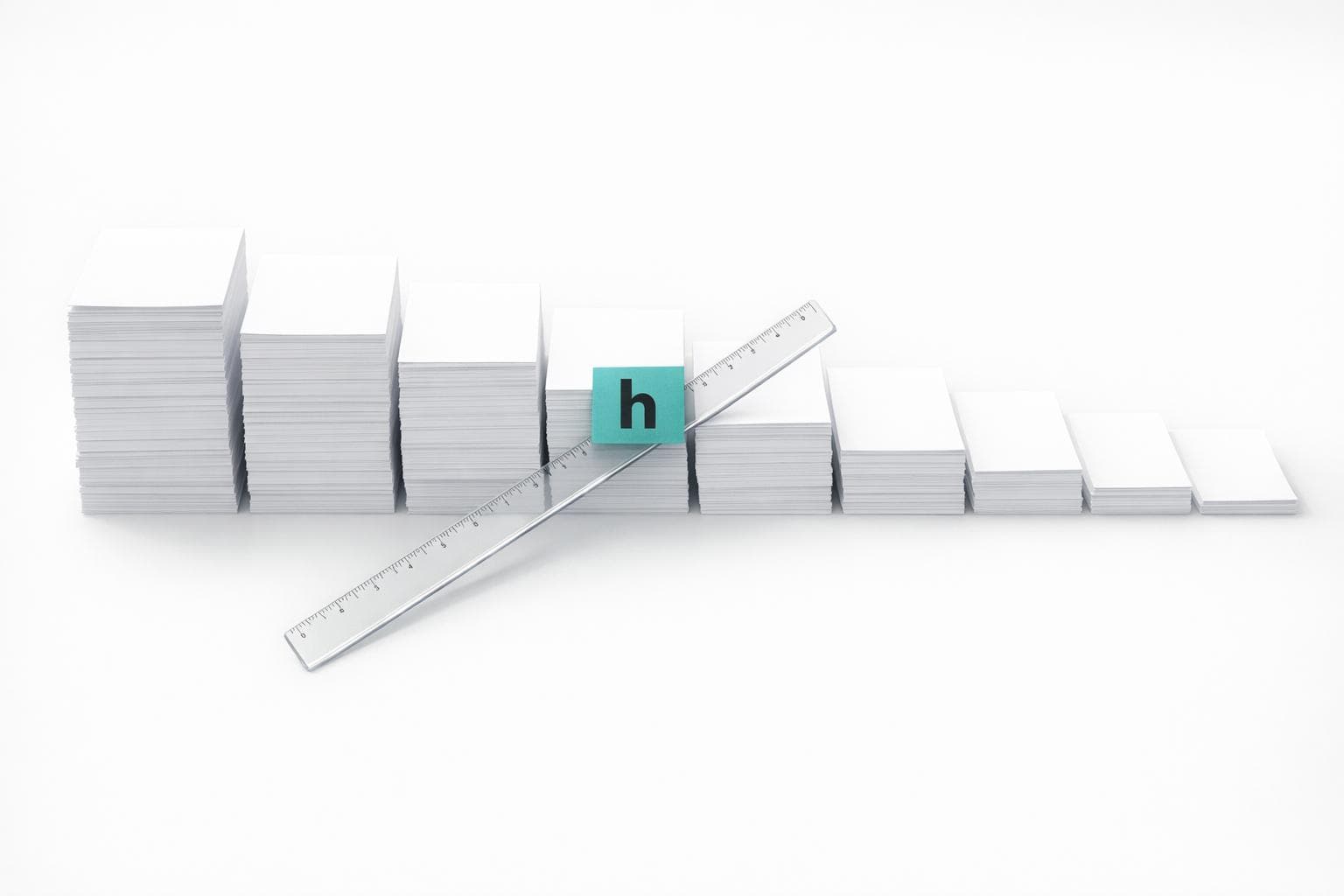
The h-index measures a researcher's impact by balancing the number of publications and their citation counts. Developed by Jorge E. Hirsch in 2005, it identifies consistent influence across multiple works. For example, an h-index of 10 means a researcher has 10 papers cited at least 10 times each.
Key Points:
- Purpose: Balances productivity (number of papers) and influence (citations).
- Calculation: Rank papers by citations; the h-index is the highest rank where citations ≥ rank.
- Field Variation: Benchmarks vary by discipline (e.g., Physics: ~25; Law: ~3).
- Limitations: Favors senior researchers, varies by database (Google Scholar, Scopus, Web of Science).
To improve your h-index, focus on publishing quality research and using tools like Sourcely for finding and managing sources efficiently.
What is the h-index and what are its limitations? Or: Stop using the h-index [Animation]
sbb-itb-f7d34da
How to Calculate the h-index
How to Calculate Your h-index: 5-Step Process
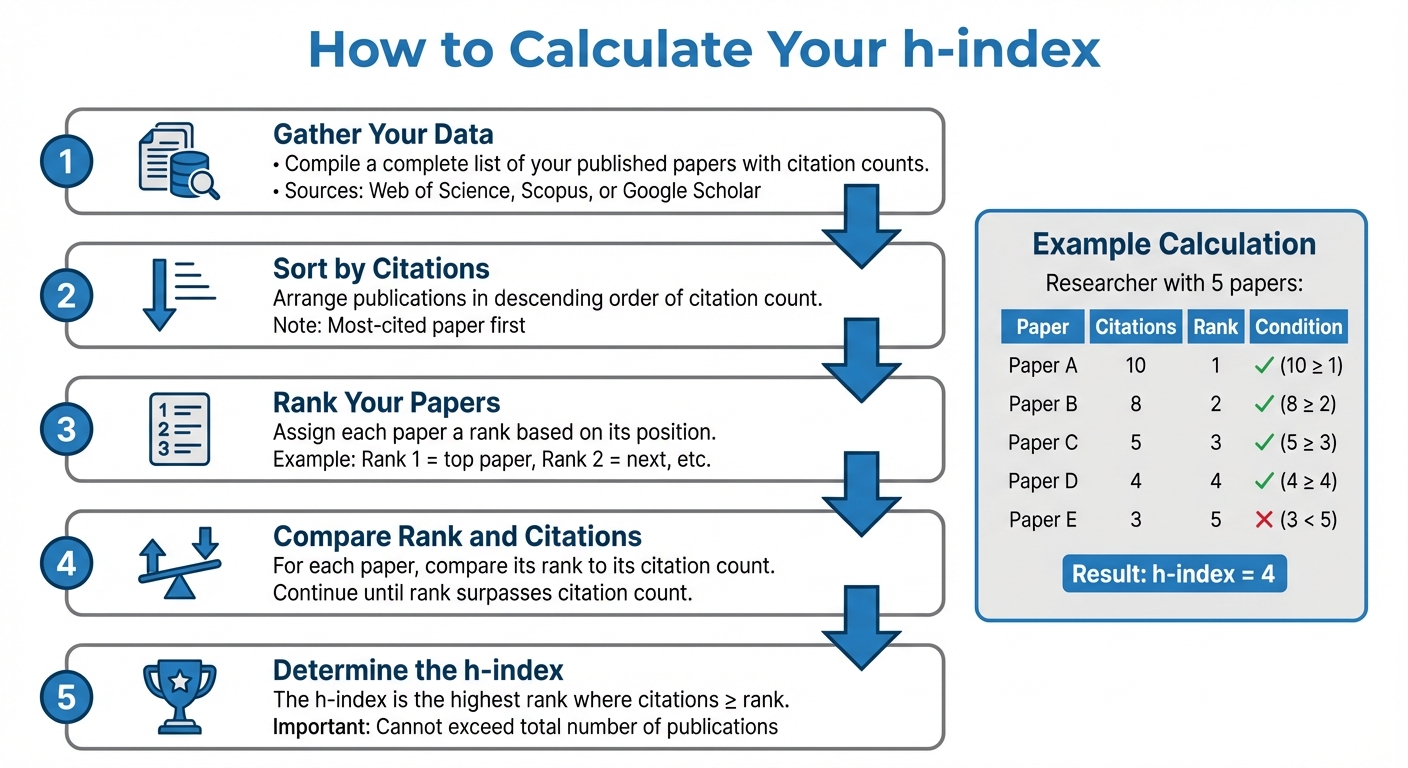
Calculating the h-index manually involves a few straightforward steps. This method requires organizing your publication data and pinpointing where your citation count aligns with your publication rank. While tools like Google Scholar and Web of Science can calculate it instantly, understanding the manual process helps you grasp the concept better.
Step-by-Step Calculation
- Gather your data: Compile a complete list of your published papers along with their citation counts by finding relevant sources for your publication history. Reliable sources for academic research include Web of Science, Scopus, or Google Scholar.
- Sort by citations: Arrange your publications in descending order of citation count, starting with the most-cited paper.
- Rank your papers: Assign each paper a rank based on its position in the sorted list - rank 1 for the top paper, rank 2 for the next, and so on.
- Compare rank and citations: For each paper, compare its rank to its citation count. Continue down the list until you find a paper where the rank surpasses the citation count.
- Determine the h-index: The h-index is the highest rank where the citation count is equal to or greater than the rank. Keep in mind, your h-index cannot exceed your total number of publications.
Example Calculation
Let’s look at an example. Imagine a researcher has five publications (A, B, C, D, and E) with citation counts of 10, 8, 5, 4, and 3, respectively. When sorted by citations:
- Paper A has 10 citations, and its rank is 1 (10 ≥ 1).
- Paper B has 8 citations, and its rank is 2 (8 ≥ 2).
- Paper C has 5 citations, and its rank is 3 (5 ≥ 3).
- Paper D has 4 citations, and its rank is 4 (4 ≥ 4).
- Paper E has 3 citations, and its rank is 5 (3 < 5).
Here, the h-index is 4 because four papers have at least four citations each, but there aren’t five papers with at least five citations.
Another example comes from the University of Oklahoma Research Guides. A researcher with 15 articles has a 6th most-cited paper with 7 citations and a 7th paper with only 4 citations. This means their h-index is 6, as they have six papers with six or more citations, but not seven with seven or more.
With this manual calculation method clear, the next section will explore how to locate an author’s h-index using various tools.
Where to Find an Author's h-index
If you're looking to find an author's h-index without manually calculating it, there are a few reliable online tools to consider. Google Scholar is probably the easiest and most accessible option. It’s free, and you can see the h-index directly on a researcher's public profile. Just head to scholar.google.com, search for the author's name, and open their profile. The h-index will be displayed in the "Cited by" section on the right-hand side.
For more curated data, Scopus and Web of Science are excellent alternatives, though they often require an institutional subscription. On Scopus, use the "Author Search" tab to locate the researcher, then click on "Citation Overview" to view their h-index. If the author’s work is listed under multiple name variations, make sure to select all relevant entries to get an accurate combined h-index. In Web of Science, search using the "Author" tab and then click "Create Citation Report" to find the h-index.
"The h-index in Google Scholar is usually higher than the one in Web of Science, since Google Scholar's database is larger and less curated than Web of Science's."
- Karen Merguerian, Northeastern University Library
It’s worth noting that h-index values can vary depending on the platform. Google Scholar includes a broader range of sources, such as books, technical reports, and preprints, which often results in higher h-index numbers. On the other hand, Scopus and Web of Science focus on peer-reviewed journals and conference proceedings, leading to more conservative figures. When sharing an h-index, always specify the source and the date (e.g., "h-index of 15 per Scopus on April 13, 2026") to ensure clarity and context.
For researchers with common names, ORCID identifiers can help you pinpoint the correct profile and avoid confusion. Without proper disambiguation, platforms like Web of Science might return irrelevant results. Additionally, tools like Harzing's Publish or Perish can aggregate data from multiple sources to calculate h-index variations. Using AI-powered research tools can streamline the discovery of these metrics. Correctly identifying the source and metrics is key to accurately evaluating an author's impact, especially when interpreting search results across different fields.
What is a Good h-index?
Defining a "good" h-index depends on factors like the researcher's field, career stage, and the database used for measurement. For instance, an h-index of 10 might be impressive in Philosophy but fairly standard in Biology. Since the h-index grows over time, it often favors researchers with longer careers. To make meaningful comparisons, it's essential to evaluate h-index values within the appropriate context. Here’s a breakdown of benchmarks that highlight these variations across disciplines.
h-index Benchmarks by Field
Fields like STEM (Science, Technology, Engineering, and Mathematics) typically see higher h-index values compared to the Humanities or Social Sciences. This difference arises because STEM researchers often publish more frequently, work in larger teams, and receive citations at a faster rate. Understanding these trends is a key part of literature sourcing and citation strategies. A 2023 study using Scopus data found that professors in Physics had an average h-index of 25, while those in Anthropology averaged just 8.
For physicists, Jorge Hirsch, who created the h-index, suggested benchmarks for U.S. research universities: an h-index of 12 for tenure, 18 for full professorship, and 20 after 20 years of research as a marker of success. He described an h-index of 40 as "outstanding" and 60 as "truly unique". In biological and biomedical sciences, the median h-index for new members of the National Academy of Sciences in 2005 was 57.
The disparity between disciplines is striking. For example, a study of UK professors reported average h-indices ranging from 2.8 in Law to 7.6 in Economics. Meanwhile, mid-career Molecular Biologists might have an h-index of 20–30, while those in Computational Mathematics might fall in the 10–15 range.
h-index Comparison Table
The following tables provide a snapshot of typical h-index ranges by academic field and career stage.
| Academic Field | Associate Professor | Full Professor |
|---|---|---|
| Physics / Biology | 15–30 | 40+ |
| Medicine | 10–25 | 20–30+ |
| Engineering / Computer Science | 10–25 | 20+ |
| Social Sciences | 5–15 | 10–20 |
| Humanities | 2–5 | 5–10 |
| Career Stage | Typical Range |
|---|---|
| Early Career (PhD/Postdoc) | 1–5 |
| Assistant Professor | 3–5 |
| Associate Professor | 8–12 |
| Full Professor | 15–20 |
| Senior Researcher (20+ years) | 20–40+ |
When assessing an h-index, it's crucial to compare researchers within the same field and use consistent databases. For example, Google Scholar often reports higher h-index values than Scopus or Web of Science, as it includes a broader range of materials like preprints, books, and technical reports.
Limitations of the h-index
The h-index provides a quick way to gauge academic impact, but it comes with several notable flaws that can distort a researcher's true contributions. One of the biggest issues is its dependency on academic discipline - citation habits differ significantly across fields. For instance, in clinical medicine, an h-index of 84 is considered strong, whereas in mathematics, a score of 19 is highly regarded. This makes comparisons between fields tricky unless adjustments are made to account for these variations. Another challenge is how the h-index disproportionately favors researchers at later career stages.
Since the h-index is cumulative, senior researchers naturally have an advantage over early-career scientists, even if the latter produce groundbreaking work. For example, a junior researcher might create transformative studies but still lag behind a veteran researcher whose work, though incremental, has had decades to accumulate citations.
The metric also fails to differentiate between solo and collaborative efforts. According to Scopus data from June 2024, 22 authors published over 200 papers in just six months, with the most prolific individual averaging 1.56 papers per day. Such practices can artificially inflate h-index scores without accurately reflecting individual contributions.
Another problem is the h-index's emphasis on quantity rather than quality. A researcher who publishes numerous moderately cited papers can achieve a higher score than someone who produces a single, field-changing study. Even Jorge Hirsch, the creator of the h-index, acknowledged this shortcoming, saying:
"If we believe citations and h-indices, by all counts my contributions to the understanding of superconductivity are insignificant".
The metric's reliability as an indicator of scientific reputation has also declined. For example, the correlation between the h-index and prestigious physics awards dropped from 34% in 2010 to 0% by 2019.
To make matters worse, database inconsistencies further muddy the waters. Google Scholar reports 53% more citations than Web of Science and Scopus combined. Additionally, the h-index overlooks important contributions like books, patents, and teaching efforts. Recognizing these limitations is crucial when relying on the h-index as a standalone measure of research impact.
How Sourcely Can Help Improve Your h-index

If you're looking to boost your h-index, publishing high-quality research backed by strong sources is key. Sourcely simplifies this process with its AI-driven tools for discovering relevant academic literature.
Finding Sources with Sourcely
Sourcely works as a reverse search engine for academic research. Instead of just typing in keywords, you can paste a draft, abstract, or specific arguments into the platform. From there, it identifies contextually relevant, peer-reviewed articles from a database of over 200 million research papers. This approach uncovers insights that traditional keyword searches might overlook.
The platform's Deep Search feature is especially helpful for comprehensive literature reviews, quickly pinpointing the most relevant academic material. Artem Vysogorets, a Data Science PhD student, shared his experience:
"Sourcely helped me find papers relevant to my current project, and I will definitely use it again when writing the literature review section of my own paper!"
To refine your search, Sourcely offers advanced filters for criteria like publication year, author, and citation count. Once you've found potential sources, features like summaries and the "Chat with Sources" tool allow you to evaluate papers quickly before diving deeper. These tools not only make source discovery more efficient but also set the stage for producing research that can strengthen your h-index.
Benefits for Researchers
Sourcely goes beyond discovery by streamlining the citation process. Its automated tools identify citation-worthy text and suggest relevant sources, helping you move seamlessly from draft to a fully referenced paper. The Citations Library feature keeps your references organized for long-term projects, supporting consistent output that contributes to h-index growth.
Currently, more than 100,000 researchers and students rely on Sourcely. With plans starting at just $7 (one-time) or $17 monthly, the platform is accessible to researchers with varying needs. By simplifying both research and citation management, Sourcely enables academics to produce work that garners more citations.
As SY, a researcher, put it:
"Sourcely.net has been a game-changer for my research and academic pursuits. It consistently provides me with the latest and most relevant peer-reviewed articles, ensuring that I am always up-to-date with the current trends and findings in my field."
Conclusion
The h-index provides a useful way to measure both productivity and the influence of one's academic work. Unlike simple publication counts or total citations, it filters out anomalies like single-hit papers or authors who publish frequently but with limited impact. As J.E. Hirsch, who developed the metric, wisely pointed out:
"A single number can never give more than a rough approximation to an individual's multifaceted profile, and many other factors should be considered in combination in evaluating an individual".
Understanding how to calculate your h-index, where to locate it, and the standards within your field can give you a clearer picture of your academic progress. For example, in physics, an h-index of 12 often indicates readiness for associate professor tenure at major U.S. research universities, while an h-index of 18 is generally expected for full professorship. However, these benchmarks vary widely across disciplines, making context especially important.
That said, the h-index has its limitations. It doesn't account for factors like career stage, co-authorship, or the citation norms of specific fields. For a more comprehensive evaluation, the h-index should be used alongside other tools, such as total citation counts, citation trends, and qualitative peer reviews.
To address these challenges, focus on producing well-researched, high-quality work. Tools like Sourcely can help by connecting you with peer-reviewed literature, managing citations, and ensuring your research is grounded in credible sources. Starting at just $7, it’s a budget-friendly way to enhance the quality of your scholarship and, in turn, your academic reputation.
While the h-index is just one piece of the puzzle, when combined with thoughtful research practices, it can offer valuable insights into your growing academic influence.
FAQs
How is the h-index different from total citations?
The h-index evaluates both an author's productivity and the influence of their work, while total citations simply tally up the overall number of citations. The h-index specifically measures the number of papers (h) that have been cited at least h times, emphasizing consistent impact across multiple works. On the other hand, total citations can be heavily influenced by a small number of highly cited papers, which may not reflect the overall consistency of an author's contributions.
Can early-career researchers rely on the h-index?
The h-index can be a helpful tool for early-career researchers to gauge their research impact, but it’s far from perfect. This metric combines two factors: the number of publications and how often they’re cited. Since both tend to increase with time, early-career researchers often end up with lower h-index scores. This doesn’t always reflect their abilities, potential, or the quality of their work. To get a clearer picture of research impact, the h-index is best used alongside other metrics and qualitative assessments.
What should I do if my h-index is different across databases?
If your h-index varies between databases, take a closer look at the coverage and citation data each one provides. These discrepancies often arise because databases index different journals and sources, which can lead to variations in citation counts. To get a clearer picture of your academic impact, it’s a good idea to consult multiple databases and compare their results. This approach offers a broader perspective on your research influence.