How to Cite a Book in Bluebook Format (Rule 15 Explained Simply)
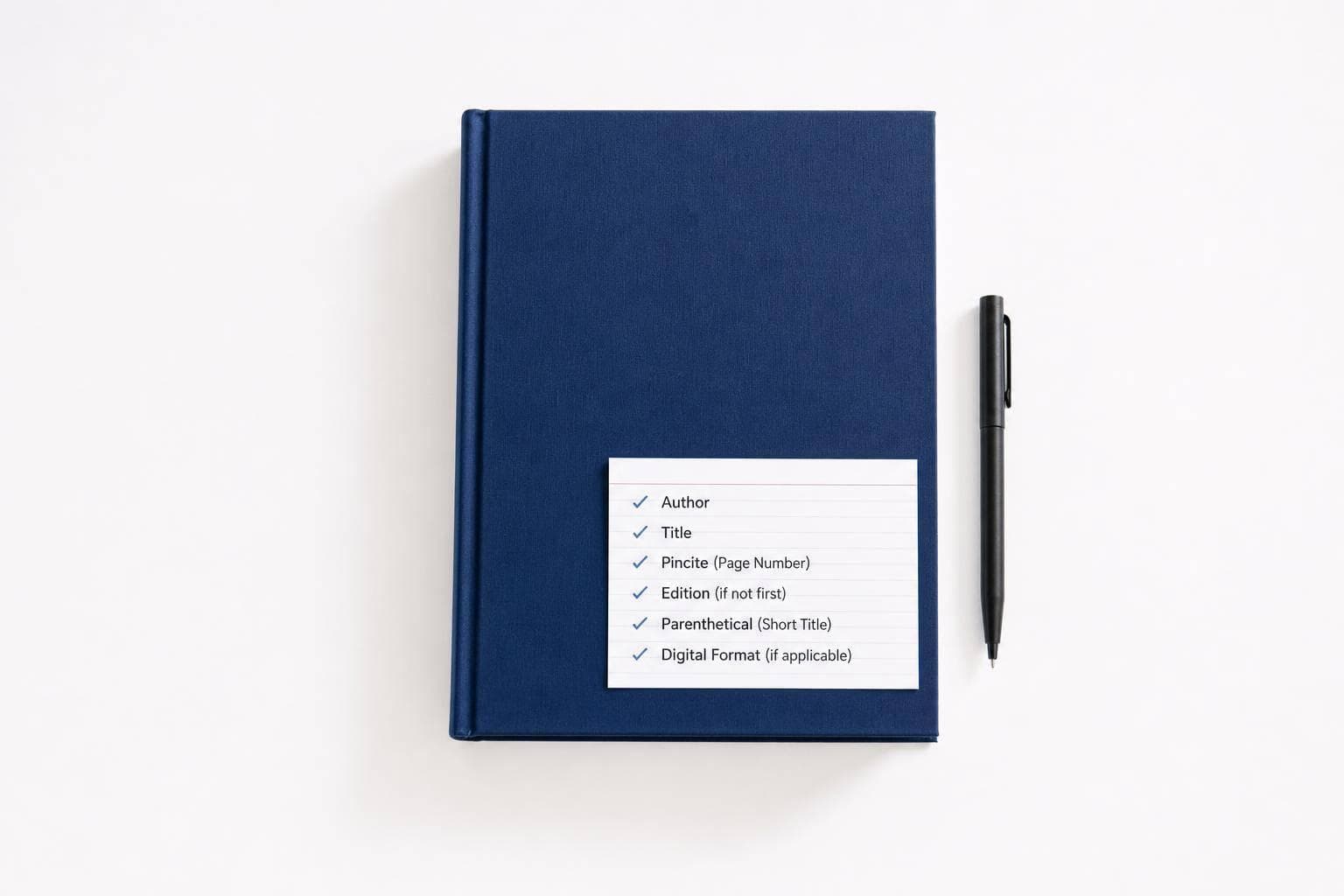
If you know 5 parts, you can cite most books under Bluebook Rule 15: author, title, pincite, parenthetical details, and year.
I’d put it even more simply: start with the author, add the book title, give the exact page or section, then close with the edition and year in parentheses. If the book has more than one volume, I place the volume number first. If I cite the same source again, I switch to id. or supra.
Here’s the whole article in one quick list:
- Rule 15 covers books and other nonperiodic sources, like treatises, dictionaries, encyclopedias, and reports.
- The standard order is: volume, author, title, pincite, parenthetical.
- The parenthetical usually holds the edition and year, and sometimes the editor, translator, or publisher.
- I do not list “1st ed.” Only later editions, like 2d ed. or 3d ed.
- For 2 authors, I list both names with an ampersand.
- For 3 or more authors, I use the first author plus et al.
- For chapters in edited books, I cite the chapter author and title, then the book title with in.
- For ebooks, I cite the version I used and add the format if no print version is available.
- For repeated citations, I use Id. for the source right before, and supra for an earlier footnote.
- Typeface changes by document type: law reviews use small caps; briefs and memos do not.
A lot of Rule 15 mistakes come from order, punctuation, and edition handling - not from the book title itself. So if I check those 3 things before filing or submitting, I catch most errors fast.
The article below walks through those rules with examples, short-form citations, digital source rules, and common book-citation setups you’re likely to use.
Bluebook Basics: Books & Book Chapters
The Core Parts of a Bluebook Book Citation
Now that you know the parts, here's how each one shows up in a Bluebook book citation. The next section walks through the standard order for putting those parts together into a full citation.
Author, Title, and Volume
Start with the author's name exactly as it appears on the title page. Include suffixes like "Jr." or "III", but leave out professional titles like "Dr." or "Judge". If there are two authors, join their names with an ampersand, as in Neal Feigenson & Christina Spiesel. If there are three or more authors, list the first author and then add et al..
The title comes next. Take it straight from the title page and capitalize it under Bluebook Rule 8: capitalize the first word, the first word after a colon, and all other words except articles, conjunctions, and prepositions of four or fewer letters.
For multivolume works, the volume number goes first. Put it at the start of the citation, before the author's name.
Pincite, Edition, Publisher, and Year
A pincite tells the reader exactly where to look in the source, whether that's a page, section (§), or paragraph (¶).
Put the edition and year in the parenthetical. Add the publisher only when that source type calls for it. Write editions as "2d ed." or "3d ed." and use the year for the exact edition you're citing, which you'll usually find on the copyright page. If you're citing a supplement or pocket part, show that in the year entry, like "Supp. 2024".
Digital Books and Online Versions
Cite the version you actually used. If there's a print version, cite that first. Use the digital version only if it's the only format available. If an ebook is your only choice, add a format label in the parenthetical, such as (ebook) or (Kindle eBook). For Westlaw or Lexis database versions, include the database name and the "database updated" date. If the digital copy doesn't have page numbers, use the location number, or "loc.", supplied by the device or software.
| Element | Where to Find It (Print) | Where to Find It (Digital) |
|---|---|---|
| Author | Front of the title page | Top of the document or "About this book" section |
| Title | Front of the title page | Top of the digital file or entry |
| Volume | Spine or title page | Database record header |
| Edition | Title page or copyright page | Beginning of the digital publication |
| Publisher | Copyright page (back of the title page) | Copyright notice at the bottom of the document |
| Year | Copyright page (back of the title page) | "Database updated" date or copyright year |
| Pincite | Page, section, or paragraph in the body of the work | Location number ("loc.") or paragraph (¶) / section (§) markers |
With the parts identified, the next section shows how to place them in the right order with the right punctuation.
How to Build a Full Bluebook Book Citation Step by Step
How to Build a Bluebook Book Citation (Rule 15 Step-by-Step)
The Standard Order of Citation Elements
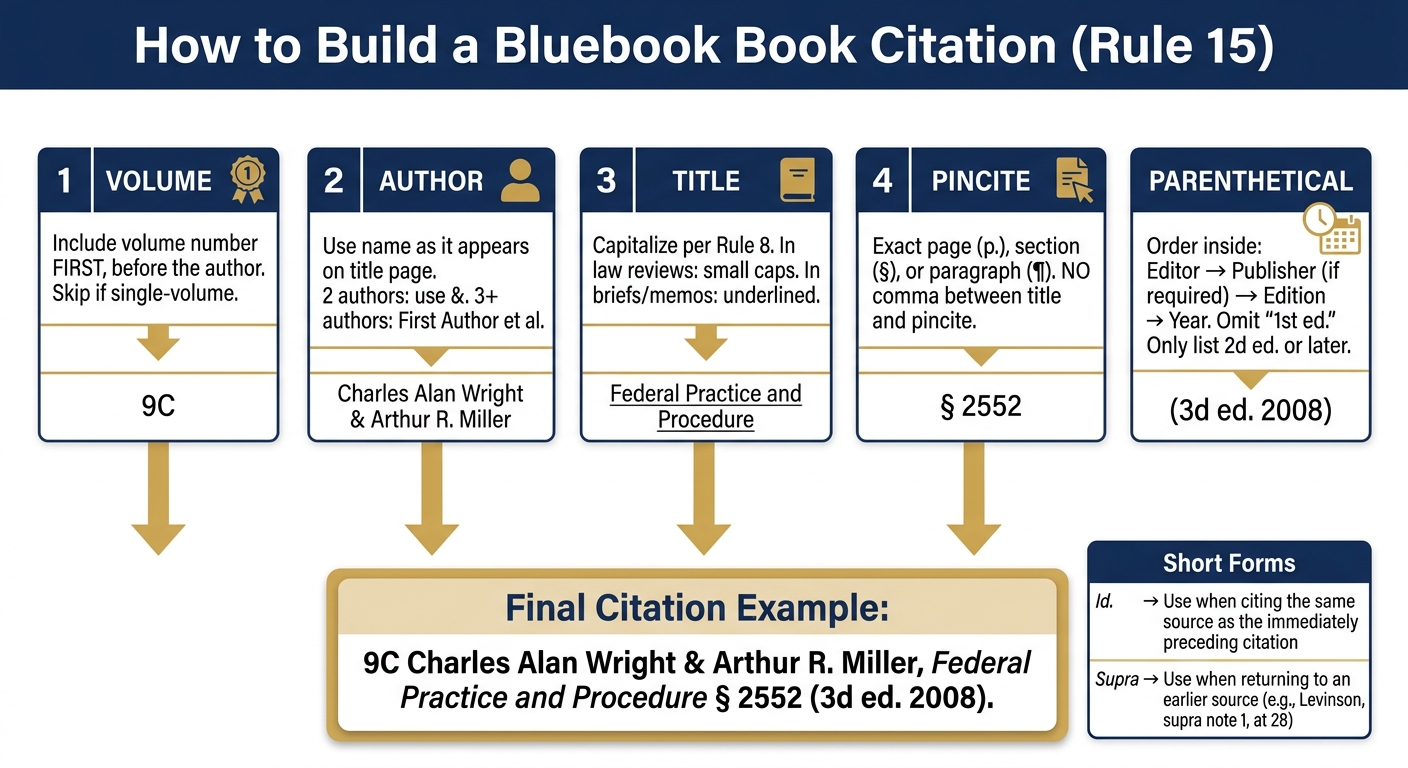
A Bluebook book citation follows this sequence: volume (if applicable), author, title, pincite, and parenthetical. Put simply: volume, author, title, pincite, parenthetical.
For a single-volume book, skip the volume and begin with the author. For a multivolume work, place the volume number first, before the author's name. The pincite goes right after the title, with no comma between the title and the pincite. Everything else - editor or translator, publisher when Rule 15 calls for it, edition, and year - belongs in the parenthetical. The basic frame stays the same, but the details shift a bit for editors, translators, and multivolume works.
How to Fill In the Parenthetical Correctly
This is where many citations go off track. If you need more than one detail in the parenthetical, list them in this order:
- editor or translator
- publisher
- edition
- year
Add the publisher only when Rule 15 requires it, such as for a reissued or pre-1900 work. Include the edition only if it is the second edition or later; do not write "1st ed.".
Here’s what a properly built citation looks like for a standard legal treatise:
9C Charles Alan Wright & Arthur R. Miller, Federal Practice and Procedure § 2552 (3d ed. 2008).
And for a book with both an editor and a translator:
Karl Marx & Friedrich Engels, The Communist Manifesto (Joseph Katz ed., Samuel Moore trans., Washington Square Press 1964).
Both examples follow the right parenthetical order. Also, "3d ed." stays in plain text, not superscript. The next section walks through the most common Rule 15 variations.
Typeface and Punctuation Checks Before You Use the Citation
Before you lock in the citation, do a quick check for comma placement, spacing, and title capitalization.
sbb-itb-f7d34da
Common Rule 15 Variations You Will Actually Use
Now let’s apply the standard Rule 15 frame to the book-citation variations you’ll use most often.
Multiple Authors, Editors, and Institutional Authors
These are the author-line exceptions that come up most often.
For two authors, list both names in the order they appear on the title page, separated by an ampersand: Neal Feigenson & Christina Spiesel, Law on Display.
For three or more authors, list the first author followed by "et al." You only need to list every author when that’s needed; otherwise, use et al.: Russell L. Weaver et al., Inside Constitutional Law.
For institutional authors, use the organization’s full name: Rocky Mountain Mineral Law Foundation, The American Law of Mining (2d ed. 1984). If the organization is also the publisher, leave the institutional author out.
For edited books, put the editor in the parenthetical. If there’s a translator, list that person after the editor.
Use these forms when the author field is not just a single person’s name.
Chapters in Edited Books, Translations, and Later Editions
Some book citations change the author line. Others change the source type.
Cite a chapter using the chapter author, chapter title, in book title, pinpoint, and the editor/year parenthetical. For example: John O. Mirick, Discovery and Trial Preparation, in Chapter 93A Rights and Remedies (Hon. Margot Botsford ed., 2005).
For translated works, put the translator’s name in the parenthetical after the editor and add "trans." For later editions, add the edition before the year: Lawrence Lessig, Code: Version 2.0 (2d ed. 2006). If you’re citing a reprint of an older work, add the original publication year in a separate parenthetical at the end.
Short-Form Citations, Supra, and Id.
After you’ve given the full citation, use short forms only when the source shows up again.
Use id. when the next citation points to the same source as the citation right before it: Id. by itself if the page is the same, and Id. at [page number] if the page changes. Use supra for an earlier source that is not the one cited immediately before, using this format: [Author's Last Name], supra note [footnote number], at [pincite].
Here’s how that looks in practice. If footnote 1 cites Sanford Levinson's Wrestling with Diversity at page 25 and footnote 2 cites Roger K. Newman's Hugo Black: A Biography at page 33, a follow-up citation to Newman at pages 35–36 becomes Id. at 35–36. A later return to Levinson becomes Levinson, supra note 1, at 28.
Using Rule 15 in Real Research and Writing
Keeping Book Citations Consistent Across Memos, Briefs, and Papers
Once you know the Rule 15 format, the next step is simple: use it the same way every time.
Write down the exact edition you used and note whether you cited the main volume or a supplement. If a pocket part updates the section you're citing, include the supplement year in the parenthetical. For example, 9 B.E. Witkin, California Procedure Appeal § 507 (5th ed. 2008 & Supp. 2016).
It also helps to stick with one citation style across the whole document. In memos and briefs, use plain text for author names and underlining for titles. In law reviews, use small caps instead.
| Element | Memos & Briefs | Law Reviews |
|---|---|---|
| Author | Plain text | Small caps |
| Title | Underlined | Small caps |
| Short forms (Id. / supra) | Italicized | Italicized |
| Pincite | Plain text | Plain text |
If a title is long, add a hereinafter label early so your later short forms stay neat and consistent.
Using Sourcely to Find Books and Gather Citation Details

When you're short on time, a research tool can help you pull the missing details fast. Just don't stop there.
Use Sourcely to find the book and collect the citation details you still need. Then check the author, edition, and year against the title page before you lock in the citation. Sourcely's filters let you narrow results by source type and publication date, which cuts down the time spent digging for the right edition by hand. If you're citing an ebook, make sure the citation matches the exact version you used, and cite the print book version first when one is available.
The Rule 15 Checklist to Remember
Use this quick check before you finalize any book citation.
- Identify the source type - make sure it's a book or treatise covered by Rule 15, not a periodical.
- Collect the core elements - author as listed on the title page, full title, volume number if needed, pincite, edition, and year. If you're using a supplement, record the supplement year on its own.
- Place elements in Bluebook order - volume, author, title, pincite, then the parenthetical with edition and year.
- Account for variations - multiple authors, editors, translated works, and chapters in edited collections each change the standard form a bit.
- Verify short forms - check that your id. and supra references point to the right footnote numbers and that the pincites match the edition you actually used.
FAQs
When do I include the publisher in a Bluebook book citation?
Under the Bluebook, you generally do not include the publisher. Add it only when it helps identify or distinguish the exact work, such as when the edition you cite came from a different publisher than the original.
Also, leave out the institutional author if that institution is also the publisher.
How do I cite a book with no page numbers?
If a book doesn’t have page numbers, cite the exact section or paragraph instead. Use the section or paragraph symbol, or the right abbreviation, to show the location clearly.
If the book title ends with a number that could look like a section or paragraph number, add a comma before the locator. That small comma helps avoid confusion.
What’s the difference between Id. and supra?
Id. refers to the authority cited in the footnote right before it. If you're pointing to a different page, you can add a pincite. But Id. should not point to an entire collection.
Supra points back to a source cited earlier, but not in the footnote right before it. It usually includes the author’s name and the note number where the full citation appears.