
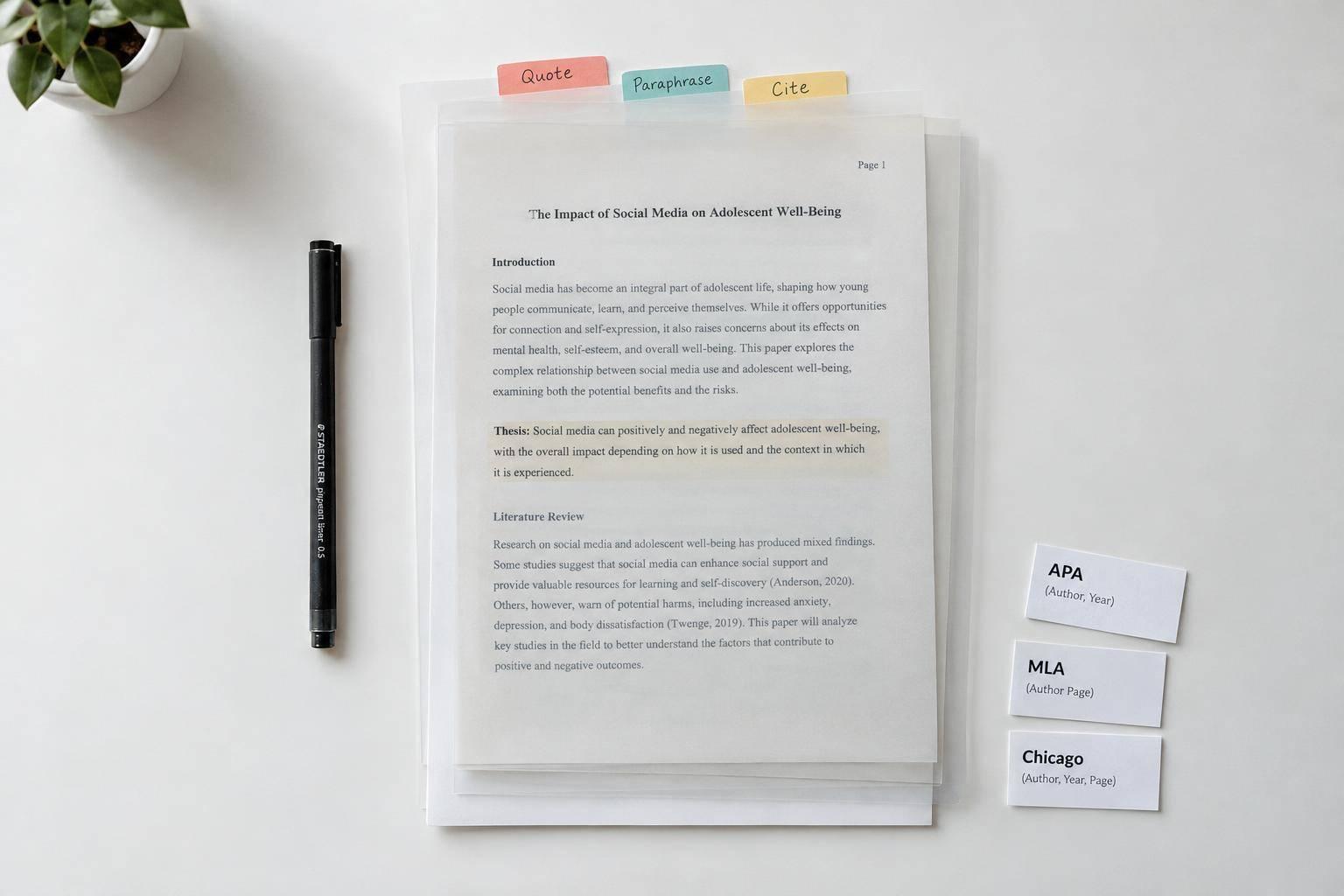
How to Use Sources in a Research Paper: Quoting, Paraphrasing, and Citing Correctly
I use sources to support my argument - not write it for me. My approach comes down to 3 choices: quote exact words when the wording matters, paraphrase a specific idea, or summarize a longer work.
Here’s the checklist I follow:
- Explain the connection. I introduce borrowed material and show how it supports my point.
- Keep the meaning intact. I use my own wording for paraphrases and summaries without making the source’s claims stronger.
- Cite all 3 types of borrowing. I follow the assigned APA, MLA, or Chicago format and link citations to source entries.
- Check before submitting. I compare quotes, wording, and publication details with the originals.
My rule for research tools, including Sourcely: <u>use them to find and organize sources</u>, then read the originals and check the citations myself.
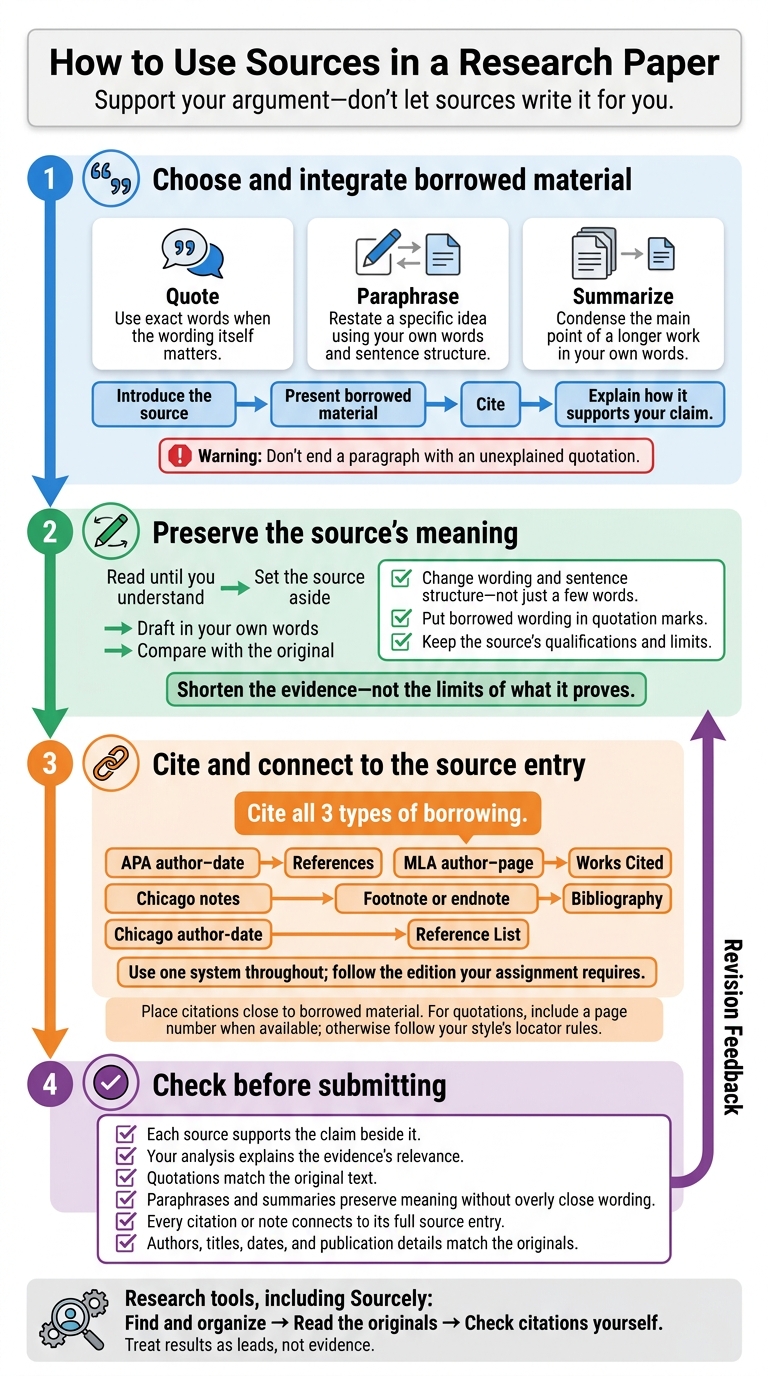
How to Use Sources in a Research Paper
Step 1: Introduce and Explain Quotations
Use Signal Phrases to Introduce Quotations
Use direct quotations when the wording itself matters. Introduce the source, provide the quote and citation, then explain how it supports your point. Readers should know who is speaking and why their words matter. Choose a precise signal verb, such as argues, reports, or suggests, that matches the source’s stance.
After the quote, highlight the exact phrase or finding that supports your claim rather than repeating the passage. If you disagree, name the specific point you challenge. Don’t end a paragraph with an unexplained quotation.
Format Quotations Without Changing Their Meaning
Put short quotations in double quotation marks. APA citations include the author, year, and page number; MLA citations include the author and page number. For short quotations with parenthetical citations, place the sentence’s final period after the citation. Use single quotation marks for a quotation within the quoted passage.
Use block quotations for APA quotations of 40 words or more, MLA prose quotations longer than four lines, and MLA poetry quotations longer than three lines. In Chicago, prose quotations of 100 words or more can generally be set as blocks. Begin on a new line, indent the whole passage, and leave off the enclosing quotation marks. For APA and MLA blocks, put the closing punctuation before the parenthetical citation, with no extra period afterward.
Use square brackets to add clarification or make grammatical changes, and ellipses to mark omitted words. Check each edit against the original so the source’s meaning stays intact. Accurate borrowing matters just as much as correct punctuation. Don’t add ellipses at the start or end unless you need them to show an omission.
Next, paraphrase the same source without borrowing its wording or changing its meaning.
sbb-itb-f7d34da
Step 2: Paraphrase and Summarize Accurately
Write From Understanding, Then Check the Source
Read the passage until you understand its main idea. Then set it aside and write from memory, using your own words and sentence structure. Paraphrase the details; summarize the main point. Both use someone else’s ideas, so both need a citation.
Compare your draft with the original. Have you kept the meaning without following the source sentence by sentence? If you borrow wording specific to the source, rephrase it or put the exact words in quotation marks. Common technical terms, such as chronic low-back pain, don’t need quotation marks. Brief notes can help: take notes, put the source away, and draft from those notes.
A side-by-side example makes the difference easier to see.
Compare a Paraphrase With an Overly Close Rewrite
The example below compares an accurate paraphrase with patchwriting: keeping the source’s wording or structure and swapping only a few words. Even with a citation, patchwriting poses a plagiarism risk.
Version Passage Source passage “From a systems thinking perspective, increased participation provides the opportunity to break down barriers between patients and providers, and citizens and policy makers.” Accurate paraphrase Swanson et al. suggest that involving more people helps eliminate the disconnect between healthcare users and those who provide care or create policy. Overly close rewrite Swanson et al. argue that more participation from all stakeholders can break down barriers between patients and providers.
The accurate paraphrase changes both the wording and structure. The overly close rewrite keeps too much of the original phrasing and leaves out part of its meaning. Summaries follow the same standard: use your own wording, preserve the meaning, and don’t inflate the claims.
Summarize Findings Without Overstating Them
Focus on the main ideas without changing the source’s tone or making its claims stronger. Shorten the evidence - not the limits of what it proves.
Writing with Sources: Quoting, Paraphrasing and Summarizing
Step 3: Match Citations to Source Entries
After quoting or paraphrasing, connect each borrowed passage to the source entry readers need to check it.
An in-text citation directs readers to the matching entry in an alphabetical source list. A superscript number directs them to a footnote or endnote. Use one system throughout, and follow the edition your assignment requires.
Compare APA, MLA, and Chicago Formats
This table uses one invented source to show formatting - not as research evidence. The examples follow APA 7th, MLA 9th, and Chicago 17th editions. Check your assignment before using these formats.
System Citation for a quotation on page 12 Matching source entry APA: author–date (Doe, 2024, p. 12) References: Doe, J. (2024). The art of research. Academic Press. MLA: author–page (Doe 12) Works Cited: Doe, Jane. The Art of Research. Academic Press, 2024. Chicago: notes-bibliography Superscript ¹ leads to this first note: 1. Jane Doe, The Art of Research (Chicago: Academic Press, 2024), 12. Bibliography: Doe, Jane. The Art of Research. Chicago: Academic Press, 2024. Chicago: author-date (Doe 2024, 12) Reference List: Doe, Jane. 2024. The Art of Research. Chicago: Academic Press.
Place Citations Close to Borrowed Material
Place parenthetical citations immediately after borrowed material, usually before the sentence’s closing period. For a paraphrase that spans several sentences, cite the source in the first sentence and make clear that the following sentences draw from it. Cite again when you switch sources. One citation at the end of a paragraph doesn’t automatically cover everything above it.
For quotations, include a page number when available. If the source has no pages, follow your style’s rules for paragraph numbers, section headings, or timestamps.
Check exceptions before finishing your source list. If you learn about an original study through another source, identify that indirect use and list the source you actually read - not the unread original. APA uses “as cited in”; MLA uses “qtd. in” for an indirectly quoted passage. Common knowledge needs neither a citation nor a source entry. A bibliography may include background reading if your assignment allows it, but don’t assume the same rule applies to References or Works Cited.
Step 4 and Conclusion: Check Your Source Use
Review Each Paragraph and the Full Paper
On your final draft pass, check that each source supports the claim beside it. Compare each paragraph with the original sources:
- Does the borrowed material serve your argument?
- Does your analysis explain how the evidence supports your claim?
- Can you cut evidence that no longer contributes?
Check that borrowed ideas keep their original meaning, avoid wording too close to the source, and support only what the source actually claims. Compare every quote with the original text.
Then review the full paper. Match every citation or note to its full source entry, and verify authors, titles, dates, and publication details against the originals. Make clear whose ideas you’re using while keeping your own argument at the center.
Use Sourcely to find and organize credible sources
After checking the full paper, use Sourcely to find relevant sources for academic research for any claims that still need support, organize your references, and export them in the required format.
Treat the results as leads, not evidence. Read the original sources, record relevant passages and their locations, and check exported references against your assignment’s citation rules before submitting. A summary can guide your reading, but it can’t replace the original source.
FAQs
How much of my paper should be quoted?
Write most of your paper in your own words to show your understanding and keep your voice at the center. Use direct quotes sparingly - only when the exact wording matters to your argument or when summarizing would lose the meaning of a striking expression. Otherwise, paraphrase or summarize the source material.
How can I tell if a fact is common knowledge?
Common knowledge generally covers facts found in multiple standard reference works, such as well-known figures’ birth or death dates and accepted dates of historical events. It can also include theories, methods, or data that readers in a particular field generally know.
When you’re unsure whether something counts as common knowledge, play it safe and include a citation.
How do I combine multiple sources in one paragraph?
Bring sources into your argument instead of stacking quotes. Keep your own writing at the center of the paragraph. Use signal phrases to introduce each author’s contribution, and add an in-text citation for every piece of evidence.
Use transitions to show where sources agree, disagree, or build on one another. Then explain how those connections support your point. Your analysis should guide the paragraph, with sources serving as evidence - not replacing your voice.


