

Review of Related Literature (RRL) Example: How to Write One Step by Step
An RRL connects studies around ideas - not a list of authors. I use four steps to build one: select sources, group findings by theme, compare what the studies support, and identify a research gap.
Using social media use and GPA among U.S. undergraduates, I show you how to:
- Find and screen studies with a focused question, search log, and literature matrix.
- Organize themes such as academic collaboration, entertainment, and study habits.
- Write comparisons using the pattern claim → evidence → comparison → meaning for your study.
- Justify a gap by checking what remains unanswered, then reviewing claims and references.
My main rule: <u>match each claim to what the research measured</u>. For example, a review of 20 studies on bedtime device use and sleep does not establish that social media lowers GPA.
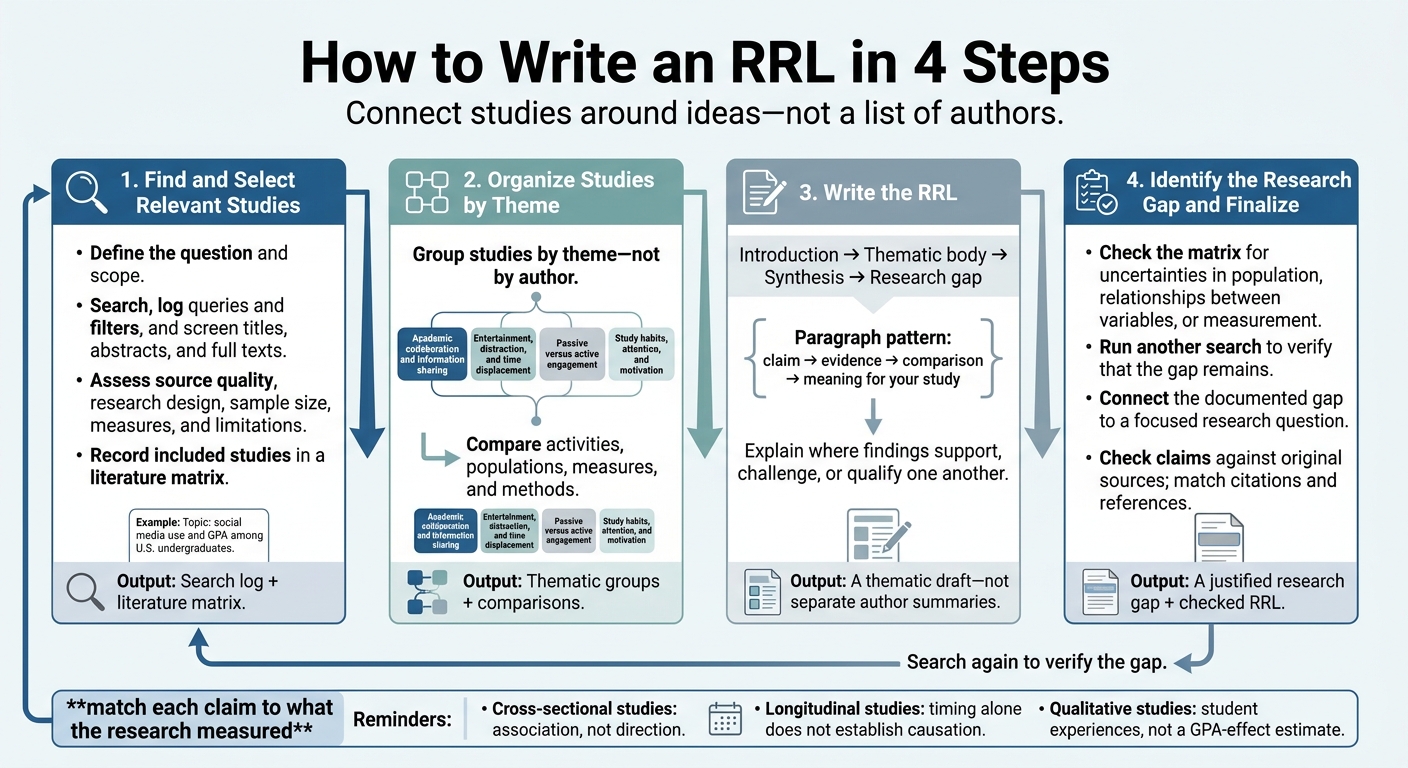
How to Write an RRL in 4 Steps
Step 1: Find and Select Relevant Studies
Build Search Queries With Sourcely
Once you’ve defined your question and scope, look for studies that match. For the social media and GPA example, build your search around three concepts: social media, academic outcomes, and college students. Use this query:
("social media" OR Instagram OR TikTok) AND ("academic performance" OR GPA OR grades) AND (undergraduate OR "college students")
Apply date filters first. Then narrow the results by language, population, and method. Use terms from relevant abstracts to refine later searches.
Summaries and citation suggestions can help you spot promising papers, but they don’t replace reading the full text. Check every claim against the original study. Keep a search log that includes the date, tool or database, exact query, filters, results retrieved, and selection decisions. Record counts exactly as shown.
Screen Studies and Assess Their Quality
Start with titles and abstracts, then read the full texts of papers that fit your question. Check whether each study includes undergraduates, measures academic performance, and examines the type of social media use you’re studying. Record reasons for excluding papers, such as:
“wrong population” or “no academic outcome.”
Keep excluded records in your log so you can explain your choices.
Use the CRAAP test to assess each source’s currency, relevance, authority, accuracy, and purpose. Check its research design, sample size, measures, and limitations, too. Keep different measures separate: self-reported grades aren’t the same as recorded GPA, and total screen time isn’t the same as social media use for a specific purpose.
Create a Literature Matrix
After screening, add each included study to a literature matrix. This makes patterns easier to compare. The table below is a template for organizing your sources, not a set of sample findings. Record each study’s reported results and group studies by theme so you can compare them rather than describe them one by one.
| Source (Author, Year) | Population | Method | Variables | Findings | Limitations | Themes | Research Gaps | Relevance |
|---|---|---|---|---|---|---|---|---|
| Author, year (survey study) | Sample size and setting | Cross-sectional design | Distinguish self-reported grades from recorded GPA | Reported association and uncertainty | Self-report and sampling bias | Main theme | Unanswered questions | Addresses use purpose and GPA? |
| Author, year (longitudinal study) | Sample and follow-up participation | Measurement dates and duration | Note repeated use and GPA timing | Changes over time | Attrition and uncontrolled factors | Main theme | Unanswered questions | Clarifies the relationship’s timing? |
| Author, year (qualitative study) | Participants and recruitment | Interviews or focus groups | Experiences of academic or entertainment use | Record the themes supported by the data | Limited generalizability; no GPA estimate unless measured | Main theme | Explanations for quantitative patterns | Explains quantitative findings? |
sbb-itb-f7d34da
Step 2: Organize Studies by Theme
Map Studies to Social Media Themes
Once you’ve filled in your matrix, group studies by theme - not by author. For a social media and GPA topic, themes might include academic collaboration, distraction, and engagement style. Place each study where its findings fit the paragraph’s main point. Start with a claim about the theme, then connect sources that support, challenge, or qualify it.
Use the table below to sort your studies. It shows what to look for, not reported findings. Replace each instruction with evidence from your sources.
| Theme | Studies to group | Methods and populations | Main findings to extract |
|---|---|---|---|
| Academic collaboration and information sharing | Studies on educational use | Surveys or interviews; student level and setting | Whether peer support or information sharing relates to academic outcomes |
| Entertainment, distraction, and time displacement | Studies on recreational use or multitasking | Research design; students and platforms studied | Whether use relates to attention or time available for studying |
| Passive versus active engagement | Studies that distinguish browsing from participation | How engagement is measured; population differences | Whether different activities have different relationships with performance |
| Study habits, attention, and motivation | Studies that measure self-regulation or time management | How these factors are measured; student characteristics | Whether these factors help explain differences in findings |
In your paragraphs, explain how the findings relate to one another instead of repeating table entries. Discuss self-regulation and motivation as factors that may explain why results differ across student groups.
Compare Findings Across Time and Methods
After grouping studies, compare how their timing and design affect the strength of their findings. Use publication dates only when changes in platforms, definitions, or theory help explain different results. Within each theme, check whether studies that disagree examined comparable activities, populations, and outcome measures. Activity type can explain more than publication year alone.
Match your wording to the research design. Cross-sectional studies show association, not direction. Longitudinal studies show timing, but that alone doesn’t establish causation. Qualitative studies explain student experiences rather than estimate a GPA effect. Use these distinctions to qualify your thematic claims instead of treating every study as equally strong evidence.
Step 3: Write the RRL With an Annotated Example
Structure the Review and Its Paragraphs
Build your review around four parts: an introduction that states your question and scope, a thematic body, a synthesis, and a research gap.
In each body paragraph, follow claim → evidence → comparison → meaning for your study. Include enough detail about methods to show what the evidence supports. You don’t need to describe every paper in full. Use the themes from Step 2 to guide your comparisons.
Compare Source Summaries With Synthesis
| Writing move | Weak source-by-source approach | Stronger thematic approach |
|---|---|---|
| Opening | Start with one author’s findings. | Start with the theme, not one author’s findings. |
| Connecting evidence | Describe each study separately. | Compare similar studies and explain differences in samples and measures. |
| Drawing a conclusion | Treat device-use findings as academic evidence. | Separate sleep findings from direct academic evidence. |
The examples below show how to turn the same theme into a focused RRL paragraph.
Explain the Sample RRL and Citations
Sample introduction and academic-use theme: This example focuses on social media use and student performance - not device use in general. It’s not a full review.
This review examines how academic and entertainment-related social media use may relate to student academic performance. Academic use should be treated as a separate theme because evidence about general device use cannot establish how academic use relates to academic performance.
Sample entertainment-use paragraph: Notice the narrative citation, Hysing et al. (2015), and the parenthetical citation, (Carter et al., 2016).
Sleep provides one possible pathway to examine when studying entertainment-related use. Hysing et al. (2015) surveyed 9,846 Norwegian adolescents ages 16–19 and found that high levels of screen time during the day and before bed were significantly related to short sleep duration and longer time needed to fall asleep. A systematic review and meta-analysis of 20 cross-sectional studies involving 125,198 children found that bedtime media-device use was consistently associated with inadequate sleep quantity and poor sleep quality (Carter et al., 2016). Together, these findings support examining sleep, but they do not establish that entertainment-related social media use lowers academic performance.
Sample synthesis and transition toward a gap: This passage identifies what these studies leave unanswered. It doesn’t claim that the entire field has missed the issue. Before submission, check the original papers and add complete reference entries for both citations.
These studies suggest that sleep deserves attention, but they do not resolve whether academic and entertainment-related social media activities have different relationships with academic performance. The review therefore needs studies that distinguish those activities and measure academic outcomes directly before it can justify a specific research gap.
Step 4: Identify the Research Gap and Finalize the RRL
Use the Research Gap to Justify Your Study
Once you’ve grouped your themes, return to the matrix to find the gap your review supports best. Add a “Relation to my study” column. For each source, note any gap in population, relationships between variables, or measurement that relates to your social media and GPA study. Prioritize the gap most clearly supported by your themes.
Check whether the studies separate academic use from entertainment use, measure GPA or another direct measure of performance, or follow participants over time through a longitudinal design. When findings differ, compare definitions, samples, measures, and designs. Build your study around the specific uncertainty those differences reveal.
To check that the gap still exists, run another search for the missing variable, population, or method. Record your keywords, databases, filters, and results. Then connect the documented gap to a focused research question.
Conclusion: Check Structure, Claims, and References
With the gap identified, check each section against your research question. Make sure your search evidence supports how you’ve brought the findings together by theme and that each paragraph leads clearly toward the gap.
Match every citation to a reference entry, and make sure every listed reference appears in the text. Before submitting, check claims and paraphrases against the original sources. Keep formatting consistent with your school’s rules for headings and citations.
Literature Review Example & Sample: Full Walkthrough + Free Proposal Template
FAQs
How many sources do I need for an RRL?
There’s no single source count that fits every study. The right number depends on your research scope, academic level, discipline, and available literature.
Start with your institution’s research manual or ask your adviser about minimum requirements. Some undergraduate programs require at least 20 sources. If there’s no set minimum, use enough high-quality sources to support your themes, reflect current knowledge, and identify a clear research gap.
How do I synthesize studies with conflicting findings?
Group studies by theme instead of summarizing them one by one. Point out where findings disagree and discuss what might explain those differences: research design, sample characteristics, geographic settings, or measurement tools.
For example:
“Unlike A (2021), B (2023) found different results, possibly because of differences in methodology.”
Examining these disagreements moves your review beyond description into analysis and helps pinpoint the research gap your study aims to address.
What if my research gap has already been studied?
If your research gap has already been studied, narrow your focus. Look for an angle previous work hasn’t addressed, such as a population, setting, or demographic group. You could also try a different research method or examine disagreements between studies that remain unresolved.
Show how your research builds on, challenges, or extends earlier findings, rather than repeating what’s already been done.


