

Systematic Review vs Meta-Analysis: Differences, Examples, and When to Use Each
A systematic review assesses studies; a meta-analysis combines their numerical results. I use this rule: start with a clear question, then pool results only when the studies and data fit that question.
Here’s how I separate the two:
- Systematic review: Find, screen, and assess studies, then explain what their findings show.
- Meta-analysis: Calculate a pooled effect and confidence interval from compatible results.
- Choosing the approach: Check populations, interventions, outcomes, follow-up periods, and available data. One review can use both pooling and narrative synthesis.
For example, I wouldn’t automatically combine stress outcomes measured after 1 week with those measured after 6 months. <u>More data doesn’t make pooling the right choice.</u>
Quick Comparison
| Criterion | Systematic review | Meta-analysis |
|---|---|---|
| Purpose | Assess research on a defined question | Estimate a combined effect |
| Data | Quantitative, qualitative, or mixed findings | Compatible numerical results |
| Methods | Search, screening, bias assessment, and synthesis | Effect-size calculation, weighting, and statistical modeling |
| Outputs | Study tables, written synthesis, and evidence certainty | Pooled estimate, confidence interval, and heterogeneity |
| When I use it | To assess the full body of relevant research | Within a review when pooling is justified |
Whichever approach I use, I report the methods, uncertainty, and limits - not just the combined number.
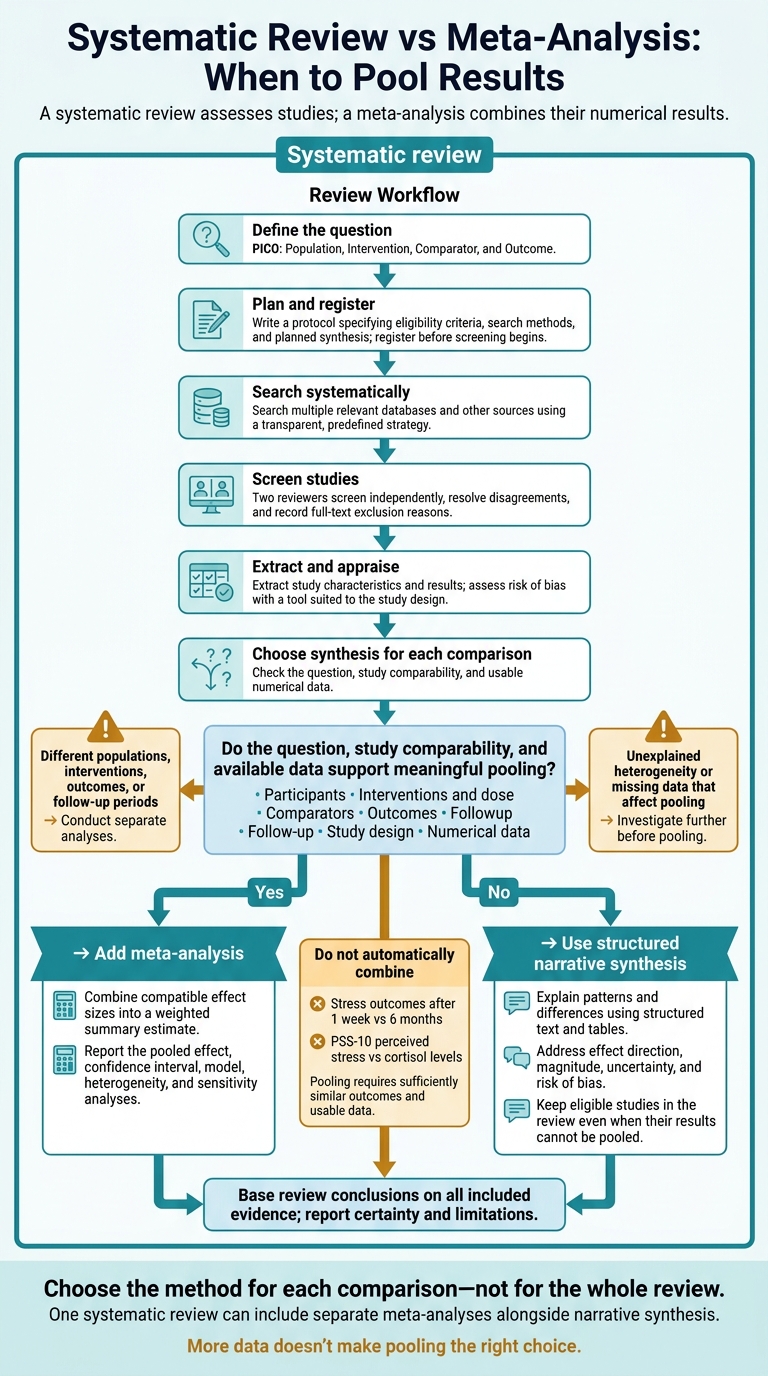
Systematic Review vs Meta-Analysis: When to Pool Results
Systematic Reviews: Steps, Examples, and Outputs
Steps From Research Question to Synthesis
Start with a focused question using PICO: Population, Intervention, Comparator, and Outcome. Then write a protocol that sets out eligibility criteria, search methods, and the planned synthesis. Register it in a relevant registry before screening begins. Search multiple relevant databases and other sources using a transparent, predefined strategy. This structure matters most when studies differ in participants, measures, or follow-up periods.
Have two reviewers screen records independently, resolve disagreements, and record reasons for full-text exclusions. Extract study characteristics and results, assess risk of bias with a tool suited to the study design, and organize findings for synthesis. For randomized trials, one such tool is RoB 2. Reference-management tools can help organize sources, but they don’t replace searches, screening, data extraction, or critical appraisal.
When studies differ too much to pool their results, narrative synthesis is the safer choice.
Hypothetical Example: Reviewing Student Stress Interventions
A review comparing mindfulness, exercise, and peer support interventions could organize findings by intervention, student population, and follow-up period. Studies involving high school students and university students may answer different questions. Likewise, perceived stress measured with the PSS-10 is not interchangeable with cortisol levels, and results after 1 week should not automatically be combined with results after 6 months. A structured narrative synthesis can describe these differences without forcing them into one average. Pooling is only appropriate when the outcomes are sufficiently similar and the data are usable.
What a Systematic Review Reports
After selection and appraisal, the report should show exactly how the review handled the evidence.
Use a PRISMA flow diagram to report the selection process. Include full-text exclusion reasons and evidence tables covering study design, participants, interventions, comparators, outcomes, and results. Compare findings across studies and explain how risk-of-bias judgments affect confidence in apparent patterns. State the limitations, certainty of the evidence, and gaps.
Narrative synthesis of quantitative findings explains numerical results through structured text and tables. PRISMA 2020 covers reviews with or without meta-analysis. SWiM guides reviews that report quantitative synthesis without pooling.
sbb-itb-f7d34da
Systematic review vs meta-analysis | What’s the difference?
Meta-Analysis: Data, Methods, and Outputs
When studies are similar enough to combine, a review can move from narrative synthesis to meta-analysis.
A meta-analysis combines compatible effect sizes into a weighted summary estimate, giving more weight to more precise studies. Having several studies isn't enough: they must address the same question and provide data that can be combined.
Check Study Comparability and Prepare the Data
Compare participants, intervention dose, comparators, outcomes, follow-up, and study design. Choose the effect measure to match the data:
- Mean difference (MD): For continuous outcomes measured on the same scale.
- Standardized mean difference (SMD): For different scales measuring the same construct.
- Risk ratio (RR) or odds ratio (OR): For binary outcomes.
For continuous outcomes, extract each group's sample size, mean, and standard deviation. For binary outcomes, extract events and totals. You can also extract effect estimates and their standard errors. Before pooling, reverse scales where needed so higher scores point in the same direction.
Use a fixed-effect model when one true effect is plausible. Use a random-effects model when effects likely vary across studies. Assess heterogeneity with forest plots, Cochran’s Q, and I². A high I² signals inconsistency; it doesn't justify pooling incompatible studies. Treat I² as a guide, not a rule. Test how results change through sensitivity analyses, including analyses that exclude studies at high risk of bias.
Hypothetical Example: Pooling Mindfulness Trials
In the student stress example, several mindfulness trials may be similar enough to pool. For comparable randomized mindfulness trials on student stress, pool outcomes only when the measures, follow-up, and numerical data match. The pooled MD or SMD summarizes the effect, and its confidence interval shows uncertainty; report heterogeneity alongside the result.
Narrative Synthesis vs Statistical Pooling
Neither approach should turn the evidence into a count of “statistically significant” studies. Focus instead on effect direction, magnitude, uncertainty, and risk of bias.
| Feature | Narrative synthesis | Meta-analysis |
|---|---|---|
| Suitable evidence | Studies whose differences or reporting prevent meaningful pooling | Compatible comparisons addressing a sufficiently similar question |
| Required data | Available study findings, including effect direction and magnitude where reported | Effect estimates and uncertainty, or numerical data needed to calculate them |
| Main results | Structured text and tables explaining patterns and differences | Pooled effect, confidence interval, forest plot, and heterogeneity assessment |
| Main risk | Selective emphasis or subjective interpretation | Misleading precision from combining incompatible results |
The next step is choosing which questions and studies justify pooling.
When to Use a Systematic Review With or Without Meta-Analysis
Start With the Research Question
Use meta-analysis only when pooling results helps answer the research question better. For questions about mechanisms, processes, or broad mapping, use narrative synthesis. Very broad mapping questions are better suited to a scoping review. The question guides whether you combine results statistically or keep the synthesis narrative.
Check Compatibility and Data Availability
Different comparisons within the same review may need different methods.
| What the evidence supports | Recommended approach |
|---|---|
| A focused effect question, compatible studies, and usable numerical data | Add meta-analysis |
| Relevant studies, but important differences or reporting gaps prevent meaningful pooling | Use structured narrative synthesis |
| Different populations, interventions, outcomes, or follow-up periods | Conduct separate analyses |
| Unexplained heterogeneity or missing data that affect pooling | Investigate further before pooling |
Contact study authors for missing data, and document what remains unavailable. Keep eligible studies in the review even when you can't pool their results. Follow SWiM when reporting quantitative findings that aren't pooled.
Separate Results That Should Not Be Pooled
Choose the method for each comparison - not for the whole review. A single systematic review can include separate meta-analyses for different populations or follow-up periods, alongside narrative synthesis for evidence that can't be pooled.
Whenever possible, define these groupings in the protocol before examining the results. Use justified subgroup analyses to investigate unexpected differences.
In the final report, present pooled results separately from narrative findings and explain why you chose each method for each comparison.
Conclusion: Report Clearly and Pool Only When Justified
Whether you choose narrative synthesis or pooling, explain that choice clearly. Use systematic review methods to assess the evidence. Add meta-analysis only when the question, study comparability, and data support pooling.
Report Methods, Uncertainty, and Limitations
Follow PRISMA 2020 when reporting search methods, study selection, eligibility criteria, risk of bias, and synthesis. Keep weaknesses in the included studies separate from limits of the review itself, such as language restrictions.
If you pool results, distinguish the combined result from the review’s other findings. Report the pooled estimate, confidence interval, model, heterogeneity, and sensitivity analyses. Statistical significance alone does not establish practical importance. A narrow confidence interval also does not guarantee strong evidence.
Distinguish Review Conclusions From Pooled Results
Base review conclusions on all included evidence - not just pooled results - and state the certainty of that evidence. A pooled estimate answers only the specific numerical comparison it summarizes. A systematic review can stand without pooling, and pooling does not remove bias.
FAQs
How many studies do I need for a meta-analysis?
A meta-analysis needs at least two studies that address the same research question and report compatible quantitative results.
If you have fewer than two studies - or their populations, interventions, or outcome measures differ too much - use narrative synthesis to summarize the findings instead.
Can I combine randomized and observational studies?
Yes, you can include both study types in a systematic review to compare their results. But combining them in one meta-analysis takes care. Observational studies are subject to more types of bias than randomized controlled trials, which can limit their ability to estimate causal effects.
If you synthesize both, report summary estimates separately for each study type to keep the results transparent and avoid misleading conclusions.
How do I assess certainty without meta-analysis?
Use the GRADE framework to assess five domains: risk of bias, inconsistency, indirectness, imprecision, and publication bias. For each outcome, rate the certainty of evidence as high, moderate, low, or very low.
These ratings communicate how much confidence you have in the evidence - even when statistical pooling isn’t possible. Clearly document the reasons behind each rating.


