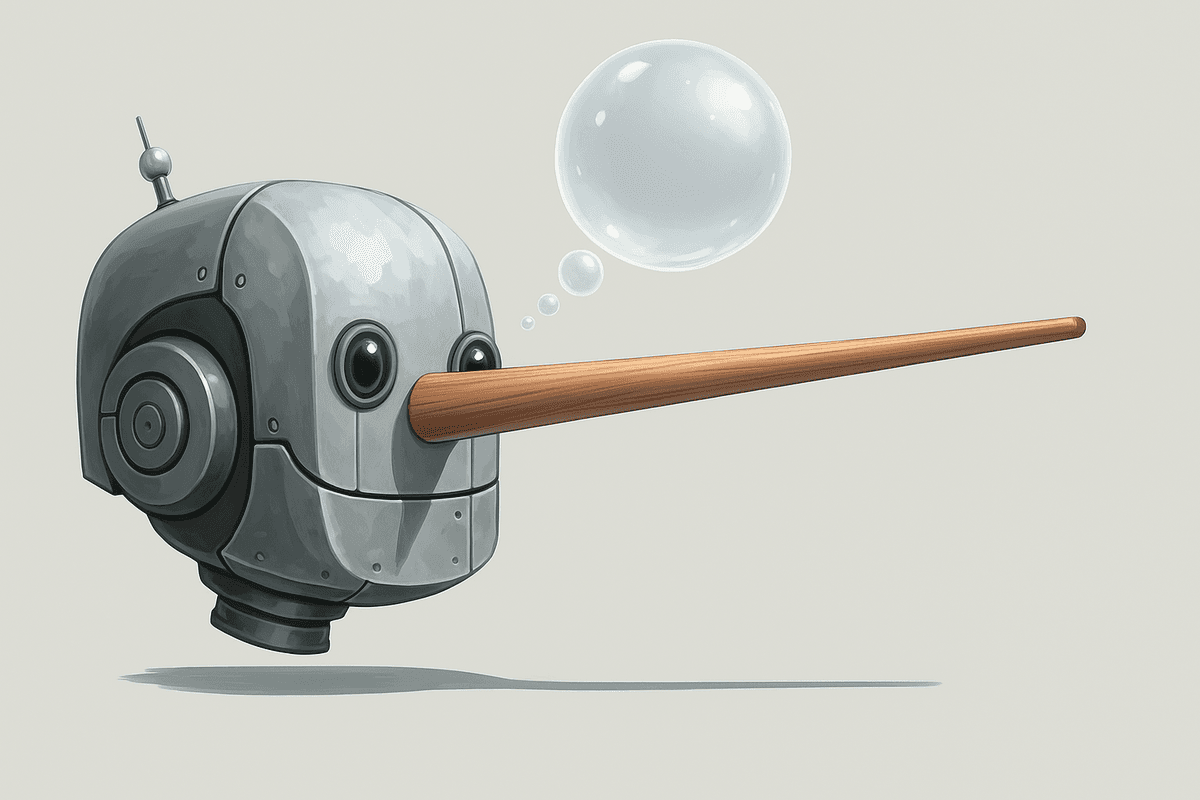
A hallucinated citation is a reference that an AI model invented. It has author names, a journal title, volume numbers, page ranges, and sometimes a DOI. It reads exactly like something from a peer-reviewed paper. None of it points to a publication that exists.
This is not a bug in the traditional sense. It is how large language models work. Understanding why hallucinated citations happen — and how to catch them — is now essential for any student or researcher who uses AI writing tools.
What Is an AI Hallucinated Citation?
When ChatGPT, Claude, Gemini, or any other language model generates a citation, it is not querying a database. It is predicting text.
The model has seen millions of academic references during training. It learned the pattern of how citations look: author format, italicized journal names, parenthetical years, DOI structure. When you ask for sources, it produces text that matches that pattern.
The output is fluent. It is also frequently fabricated.
A hallucinated citation might include:
- An author who exists but never wrote on your topic
- A journal title that sounds legitimate but has no publication record
- A DOI in the correct format that resolves to nothing
- Volume and issue numbers that were never assigned
The citation fails the most important test: you cannot find the paper anywhere.
Why Do AI Models Hallucinate Citations?
Language models optimize for plausibility, not truth. They are autoregressive text generators — each word is chosen based on what is statistically likely to come next, given everything before it.
When generating a citation, the model is not asking "does this paper exist?" It is asking "what text would a citation look like in this context?" The answer is often something that resembles a real reference without being one.
Several factors make citations especially prone to hallucination:
Training data limitations. Models may have seen citation metadata without full paper access. They learn names and titles without the ability to verify pairings.
No retrieval step. Unless explicitly connected to a search tool, models generate from memory-like weights, not live database queries.
Confidence without calibration. AI presents fabricated references with the same authoritative tone as accurate ones. There is no hedging, no "I think this might exist."
Prompt pressure. When you ask for "five peer-reviewed sources," the model will produce five citations whether or not five real papers match your query.
How Common Are Hallucinated Citations?
Multiple studies and independent audits have found fabrication rates between 40% and 60% for AI-generated bibliographies. The exact number varies by model, prompt, and discipline, but the range is consistently high enough to be alarming.
In practical terms: if ChatGPT gives you ten references, four to six of them likely have serious accuracy problems. Some may be entirely invented. Others may mix real elements incorrectly.
This is why verification cannot be optional. The base rate of error is too high to trust any single AI-generated reference without checking.
Real-World Consequences
Hallucinated citations are not a theoretical academic concern.
Mata v. Avianca (2023). A lawyer used ChatGPT to research case law. The AI cited six cases that did not exist. The court sanctioned the lawyer, fined him, and required notification to every judge potentially misled by the fake citations.
University misconduct cases. Students have faced grade penalties, course failures, and academic integrity hearings for submitting bibliographies containing AI-invented references — even when the fabrication was unintentional.
Retracted publications. Researchers have had papers retracted after peer reviewers could not verify cited sources that turned out to be hallucinated.
The defense "ChatGPT gave it to me" does not hold up. You are responsible for every citation in your work.
How to Spot Hallucinated Citations
Before using any AI-generated reference, run these checks:
1. Search the exact title in Google Scholar
If nothing appears, be skeptical. A peer-reviewed paper on a mainstream topic should be findable.
2. Resolve the DOI
Paste the DOI into doi.org or use a fake DOI checker. No resolution means the identifier is invented.
3. Verify the journal exists
Search the journal name. Check whether it is indexed in Scopus, Web of Science, or DOAJ. Phantom journals are a common hallucination target.
4. Check author-publication match
Search the author's name with the paper title. A real author with a fake paper pairing is a subtle but common error.
5. Use an automated verifier
Paste the full citation into Sourcely's citation verification tool. It cross-references every field against academic databases and returns a specific verdict with failure reasons.
For a deeper dive on ChatGPT specifically, read how to verify ChatGPT citations.
Hallucinated Citations vs. Other Citation Errors
Not every wrong citation is a hallucination. Understand the distinction:
| Error type | Example | How to catch it |
|---|---|---|
| Full hallucination | Entire paper invented | Verifier returns "fake"; no database match |
| Wrong DOI | Real paper, wrong identifier | DOI resolves to different work |
| Misattribution | Real paper, wrong author | Author search does not match |
| Outdated info | Real paper, wrong year | Year mismatch in database |
| Formatting error | Real source, wrong style | Verifier finds match despite format |
Automated tools catch all of these, but hallucinations are the most dangerous because every element looks intentional and polished.
What to Do When You Find a Hallucinated Citation
Do not submit it. Even if the citation supports your argument perfectly, a fabricated source is worse than no source.
Do not silently delete it. If you remove a fake citation, you may leave an unsupported claim. Find a real source that covers the same point.
Replace with verified sources. Use a citation and reference finder to search for real papers on the same topic. Paste your paragraph and get peer-reviewed alternatives with proper formatting.
Verify your entire bibliography. One hallucinated citation often means others in the same batch are suspect. Check every AI-generated reference, not just the one you caught.
Building a Verification Habit
The students who avoid citation problems treat verification as a standard step, like spell-checking:
- Generate or collect references (from AI or elsewhere)
- Paste each into a citation verifier
- Replace any flagged entries with verified sources
- Submit with confidence
It takes minutes. It prevents problems that take weeks to resolve.
Learn More
- AI Hallucinated Citations — interactive guide
- Check if a citation is real
- Source credibility checker for evaluating URLs
Hallucinated citations are a predictable consequence of how AI models work. They are not going away. But with the right verification tools, they do not have to end up in your paper.