AMA Citation Guide: How to Cite Anything in AMA Format
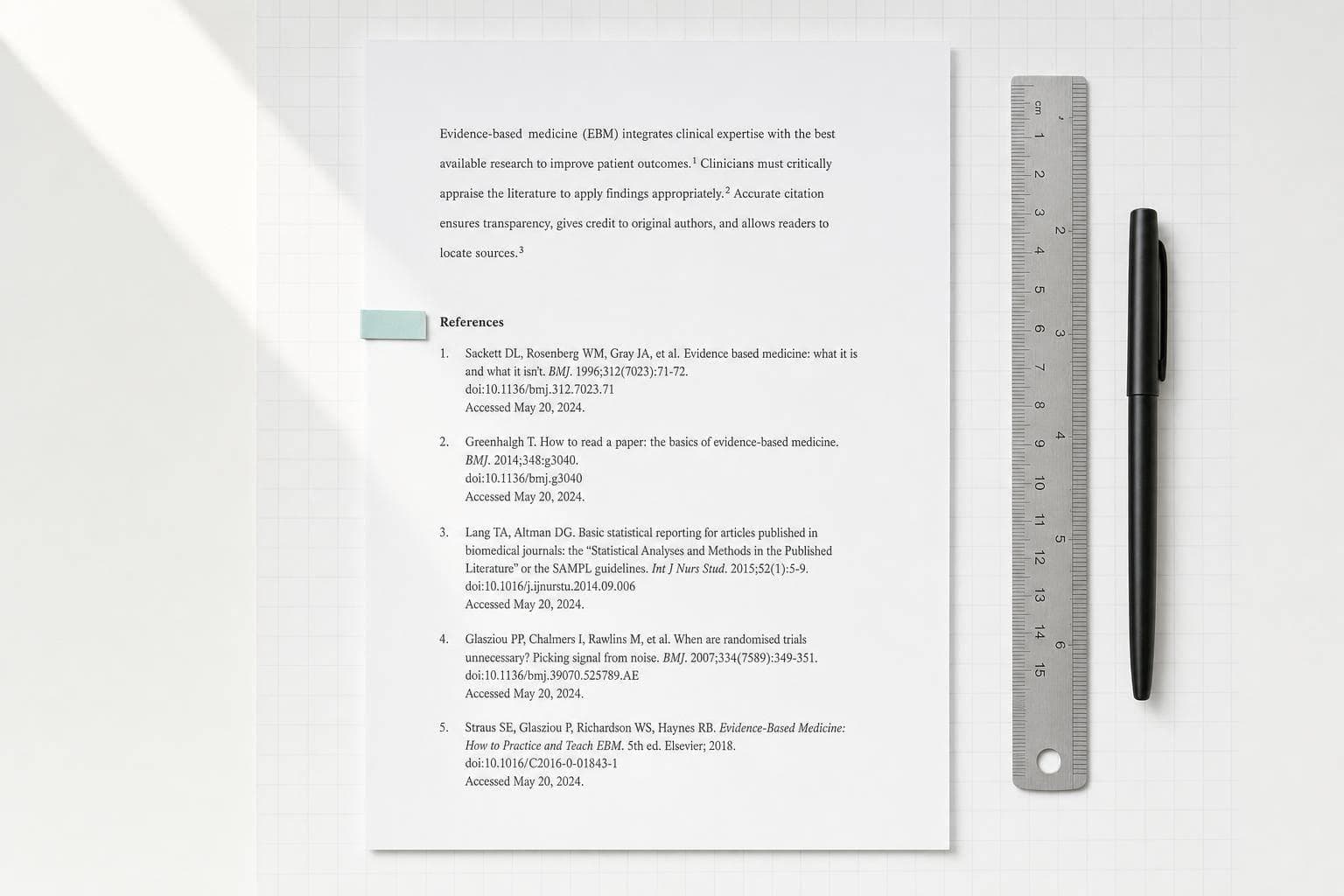
If you use AMA style, the main rule is simple: cite sources with superscript numbers in the order they first appear, then match those numbers to a reference list in the same order.
I’d boil this guide down to a few things you need to get right every time:
- Use superscript numbers in the text
- Reuse the same number when you cite the same source again
- Put citations in a numbered References list, not alphabetical order
- List all authors if there are 1 to 6
- For 7 or more authors, list the first 3, then et al
- Use DOIs when available and don’t put a period after a DOI or URL
- Add access dates for websites, online reports, and database entries
- For book chapters, start with the chapter author, then add “In:” and the book details
- If there’s no author, start with the title
- If material is unpublished or a personal communication, cite it in the text only
A lot of AMA mistakes come from small details, not big ones. For example, journal titles use NLM abbreviations, article and page titles use sentence case, and book and journal titles are usually italicized. Also, if an online article has an e-locator instead of page numbers, use that in place of a page range.
Here’s the short version: AMA is a numbered system with strict punctuation and source-order rules. Once I keep those rules straight, the rest is mostly plugging each source type into the right pattern.
This intro gives you the full map so you can scan the article and find the source type or edge case you need.
AMA Citation Basics: Superscripts, Numbering, and Reference List Rules
How AMA in-text superscript citations work
AMA uses superscript numbers based on the order each source first appears. Once a source gets a number, it keeps that same number every time you cite it later in the paper. Put the superscript right after the claim it supports, with no space in between. If you need more than one citation in the same spot, use commas for nonconsecutive numbers and hyphens for consecutive ranges.
Superscripts go outside periods, commas, quotation marks, and parentheses, but inside colons and semicolons. There’s one easy-to-miss rule here: don’t place a citation right after a numeral or an abbreviated unit, because it can look like an exponent.
Once you’ve set the numbering system, move to the References page.
How to format the References page
Your reference list follows the same order as your superscript citations. Put it at the end of the paper under the centered, bold heading References. List each source in the order it first appears, and include each source only once, even if you cite it more than one time.
For titles, use sentence case for article titles, web page titles, and chapter titles. Use title case and italics for book titles and journal names. Journal names should follow NLM abbreviations. If a source has a DOI, use that instead of a URL, and don’t add a period after either one.
After the page layout is in place, apply the author-name rules to each entry.
Author names, corporate authors, and et al
These rules apply to every entry in the reference list. Start with the surname, then add the initials with no periods and no spaces. Separate author names with commas.
| Author Scenario | Reference List Rule |
|---|---|
| 1–6 authors | List all authors |
| 7+ authors | First 3 authors + et al |
| Corporate/group author | Full organization name |
| Individual + group | Individuals; Group Name |
| No author | Start entry with the title |
Use the full organization name for corporate authors. If both individual authors and a group author appear, list the individuals first and then the group name. If no author is given, start the entry with the title. Use Anonymous only when it appears in the source byline.
With those ground rules set, you can apply them to common source types.
sbb-itb-f7d34da
Citing & Using AMA Style
How to Cite Common Sources in AMA Format
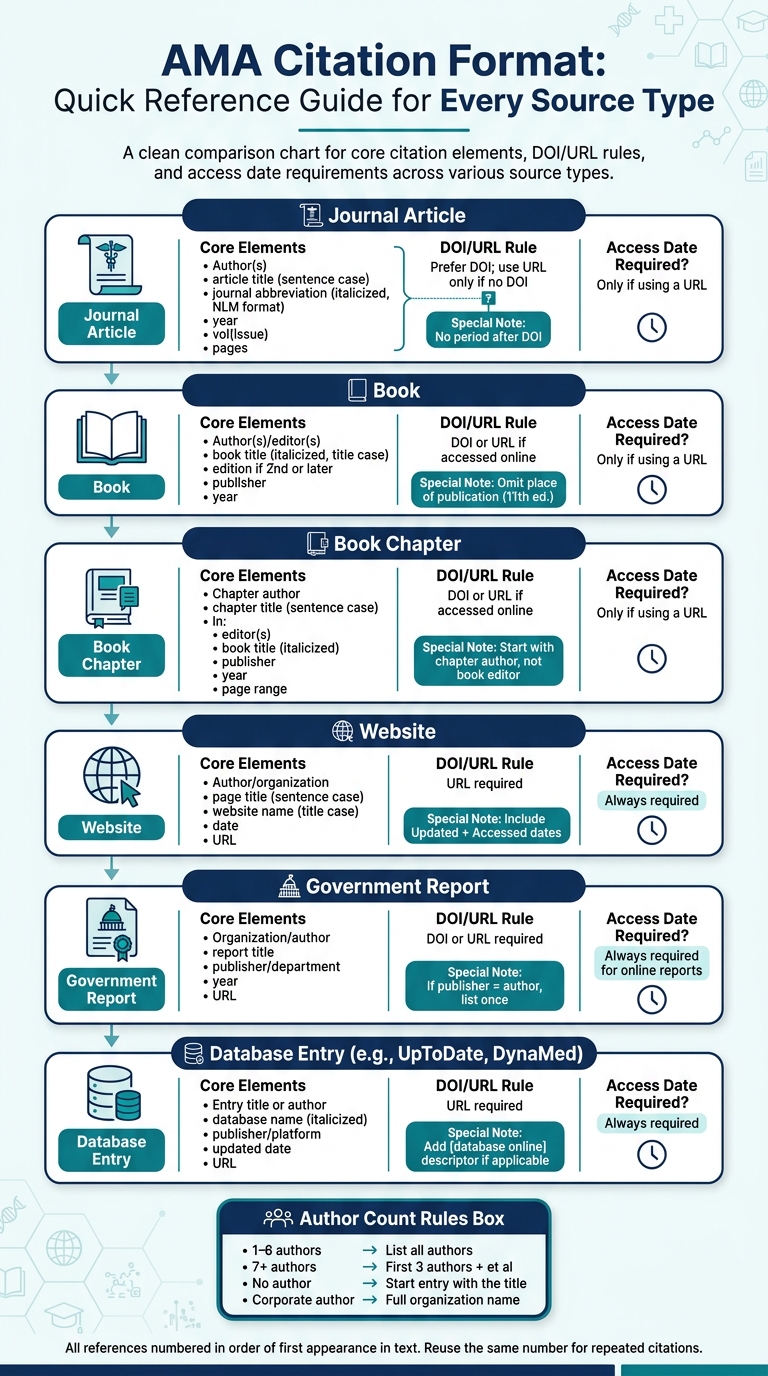
AMA Citation Format: Quick Reference Guide for Every Source Type
Use the numbering rules above for the source types you’ll cite most often.
Journal articles and online journal articles
For journal articles, AMA uses a standard pattern:
author(s). article title. Journal Abbrev. Year;volume(issue):pages.
Article titles should be in sentence case. Journal names should use the official NLM/PubMed abbreviation and appear in italics. If you’re citing an online journal article and a DOI is listed, place it at the end. Don’t add a period after the DOI.
This same AMA pattern also works for books, web pages, reports, and databases. The structure stays similar, while the source details shift based on what you’re citing.
Books, book chapters, websites, and government reports
| Source Type | Core elements |
|---|---|
| Whole book | Author(s) or editor(s), Title (italicized, title case), edition if not first, publisher, year |
| Online book | Same as a whole book, plus DOI or URL and accessed date |
| Book chapter | Chapter author(s), chapter title (sentence case), "In:", editor(s), Book Title, publisher, year, page range |
| Website/web page | Author or organization, page title, URL |
| U.S. government report | Author or organization, report title, URL |
Book chapters trip people up all the time. The key point is simple: start with the chapter author, not the book editor. Then use "In:" to introduce the larger book.
For websites and government reports, use the most specific source details you can find and keep the style consistent across the reference list.
Databases follow the same source-entry logic, but they also need update and access dates.
Online databases, clinical tools, and reference platforms
Clinical databases such as UpToDate, DynaMed, and Lexicomp are usually cited like book chapters. If the entry names an author, list that person first. If it doesn’t, start with the entry title instead. Then include the database name in italics, followed by the publisher or platform.
For databases that change often, include:
- Updated date
- Accessed date
- URL
Propylthiouracil. In: DynaMed. EBSCO Information Services. Updated July 22, 2020. Accessed September 30, 2020. https://www.dynamed.com/drug-monograph/propylthiouracil
How to Handle Tricky AMA Citation Cases
Use these rules when a source doesn’t match the usual AMA pattern.
Many authors, no author, and missing dates
Some sources come with gaps. When that happens, follow the rules below so your references stay consistent.
If no person or organization is listed as the author, start the reference with the title of the work. If the source names Anonymous, use Anonymous as the author. If both named authors and a group are credited, list the individual authors first, then add a semicolon followed by the group name.
For undated books, use date unknown. For websites, leave out the publication date and use the Updated and Accessed dates instead.
Editions, missing page numbers, and unpublished material
Include an edition only for a second edition or later. You don’t need to label a first edition. For example, a third edition should appear as 3rd ed after the title.
Online-only journal articles often use an e-locator or article ID instead of page numbers. If a journal article has neither page numbers nor an e-locator, keep the colon and leave the page field blank.
For theses and dissertations, include the italicized title, the type of document, the institution, and the year. If material has been submitted but not accepted, cite it only in the text as unpublished data and leave it out of the reference list. Personal communications, including emails and conversations, should also appear only in the text.
AMA edge cases at a glance: a quick-reference table
Use this table when you need a fast check on the details that most often throw AMA style off.
| Scenario | What to include | What to omit | AMA note |
|---|---|---|---|
| Missing date (website) | Updated date + Accessed date | Published date | Use the Updated and Accessed dates. |
| Missing date (book) | date unknown | Year | Use only if no copyright or update date exists. |
| Online-only article | e-locator (e.g., e000239) | Page range | Use the identifier provided by the journal. |
| Thesis or dissertation | Title, document type, institution, year | Journal/publisher info | Include Master's thesis or Dissertation. |
AMA Citation Checklist for U.S. Academic Writing
U.S. formatting details that affect citation consistency
Use U.S. formatting across dates, numbers, and units so your citations stay consistent. That means dates should appear as Month Day, Year. Numbers should use a comma for thousands, like 1,000, and a period for decimals, like 3.5. AMA also uses metric units and degrees Celsius.
Use this final checklist to catch small formatting mistakes before you submit. The table below pulls together the citation parts you’ll use most often.
Major source types at a glance: a quick-reference table
Use this checklist to apply those rules the same way throughout U.S. academic writing.
| Source Type | Core elements | DOI or URL rule | Access date | AMA rule |
|---|---|---|---|---|
| Journal Article | Author(s), article title, journal abbreviation, year, vol(issue), pages | Prefer DOI; use URL only if no DOI | Only if using a URL | Use the journal's official abbreviation |
| Book | Author(s)/editor(s), book title, edition (if not 1st), publisher, year | DOI/URL if accessed online | Only if using a URL | Title is italicized and in title case; place of publication is omitted in the 11th edition |
| Book Chapter | Chapter author, chapter title, In: editor(s), book title, publisher, year, pages | DOI/URL if accessed online | Only if using a URL | Use "In:" before the editor/book info |
| Website | Author/org, page title, website name, date, URL | URL required | Always required | Page title is in sentence case; website name is in title case |
| Government Report | Organization/author, report title, publisher/department, year, URL | DOI or URL | Always required for online reports | If publisher is the same as the author, list once |
| Database Entry | Database title, publisher, year, updated date, URL | URL required | Always required | Include a descriptor such as "[database online]" if applicable |
Conclusion: Core AMA rules to check before you submit
Before you submit, check the basics one more time. Number sources in the order they first appear in the text, and reuse that same number each time you cite the source again. Don’t create a new entry for a source that already has a number. Your References page should follow numeric order, not alphabetical order.
It also helps to give each entry a last pass for author count, edition details, and access-date rules. Prefer a DOI over a URL, add access dates when a URL is used, and keep all reference entries in numeric order.
FAQs
When should I reuse a citation number?
In AMA style, you reuse the same citation number every time you mention a source after its first citation. Once a source is assigned a number, that number stays the same throughout the paper, including in tables, figures, and boxes.
Why does that matter? Each source has just one entry in the reference list. Reusing the same number keeps every in-text citation tied to that single entry.
If you need to point readers to a certain part of the source, add page numbers to the superscript, like this: 1(pp13-15).
How do I cite a source with no author?
In AMA format, if a source has no listed author, start the reference with the title of the work. For a book, that means the title comes first, followed by the edition, publisher, and year.
If the source lists a group or organization as the author, use that name as the author. If the source is explicitly labeled Anonymous, use Anonymous as the author name.
Do I need a DOI, URL, or access date?
In AMA format, include a DOI whenever one is available.
If a DOI is included, you do not need an access date.
If no DOI is available, include the URL instead and add an access date.
Format the DOI as doi:xx/xx, without the prefix.