
How to Cite a YouTube Video and Other Media in APA, MLA, and Chicago
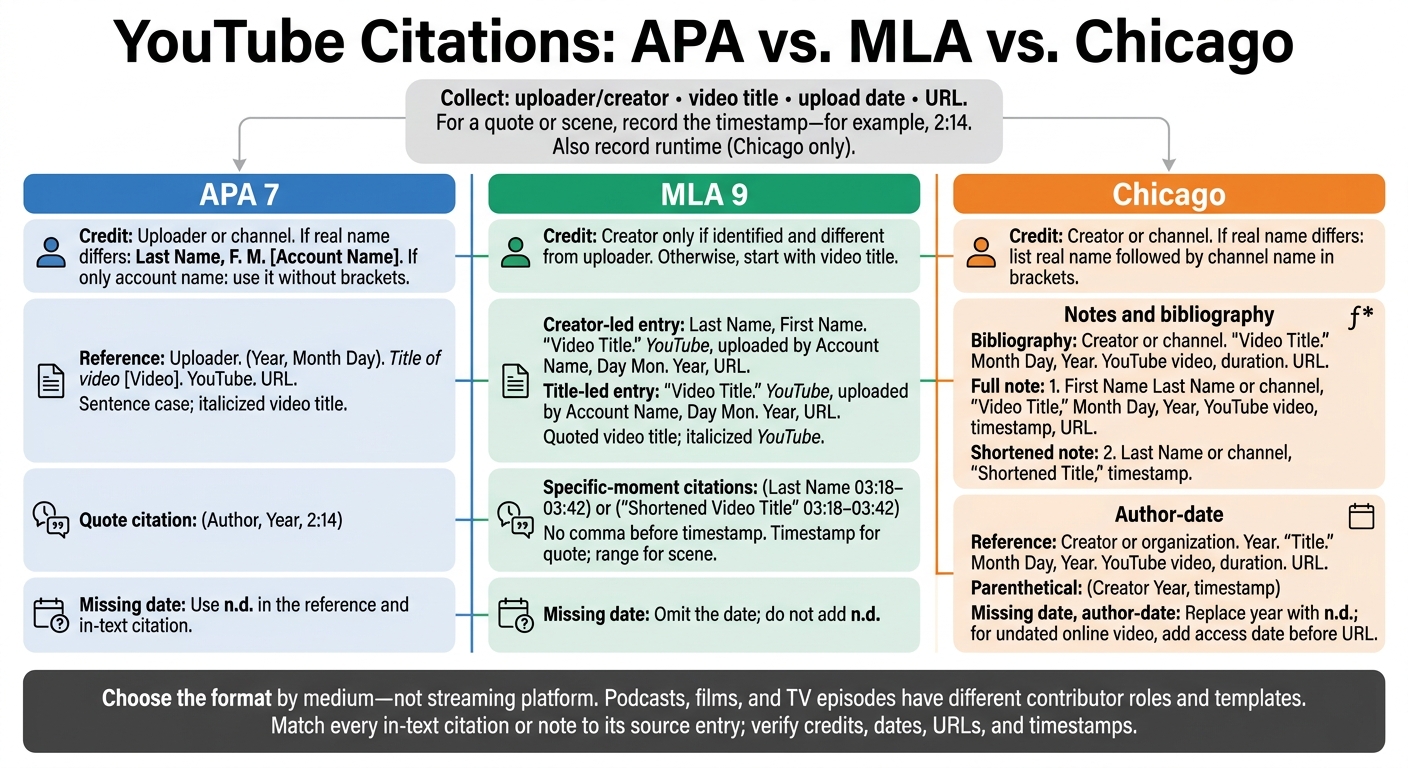
To cite a YouTube video, identify the uploader, title, upload date, and URL - then follow the required citation style. For a quote or scene, add a timestamp, such as 2:14, so readers can find the exact moment.
The main differences come down to credit and format:
- APA 7: Usually credits the uploader or channel and uses author-year citations.
- MLA 9: Starts with the named creator or video title and uses a matching name or title in the text.
- Chicago: Uses either numbered notes and a bibliography or author-date citations.
Podcasts, films, and TV episodes have their own formats, even when accessed through a streaming service. This guide covers contributor roles, dates, missing details, and timestamps for each medium, plus a final checklist for checking citations against the source.
YouTube Citations: APA vs. MLA vs. Chicago
Cite Videos and Other Media in APA
Format YouTube References and In-Text Citations
Reference template: Uploader. (Year, Month Day). Title of video [Video]. YouTube. URL.
Write the title in sentence case, capitalizing the first word and the first word after a colon.
Credit the uploader as the author, even when someone else speaks in the video. When a real name is available, use the uploader’s surname in the in-text citation. If that name differs from the channel name, format the reference author as Last Name, F. M. [Account Name]. If you have only the account name, use it without brackets.
Podcasts, films, and television follow the same basic APA rules, but each medium credits a different role as the author.
Format Podcast, Film, and Television References
Choose the citation format based on the medium - not the platform where you watched or listened. Streaming access doesn’t change the source type.
| Medium | Author slot | Date | Title formatting | Medium label |
|---|---|---|---|---|
| Podcast episode | Host | Year, Month Day | Plain episode title; italicized podcast title | [Audio podcast episode] |
| Film | Director | Year | Italicized film title | [Film] |
| Television episode | Writer and director | Year, Month Day | Plain episode title; italicized series title | [TV series episode] |
Use the reference templates below. Include episode numbers only if they’re officially assigned, and separate multiple production companies with semicolons.
For podcasts, link to the episode’s own webpage. For films and television episodes, include a URL only if it’s a stable, freely accessible address that leads directly to the source.
Podcast episode
Host, A. A. (Host). (Year, Month Day). Episode title (No. number) [Audio podcast episode]. In Podcast title. Production Company. URL
Film
Director, A. A. (Director). (Year). Film title [Film]. Production Company.
Television episode
Writer, A. A. (Writer), & Director, B. B. (Director). (Year, Month Day). Episode title (Season number, Episode number) [TV series episode]. In C. C. Producer (Executive Producer), Series title. Production Company.
Handle Missing Details and Add Timestamps
If details are missing, use these fallback rules.
Use the account name as the author. Switch to a title-first reference only if you can’t identify an author or uploader. If there’s no date, use n.d. in both the reference and the in-text citation.
For title-based citations, shorten the title if needed. Keep italics for a standalone work, or use quotation marks for an episode title.
Direct quotations require a timestamp showing where the quoted passage begins:
(Author, Year, 2:14) or (Author, Year, 1:12:30)
For paraphrases, add a timestamp only when readers need a precise location. Name the speaker in your sentence when needed, but keep the source’s credited author in the citation.
sbb-itb-f7d34da
Citing YouTube Videos Using APA for References and In-Text Citations by Patrick T. Randolph
Cite Videos and Other Media in MLA
MLA 9 uses nine core elements: author, title, container, contributors, version, number, publisher, date, and location. Include only the elements that apply to your source. Your in-text citation should match the first element of the Works Cited entry - a name or a title.
Here’s how to apply those elements to videos and other media.
Format YouTube Works Cited Entries
Start with the creator’s name only if the creator is identified and differs from the uploader. Otherwise, begin with the video title and list the uploader after YouTube.
Put video titles in quotation marks, italicize YouTube, and write dates in day-month-year order. Leave out missing details instead of adding “n.d.” If the video has no title, use a brief description without quotation marks.
Creator-led template: Last Name, First Name. “Video Title.” YouTube, uploaded by Account Name, Day Mon. Year, URL.
Title-led template: “Video Title.” YouTube, uploaded by Account Name, Day Mon. Year, URL.
Example: “building only using CURVES in the sims 4.” YouTube, uploaded by CarynandConnieGaming, 1 Jan. 2025, https://www.youtube.com/watch?v=YDUfVKEB7Ok.
The same first-element rule applies to podcasts, films, and television episodes.
Format Podcast, Film, and Television Entries
Credit hosts, directors, and other contributors when relevant. Add season and episode numbers when they apply.
For television or podcasts accessed online, include the primary container, then add the streaming platform as a second container. Keep original release details separate from upload details.
| Source | Title formatting | Works Cited template |
|---|---|---|
| Podcast episode | Quoted episode; italicized podcast | “Episode Title.” Podcast Title, hosted by First Last, season number, episode number, Publisher, Day Mon. Year, URL. |
| Entire podcast | Italicized podcast | Podcast Title. Hosted by First Last, Publisher, Year, URL. |
| Film | Italicized film | Film Title. Directed by First Last, Distributor, Year. |
| Television episode | Quoted episode; italicized series | “Episode Title.” Series Title, directed by First Last, season number, episode number, Production Company, Day Mon. Year. |
| Online television episode | Add a second container: Platform, URL. | “Episode Title.” Series Title, directed by First Last, season number, episode number, Production Company, Day Mon. Year. Platform, URL. |
Film example: Mrs. Doubtfire. Directed by Chris Columbus, 20th Century Fox, 1993. Disney+, https://www.disneyplus.com/browse/entity-ae21cb0c-0cc8-41ff-ad75-a1f249b58efd.
When quoting or pointing to a specific moment, add a time marker after the name or title.
Add Timestamps for Scenes and Quotes
Use a timestamp for a quote and a timestamp range for a scene. Place it after the surname or shortened title, with no comma between them.
Author-led pattern: (Last Name 03:18–03:42)
Title-led pattern: (“Shortened Video Title” 03:18–03:42)
Film example: (Mrs. Doubtfire 1:22:33–1:33:44)
If you name the author or title in the sentence, put only the timestamp in parentheses: (03:18–03:42). Use page or chapter locators only when the source provides them.
Cite Videos and Other Media in Chicago
Chicago has two citation systems: notes and bibliography and author-date. Follow whichever your instructor or publisher requires, and use it consistently.
Both systems use the same source details but place them in different spots. This table shows the basic patterns.
| Citation form | Purpose | Basic pattern |
|---|---|---|
| Bibliography entry | Lists a source in notes and bibliography | Creator or channel. “Title.” Month Day, Year. YouTube video, duration. URL. |
| Full note | Identifies a source at its first citation | First Name Last Name or channel, “Title,” Month Day, Year, YouTube video, timestamp, URL. |
| Shortened note | Cites the source again | Last Name or channel, “Shortened Title,” timestamp. |
| Author-date reference entry | Lists a source in author-date | Creator or organization. Year. “Title.” Month Day, Year. YouTube video, duration. URL. |
| Parenthetical citation | Points to an author-date entry | (Creator Year, timestamp) |
Format YouTube Bibliography Entries and Notes
If you know the creator’s real name and it differs from the channel name, list the real name first, followed by the channel name in brackets. Otherwise, use the channel name. Include the upload date and runtime in the entry, and use a timestamp to point readers to the passage you cite.
Bibliography: Creator or channel. “Video Title.” Month Day, Year. YouTube video, duration. URL.
Full note: 1. First Name Last Name or channel, “Video Title,” Month Day, Year, YouTube video, timestamp, URL.
Shortened note: 2. Last Name or channel, “Shortened Video Title,” timestamp.
Format Podcast, Film, and Television Entries and Notes
Chicago follows the same basic approach for other media. What changes? The contributor roles and the details needed to identify the source.
State each contributor’s role, include season and episode details when relevant, and add production or distribution information and the release date. For an online version, include the URL you consulted.
Podcast bibliography: Last Name, First Name, host. Podcast Title. Podcast. Season number, episode number, “Episode Title.” Month Day, Year, duration. URL.
Podcast note: 1. First Name Last Name, host, Podcast Title, Podcast, season number, episode number, “Episode Title,” Month Day, Year, timestamp, URL.
Film bibliography: Last Name, First Name, dir. Film Title. Production Company, Year. Format or platform. URL.
Film note: 1. Film Title, directed by First Name Last Name (Production Company, Year), format or platform, timestamp, URL.
Television bibliography: Series Title. Season number, episode number, “Episode Title.” Directed by First Name Last Name. Aired Month Day, Year, on Network. URL.
Television note: 1. Series Title, season number, episode number, “Episode Title,” directed by First Name Last Name, aired Month Day, Year, on Network, timestamp, URL.
Format Chicago Author-Date Citations
Place the year right after the credited name. Keep the full posting date with the media details, and use the same name in the reference entry and parenthetical citation. When citing a specific moment, add a timestamp after the year.
Reference: Last Name, First Name, or organization. Year. “Video or Episode Title.” YouTube video, duration. Month Day, Year. URL.
Parenthetical: (Last Name Year, timestamp)
If no person is credited, look for a responsible organization. If neither is named, start the reference entry with the title and use a shortened title in the parenthetical citation. For an undated source, replace the year with n.d. For an undated online video, also add an access date before the URL.
Conclusion: Check Your Citations
Handle Missing Details and Access Problems
Before submitting, check the details that often lead to citation errors.
Verify contributor credits against the video, description, and channel page. Cite the version you used.
Follow your style’s missing-date rule consistently: APA uses n.d., MLA omits the date, and Chicago gives guidance based on the citation system.
If the source disappears, keep the citation as a record of what you consulted. Use an archived version only when needed.
With those details checked, review formatting and accuracy.
Use the Final Citation Checklist
Check formatting and make sure each citation matches its source.
- Check names, roles, titles, dates, URLs, episode details, and timestamps.
- Rewatch quoted passages and check the wording against the audio - not automatic captions.
- If no style is assigned, ask your instructor which one to use.
Final check: Confirm the style and medium, verify contributor credits, check formatting against the required style, test URLs, and confirm timestamps. Make sure every in-text citation or note matches its reference entry. If you use a citation tool, check its output against both the source and the required style.
FAQs
How do I cite a video transcript instead of the video?
When citing a video transcript, add a note identifying the format if your citation style calls for one. For a standalone transcript supplied with a video, use the bracketed description to label it as a transcript.
For example, in APA style, a podcast episode with a transcript would include [Audio podcast episode with transcript] in the reference entry’s title field.
How do I cite a reuploaded clip from a film?
Cite a reuploaded film clip as an online video, not as the original film. Use the uploader as the author because they published the clip on the platform.
Include the video title exactly as it appears on the site, the platform name, the upload date, and the URL. To point readers to a specific moment, add a timestamp to your in-text citation.
How do I cite multiple videos from the same channel?
Give each YouTube video its own entry in your reference list, bibliography, or works cited page. Include the video’s title, upload date, and URL.
APA: Use the channel or uploader name as the author in every entry.
MLA: If the author and uploader are the same, start with the video title to avoid repeating the name.


