
How to Read a Research Paper in 30 Minutes: A Method for Students
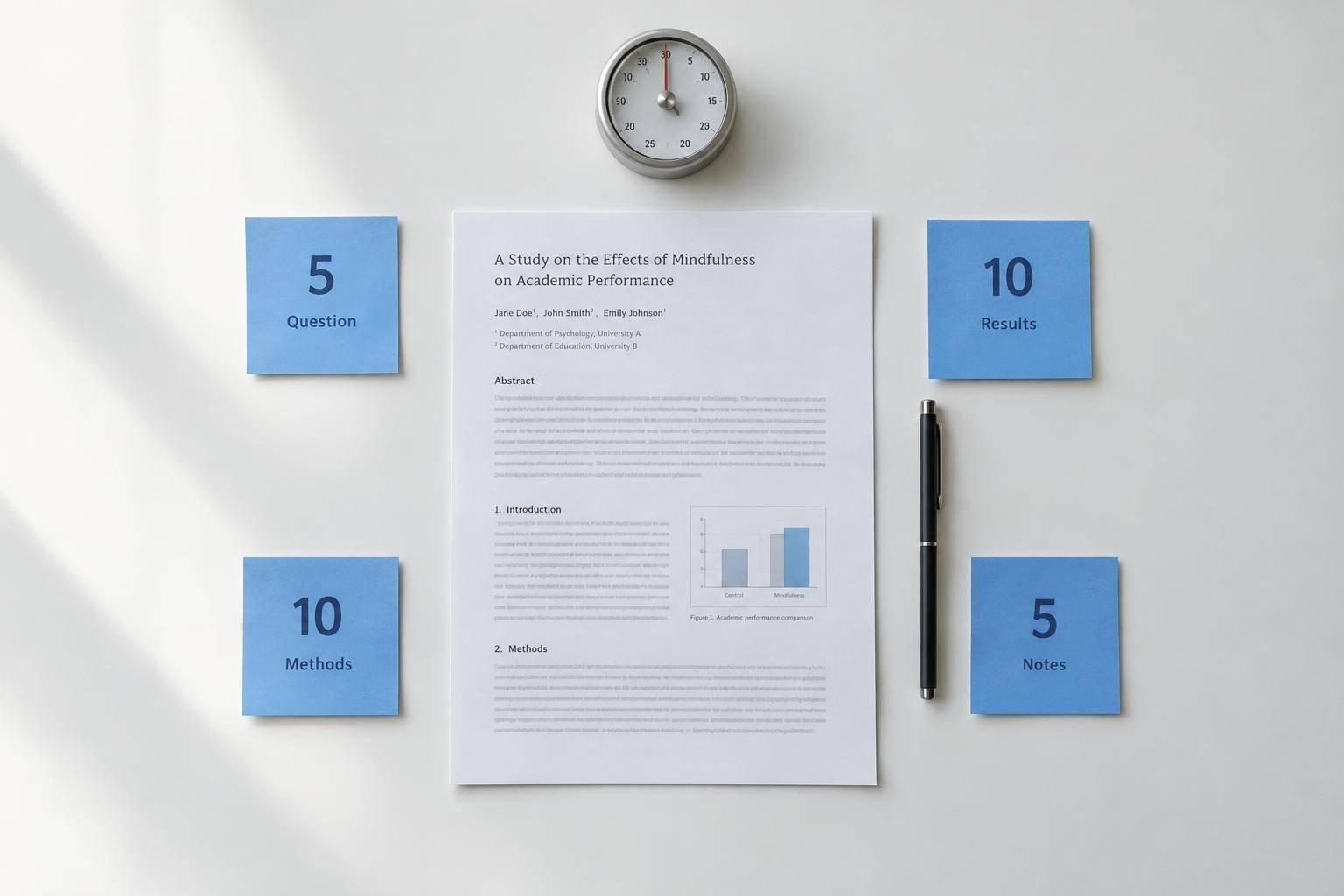
Use a 5–10–10–5-minute plan to decide whether a research paper fits your assignment. The goal is to check its main claim, assess the supporting results, and save useful notes - not understand every detail.
Before starting, check the assignment’s topic, date range, population, and study requirements. Sourcely can help find papers, but check AI summaries and citation details against the original text.
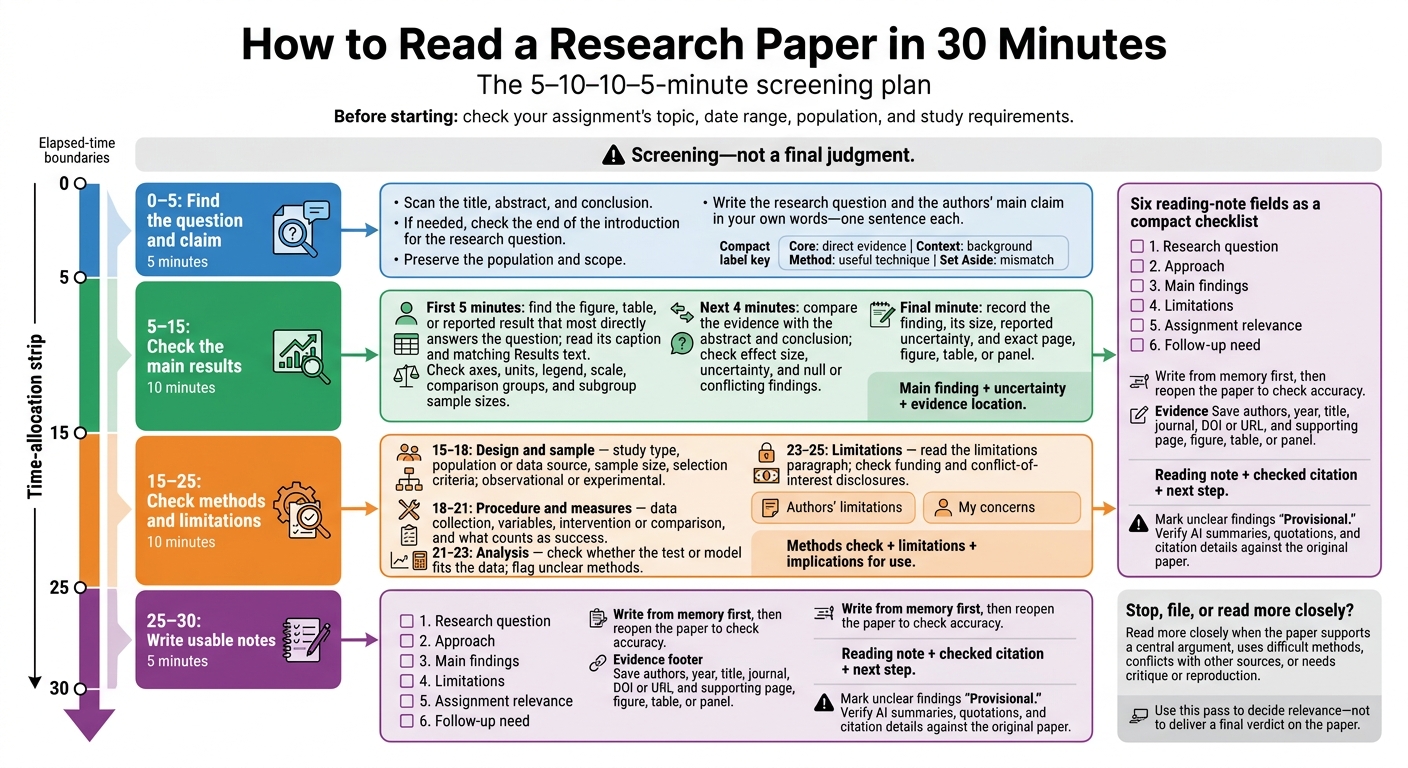
- Minutes 0–5: Scan the title, abstract, and conclusion. Note the research question and the authors’ claim.
- Minutes 5–15: Check the main results, figures, and tables. Look at effect sizes, uncertainty, and whether the findings support the claim.
- Minutes 15–25: Review the study design, sample, measures, analysis, and limitations.
- Minutes 25–30: Record the question, approach, findings, limitations, assignment relevance, and follow-up needs. Save citation details and exact evidence locations.
Treat this pass as screening, not a final judgment. Read more closely when the paper supports a central argument, uses difficult methods, or conflicts with other sources.
How to Read a Research Paper in 30 Minutes
Minutes 0–5: Find the Research Question and Main Claim
Scan the Title, Abstract, and Conclusion
Spend about 2 minutes reading the title and abstract. The title gives you the topic and key terms. In the abstract, look for the population, research question, approach, and reported finding. Keep your assignment in mind, and separate what the authors studied from what they say they found. If the paper looks relevant, plan to scan the results once you finish these notes.
Spend the next minute on the conclusion. If there isn’t one, read the closing discussion paragraphs. Look for the authors’ answer, what they think follows from it, and why they think it matters. Treat this as the authors’ claim - not yet verified. You’ll check it against the results later.
If the question is still unclear, spend the next minute checking the end of the introduction for a purpose statement or research question. Then skim the section headings and figure captions. Background covers earlier work; direct statements about what the authors aim to study point to this paper’s purpose.
Note the Question and Decide Whether to Continue
Use the final minute to write the research question and main claim in your own words - one sentence each. Keep the population and scope intact: a finding about one group does not apply to everyone. Note any unclear terms and briefly explain how the paper might serve your assignment. If the question is still fuzzy, return to the purpose statement instead of guessing.
Give the paper a working label: Core for direct evidence, Context for background, Method for a useful technique, or Set Aside for a mismatch. Save its details if useful. A matching topic alone isn’t a reason to keep reading. If the paper earns a Core or Method label, move to the results.
sbb-itb-f7d34da
Minutes 5–15: Examine Results, Figures, and Tables
Check What Each Result Measures
Use the first 5 minutes to find the figure, table, or reported result that most directly answers the research question. Focus on checking the main finding, not reading every result. Read the title and caption, then use Ctrl+F to find the matching Results text.
Before judging the pattern, check the axes, units, legend, and scale. Identify what the researchers measured, which groups they compared, and how many participants or observations contributed. Check subgroup sample sizes - not just the total.
Look for truncated axes, and check whether error bars show standard deviation, standard error, or confidence intervals. These describe different aspects of variation or uncertainty. Then ask whether the key figure or table supports the paper’s claim.
Check Whether Results Support the Claims
Spend the next 4 minutes comparing the result with the abstract and conclusion. Put the finding in your own words. Does the authors’ claim refer to the same outcome and comparison? Look for null or conflicting results, too - not just the strongest finding.
Check effect size and uncertainty, not just p-values or an eye-catching chart. Statistical significance does not prove practical importance. For health outcomes, compare absolute effects with relative percentages. If a confidence interval crosses zero for a difference or one for a risk ratio, don’t treat the result as clear evidence of an effect.
“Trend toward significance” is not a substitute for supporting evidence.
Use the final minute to record the most relevant finding, its size, any reported uncertainty, and its exact location: page, figure, table, or panel.
Keep qualifiers such as “may” or “suggests.”
Flag unclear comparisons or missing information for the methods check rather than guessing. If the result still seems unclear, move to the methods.
Minutes 15–25: Check Methods and Limitations
Review the Design, Data, Measures, and Analysis
Once you’ve verified the main result, check whether the study’s design and analysis support it.
Minutes 15–18: Identify the design and sample. Find the study type, population or data source, sample size, and selection criteria. These details help you judge where the findings apply and whether the study supports the authors’ claim. Check whether the design is observational or experimental.
Minutes 18–21: Trace the procedure and measures. Follow how the researchers collected data, defined variables, and set up the intervention or comparison. Pin down what counts as success or correctness. For statistical papers, state the exact quantity the study aims to estimate.
Minutes 21–23: Check the analysis for the main claim. Identify the statistical test or model, then check whether it fits the data. For machine learning papers, review the baselines, compute budgets, and random seeds used in the experiments. If a method is unclear, note its name, where it appears, and the exact question you need answered.
Separate the Authors’ Limitations From Your Concerns
Minutes 23–25: Read the limitations paragraph in full. Keep two separate note fields: Authors’ limitations and My concerns. Look for the authors’ limitations in the Discussion or Conclusion. In your own field, record issues such as sampling bias, measurement problems, confounding, or limits on applying the findings to your assignment. Also check funding and conflict-of-interest disclosures.
For each limitation, note whether it means you should narrow the claim, use the paper only as background, or read more closely before relying on it. Flag central technical questions for closer reading, especially when the paper is a core source for your argument. In your notes, specify how these limits affect the weight you’ll give the paper in your assignment.
How to Read a Paper Efficiently (By Prof. Pete Carr)
Minutes 25–30: Write Notes for Your Assignment
Once you’ve checked the main claim, methods, and limits, turn your notes into a record you can use in your assignment.
Complete a 6-Field Reading Note
Fill in the template with short entries in your own words. This makes the paper easier to cite and compare with other sources later.
| Field | Your note |
|---|---|
| Research question | The specific question the paper answers. |
| Approach | Study design, data source or population, and sample size. |
| Main findings | What the evidence shows in 1–2 sentences. Separate the authors’ conclusions from your interpretation. |
| Limitations | The main caveat that affects how you can use the findings. |
| Assignment relevance | The assignment claim the finding supports, challenges, or puts in context. Include a paraphrase. |
| Follow-up need | The unresolved question and the next source to check. |
Write from memory first, then reopen the paper to check your accuracy. Use your own sentence structure, and mark a finding Provisional if the evidence or methods are still unclear.
Save Evidence and Citation Details
With each note, record the authors, year, title, journal, DOI or URL, and the supporting page, figure, or table. Include the panel when needed. Check any AI-supplied quotation or location against the original text.
Label each note with the essay section it supports. Use Sourcely to export the citation in your required format, then check the authors, date, title, and journal against the paper.
Conclusion: Decide Whether to Read More Closely
Once your notes are done, use them to decide whether the paper needs another pass. The 5–10–10–5-minute method helps you identify the argument, review results, check methods, and record takeaways.
If your notes cover the question, evidence, methods, limitations, and relevance, the first pass is enough. If you can also explain the core argument and how the evidence supports it in plain English, stop there for now. This pass helps you choose whether to stop, file the paper, or read it closely. It’s not a final verdict on the paper.
Know When Close Reading Is Needed
Read more closely when the paper is central to your work, uses complex methods, conflicts with other sources, or needs to be critiqued or reproduced. The goal is to check whether the evidence supports how you plan to use the paper.
Use this table to choose your next step.
| 30-minute triage | Close reading | Best use | Expected output |
|---|---|---|---|
| Screen the question and claims | Read the argument more than once | Deciding relevance | Core, Context, Method, or Set Aside |
| Record provisional findings | Check evidence and cited sources | Supporting a central claim | Verified understanding of evidence |
| Flag unclear methods | Examine methods, assumptions, and limitations | Critique or reproduction | A defensible assessment |
Use this final checklist
- [ ] I can state the research question.
- [ ] I can describe the approach.
- [ ] I can identify the main finding.
- [ ] I can explain at least one limitation.
- [ ] I can connect the paper to my assignment.
- [ ] I can decide whether close reading is needed.
- [ ] I can locate important evidence by page, table, or figure.
FAQs
How can I assess methods I don’t understand?
Start with the big picture: decide whether you need the methods’ details for your purpose. Look up unfamiliar terms, and try sketching each experiment to make sense of what the researchers did.
If the technical or statistical descriptions still feel hard to follow, it’s OK to skim the methods. Focus on the introduction and discussion to understand what the study adds and what its findings could mean.
How do I adapt this plan for review papers?
Look beyond individual research methods and focus on how the review brings the field together. During your 10-minute content deep dive, give the literature review section priority. Use it to understand why the topic matters and how the author frames it.
Pay attention to arguments and themes rather than individual study results. Organize your final notes by major themes, then map the connections among sources to build your own conceptual framework.
What if the abstract and results disagree?
If the abstract and results seem to disagree, don’t treat the abstract as the final word. It may simplify the findings too much or offer interpretations that need to be checked against the data.
Give more weight to the full results section, figures, and tables. Check whether the data support the authors’ conclusions, and look for other possible explanations or limitations the abstract may leave out.


