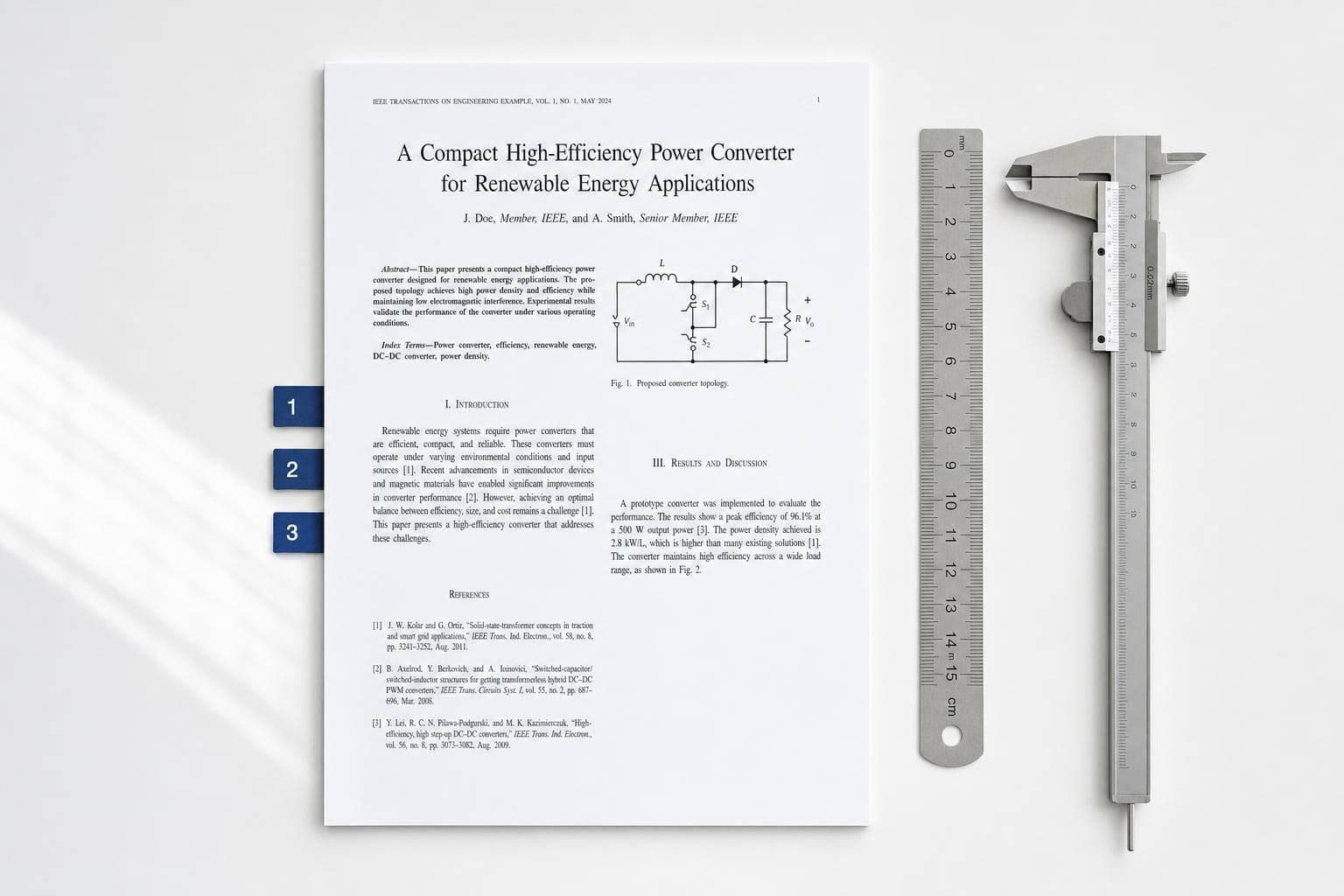
IEEE Citation Guide: Format Rules and Examples for Engineering Papers
IEEE style is simple at its core: number sources in the order you first cite them, reuse the same number every time, and place citations before the period. If you miss any one of those 3 rules, your paper can fall out of IEEE format fast.
I’d boil the whole guide down to this:
- Use bracketed numbers in the text, like
- List references by first appearance, not A–Z
- Reuse the same number for the same source every time
- Put citations before punctuation, as in
...[4]. - Use ranges for 3+ consecutive sources, like –
- Add a page or section for pinpoint cites, like [4, p. 22] or [4, Sec. III]
- Format each source by type, such as journal article, conference paper, book, website, standard, or report
- Renumber carefully during edits, because even one new source near the top can shift the full list
If I were checking an engineering paper fast, I’d look for 4 things first:
- Does the first source cited appear as ?
- Does every repeated source keep its original number?
- Does the highest citation number match the total number of reference entries?
- Are references listed in citation order, not alphabetically?
A lot of citation errors come from revision. In one move, a paper can go from clean to broken if a new source is added early and the numbering is not updated across the draft. That is why IEEE style is less about memorizing odd rules and more about keeping the numbering system tight from start to finish.
Bottom line: if you keep one source = one number, format the References page in the same order as the text, and do a last search for each bracketed number, you’ll cover the main IEEE rules without much trouble.
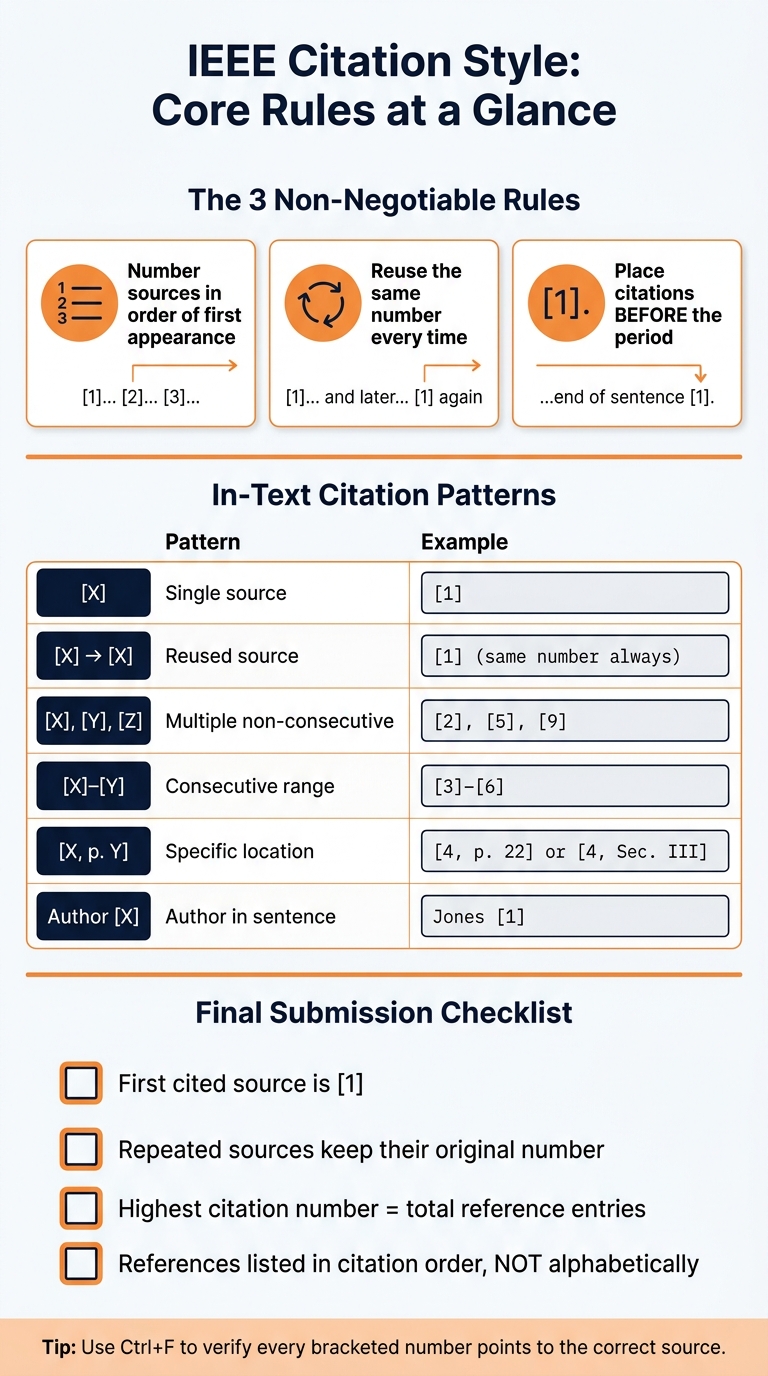
IEEE Citation Style: Core Rules at a Glance
IEEE Citation Basics: Numbering, Order, and Reuse Rules

How In-Text Citation Numbers Work
In IEEE style, you give each source a number the first time it appears. After that, you keep using that same number every time you cite that source. In plain English: one source, one number. No new number later, and no ibid.
If one sentence points to several unrelated sources, list each citation on its own:,,. If you cite three or more sources in a row, shorten them into a range: –. And if you're using a direct quote, add the page number, like this: [4, p. 22].
That one rule does a lot of work. It keeps each citation tied to the same source from start to finish, which makes the paper easier to follow.
Once a source has its number, the next step is knowing where that number belongs in the sentence.
Where to Place Citations in a Sentence
In IEEE style, citations go inline with the text. Put a space before the opening bracket, and place the citation before the sentence punctuation. For example: "...as demonstrated in previous experiments." Not "...as demonstrated in previous experiments. "
That placement may seem small, but it keeps technical writing neat and easy to scan.
You have a couple of standard ways to work citations into a sentence:
- Use the number as part of the sentence: "As shown in,"
- Attach the number to the author's name: "Jones has argued..."
You can also use the bracketed number by itself, which is fully acceptable in IEEE style.
The table below shows the citation patterns you'll use most often.
Table: In-Text Citation Patterns and When to Use Them
| Citation Pattern | Format Example | When to Use |
|---|---|---|
| Single source | First time you cite one source | |
| Reused source | Every later cite of the same work; keep the original number | |
| Multiple non-consecutive | ,, | Citing several unrelated sources at one location |
| Consecutive range | – | Three or more sources with sequential numbers |
| Specific location in source | [4, p. 22] or [4, Sec. III] | Direct quotes or references to a specific page, section, equation, figure, or table |
| Author named in sentence | Jones | When the author's name is part of the sentence |
Next, use these numbering rules to build the reference list in first-appearance order.
sbb-itb-f7d34da
How to Set Up the IEEE References Section
Reference List Order and Layout
After you number sources in the text, build the References list using those same numbers.
The References section goes at the end of the paper, and it lists sources in the order they first appear in the text.
Put the References heading at the top of a new page in bold. You can center it or left-align it. Don’t give it a section number. Start each entry with its bracketed number flush with the left margin, then use a hanging indent for the rest of the reference. Use single spacing within each entry, with a blank line between entries.
For each entry, put article and chapter titles in quotation marks and use sentence case for those titles. Italicize book and journal titles. Abbreviate Jan., Feb., Mar., Apr., Aug., Sept., Oct., Nov., and Dec. Spell out May, June, and July. Use vol., no., and pp. in lowercase. For page ranges, use an en dash, like pp. 45–52.
| Element | IEEE Rule |
|---|---|
| Author names | First initial(s) followed by last name, e.g., J. S. Doe |
| Article/chapter titles | "Quotation marks", sentence case |
| Book/journal titles | Italicized, Title Case |
| 7+ authors | First author + et al. |
| Page ranges | pp. 10–15 (use an en dash) |
| DOI vs. URL | Prefer DOI; use a URL only when a DOI is unavailable |
Once the list is in order, apply the source-specific formats in the next section.
How to Update References During Draft Revisions
Any time you add, remove, or move a source earlier in the paper, renumber both the in-text citations and the reference list. Then check each source type against the format rules that follow.
How to Write References in IEEE Format || Citations and References in Ms Word ||
IEEE Reference Formats for Common Engineering Sources
Use these source-based patterns to format the references you renumbered in the previous section. These are the source types engineering students and researchers use most often, so it helps to get the format locked in early.
Journal Articles, Conference Papers, and Books
Use sentence case for titles in quotation marks. Use Title Case for italicized titles.
Each source type follows a set order. To keep things simple, here’s one short pattern for each type, while the table below shows the full element list:
- Journal article: Author(s), "Article title", Abbreviated Journal Title, vol., no., pp., Month Year, DOI.
- Conference paper: Author(s), "Paper title", in Proceedings Title, City, Year, pp.
- Book: Author(s), Book Title, edition, City, State or Country: Publisher, Year.
Websites, Standards, and Technical Reports
- Website: Author(s) or organization, "Page title", Website Title, Month Day, Year. [Online]. Available: URL. (Accessed: Month Day, Year). Use the sponsoring organization when no individual author is listed.
- Technical report: Author(s) or organization, "Report title", abbreviated organization name, City, State, Rep. no. xxx, Year.
- Standard: Title of Standard, Standard number, Date. Do not list an author.
Table: Required Elements by Source Type
Use the table below as a quick check for the required elements in each source type.
| Source Type | Author Format | Title Format | Key Identifiers |
|---|---|---|---|
| Journal Article | Initials Surname | "Sentence case" in quotes | vol., no., pp., Month Year, DOI |
| Conference Paper | Initials Surname | "Sentence case" in quotes | "in" + Proceedings Title, City, Year, pp. |
| Book | Initials Surname | Title Case in italics | Edition, City, State or Country: Publisher, Year |
| Website | Initials Surname or Org | "Sentence case" in quotes | Website Title, Date, URL, Access Date |
| Technical Report | Initials Surname or Org | "Sentence case" in quotes | Org name, City, State, Rep. no., Year |
| Standard | None | Title Case in italics | Standard number, Date |
If a source has more than 6 authors, list only the first author followed by et al. If it has 6 or fewer, list every author.
Apply these rules to each entry before you run the final citation check.
Common IEEE Mistakes and a Final Submission Check
Citation Errors That Cause the Most Problems
After you format the references, do one last pass. This is where small citation mistakes tend to sneak in.
Don’t alphabetize the References list. In IEEE style, entries appear in the order they first show up in the text.
Put the citation before the period, with one space before the bracket: ...as demonstrated in [4].
Stick to the original source. Don’t cite a secondary source instead.
Final IEEE Citation Checklist
Before you submit, run a final check.
Use this scan to confirm numbering, reuse, and placement.
| Check | Rule |
|---|---|
| Numbering sequence | First appearances follow strict order: [1], [2], [3]... |
| Repeated sources | The same source always uses its original number; no ibid. or op. cit. |
| Reference list length matches the highest number used | The highest in-text number matches the total number of entries in the reference list |
| Bracket placement | Leave a space before the bracket and place it before punctuation: [4]. not .[4] |
One last manual check is worth the minute it takes: use Ctrl+F to search for each bracketed number in your document. Make sure every instance of, say, [9] points to the same source, and check that no number was skipped or duplicated during revision.
FAQs
How do I cite a source with no author in IEEE style?
If a source has no author, use the source title in place of the author name in the reference list entry.
For blog sources, use the blog name if no author is listed. Don’t use labels like Staff Writer or Editors.
The in-text citation does not change. Use a bracketed number like that matches the full reference list entry.
What should I do if I add a new source after numbering my citations?
If you add a new source after numbering your citations, you’ll need to update the numbers by hand. In IEEE style, references are listed numerically in the order they first appear in the text.
That often means renumbering later in-text citations and the matching entries in your reference list. Check each citation number carefully so it points to the right source in the final reference section.
When should I use a DOI instead of a URL in an IEEE reference?
Use a DOI whenever one is available. In IEEE style, it’s the preferred identifier for electronic sources, and it should appear at the end of the citation.
If a source has both a DOI and a URL, list the DOI first. Add the URL only if it’s needed. When a DOI is included, you’ll usually leave out [Online] and the Available statement.