The Complete Legal Citation Guide for Non-Law Students
If you cite legal sources, you need 2 things right away: the source type and the exact source details. Once I know whether I’m citing a case, statute, regulation, constitution, law review article, or government document, the format gets much easier.
Here’s the short version: this guide shows me how to collect the right parts of a legal source, how Bluebook, APA, MLA, and Chicago treat that source, where to check the source text, and which mistakes make citations hard to verify. It also clears up common trouble spots like pincites, code edition years, court names, and proper use of Id..
If I need a fast checklist, these are the main takeaways:
- Cases need the case name, reporter, page, court, and year
- Statutes need the act name, title number, code, section, and code year
- Regulations need the title number, C.F.R. section, and year
- Constitutions need the jurisdiction, article or amendment, and section
- Law review articles need the author, title, journal, page, and year
- Government documents need the agency or committee, title, number, session, and date
- Bluebook is the main U.S. legal system, while APA and Chicago often follow its citation string
- MLA pays more attention to the version I used
- The U.S. Code is updated in editions, and the eCFR is updated often, so dates matter
- A missing pincite or court name can make a citation much less useful
Essentials of Legal Research and Bluebook Citation - 2025

Quick Comparison
| Style | Main Focus | Usual Format |
|---|---|---|
| Bluebook | Legal source location | Reporter/code citation with court and year |
| APA | Reference list format | Legal citation shaped to fit APA rules |
| MLA | Version consulted | More spelled-out source details |
| Chicago | Footnotes | Bluebook-like citation in notes |
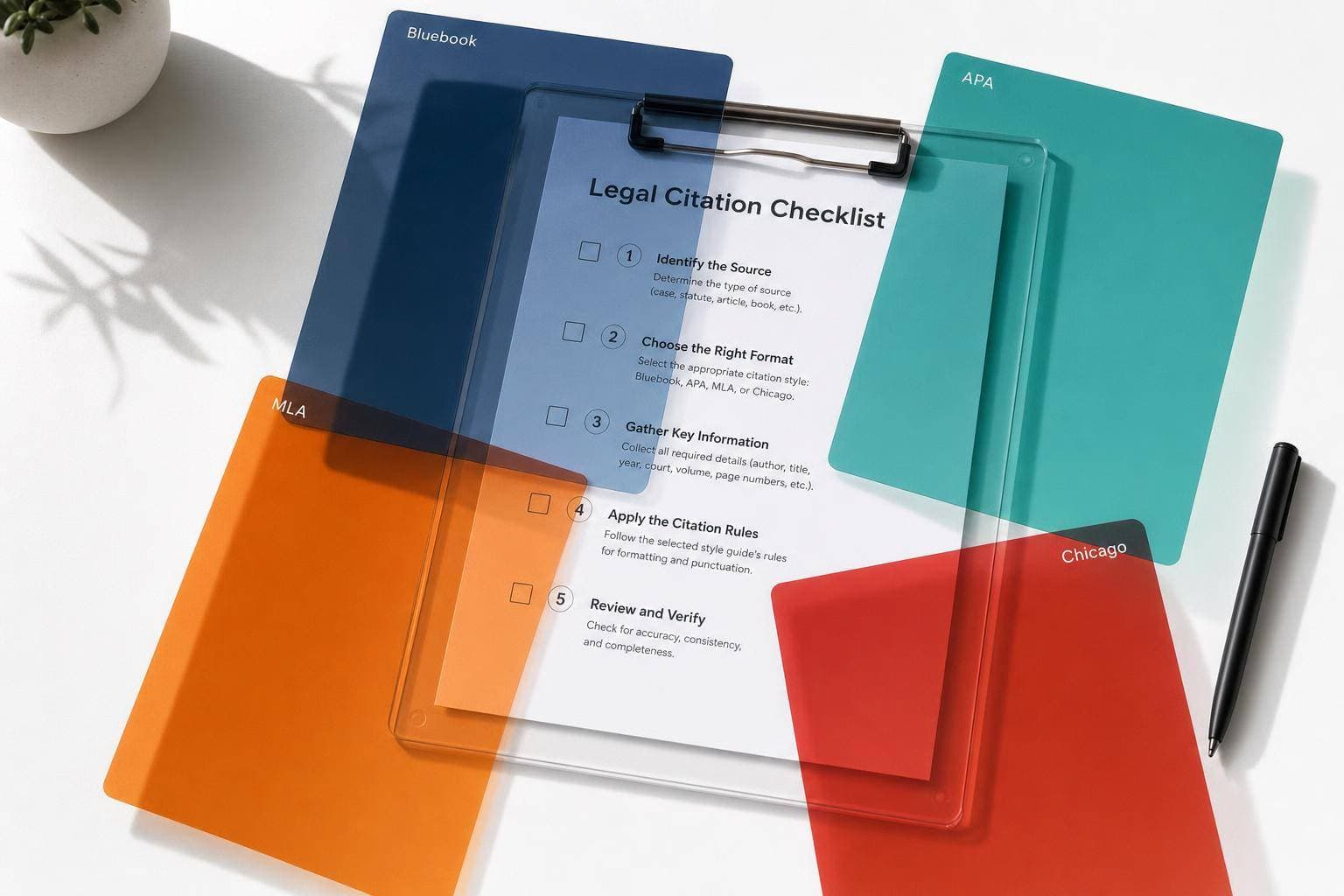
In short, I’d use this guide to identify the source, collect the right fields, format the citation in the required style, and run a last check for missing details.
The Main Legal Source Types and What Citation Details to Collect
Start by identifying the source type. That tells you which citation details matter. Once you know what kind of source you're working with, you can gather the exact pieces the citation format asks for.
Cases, Statutes, and Regulations
A case is a court decision in a specific dispute. You can often spot one by the "v." between the party names, such as Miranda v. Arizona or Brown v. Board of Education.
For cases, collect the case name, volume number, reporter abbreviation (for example, "U.S." for United States Reports or "F.3d" for the Federal Reporter), starting page number, court name, and year of the decision. For example, Brown v. Board of Education is cited as 347 U.S. 483 (1954) - that means volume 347 of the United States Reports, starting on page 483, decided in 1954.
Statutes are laws passed by Congress or a state legislature, like the Civil Rights Act. The code abbreviation tells you where the law appears: "U.S.C." for statutes and "C.F.R." for regulations. For a statute, gather the act name, title number, code abbreviation, section number using the § symbol, and the year of the code edition.
Regulations are rules issued by agencies and published in the C.F.R. For those, collect the title number, C.F.R. abbreviation, section number, and year.
Constitutions, Law Review Articles, and Government Legal Documents
Use constitutional citations when you're dealing with rights claims or questions about how government is set up. You'll need the jurisdiction abbreviation such as "U.S. Const.", the article written as "art." with a Roman numeral, the section number, and the amendment number if it applies, such as "amend. XIV".
Law review articles are scholarly pieces published in legal journals. These are secondary sources, and people often use them to support interpretation or critique. Collect the author's full name, article title, volume number, journal abbreviation, first page of the article, and publication year.
Government legal documents include congressional hearings and committee reports. They're often cited to show legislative intent or official action. For these, gather the issuing agency or committee, document title, report or hearing number, Congress and session number, and date.
Use the table below as a quick checklist. You’ll use these details later when you format the source in Bluebook, APA, MLA, or Chicago.
| Source Type | When to Cite | Required Details |
|---|---|---|
| Cases | Judicial interpretation or precedent | Case name, volume, reporter, page, court, year |
| Statutes | Text of a law or act | Act name, title, code (e.g., U.S.C.), section (§), year |
| Regulations | Agency rules or policy implementation | Title, C.F.R., section (§), year |
| Constitutions | Rights claims or government structure | Jurisdiction, "Const.", article, section, amendment |
| Law Review Articles | Expert analysis or legal critique | Author, title, volume, journal, page, year |
| Government Documents | Legislative intent or official action | Issuing agency or committee, title, doc number, Congress/session, date |
These details are the raw material you'll use in the formatting examples in the next section.
sbb-itb-f7d34da
How to Format Legal Sources in Bluebook, APA, MLA, and Chicago
Legal Citation Styles Compared: Bluebook, APA, MLA & Chicago
Once you’ve gathered the source details, the next step is to format them for the citation style your assignment calls for. The source itself doesn’t change. What changes is the order, punctuation, italics, and abbreviations. A good way to handle it is to start with Bluebook, then convert that citation into APA, MLA, or Chicago.
Bluebook Basics: Cases, Statutes, Regulations, and Constitutions
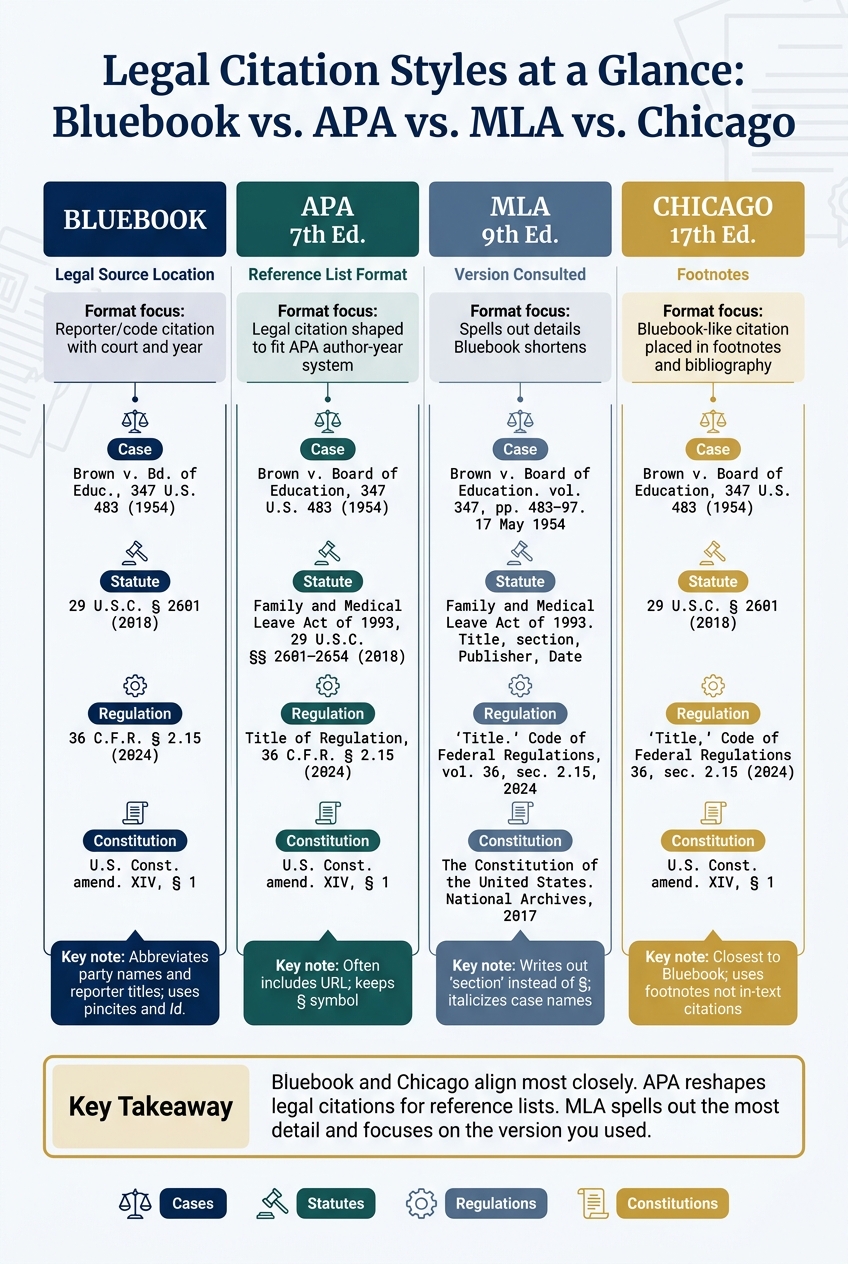
Bluebook centers on three parts: the source name, the reporter or code location, and a parenthetical with the court and year. It also shortens party names and reporter titles. So Brown v. Board of Education becomes Brown v. Bd. of Educ., 347 U.S. 483 (1954).
For statutes, Bluebook starts with the title and code: 29 U.S.C. § 2601 (2018). The year in parentheses refers to the edition of the code, not the year Congress passed the law. Regulations use the same basic setup: 36 C.F.R. § 2.15 (2024). Constitutional citations are even more compact: U.S. Const. amend. XIV, § 1.
Two Bluebook points often trip people up: pinpoint citations and short forms.
- A pincite points readers to the exact page you’re using. For example: 347 U.S. 483, 495.
- For repeat citations, use Id. only if the citation right before it contains a single source.
- If you cite a case again later, use a shortened case name plus a pincite, such as Strickland, 466 U.S. at 687.
Fitting Legal Sources into APA, MLA, and Chicago
APA (7th ed.) keeps the legal details, but reshapes them to fit APA’s author-year system. In the reference list, APA gives the full act name before the code citation. For instance: Family and Medical Leave Act of 1993, 29 U.S.C. §§ 2601–2654 (2018). It also often includes a URL for the version you used.
MLA (9th ed.) focuses on the version you consulted rather than the canonical legal text. Case names are italicized, but act names like the Civil Rights Act are not. MLA also spells out parts that Bluebook shortens, so “vol. 347, pp. 483–97” appears instead of the tighter “347 U.S. 483.”
Chicago (17th ed.) stays very close to Bluebook. It uses the same case name, volume, reporter, and parenthetical setup, but places them in footnotes and a bibliography instead of in-text citations.
APA and Chicago usually keep the section symbol (§) for statutes and regulations. MLA often writes it out as “section” or “sec.”
Comparison Table: One Legal Source Type Across Four Citation Styles
The table below shows the same source type formatted in all four styles.
| Source Type | Bluebook (Practitioner) | APA (7th Ed.) | MLA (9th Ed.) | Chicago (17th Ed.) |
|---|---|---|---|---|
| Court Case | Brown v. Bd. of Educ., 347 U.S. 483 (1954). | Brown v. Board of Education, 347 U.S. 483 (1954). | Brown v. Board of Education. vol. 347, pp. 483–97. 17 May 1954. | Brown v. Board of Education, 347 U.S. 483 (1954). |
| Federal Statute | 29 U.S.C. § 2601 (2018). | Family and Medical Leave Act of 1993, 29 U.S.C. §§ 2601–2654 (2018). | Family and Medical Leave Act of 1993. Title, section, Publisher, Date. | 29 U.S.C. § 2601 (2018). |
| Regulation | 36 C.F.R. § 2.15 (2024). | Title of Regulation, 36 C.F.R. § 2.15 (2024). | "Title." Code of Federal Regulations, vol. 36, sec. 2.15, 2024. | "Title", Code of Federal Regulations 36, sec. 2.15 (2024). |
| Constitution | U.S. Const. amend. XIV, § 1. | U.S. Const. amend. XIV, § 1. | The Constitution of the United States. National Archives, 2017. | U.S. Const. amend. XIV, § 1. |
Bluebook and Chicago line up most closely. APA reshapes legal material for the reference list, while MLA spells out more of the citation. Before you lock anything in, check each detail against the source you actually used.
How to Find Accurate Legal Citation Details and Full Texts
A Simple Research Workflow for Legal Citation Accuracy
Once you know what kind of source you're working with, check the citation details before you format anything. It sounds basic, but this is where a lot of mistakes start. Put every field side by side in one place: source name, location, pinpoint page or section, court or agency, and date.
For primary law, start with official databases. Then move to scholarship and commentary. GovInfo (govinfo.gov) covers federal regulations and statutes, and Congress.gov handles legislative materials like bill text, committee reports, and hearing records. If you need a Supreme Court opinion, Google Scholar’s "Case law" mode is a handy shortcut. Type the official case citation into the search bar, and you can go straight to the full opinion text.
Two details students miss all the time are the edition year for codes and the pincite. The U.S. Code is published every six years with annual supplements in between, so the year in your citation needs to match the exact edition you used - not the year the law was passed. The eCFR updates daily and is usually current within two business days, which makes it useful for checking the current section number.
Using Sourcely to Find Legal and Academic Sources

After you confirm the primary source, use Sourcely to find scholarly context, policy research, and supporting commentary. Paste your draft into Sourcely, and it flags places that need support. From there, you can look for law review articles and policy research tied to a case or statute, use filters to narrow results to U.S.-based scholarship, export formatted references, and download free PDFs when they're available.
Workflow Table: Common Legal Citation Tasks and What to Verify
Use the table below to line up each task with the details you need to check.
| Task | Required Details to Verify | How Sourcely Helps |
|---|---|---|
| Citing a Supreme Court case (e.g., criminal justice essay) | Case name, volume, "U.S." reporter, starting page, pincite, year | Finds related scholarship and the full opinion |
| Citing a federal statute (e.g., policy paper on labor law) | Act name, title number, U.S.C. section (§), edition year | Finds scholarship that explains or critiques the statute |
| Citing a federal regulation (e.g., health policy paper) | Title number, C.F.R. section (§), edition year; verify against eCFR | Finds agency reports and policy analysis on the rule |
| Citing a congressional report (e.g., public administration paper) | Agency, document title, report number, Congress session information, full date | Locates the report text and supporting sources |
Common Legal Citation Mistakes and a Final Checklist
The Mistakes That Cause Most Citation Problems
Once you've checked the source details, look at the citation format itself. That's where a lot of problems show up.
One common mistake is mixing Bluebook's practitioner rules with its academic rules. For student papers, stick with the format your assignment calls for, and use it the same way from start to finish.
Students also often leave out code edition years and court names. A statute citation without a year parenthetical - like 42 U.S.C. § 1983 with no date - makes it hard for readers to verify which version you used. The same goes for a citation to F.3d without the court in the parenthetical. Since F.3d includes cases from all federal circuits, the reader can't tell which court decided the case.
Two more mistakes cause trouble all the time: mixing up § and ¶, and using Id. the wrong way. Use § for statutes and regulations. Use ¶ only for sources organized by paragraph number. And Id. works only when the citation right before it contains a single authority. If the prior citation lists more than one source, Id. becomes unclear and shouldn't be used.
Pincites matter for a simple reason: they show readers the exact language you're relying on.
Diagnostic Table and Submission Checklist
Use this table as a quick last pass before you turn in your paper.
| Error | Why It Matters | How to Fix |
|---|---|---|
| Missing code edition year | Prevents readers from checking the version you used | Add the year in parentheses: 42 U.S.C. § 1983 (2018) |
| Omitted court name | F.3d covers all circuits; jurisdiction stays unknown |
Add the court before the year: (2d Cir. 2007) or (D. Alaska 2022) |
| Missing pincite | Forces the reader to search an entire opinion for one quote | Add the specific page after the starting page: 347 U.S. 483, 495 |
| Wrong symbol (§ vs. ¶) | Signals the wrong document structure to the reader | Use § for statutes and regulations; use ¶ for paragraph-numbered sources |
| Missing C.F.R. title number | Regulations are organized by 50 titles; without the title number, the section is unfindable | Put the title number first: 45 C.F.R. § 164.502 |
| Mixing practitioner and academic style | Inconsistency makes the reference list hard to follow | Stick to one format throughout the paper |
| Ambiguous Id. usage | If the previous cite had two sources, the reader doesn't know which one Id. refers to | Replace it with a short-form name: Strickland, 466 U.S. at 668 |
Run each citation through the table before submitting.
FAQs
How do I know which legal citation style my instructor expects?
Check your course syllabus or assignment rubric first. In most cases, it tells you which citation style to use.
If the style isn’t listed, ask your instructor whether they want APA, MLA, or Chicago, or legal citation rules from The Bluebook or ALWD. It also helps to confirm whether they expect practitioner format for court-style documents or academic format for research papers.
When should I cite the original law instead of a law review article?
Cite the original law when you need the primary source authority, such as a statute, regulation, or court decision. It carries more weight than a law review article and lets readers check the source for themselves.
Use law review articles for context or analysis. But when you discuss the official record, the court’s reasoning, or the legal standard, cite the original law.
What should I do if I can’t find the court name, code year, or pincite?
Prioritize the official publication of the record when you complete the citation. Cross-check the source in library databases or on official government websites, such as the Library of Congress, to fill in any missing details.
If a page number isn’t available, check whether the source uses paragraph numbers instead. If you still can’t verify the court name, code year, or pincite, consult a librarian or a legal citation guide.