
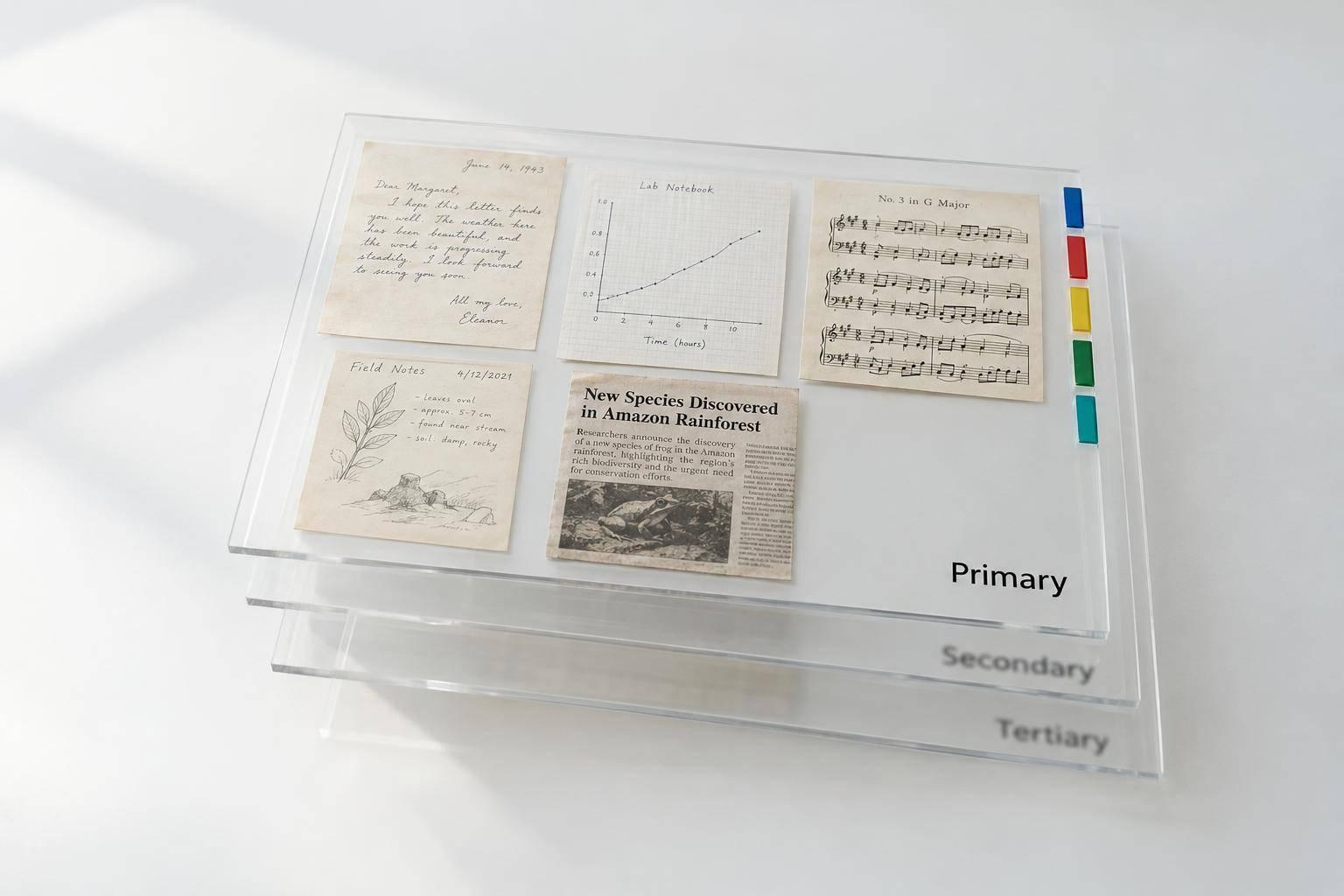
What Is a Primary Source? Definition and 20 Examples by Discipline
A primary source gives you direct evidence for your research question. My first check: Does it provide original records, data, or work - or explain someone else’s findings? Check who made it, when, and what it can support. <u>Firsthand doesn’t mean error-free.</u>
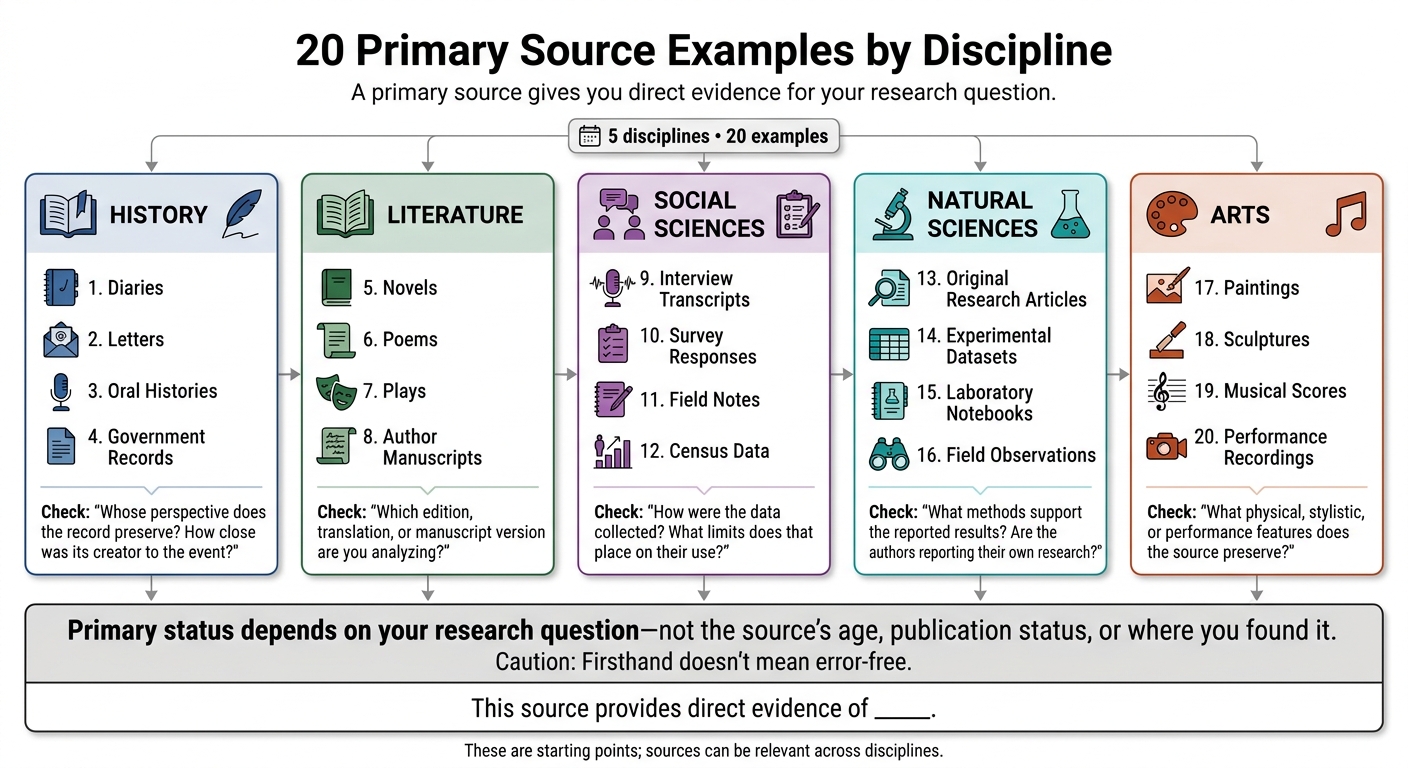
I’ve grouped 20 examples across 5 disciplines:
- History: Diaries, letters, oral histories, government records.
- Literature: Novels, poems, plays, author manuscripts.
- Social sciences: Interview transcripts, survey responses, field notes, census data.
- Natural sciences: Original research articles, experimental datasets, laboratory notebooks, field observations.
- Arts: Paintings, sculptures, musical scores, performance recordings.
The key is how you use the source. A novel can support a study of its language - not prove its plot happened. Secondary sources analyze evidence; tertiary sources compile information. I’ll show you how to tell them apart and choose sources that fit your assignment.
20 Primary Source Examples by Discipline
What Are Primary Sources?
sbb-itb-f7d34da
What Is a Primary Source?
A primary source provides direct evidence you can use to answer a research question. What counts as one depends on the discipline and the question you’re asking. The next section explains how primary, secondary, and tertiary sources differ.
“Original” refers to authorship - not age, handwriting, or neutrality.
A recent journal article can be a primary source when it reports the authors’ own methods and results; its role can change across disciplines and research questions.
Secondary sources interpret primary evidence. But that interpretation can become primary evidence if you’re studying the scholar’s ideas or writing.
Primary doesn’t mean accurate or unbiased. For your assignment, check who created the source, when they created it, and what claims it can support. These checks matter most when comparing primary, secondary, and tertiary sources.
Primary, Secondary, and Tertiary Sources
When finding credible sources for your assignment, classify sources by what they do - not their format.
Source category Purpose Example Primary Provides direct evidence or original data. Original research article or dataset. Secondary Analyzes, interprets, or reviews evidence. Review article. Tertiary Compiles, summarizes, or indexes information. Encyclopedia or bibliography.
To tell original research apart from a review, check how the source was produced. An original research article reports the authors’ own study and typically includes methods and results sections. Format alone won’t tell you which type you’re reading.
A source’s category can change when it becomes the subject of analysis.
A textbook can be primary evidence when the textbook itself is the object of study.
Use tertiary sources for definitions, secondary sources for scholarly context, and primary sources for direct evidence.
1. Diaries
Diaries record daily experiences, beliefs, and reactions as they happen. Historians use them to understand how people lived through social and political change.
Their value depends on date, authorship, and context. Check when each entry was written and whether the writer witnessed the event firsthand. Published or digitized diaries still serve as primary evidence, but personal opinions show the writer’s perspective - not proof that their account is factually correct.
Treat a published or digitized transcription as a separate layer from the original diary. Compare it with manuscript images when available, and keep the writer’s entries separate from editorial introductions and notes.
2. Letters
Unlike diaries, letters are written to someone. The recipient shapes both the message and how the writer delivers it. As firsthand records of communication, letters can reveal tone, intent, and relationships.
In June 1937, Frederick Noonan wrote to Mary Beatrice Noonan from Paramaribo, Suriname, during his flight with Amelia Earhart. Purdue University preserves the letter in its Frederick J. Noonan and Mary Beatrice Noonan papers, collection MSP 224, and makes it available through its digital e-Archives.
Read with the recipient in mind. Writers tailor their words to their audience, making letters useful for studying relationships, persuasion, and reactions in context.
To find letters in library catalogs, search the person’s name alongside correspondence, letters, or manuscripts. Choose letters that directly answer your research question - not those that merely mention the topic.
3. Oral Histories
Like diaries and letters, oral histories preserve firsthand accounts of events people experienced or witnessed. Most are recorded through interviews, so the interview itself helps shape the record. These accounts are primary sources; scholarship that analyzes them is secondary.
Check the interviewee’s role, when the interview took place, and how much time had passed since the events. Compare the account with records from that period, and consider how the interviewer’s questions may have influenced the answers.
For close analysis, compare the transcript with the recording. Tone, pauses, and the interviewer’s wording can affect meaning. An interview can reveal both what happened and how someone remembered it later.
You can find oral histories in university archives, special collections, and library subject guides. Cite the recording or transcript you used.
4. Government Records
Government records document institutional actions rather than the personal memories found in oral histories. They’re primary sources when they record official actions, decisions, or data firsthand.
Use laws, treaties, court filings, trial transcripts, and legislative hearings as evidence of what a government did or recorded.
These sources are most useful for tracing official policy, procedures, or administration.
An agency report can be primary evidence of that agency’s position, even if parts of it analyze earlier records.
By contrast, scholarship that interprets a law is a secondary source. Official doesn’t mean free from bias. Check whose perspective the record preserves - and whose voice is missing.
Use the Congressional Record for legislative proceedings and data.census.gov for Census Bureau data. For citations, save the issuing agency, title, date, and record number. If you work with a digitized image or transcription, compare it with the original record.
5. Novels
In literary research, a novel is a primary source when its text is the evidence you’re studying. Literary criticism is a secondary source because it interprets that text. So the edition you choose is part of your evidence, too.
Novels can reflect the society that produced them, but fiction doesn’t prove that the events it depicts actually happened. A novel’s role as a source depends on your research question.
For close reading, use an original or scholarly edition. For reader reception or translation studies, choose the specific edition or translation your question calls for.
6. Poems
Like novels, poems are primary sources when the poem itself is the evidence you’re studying. The language, imagery, and form offer direct evidence. Literary criticism, by contrast, offers interpretation.
Keep the speaker separate from the poet. The speaker’s voice presents a viewpoint - not direct facts about the poet’s life. In historical research, read that voice in the context of its time and society.
Choose the version that fits your research question: a manuscript for studying revisions, or a published edition for studying what readers saw at the time. Use a translation only when your question requires it, and name the translator and edition to make its layer of interpretation clear.
7. Plays
Unlike novels and poems, plays can serve as primary evidence in both written and performed form. The script provides evidence of dialogue, stage directions, and structure. A performance recording provides evidence of staging, delivery, and directorial choices.
Start by deciding whether you’re studying the text, a production, or its reception. If you’re examining how a production portrays the past, focus on its staging - don’t treat the plot as historical fact. Choose the version that supplies the evidence your research question needs.
A critical essay is usually a secondary source because it interprets the play. A review written at the time, however, can serve as primary evidence of audience and critical reception.
8. Author Manuscripts
Author manuscripts show a work taking shape through early drafts, handwritten revisions, and annotated typescripts. Unlike finished novels, poems, and plays, these primary sources document revisions made before publication.
Compare a manuscript with the published text to track changes in wording, structure, and characters. This lets you study how the work changed - not just its final form.
To find manuscripts, search library catalogs for the author’s name alongside “papers,” “manuscripts,” or “special collections.” Before citing a draft, check the finding aid and item metadata for its creator, date, and version. Ask an archivist to confirm anything unclear.
9. Interview Transcripts
In social science research, interview transcripts preserve participants’ words as primary evidence. Sociologists and psychologists use them to study personal experiences, attitudes, and behavior. A researcher’s summary or interpretation, by contrast, is secondary evidence.
Firsthand evidence can still be biased. Interviewers can shape the record, while participants’ later recollections may reflect hindsight. Editing and shortening a transcript can also change how closely it matches the interview. Still, a retrospective interview remains primary evidence of the participant’s account.
Check who conducted the interview, when it took place, whether the transcript was shortened or edited, and whose perspectives are missing. Compare it with other records to verify details and spot gaps. Choose the transcript version that best fits your research question.
10. Survey Responses
Survey responses, like interview transcripts, record firsthand answers. But surveys usually follow a standard format, making responses easier to compare. Survey responses are primary sources because they preserve participants’ answers as recorded. In the social sciences, responses and tabulated poll results offer direct evidence of reported opinions, behaviors, and reactions.
You don’t have to run the survey yourself. Existing survey data counts as primary evidence when you use raw responses or tabulated results rather than someone else’s later analysis. The data must directly answer your research question.
A report about a survey counts as a primary source only when the report itself is what you’re studying. Survey responses and results, by contrast, can help you study participants’ reported attitudes, behaviors, or reactions.
11. Field Notes
Field notes are firsthand records of what a researcher observes during fieldwork. Unlike interview transcripts and survey responses, they document observations rather than participants’ answers. In sociology and anthropology, they serve as primary sources because they record what the researcher saw or heard. They can include written descriptions, sketches, and architectural drawings.
Keep observed details separate from later interpretation. Field notes may contain both, so this distinction matters when analyzing fieldwork.
Before citing field notes, identify the observer and compare the notes with other firsthand accounts. Check any transcription for omissions or errors, too.
12. Census Data
Census data describe a population as a whole, unlike interview transcripts and survey responses, which record individual answers. Census data are primary sources because they’re original numerical records collected to describe a population. They provide direct evidence, not analysis. Articles that interpret census findings are secondary sources.
For assignments, choose data that answer your research question. The U.S. Census Bureau website provides current population and housing data. If you’re studying change over time, use library databases and government archives to find historical counts and tables.
Check how the data were collected and which groups may be undercounted. Official categories can also reflect the era in which they were created.
13. Original Research Articles
In the natural sciences, primary sources usually describe a study’s own methods and results. An original research article is a primary source when it reports the authors’ own study, data, and results.
Look for separate Methods and Results sections. Methods explain how the study was done; Results share its new findings. A paper that brings together findings from earlier studies is usually a secondary review.
14. Experimental Datasets
Experimental datasets contain raw data collected directly during experiments. They count as primary sources because they preserve original measurements before interpretation.
Organizing or formatting those measurements doesn't make them secondary sources. The data remain primary evidence, unlike later analysis that interprets them.
When choosing a dataset for your assignment, check its source, collection date, measurement method, and fit with your research question. Review the methods and lab notes to confirm the collection conditions and any processing applied to the data.
15. Laboratory Notebooks
Laboratory notebooks are primary sources because they record research in real time: procedures, observations, measurements, and hypotheses. They also preserve failed experiments and abandoned approaches that published articles often leave out.
Use these notebooks to trace the research process, not just the results. They can show how an experiment was planned and carried out, when a method changed, or why a researcher dropped an approach. In lab-based research, they serve much the same role as field notes in outdoor or on-site work.
Look for notebooks in university special collections and researchers’ papers. Check who wrote them, look for missing pages or dates, and compare entries with related publications or correspondence. A notebook’s value depends on its completeness and context - not its format alone. Even a firsthand record can have gaps or contradictions.
16. Field Observations
Field observations are firsthand observations or measurements recorded in a natural setting. In field-based research, these records count as primary evidence when they come from the researchers’ own observations - not a later summary. As with any primary source, check who observed it, when, and how.
Look at the date, location, observer, and collection method to decide whether the records answer your research question and preserve the original observation. Pay attention to what the observer recorded - and what they left out. Firsthand evidence isn’t automatically complete or free from bias.
Use the field notes, report, or dataset containing the observation itself. Field notes hold the record; the observation is the evidence. A paper counts as a primary source only when it reports the researchers’ own observations or measurements.
17. Paintings
In the arts, the work itself often serves as evidence. A painting is a primary source when you study the artwork itself to answer your research question. Its composition, brushwork, and imagery can reveal technique, perspective, and historical context. Art-historical analysis of those features is a secondary source.
A painting created long after an event can provide primary evidence of how people later interpreted that event - not of the event itself.
For your assignment, check the catalog record for the artist, creation date, and ownership history (provenance). Use a high-quality reproduction only when needed, and treat it as one step removed from the original. The same rule applies to sculptures, scores, and recordings.
18. Sculptures
Like paintings, sculptures are primary sources when you study the work itself to answer a research question in art history, archaeology, or cultural history. Their three-dimensional form offers evidence of scale and placement. Look at the materials, technique, inscriptions, original location, and patron to understand what the sculpture was meant to do.
A commissioned monument reflects both the patron’s values and the artist’s vision. Compare it with records from the same period and, when available, preparatory sketches or models to trace how its message took shape. Questions about form, context, and use also apply to musical scores and performance recordings.
19. Musical Scores
Musical scores are primary sources when the score itself is your evidence. The notation gives you direct evidence of structure, tempo, dynamics, and other performance instructions. But the version matters: an autograph manuscript, a published score, and a modern edition can answer different questions. An autograph score can show revisions, while a contemporary published score shows how the work appeared at the time.
Check the edition before using it as evidence. Modern editions may contain editorial corrections and changes in interpretation. When studying composition, use the score as primary evidence and choose an edition that fits your question. Treat editorial notes as secondary commentary.
If your question focuses on performance rather than notation, turn to performance recordings.
20. Performance Recordings
Recordings offer evidence that a score alone cannot provide. Audio and video recordings are primary sources when the recording itself is the evidence. They preserve timing, vocal delivery, movement, and audience response. Reviews and critiques, by contrast, are secondary sources.
Check the date, identify the performers, and verify who made the recording. Use recordings made during or soon after the performance.
Treat each recording as partial evidence, not a complete record. Camera framing and editing can shape what you see. Compare the recording with other sources from the time, and note its limits.
How to Choose Primary Sources for Your Assignment
Start with your research question and assignment rules. Be clear about what you need to answer. Then check your instructor’s requirements for source types, dates, and evidence used in your field. Match the evidence to your question: firsthand testimony, data, original works of art or literature, or experimental results. Pick sources for what they show - not just because they carry the “primary” label.
Check how you’ll use the source. Will it serve as evidence in your paper or as commentary on other evidence?
Look at who created it, when, and under what circumstances. Did the creator have direct contact with the event, place, or period? Consider whose perspectives are missing, too.
A biased source can still be useful. Check key claims against other evidence, compare conflicting accounts, and keep your conclusions within what the record supports. Use the checklist below to apply these steps in your field.
Primary Source Checklist by Discipline
Use this checklist to find primary sources for your discipline and identify what to check.
| Discipline | Typical primary sources | What to check |
|---|---|---|
| History | Diaries, letters, oral histories, government records | Whose perspective does the record preserve? How close was its creator to the event? |
| Literature | Novels, poems, plays, author manuscripts | Which edition, translation, or manuscript version are you analyzing? |
| Social sciences | Interview transcripts, survey responses, field notes, census data | How were the data collected? What limits does that place on their use? |
| Natural sciences | Original research articles, experimental datasets, laboratory notebooks, field observations | What methods support the reported results? Are the authors reporting their own research? |
| Arts | Paintings, sculptures, musical scores, performance recordings | What physical, stylistic, or performance features does the source preserve? |
Treat these as starting points. If your work spans several disciplines, use every relevant row.
Conclusion: Match Sources to Your Research Question
Use the checklist above to check whether a source fits your research question. Primary status depends on your research question - not the source’s age, publication status, or where you found it.
Before citing a source, check who created it, when, and why. Then separate original evidence from later commentary.
In your notes, finish this sentence:
“This source provides direct evidence of ___.”
If you can only summarize another writer’s conclusion, add primary evidence.
FAQs
Can one source be both primary and secondary?
Yes, a source can be both primary and secondary, depending on how you use it in your research. It’s primary when it gives direct evidence about your topic. It’s secondary when it analyzes or interprets original materials.
For example, a biography is usually a secondary source. But if you’re studying the author’s writing methods or how biographical styles have changed over time, that same book can serve as a primary source.
How do I cite a digitized primary source?
Use the citation style your instructor or discipline requires, such as APA, MLA, or Chicago. Include the details readers need to find the digital version, including the database or repository where you accessed it.
Check your style’s rules for electronic or archival materials. You may need to state that the document is a digital reproduction of an original firsthand record.
What if my primary sources contradict each other?
Contradictions between primary sources are a normal part of research - not a sign that your work has gone wrong. They show how historical interpretations can shift and depend on context.
Instead of searching for one absolute truth, examine why the accounts differ. Compare the witnesses’ or creators’ perspectives, and look at the circumstances in which each source was produced. That work helps you build an evidence-based argument that accounts for those differences.


