
Website Credibility Checker: How to Evaluate Any Website in 5 Minutes
A five-minute website check starts with who wrote it and what supports its claims - not how polished it looks. Check one claim at a time, then decide whether to cite, verify further, or avoid it.
- Minutes 1–2: Check the author, publisher, and sources behind the claim.
- Minutes 3–4: Review dates, relevance, sales motives, and misleading web addresses.
- Minute 5: Compare the claim with at least two independent sources, then record the decision and citation details.
Missing details call for more checking, not an automatic rejection. Five minutes is a first pass; health, legal, and financial claims need closer review.
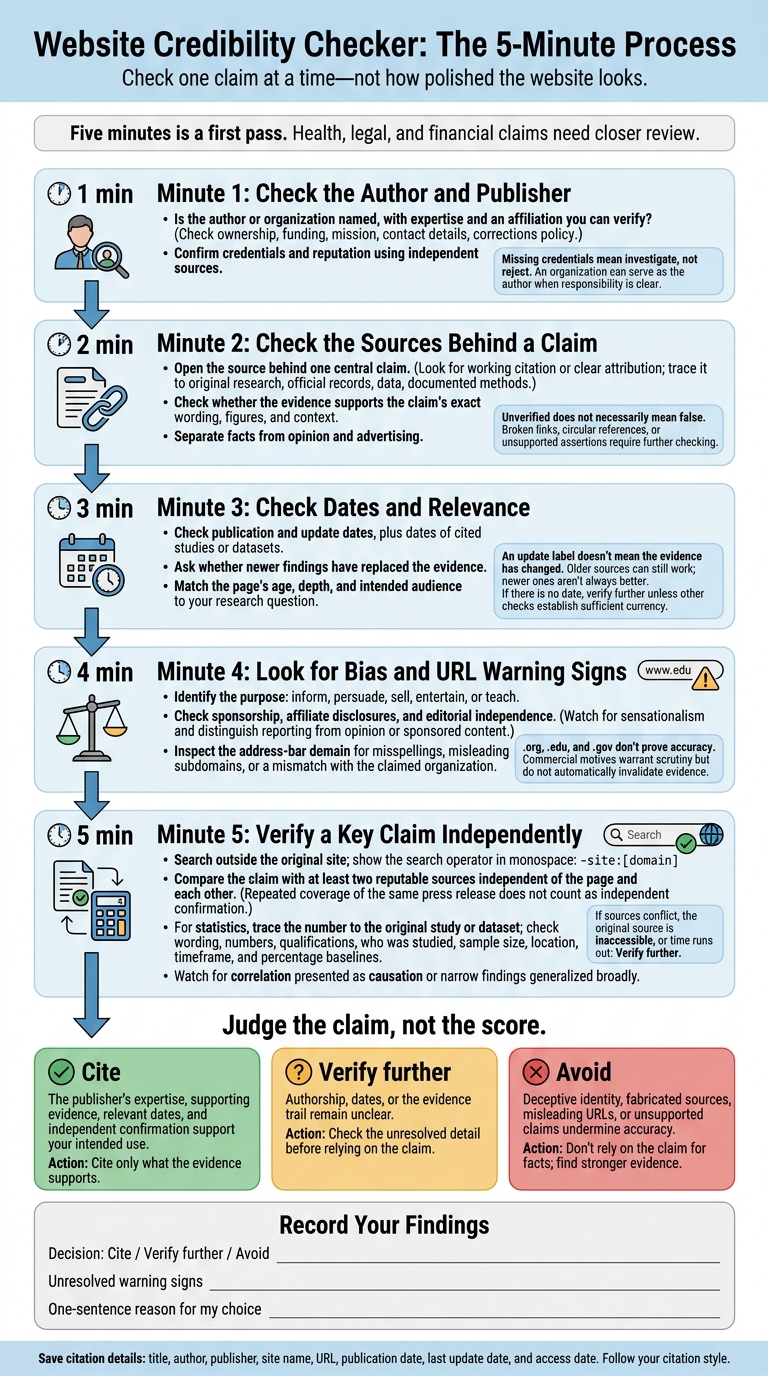
Website Credibility Checker: The 5-Minute Process
Minutes 1–2: Check Who Wrote It and What Supports It
Minute 1: Check the Author and Publisher
Mark Yes or No for each check. An organization can serve as the author - an individual byline isn’t needed if responsibility is clear. Missing credentials mean investigate, not reject.
- [ ] Yes / No: Is the author or organization named, with expertise and an affiliation you can verify?
- [ ] Yes / No: Does the publisher share its ownership, funding, mission, contact details, and corrections policy?
- [ ] Yes / No: Do independent sources confirm the author’s credentials and the publisher’s reputation?
Search the author’s name plus biography or expertise. For outside coverage of the publisher, search [WEBSITE URL] -site:[WEBSITE URL].
If the author checks out, move to the evidence behind the claim.
Minute 2: Check the Sources Behind a Claim
Open the source behind one central claim. Look for original research, official records, data, or documented methods. Use primary or peer-reviewed sources when appropriate, and check exactly which claim they support.
- [ ] Yes / No: Does the claim include a working citation or clear attribution?
- [ ] Yes / No: Can you trace it to evidence, rather than pages that only cite one another?
- [ ] Yes / No: Does the evidence support the claim’s exact wording, figures, and context?
- [ ] Yes / No: Are facts clearly separated from opinion and advertising?
A broken link, circular reference, or unsupported assertion leaves the claim unverified, not necessarily false. Mark it verify further before citing it. A long reference list doesn’t replace checking the evidence.
sbb-itb-f7d34da
Minutes 3–4: Review Dates, Purpose, and Web Address
Minute 3: Check Dates and Relevance
Once you’ve checked the author and citations, decide whether the information is current enough for your topic.
Look near the headline or footer for publication and update dates. Record them in U.S. format:
November 12, 2026
Then check the dates of the studies or datasets the page uses. An update label doesn’t mean the evidence has changed. For health, technology, and other fast-changing topics, check whether newer findings have replaced the information.
Match the page’s age, depth, and intended audience to your research question. Older sources can still work, and newer ones aren’t always better. A basic overview, for instance, may not support an advanced assignment. If there’s no date, mark verify further unless dated source material or other checks establish that the information is current enough.
Minute 4: Look for Bias and URL Warning Signs
Identify what the page aims to do: inform, persuade, sell, entertain, or teach. Check sponsorship and affiliate disclosures for financial incentives, along with any explanation of editorial independence. Commercial content deserves a closer look, but verified evidence still counts.
Watch for sensationalism, clickbait headlines, and wording that stirs anger or fear before you’ve examined the facts. Before adding the page to your academic notes, confirm that factual reporting is clearly separated from opinion or sponsored content. A confident tone doesn’t mean balanced coverage.
Check the domain in the address bar for misspellings, misleading subdomains, or an address that doesn’t match the claimed organization. Endings such as .org, .edu, and .gov don’t prove accuracy.
If the page still looks plausible, check one key claim against an independent source.
Evaluating Websites for Research | Workshop
Minute 5: Verify a Key Claim Independently
Test the claim at the center of your research. Open a new tab, search its main terms, and add -site:[domain] to leave out the original site. Scan the results before clicking. Choose evidence, not just the top result. This is lateral reading: checking outside a site before trusting it.
Compare the claim with at least two reputable sources independent of the page and each other. Look for government data, scholarly research, or professional organizations with relevant expertise. Several outlets repeating the same press release don’t count as independent confirmation.
For a claim built on a statistic, trace the number to the original study or dataset. Follow the citation. If the link is broken, search for the study title and publisher. Check the exact wording, numbers, and any limits or qualifications.
Next, check how the site interprets the data. Review who was studied, the sample size, location, and timeframe. Make sure percentages use the same baseline and the site’s reading matches the findings. Watch for claims that correlation proves causation or that results from a narrow sample apply broadly.
If sources conflict, you can’t access the original source, or time runs out, mark Verify further and move on.
Conclusion: Decide Whether to Cite the Website
After the five-minute check, decide whether this specific claim is fit for your intended use. Judge the claim, not the score. Weigh authorship, evidence, dates, purpose, and independent confirmation. Use the claim only if the evidence supports it.
Choose Cite, Verify Further, or Avoid
Choose one of three next steps based on what you found.
| Decision | Evidence required | Next action |
|---|---|---|
| Cite | The publisher’s expertise, supporting evidence, relevant dates, and independent confirmation support your intended use. | Cite only what the evidence supports. |
| Verify further | Authorship, dates, or the evidence trail remain unclear. | Check the unresolved detail before relying on the claim. |
| Avoid | Deceptive identity, fabricated sources, misleading URLs, or unsupported claims undermine accuracy. | Don’t rely on the claim for facts; find stronger evidence. |
Save Citation Details and Trace the Original Source
Save the title, author, publisher, site name, URL, publication date, last update date, and access date. Follow the format your citation style requires.
Use the 5-Minute Checklist
You’re checking one claim, not judging the whole site. Record your findings and decision in your notes before moving on.
- [ ] Minute 1: Check author expertise and publisher accountability.
- [ ] Minute 2: Check whether sources support the claim.
- [ ] Minute 3: Check dates and relevance.
- [ ] Minute 4: Check purpose, bias, and URL warning signs.
- [ ] Minute 5: Record the strongest independent source and choose a decision.
Decision: Cite / Verify further / Avoid
Unresolved warning signs: ____________________
One-sentence reason for my choice: ____________________
FAQs
Does HTTPS mean I can trust a website?
No. HTTPS indicates a secure connection, but it doesn’t tell you whether a website’s claims are accurate, its content is high quality, or its author is reliable.
Check the author’s credentials, the publisher’s reputation, and whether evidence supports the claims. Verify key claims through independent sources before deciding whether the information is reliable enough to cite.
How can I tell if sources are truly independent?
Look beyond the source’s own website. Use lateral reading: open new tabs to research the author, organization, or publisher. Check their professional background, credentials, and ties to institutions, corporations, or advocacy groups.
Then check the source’s purpose. Is it trying to inform, sell, or persuade? That goal can help you spot possible bias. Compare its claims with government reports, peer-reviewed journals, or established news organizations to see whether other trusted sources support them.
What should I do when credible sources disagree?
Disagreement doesn’t automatically make information unreliable. Compare multiple independent, trusted sources and look for evidence or context that explains why they differ.
If reliable sources repeatedly contradict a claim, find flaws in its evidence, or flag serious concerns about the original source, look for a source with more authority or stronger support. Favor information backed by verifiable data, academic research, or agreement among respected organizations.


