
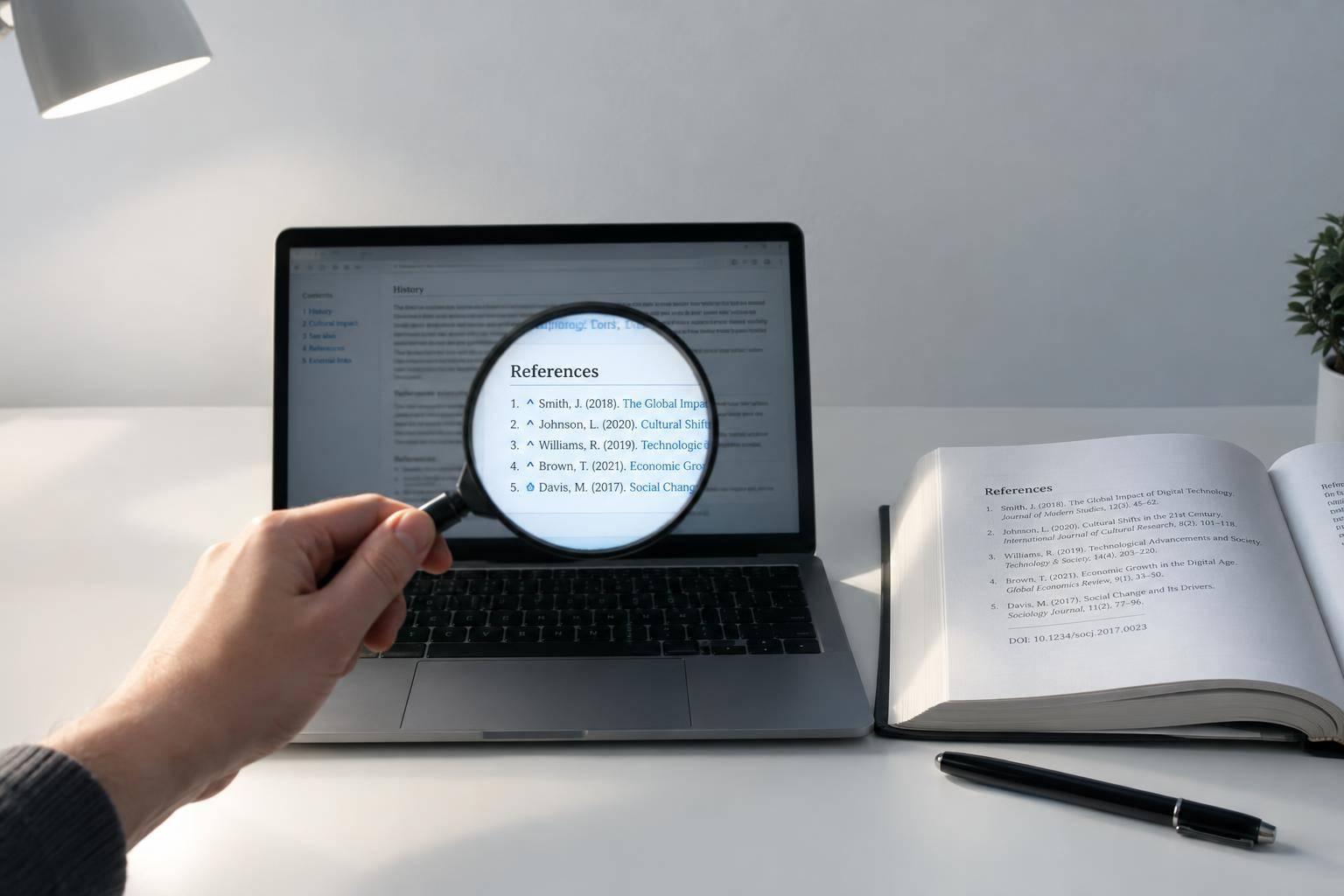
Is Wikipedia a Credible Source? When You Can and Cannot Cite It
Use Wikipedia to learn about a topic - not as the default source for a research claim. Before citing, check the assignment rules, read the sources behind the claim, and confirm that they support it.
Keep these 3 rules in mind:
- For background: Use Wikipedia to find terms, context, and sources worth reading. Volunteer review is not scholarly peer review.
- For research claims: Cite scholarly studies, official records, or other suitable sources that have been read and checked. Warnings, edit histories, and Talk pages can flag problems, but no warnings does not mean no errors.
- For Wikipedia analysis: Cite the exact revision being studied. Other uses depend on assignment or publication rules - and permission alone does not make a page enough support.
Never cite a source without reading it. For medical, legal, scientific, or fast-changing claims, check current sources suited to the field.
How to Use Wikipedia Wisely
sbb-itb-f7d34da
Why Wikipedia’s Reliability Varies
Polished writing is not proof of strong evidence. Even a long bibliography can hide gaps in coverage. A page’s reliability depends on the quality of its evidence and the accuracy of its sources - not how well it reads. The next step is deciding whether you can trust the page as evidence or use it only to find better sources.
| Research feature | Effect on reliability |
|---|---|
| Topic overviews and terminology | Helps you map a subject and find search terms, but may leave out key qualifications or use specialized language. |
| Source discovery | Footnotes lead to primary and scholarly sources, but citations may be weak, outdated, self-published, or fail to support the exact claim. |
| Open editing and changing versions | Allows fast corrections and updates, but also creates risks of vandalism, hoaxes, bias, and unstable content. |
These features make Wikipedia useful for early topic research.
How Open Editing and Community Review Work
Contributors may use pseudonyms or edit without publicly verified credentials, which can make their expertise hard to check. Wikipedia relies on volunteer discussion and consensus. Community review is not scholarly peer review, where subject specialists evaluate work through a publication’s review process. Since anyone can edit, each page still needs independent verification.
Talk pages, revision histories, and warning templates reveal disputes and known problems. Treat them as transparency tools, not proof of accuracy. Repeated reversals may point to an unresolved dispute. Protected or semi-protected pages limit who can edit to reduce disruption, but protection does not mean the content is correct.
How Sources, Missing Context, and Bias Affect Accuracy
Judge sources by their authority, date, relevance, and purpose - not their format. Check that each citation supports the exact claim it follows. This check helps you decide when Wikipedia works as background reading and when you need a source you can cite directly. The entry points you toward evidence; that evidence must support the claim.
When You Can and Cannot Cite Wikipedia
Once you’ve checked a page’s sources, decide whether you can cite Wikipedia itself.
Cite Wikipedia When Analyzing It
Cite Wikipedia when the page itself is your evidence. This includes studying its wording, structure, editorial disputes, or changes across revisions. If you’re analyzing contributor discussions or consensus, cite the Talk page. Use a permalink to the exact revision from “View history” so readers can check the version you studied.
For other uses, follow your assignment or publication rules.
Check Assignment and Publication Rules
Check the rubric or publication guidelines. Do they allow Wikipedia citations, or only its use as a research tool? Permission to cite Wikipedia doesn’t make it enough evidence for every claim.
If Wikipedia isn’t explicitly allowed, use it only to find the primary or scholarly source that supports your claim.
Use Scholarly or Primary Sources for Research Claims
Match the source to your claim: use datasets for data-based evidence, legislation for statutory wording, court decisions for rulings, and archival records for historical evidence.
Use scholarly research to explain findings and weigh competing interpretations.
For medical, legal, scientific, or fast-changing claims, check current official or field-specific sources. Medical claims usually require systematic reviews, not a single study.
How to Check Wikipedia and Find Sources to Cite
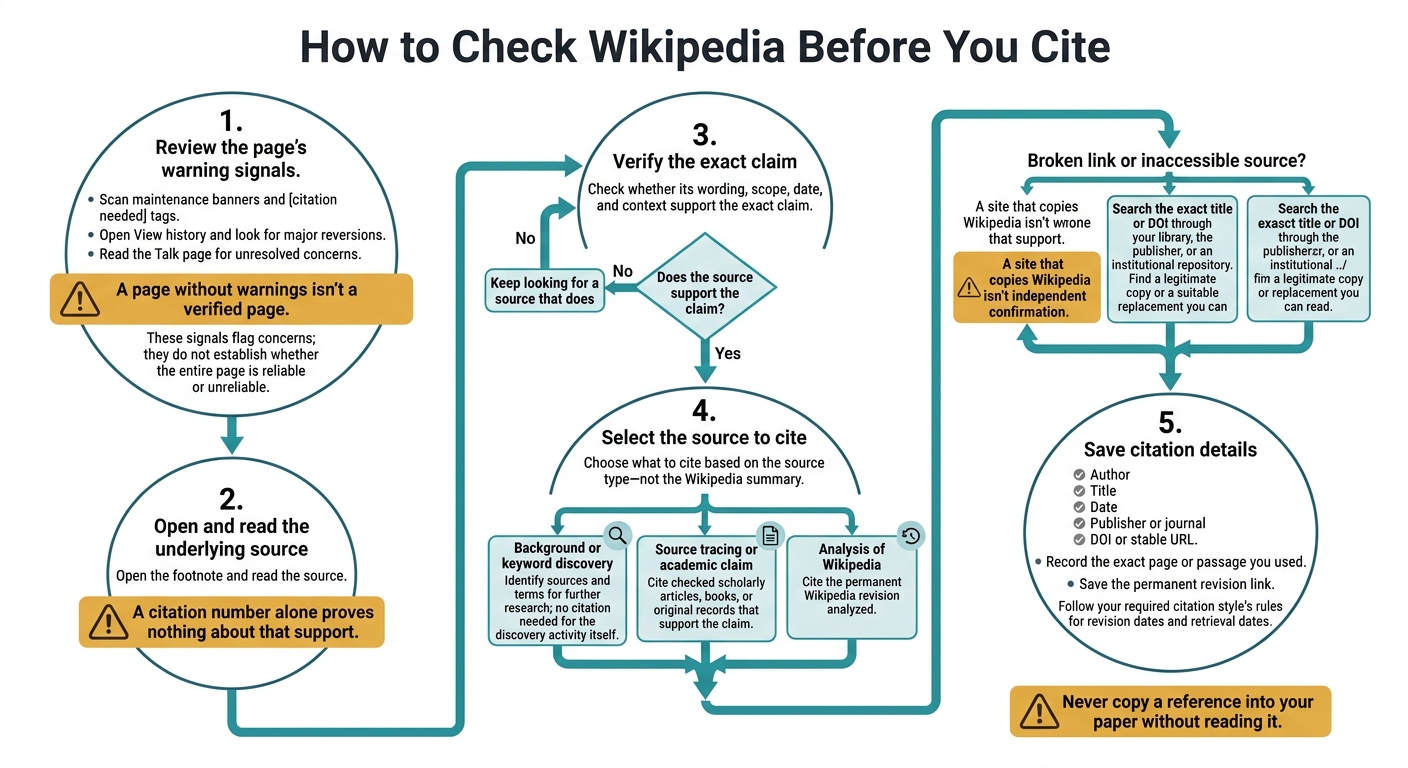
How to Check Wikipedia Before You Cite
Wikipedia can help you find sources, but check the claim before relying on it. Use these steps to see whether a page points to evidence you can cite.
Review Warnings, Citations, and Edit History
- Scan maintenance banners and
[citation needed]tags. - Open View history and look for major reversions.
- Read the Talk page for unresolved concerns.
A page without warnings isn’t a verified page. These signals help you spot claims that need checking. They don’t tell you whether the entire page is reliable or unreliable.
Read and Check the Underlying Sources
Open the footnote and read the source. Check whether its wording, scope, date, and context support the exact claim. A citation number alone proves nothing about that support.
If a reference link is broken or you can’t access it, search for its exact title or DOI through your library, the publisher, or an institutional repository. Find a legitimate copy or a suitable replacement you can read. A site that copies Wikipedia isn’t independent confirmation. And never copy a reference into your paper without reading it.
If the source doesn’t support the claim, keep looking for one that does.
Select Your Sources and Save Citation Details
Choose what to cite based on the source type - not the Wikipedia summary.
| Research use | Cite Wikipedia? | What to do | Preferred source |
|---|---|---|---|
| Background reading | No citation needed | Identify sources to check. | Relevant reference work |
| Keyword discovery | No citation needed | Collect terms for library searches. | Sources found through those searches |
| Source tracing | No | Follow footnotes and check the evidence. | Scholarly articles, books, or original records |
| Analysis of Wikipedia | Yes | Cite the revision analyzed. | Permanent Wikipedia revision |
| Academic claim | No | Cite evidence that supports the claim. | Relevant scholarly or primary sources |
Save the author, title, date, publisher or journal, and DOI or stable URL. Record the exact page or passage you used. If you’re analyzing Wikipedia itself, also save the permanent revision link. Follow your required citation style’s rules for revision dates and retrieval dates.
Conclusion: Verify Before You Cite
Wikipedia is a starting point for research, not a substitute for evidence. Cite it only when you’re analyzing the article itself or your assignment or publication rules explicitly allow it. Even then, permission alone doesn’t make it enough to support a research claim.
Before citing, check the rules, review the article, read its sources, and verify the claim. Cite only evidence you’ve consulted. If you can’t verify a claim, remove it or replace it with stronger support.
FAQs
Do I need to cite Wikipedia if I paraphrase it?
In general, avoid citing Wikipedia in academic papers or presentations, even when you paraphrase it. As a tertiary source, it’s better suited to background reading than academic evidence.
Instead, use the article’s references and footnotes to find reliable primary or scholarly sources. Check the information in those sources, then cite them directly. If your assignment explicitly allows Wikipedia citations, cite Wikipedia when paraphrasing its content.
Are Wikipedia’s featured articles more reliable?
Wikipedia’s featured articles and longer, well-developed entries generally carry more authority than short, underdeveloped pages. Its policies on neutrality, verifiability, and no original research help maintain standards. But its articles don’t undergo rigorous scholarly review.
Even well-developed articles can contain bias or errors. Read them critically rather than treating them as definitive academic evidence.
What if Wikipedia’s sources contradict each other?
When sources cited in a Wikipedia article disagree, don’t rely on Wikipedia to settle the conflict. Check the primary or secondary sources in its references and compare the evidence behind each claim.
Trace the information back to reliable original sources instead of accepting Wikipedia’s summary. In academic work, Wikipedia should serve neither as the final authority nor as primary evidence.


