What Is a Citation Index? SCI, Scopus, and Web of Science Explained
If you want the short answer: use Scopus for a broad search, Web of Science for older citation data and Journal Impact Factor, and SCIE when you need to confirm whether a science journal is in the index people still call “SCI.”
I’d sum it up like this:
- A citation index shows which papers cite other papers.
- Citation counts change by database, because each one includes a different set of journals, books, and conference papers.
- SCIE is the current version of what many people still call SCI.
- Scopus includes more source titles and strong conference coverage.
- Web of Science is more selective and goes back to 1900.
- Journal Impact Factor (JIF) comes from Web of Science / Journal Citation Reports, not Scopus.
- If I were checking a journal before submission, I’d verify it in the Clarivate Master Journal List or the Scopus Sources page.
That’s the core point of the article: pick the database based on the task, not by name alone.
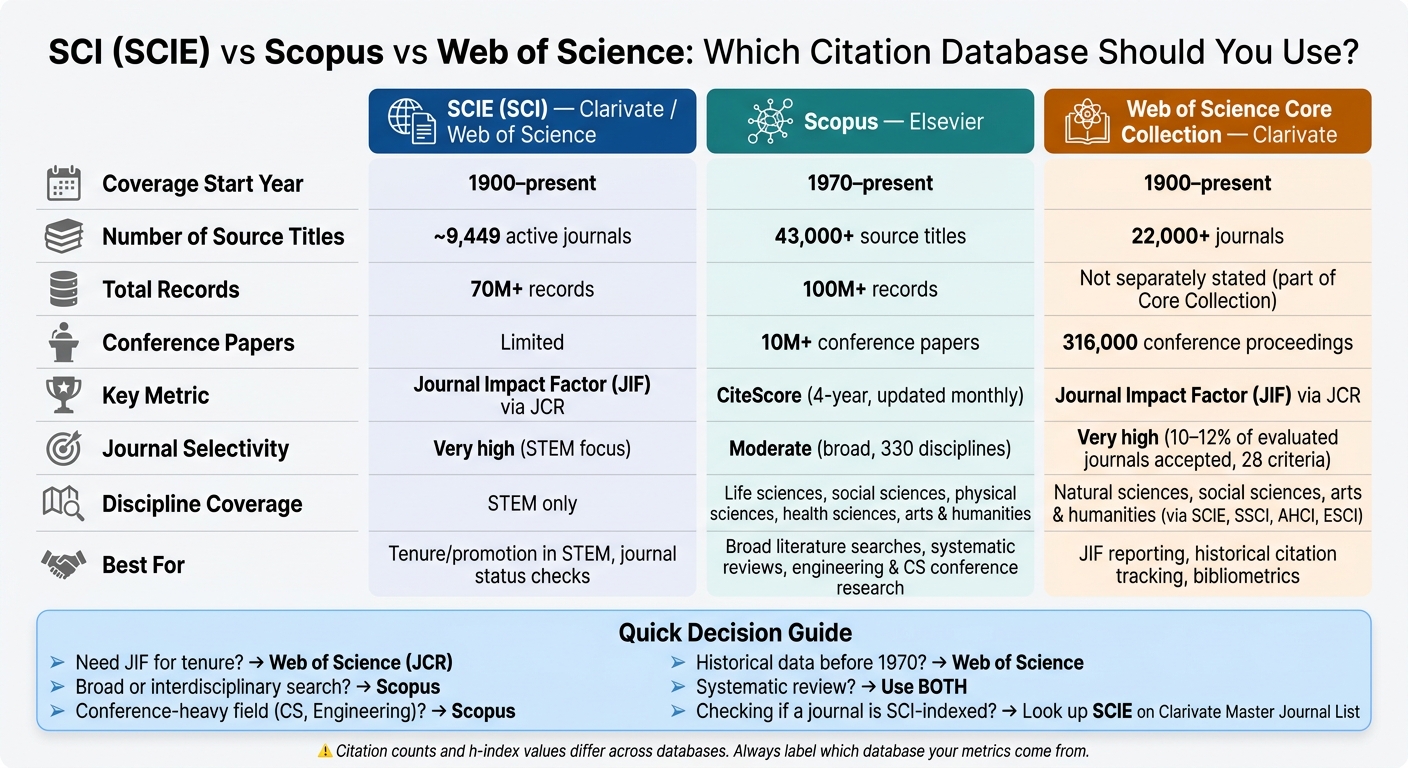
SCI vs Scopus vs Web of Science: Citation Database Comparison
Scopus vs Web of Science: Which Research Tool is Right for You?

Quick Comparison
| Database | Best for | Time coverage | What stands out |
|---|---|---|---|
| SCIE (SCI) | Science journal checks, tenure files in STEM | 1900–present | About 9,449 active journals and tied to JIF |
| Scopus | Broad literature searches, conference-heavy fields | 1970–present | 43,000+ source titles, 100M+ records, 10M+ conference papers |
| Web of Science | JIF, older citation tracking, selective journal review | 1900–present | 22,000+ journals in Core Collection, strict screening |
If you’re comparing journals, authors, or citation totals, I’d keep one rule in mind: don’t mix numbers from different databases without labeling them. A Scopus h-index and a Web of Science h-index can differ a lot.
The rest of the article explains where each database fits, what each one counts, and how to avoid common mistakes when you check indexing status or report citation metrics.
1. Science Citation Index (SCI)
SCI started in 1964. Today, the current version is Science Citation Index Expanded (SCIE), a Clarivate index inside the Web of Science Core Collection. In everyday use, most people still say SCI when they mean SCIE. So if you're checking whether a journal is SCI-indexed, SCIE is the database to look at.
SCIE covers STEM subjects, with strong coverage in engineering, chemistry, biology, physics, medicine, computer science, environmental science, and materials science. As of 2026, it indexes 9,449 active journals and more than 70 million records, with coverage going back to 1900. That's a huge archive, and it's a big reason SCIE still sits at the center of citation-based evaluation.
The main metric linked to SCIE is the Journal Impact Factor (JIF), which Clarivate publishes each year in Journal Citation Reports (JCR). Because SCIE is selective, many universities and funding bodies treat it as a benchmark for tenure, promotion, and grant review.
One point trips people up: a journal can be in Web of Science without being in SCIE. For example, the Emerging Sources Citation Index (ESCI) includes journals that meet quality standards but haven't yet shown enough citation impact for SCIE inclusion. If you want to confirm a journal's current status, use the Master Journal List at mjl.clarivate.com. Indexing can change over time.
Next, Scopus gives you a broader cross-discipline view, with different coverage and different citation counts.
2. Scopus
Scopus is a curated abstract and citation database launched by Elsevier in 2004. It covers 330 disciplines across life sciences, social sciences, physical sciences, health sciences, and arts and humanities. In plain English, it casts a broader net than SCI and includes more source types, with strong coverage of conference papers. That matters a lot in applied sciences, engineering, social sciences, and fast-moving fields where research often shows up first outside standard journal articles. Today, Scopus indexes more than 43,000 source titles, contains over 100 million records, and tracks 2.4 billion cited references.
Scopus tracks citations from 1970 onward. It also includes more than 10 million conference papers, which is a big plus for computer science and engineering researchers. In those fields, conferences are often the main place where new work appears. If you want to confirm whether a journal or other source is covered, use the Scopus Sources page.
For journal metrics, Scopus uses CiteScore, a 4-year metric updated monthly through CiteScore Tracker. It also counts all document types, unlike Journal Impact Factor, which uses a 2-year window. On the Scopus Sources page, you can check CiteScore, SJR, and SNIP. Full access requires a subscription.
Scopus Author ID helps separate researchers who have similar names. That makes it useful when you need a cleaner author profile or want to track h-index over time. Many researchers also use Scopus data when putting together files for promotion or tenure review. If you include a Scopus h-index on your CV, label it clearly as a Scopus h-index. It often comes out higher than the Web of Science version because Scopus covers more sources. Web of Science follows a different selection model and citation profile, so comparing the two can be helpful.
sbb-itb-f7d34da
3. Web of Science
Web of Science (WoS) is Clarivate's curated citation database. It’s more selective than Scopus. Only about 10–12% of evaluated journals make it into its core indexes: SCIE, SSCI, and AHCI. WoS reviews journals against 28 criteria tied to quality and impact before indexing them. Put simply, it has the toughest journal screening of the three.
The Core Collection indexes more than 22,000 journals article by article, along with 160,000 books and 316,000 conference proceedings. WoS also includes citation data going back to 1900, while Scopus starts at 1970. That longer timeline makes a big difference when you want to trace how an idea changed over many decades.
Core Collection indexes are grouped by field:
| Index | Discipline Focus | Approx. Journal Count |
|---|---|---|
| SCIE | Natural Sciences, Engineering, Biomedical | ~9,400 |
| SSCI | Social Sciences, Economics, Psychology | ~3,500 |
| AHCI | Arts, Humanities, Literature, History | ~1,800 |
| ESCI | All disciplines (newer journals that meet quality standards) | ~7,800 |
Those index differences shape what you find in search results, how citation counts look, and how visible a journal is on the platform.
One detail trips people up all the time: ESCI journals do not receive a Journal Impact Factor. So if your institution asks for JIF, make sure the journal is listed in SCIE or SSCI. The easiest way to check is Clarivate’s free Master Journal List, which shows a journal’s current status and exact index before you submit a manuscript.
For metrics, WoS is the only source for the Journal Impact Factor, published through Journal Citation Reports (JCR). The JIF uses a 2-year citation window. Researchers also use InCites for institutional benchmarking and Citation Reports to pull group stats like total citations, average citations per item, and h-index for a search set.
If your institution requires JIF, or if you need citation data from before 1970, WoS is the better fit. Those strengths and limits matter in the comparison below.
Pros and Cons of Each Database
No single database is best at everything. Each one makes trade-offs between broad coverage and tight selection, and that matters a lot once you know your goal. A database that works well for tenure review may not be the best fit for a systematic review or a student literature search.
Put simply: these databases trade breadth for selectivity, so the right pick depends on the job.
The biggest differences come down to coverage, selectivity, and access to metrics.
| Database | Pros | Cons | Ideal User / Task |
|---|---|---|---|
| SCIE (often still called SCI) | Widely used in journal evaluation; strict journal screening; selective by design | Very selective; may miss niche or regional journals; limited to science disciplines | Tenure, promotion, and grant review in STEM |
| Scopus | Broad multidisciplinary coverage; strong conference paper indexing; large source count | Citation coverage starts in 1970; may include lower-selectivity sources | Students; interdisciplinary researchers; systematic reviews; engineering and computer science researchers |
| Web of Science | Widely used in journal evaluation; historical depth back to 1900; strong author and institution disambiguation; strict quality control | Narrower coverage than Scopus; less intuitive for new users; subscription costs can be significant | Bibliometricians; faculty building tenure dossiers; researchers needing JIF or pre-1970 citation data |
One small but important detail: CiteScore is publicly visible, while JIF requires Journal Citation Reports.
That difference can shape what you can check fast versus what sits behind a paywall. If you're comparing journals on a deadline, that matters.
For systematic reviews, searching both Scopus and Web of Science is usually the better move because each one picks up citations the other misses. The same issue shows up with author metrics. h-index values vary across platforms because each database indexes a different set of documents.
Conclusion
Put simply, the main takeaway is this: match the database to the job.
No single citation index gives you the whole story. Scopus casts a broader net, while Web of Science is more selective and goes back further in time. Because of that, citation counts and author metrics can change from one database to another.
| Task | Best Starting Point |
|---|---|
| Broad search | Scopus |
| Historical tracking | Web of Science |
| Journal Impact Factor for tenure review | Web of Science (via Journal Citation Reports) |
| Conference papers | Scopus |
| Systematic reviews | Both Scopus and Web of Science |
Use that as your starting rule. Then check counts inside the same database you plan to cite or report.
Citation counts are database-specific, not absolute. Treat each database's numbers as signals based on that database's own coverage, not as universal measures of impact. In citation work, scope matters as much as count.
FAQs
Why do citation counts differ across databases?
Citation counts differ because each database works from its own rules. It chooses which journals to index, what types of documents to include, and how to classify them.
Scopus often casts a wider net. It usually includes more journals and conference proceedings. Web of Science Core Collection, by contrast, uses tighter editorial screening.
There’s another layer too: databases don’t process citations the same way. They match references differently, and they handle document types and author metadata in their own way. That means the same paper - or the same author - can end up with different citation counts depending on where you look.
How can I verify whether a journal is SCI or SCIE indexed?
Check the official Clarivate Master Journal List to confirm whether a journal is indexed in SCIE.
Don’t rely only on the journal’s own website. That information can be out of date or plain misleading. Instead, search the journal title in the Clarivate Master Journal List to confirm its current status and make sure it appears in SCIE, not a different Web of Science collection such as ESCI.
Which database should I use for my research goal?
First, check your institution’s requirements. Some organizations ask for specific indexes for tenure reviews or grant reporting.
Use Web of Science Core Collection when you need selective, curated evaluation or Journal Impact Factor metrics. Use Scopus when you want broader cross-disciplinary coverage. For biomedical research, use PubMed/MEDLINE.
Before you decide, confirm a journal’s current status with official lookup tools such as the Master Journal List or Scopus Sources.