How to Cite an Equation (APA, MLA, IEEE) With Examples
If you borrow an equation, cite the source right next to it. That rule stays the same in APA, MLA, and IEEE. What changes is the citation format: APA uses author-year-page, MLA uses author-page, and IEEE uses bracketed numbers.
Here’s the short version:
- Copy the equation exactly? Use “From” and cite the source.
- Change the equation? Use “Adapted from” and cite the source.
- Keep the citation close to the displayed equation.
- Define every variable near the equation.
- Add the source to your reference list, Works Cited, or IEEE references.
- Use equation numbers instead of saying “the formula above” or “below.”
About 3 main style systems show up in this guide, but the core rule is the same in 100% of them: if the formula came from a source, you need to give credit.
Quick Comparison
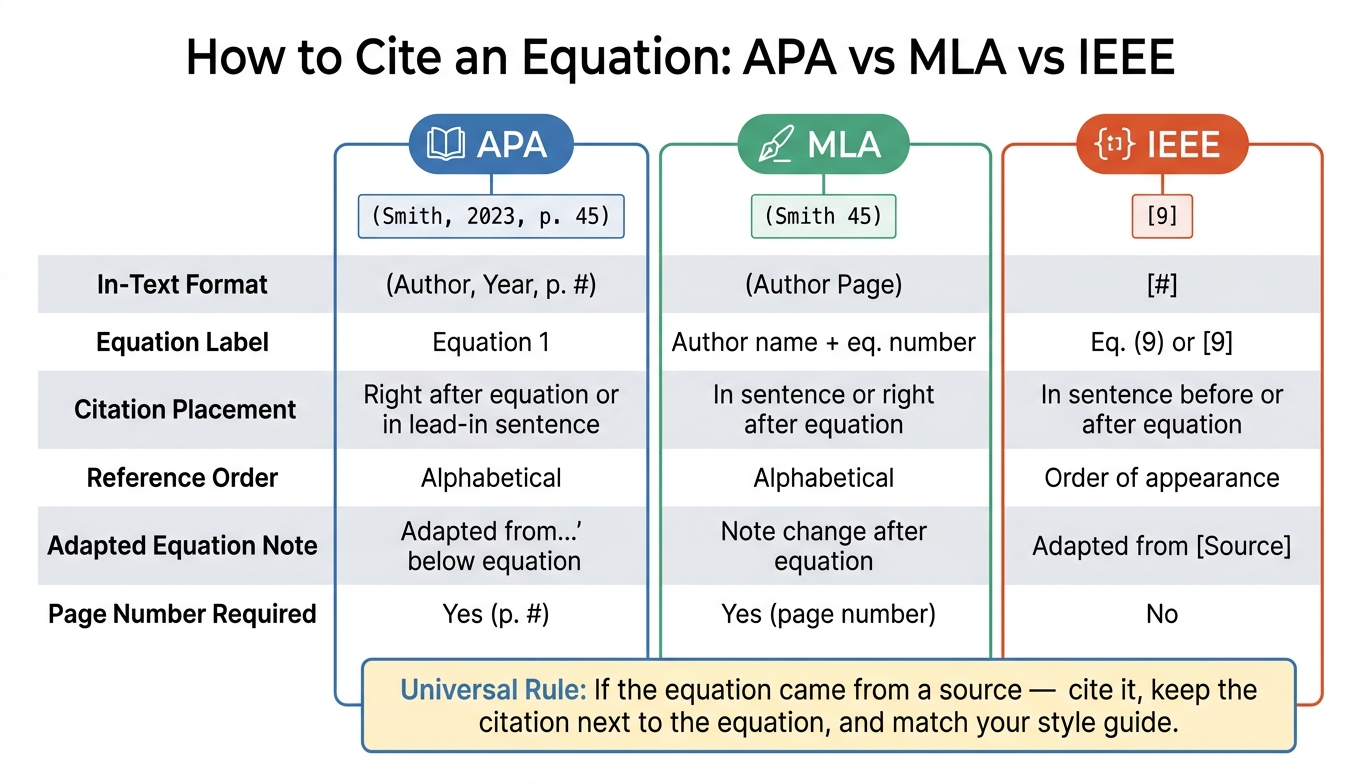
APA vs MLA vs IEEE Equation Citation: Quick Comparison Guide
| Style | In-text format | Best place for the citation | Reference section order |
|---|---|---|---|
| APA | (Author, Year, p. #) | Right after the equation or in the sentence with it | Alphabetical |
| MLA | (Author Page) | In the sentence or right after the equation | Alphabetical |
| IEEE | [#] | In the sentence before or after the equation | Order of appearance |
A few mistakes cause most problems: missing page numbers in APA, forgetting “Adapted from” after changes, and mixing one style’s in-text citation with another style’s reference list. That’s what you want to avoid.
If I had to sum up the whole article in one line, it would be this: cite the source document, keep the citation next to the equation, and match the rules of your style guide every time.
General Rules Before Applying APA, MLA, or IEEE
A few ground rules apply no matter which citation style your paper uses. If you get these parts right first, the style-specific stuff is much easier in the next sections.
Where to Place Citations Around an Equation
For both reproduced and adapted equations, keep the citation close to the formula. Put it in the lead-in sentence or in the sentence right after the equation.
Treat a displayed equation as part of the sentence around it. That means it should end with a period if the sentence ends there, or a comma if the sentence keeps going. If your style uses equation numbers, label them in sequence and refer to them by number throughout the paper.
Define each variable right after the equation.
The same rule applies to the source entry: cite the document that contains the equation.
What to Include in the Source Entry
After placing the citation, record the source in the reference list or Works Cited.
Cite the source document itself, such as a journal article, textbook, conference paper, or report. Gather the author, year, title, publication, volume and issue, page range, and DOI or URL.
If the source gave the equation its own number, mention that number in your prose when it helps readers find the formula faster. Your reference list entry should be a standard entry for the source document. There’s no special format for citing an equation instead of a table or figure from the same publication.
How to Cite an Equation in APA Style
Once the general rules are set, APA adds author-date citations plus a page number for reproduced equations.
APA In-Text Citations for Reproduced and Adapted Equations
If you reproduce an equation exactly, put the citation right after the equation or after its equation number. For example:
$KE = \frac{1}{2}mv^2 \tag{1}$
"The formula for kinetic energy is $KE = \frac{1}{2}mv^2$ (Smith, 2020, p. 45)."
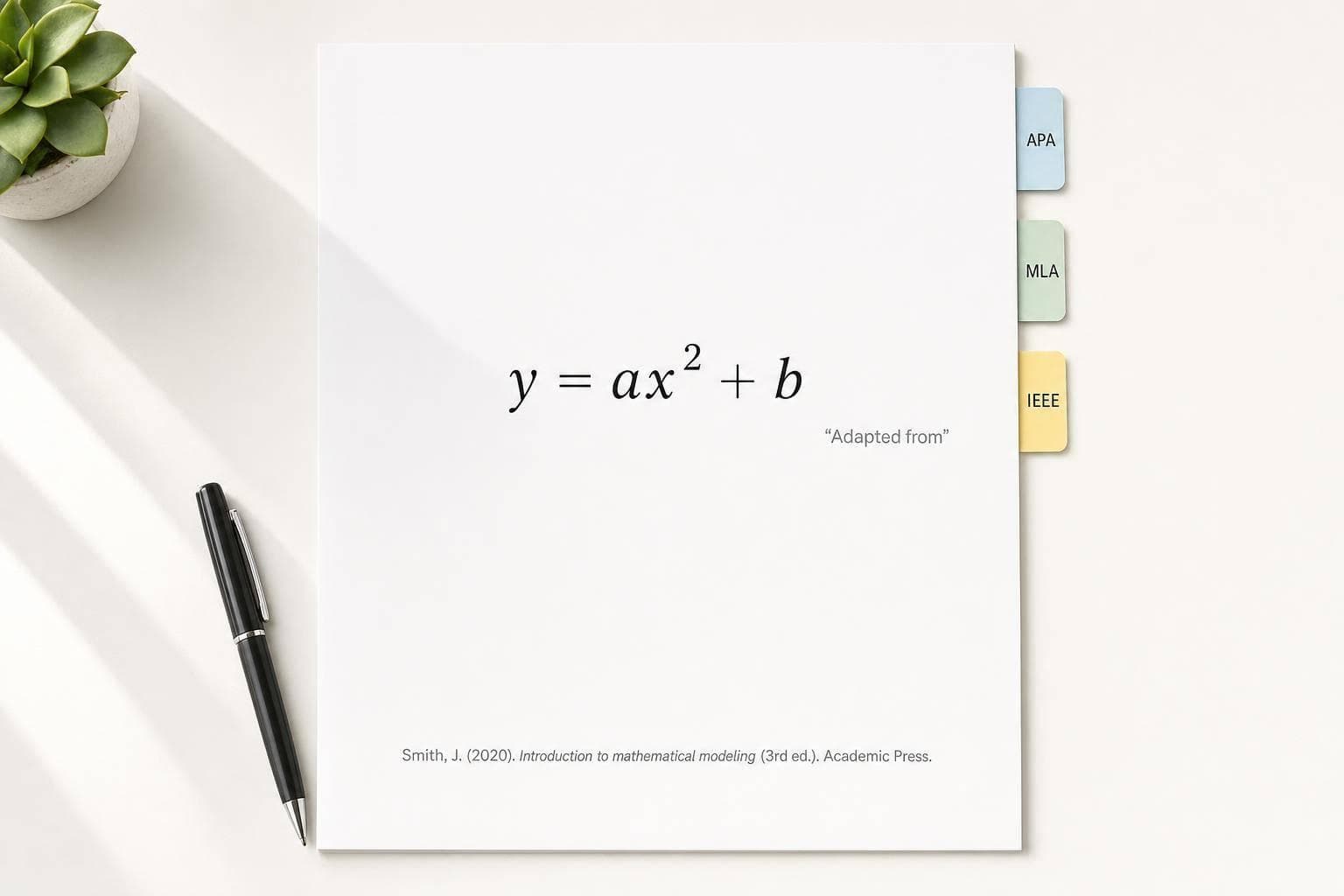
If you adapt an equation, work the source into the sentence instead. For example: "The model is adapted from Smith (2020, p. 45)."
In running text, write Equation 1. Use equation only when it starts a sentence.
APA Equation Numbering and Reference List Examples
APA also follows standard formatting for displayed equations. Center the equation and put its number flush right in parentheses. Number equations in the order they appear in your paper.
For the reference list, use the normal entry for the source that contains the equation. Here’s a journal article example:
| Source Type | Reference List Example |
|---|---|
| Journal Article | Shi, F., & Zhu, L. (2019). Analysis of trip generation rates in residential commuting based on mobile phone signaling data. Journal of Transport and Land Use, 12(1), 201–220. |
Place a Note directly below the displayed equation. Start with "From…" if the equation is copied exactly, or "Adapted from…" if you changed it. Then include the author, year, source, and page number. Add any required permission note after the source details.
sbb-itb-f7d34da
How to Cite an Equation in MLA and IEEE
MLA: Author-Page Citations, Equation Labels, and Works Cited Entries
MLA uses author-page citations, so equation references work the same way. If you reproduce an equation, mention the author in the sentence and put the page number after the equation. For example: "Johnson derives the heat transfer rate as $q = hA(T_s - T_\infty)$ (Johnson 47)." You can also mention the equation in running text, like this: "Johnson's equation (3)."
For the Works Cited entry, start with the authors' names. For instance, Rainville, Earl D., and Phillip E. Bedient. Then add the usual source details. If you adapt an equation instead of copying it exactly, note the change right after the equation.
IEEE: Numbered Equations, Bracketed Citations, and Reference Entries
IEEE uses numbered references, so equation citations are shorter and more direct. Cite the source in the sentence before or after the equation with a bracketed number, such as. If you need to point to a specific equation in a source, combine the source number and equation number in one reference: [eq. (17)]. At the start of a sentence, write: Equation shows…
A journal article reference in IEEE looks like this: G. Sanico and M. Kakinaka, "Terrorism and deterrence policy with transnational support", Def. Peace Econ., vol. 19, no. 2, pp. 153–167, Apr. 2008.
APA vs. MLA vs. IEEE: Side-by-Side Comparison
The main difference between these styles isn't the equation itself. It's where the source details show up.
| Feature | APA | MLA | IEEE |
|---|---|---|---|
| In-text citation | (Author, Year, p. #) | (Author Page) | [#] |
| Equation label | Equation 1 | Author's name + equation number | Eq. (9) or |
| Bibliography order | Alphabetical | Alphabetical | Order of appearance |
Common Mistakes and a Final Checklist
Mistakes That Cause Citation Problems
Once you’ve set your citation format, the main thing that can go wrong is simple: mislabeling the equation or leaving out the source. A borrowed formula needs a citation just like borrowed text, data, or figures.
A few other slipups show up all the time.
Don’t cite by position. Avoid phrases like “above” or “below.” Use the equation number instead.
Label every adapted equation. If you changed a formula, mark it as “Adapted from”.
Two more issues often show up during revisions: mixing citation styles and forgetting to add bibliography entries for equations added at the last minute. Before you submit, check the reference list one more time.
The table below pulls the most common problems into one fast review.
| Common Mistake | Why It's a Problem | Fix |
|---|---|---|
| Citing by position ("the formula above") | Layout changes break the reference | Use the equation number ("Eq. 3") |
| No "Adapted from" label | Implies the formula is an exact copy | Add "Adapted from [Source]" |
| Style mixing (APA in-text + IEEE references) | Inconsistent formatting signals careless work | Pick one style and apply it throughout |
FAQs
Do I need to cite a common equation?
You don't need to cite equations that are standard in your field and widely known.
But you do need to cite any equation that isn't common knowledge, or any equation you borrowed, reproduced, or adapted from another source.
And here's the part people sometimes miss: even if you change or rework an equation, you still need to credit the original source.
What if I only change part of an equation?
If you change part of an equation, you still need to cite the original source. The reason is simple: the original work is still the basis for what you’re showing. Even if you revise it, use the standard bracketed citation format, such as [5, eq. (14)].
The same rule applies to figures and other visual elements. If you alter the original item, add a note at the end of the caption saying that you modified the source material.
Are equations from textbooks and reports cited the same way?
Yes. Equations from textbooks and reports follow the same basic citation rules as other sources.
Add an in-text citation where the equation appears, and include the full source in your reference list. Then format it based on the style you're using, such as APA, MLA, or IEEE.