
Predatory Journals: How to Spot Them and Check Before You Cite
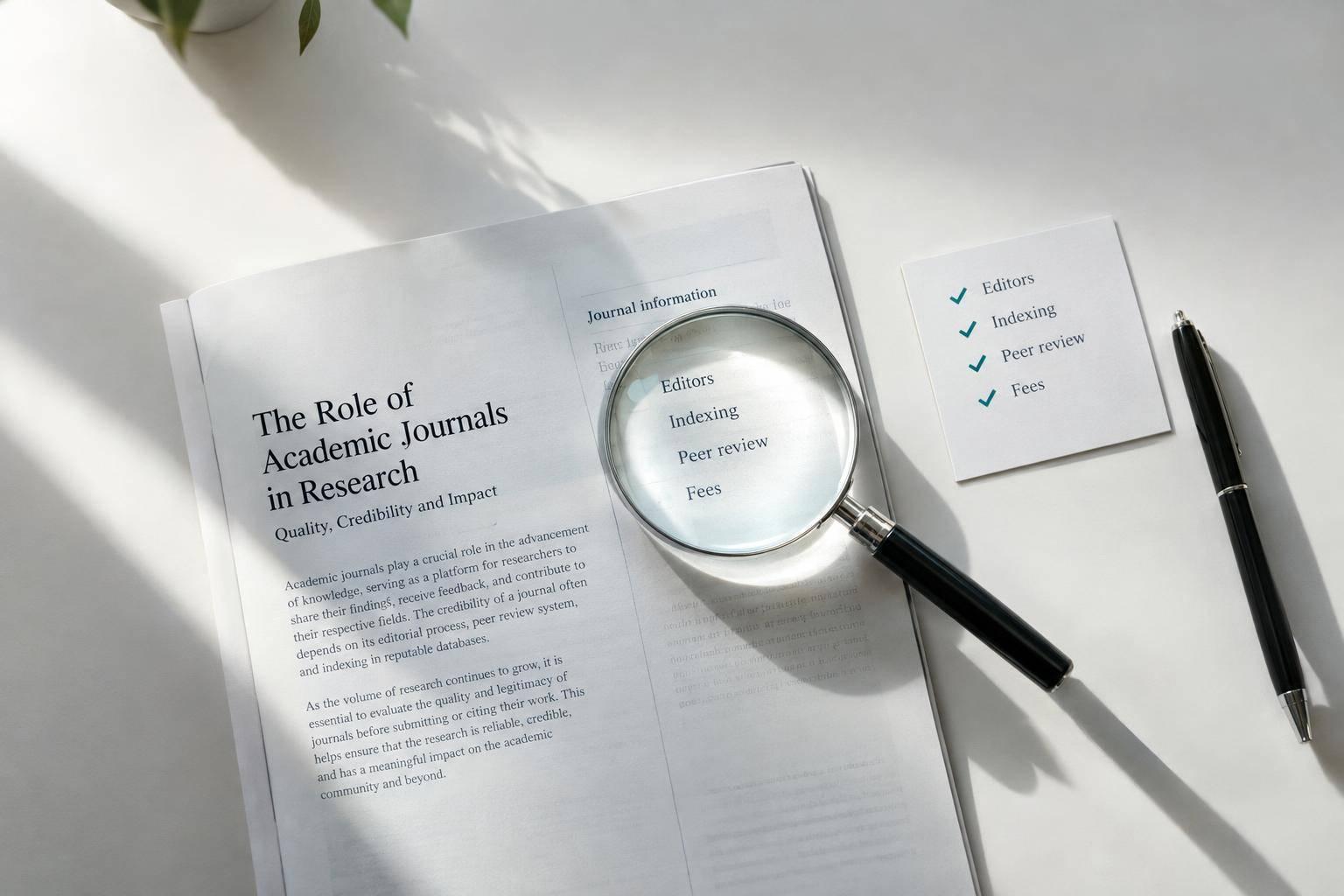
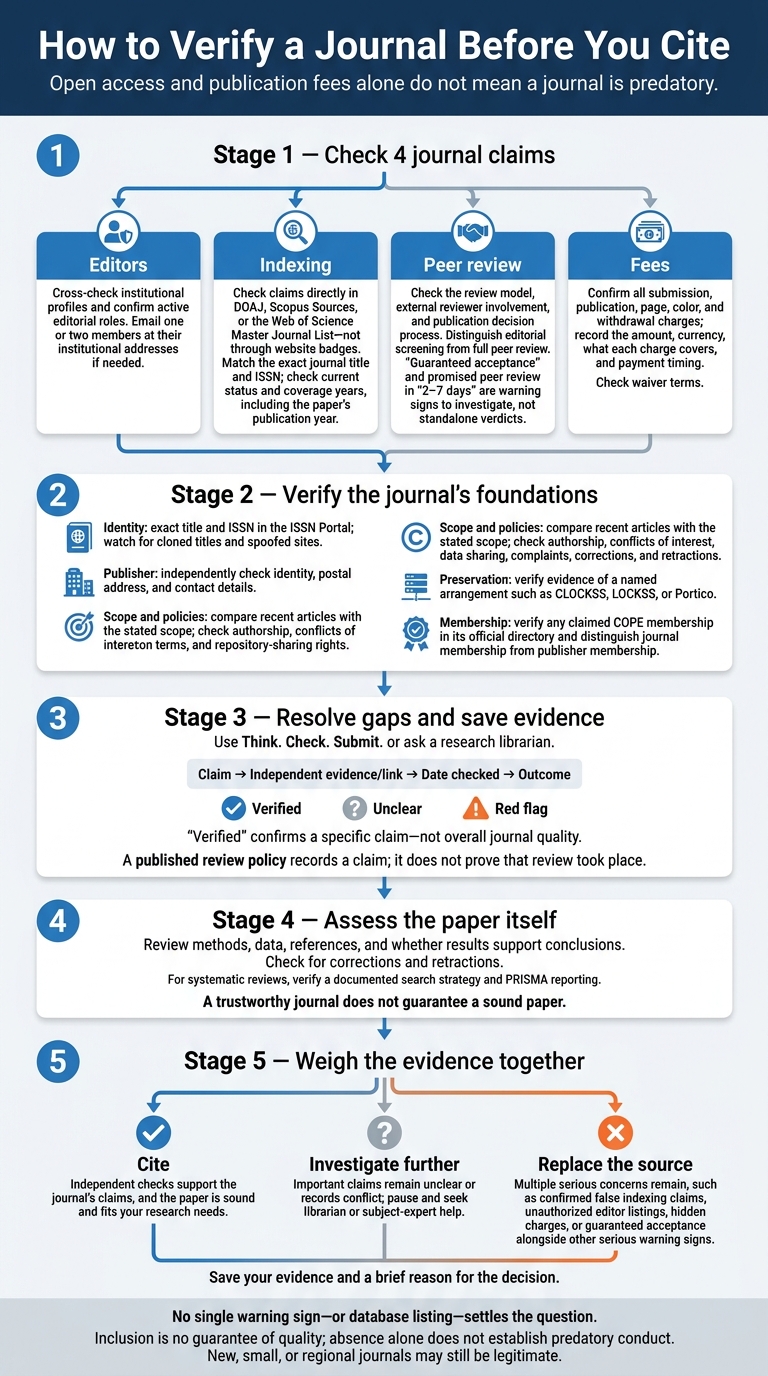
Before citing a paper, check 4 journal claims: editors, indexing, peer review, and fees. Confirm editors’ roles through their institutions and indexing claims directly in DOAJ, Scopus Sources, or the Web of Science Master Journal List - not through website badges.
Open access and publication fees alone do not mean a journal is predatory. Instead, look for a pattern of false claims, hidden charges, or promised acceptance.
- Check the basics: Verify the journal’s identity, publisher, policies, licensing, and long-term preservation.
- Resolve gaps: Use Think. Check. Submit. or ask a research librarian, and save dated records.
- Assess the paper: Review its methods, data, conclusions, and any corrections or retractions.
Then decide whether to cite, investigate further, or replace the source. No single warning sign - or database listing - settles the question.
How to Verify a Journal Before You Cite
How to Spot Predatory Journals & Conferences - Tips to Protect Your Research
sbb-itb-f7d34da
Journal Warning Signs to Investigate
Caution: New, small, or regional journals may still be legitimate. Judge the pattern, not one flaw or badge.
Check each journal’s claims before you cite its articles.
Editors and Journal Details You Cannot Verify
Cross-check each editorial board member against an institutional profile. Email one or two members at their institutional addresses to confirm they’re actively serving. Some journals list scholars without their consent.
Look up the journal’s ISSN in the ISSN Portal, and watch for cloned titles or spoofed sites. Verify the publisher’s street address and institutional email address. A contact form alone isn’t enough.
Acceptance Promises, Hidden Fees, and False Indexing Claims
Promises of guaranteed acceptance or peer review in 2–7 days are red flags. Check who reviews manuscripts and how the journal makes publication decisions.
Before submitting, confirm the article processing charge (APC), including the amount, currency, and payment timing. Don’t rely on website logos as proof of indexing. Check the indexing records directly, making sure the journal’s title and ISSN match. Treat unfamiliar impact metrics as unsupported claims.
Missing Policies and Inconsistent Content
Once the basic checks are done, compare the journal’s public policies with what it publishes. Look for policies on authorship, conflicts of interest, data sharing, corrections, and retractions. Missing policies - or ones you can’t access - leave important questions unanswered.
Scan a recent issue to see whether the articles fit the journal’s stated scope. A broad scope is fine; unexplained mismatches are not.
Printable Checklist: Verify a Journal Before Citing
Use the warning signs above to document your checks before citing a journal.
Check each box only after verifying the item. Save a link or record, enter November 14, 2026, and mark the outcome verified, unclear, or red flag. “Verified” means that specific claim checks out - not that the journal’s quality is guaranteed.
Refer to these same records if a claim is unclear or inconsistent.
Check Journal Identity, Publisher, and Peer Review
☐ Title and ISSN: Record the exact journal title and ISSN listed in the ISSN Portal.
Records/links: ________ | Date: ________ | Outcome: ________
☐ Scope statement: Save the journal’s scope statement.
Records/links: ________ | Date: ________ | Outcome: ________
☐ Publisher identity: Record the publisher’s name and a postal address you can check independently.
Records/links: ________ | Date: ________ | Outcome: ________
☐ Publisher contacts: Record contact details that identify who runs the journal.
Records/links: ________ | Date: ________ | Outcome: ________
☐ Editors: Record editors’ names, confirmed affiliations, and evidence of their editorial roles.
Records/links: ________ | Date: ________ | Outcome: ________
☐ Review process: Record the peer-review model, whether external reviewers take part, and the stated timeline. Distinguish editorial screening from full peer review.
Records/links: ________ | Date: ________ | Outcome: ________
Check Fees, Licensing, and Archiving
Open access and fees alone do not indicate predatory practice. Record the stated currency exactly; use $1,500.00 for U.S. dollars. For currency conversions, include the exchange-rate source and conversion date.
☐ All author charges: Record any submission, publication, page, color, and withdrawal charges. Note what each charge covers and when payment is due.
Amounts/links: ________ | Date: ________ | Outcome: ________
☐ Waivers: Record who qualifies and when to apply, or save an explicit statement that no waivers are available.
Records/links: ________ | Date: ________ | Outcome: ________
☐ Copyright and licensing: Record the copyright owner, exact license, author-retention terms, repository-sharing rights, and deadline for signing an agreement.
Records/links: ________ | Date: ________ | Outcome: ________
☐ Long-term preservation: Record a named preservation arrangement, such as CLOCKSS, LOCKSS, or Portico, and evidence that it covers the journal.
Records/links: ________ | Date: ________ | Outcome: ________
Verify Indexing and Membership Claims
Check the official directories below rather than relying on website badges. Match the exact title and ISSN, record current status and coverage years, and note whether membership applies to the journal or its publisher.
Weigh multiple signals. Inclusion is no guarantee of quality, and absence alone does not establish predatory conduct. An inclusion claim without supporting evidence needs a closer look.
☐ DOAJ: Check claimed inclusion against DOAJ and record what you find.
Matching record/status/years: ________ | Link: ________ | Date: ________ | Outcome: ________
☐ Scopus Sources: Record active or discontinued coverage in Scopus Sources. Check whether coverage includes the paper’s publication year.
Matching record/status/years: ________ | Link: ________ | Date: ________ | Outcome: ________
☐ Web of Science: Record the specific citation index and available coverage details in the Master Journal List.
Matching record/index/years: ________ | Link: ________ | Date: ________ | Outcome: ________
☐ COPE: Verify claimed Committee on Publication Ethics membership in its official directory.
Member name/status: ________ | Link: ________ | Date: ________ | Outcome: ________
Check Editorial Responsibilities and Policies
☐ Responsibilities and ethics: Save policies covering editorial duties, reviewer expectations, conflicts of interest, and how the journal handles complaints or corrections.
Records/links: ________ | Date: ________ | Outcome: ________
Use Think. Check. Submit. for Unresolved Questions
Use Think. Check. Submit. to work through any uncertainty left after your checks.
Review Journal Fit and Unanswered Questions
If a checklist item remains unclear, use Think. Check. Submit. to decide whether the journal is reliable enough to cite. Check whether the paper fits the journal’s scope, and search trusted databases for journals with similar titles. An unfamiliar name alone is not evidence of misconduct.
Use Check to revisit unresolved claims about the publisher, peer review, fees, policies, memberships, or indexing. Keep verifiable facts separate from promises of prestige or speed. Use Submit - here meaning cite - only after confirming the key answers.
Pause if an indexing claim remains unresolved or an acceptance promise seems implausible. A research librarian can help you sort out conflicting records or unfamiliar metrics.
Record Claims, Sources, and Decisions
Add a brief decision log to your existing records, focusing only on unresolved claims. Distinguish independent confirmation from the journal’s own statements: a published review policy records a claim; it does not prove that review took place.
Save official records, policy links, the date you checked them, and any unanswered questions. Ownership and indexing status can change. Use this log to decide whether to cite, pause, or replace the source.
| Claim to resolve | Independent evidence to save | Decision |
|---|---|---|
| Journal website is genuine | ISSN record and matching publisher details | Verified / Unclear / Red flag |
| Named editor holds the stated role | Institutional profile or direct confirmation | Verified / Unclear / Red flag |
| Claimed indexing covers the paper | Official database record and coverage dates | Verified / Unclear / Red flag |
Conclusion: Cite, Investigate, or Replace the Source
Choose Whether to Cite or Seek Another Source
After completing the checklist, decide whether to cite the source. Weigh the evidence together. No single listing, omission, fee, or open-access status determines quality. Cite only when independent checks support the journal’s identity, publisher, review process, policies, and indexing claims - and the paper fits your research needs.
If you’re still unsure, ask a research librarian or subject expert. Replace the source if multiple serious concerns remain.
Review the Paper and Save Your Checks
Even if the journal passes your checks, review the paper itself. A trustworthy journal does not guarantee a sound paper. Examine the methods, data, and references, and check whether the results support the conclusions. Look for corrections and retractions, too. For systematic reviews, verify that the search strategy is documented and follows PRISMA guidelines.
Use this table to guide your decision - not as a scoring system.
| Supports trust | Needs caution | Supports replacement |
|---|---|---|
| Claimed inclusion confirmed directly in DOAJ, Scopus Sources, or the Web of Science Master Journal List | New or specialized journal lacks major-index coverage | Confirmed false indexing claims |
| Editors’ roles independently verified | Editors’ roles remain unclear | Researchers listed as editors without their knowledge |
| Fees and licensing terms disclosed upfront | Fee information is incomplete | Fees revealed only after acceptance |
| Clear peer-review and correction policies | Review process is vaguely described | Guaranteed acceptance alongside other serious warning signs |
Keep a record of your checks so you can explain your decision later. Save database results, journal records, fee disclosures, the review date, and a brief reason to cite, pause, or replace the source. Run these checks before relying on a questionable paper in an assignment, literature review, or manuscript.
FAQs
Can I cite a credible paper from a questionable journal?
Use extreme caution. A paper in a questionable journal isn’t automatically invalid. But these journals often skip rigorous peer review, so research quality and ethical oversight may fall short.
Before citing the paper, examine its methods and how openly it explains the study design. Check whether reliable, peer-reviewed sources support its findings. If you can’t verify the paper’s quality, choose a more reliable source to protect the integrity of your work.
What if journal indexing records conflict?
Conflicting indexing claims are a serious warning sign. Check them by searching the journal’s title in official resources such as DOAJ, the NLM Catalog for MEDLINE, or Scopus Sources.
False claims are a major red flag, but mismatches may stem from indexing delays or curation still in progress. Even reputable indexes can include predatory journals. Look at several signals, including editorial transparency, fees, and peer-review quality.
What should I do if I already cited a predatory journal?
Don’t panic. Start by checking multiple independent sources, such as the Directory of Open Access Journals, Scopus Sources, or the Web of Science Master Journal List. A journal’s presence or absence in any one listing isn’t conclusive.
If those checks confirm your concerns, ask your institutional librarian how the citation might affect your work. Keep a record of your findings and, if needed, explain the source’s reliability in future research or updates.
Related posts
- Scholarly Sources: What Counts, What Does Not, and Where to Find Them
- What Are Scholarly Journal Articles? How to Identify Them and Where to Find Them
- Peer-Reviewed Sources: Definition, Examples, and How to Check a Source Is Peer Reviewed
- How to Know If a Source Is Credible: 8 Questions to Ask Before You Cite It


