
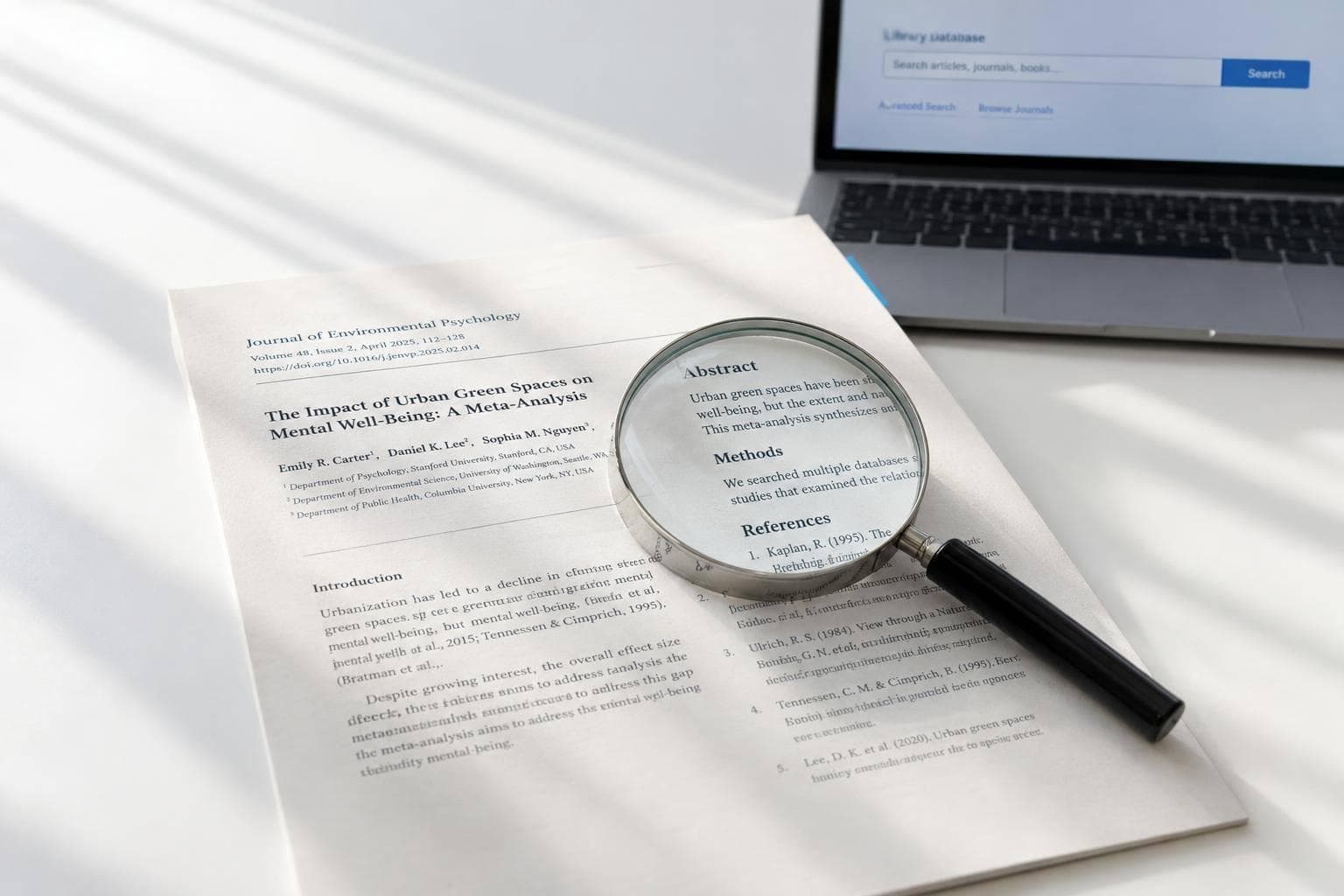
What Are Scholarly Journal Articles? How to Identify Them and Where to Find Them
Scholarly journal articles are papers written by subject experts to share research, review studies, or explain theories. When I check one for an assignment, I start with its authors, references, and article type - not just the journal’s name.
Here’s my approach:
- Find sources: Search Google Scholar, library databases, PubMed, DOAJ, or Sourcely.
- Check the article: Look at the authors’ backgrounds, research methods, citations, and journal policies. Scholarly doesn’t always mean peer-reviewed.
- Get the full text: Use library access, open-access copies, or interlibrary loan - not just an abstract.
- Verify before citing: Match the file to its citation, check its version and any corrections or retractions, and confirm that it meets your assignment’s rules.
My rule: <u>read the full article before citing it</u>. A DOI, search filter, or journal listing alone doesn’t tell you whether a source fits your assignment.
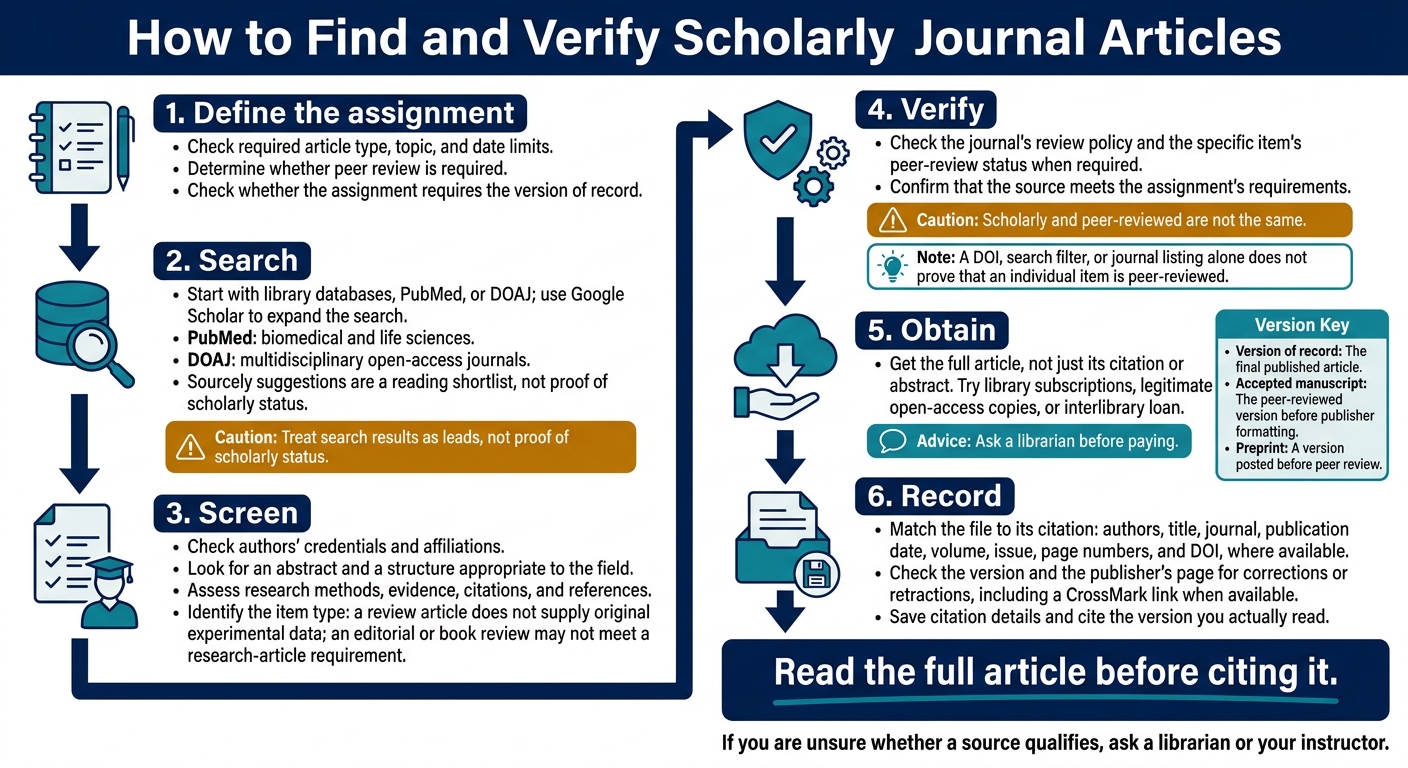
How to Find and Verify Scholarly Journal Articles
How to identify a scholarly journal article
Identifying these articles is the first step in learning how to find relevant sources for your literature review.
sbb-itb-f7d34da
How to Identify Scholarly Journal Articles
Once you know what scholarly writing looks like, use these checks to screen a source.
Scholarly Articles vs. Popular Articles
Look at several clues together - not just one feature. Compare the article’s purpose, evidence, language, and publication details.
| Feature | Scholarly articles | Popular articles |
|---|---|---|
| Audience | Researchers, scholars, and students | General public |
| Author credentials | Subject-matter experts; affiliations usually listed | Journalists, freelancers, or staff writers |
| Purpose | Present research, analyze ideas, or review scholarship | Inform, entertain, or provide general summaries |
| Language | Field-specific terms | Mostly everyday language |
| Publication venue | Academic or research journal | Magazine, newspaper, or general-interest website |
| Evidence | Research data, documented analysis, or synthesis of studies | Reported facts and summaries, usually without formal citations |
| Citations | Formal citations and references | Few or no formal citations |
| Editorial process | Usually peer reviewed | Staff edited |
These are screening clues, not fixed rules.
If the article passes this first check, take a closer look at its authors, structure, and sources.
Check Authors, Article Structure, and Sources
Check whether the authors’ credentials and affiliations match the subject. Look for an abstract and a structure that fits the field: Methods/Results/Discussion in the sciences and social sciences, or introduction/literature review/body in the humanities.
Next, check whether the citations support the main claims and fit the article’s purpose. A DOI helps you locate an article; it does not prove scholarly status or peer review.
If the article looks scholarly, check the journal and your assignment requirements next.
Verify Journal Details and Assignment Requirements
Look for a clear review policy on the journal’s homepage, editorial board page, and “Information for Authors” page. These details help you check the journal, but they do not establish whether a specific item was peer reviewed. Ask a librarian if that item’s status is still unclear.
Start by identifying the item. Then confirm the authorship and journal, verify peer review if your assignment requires it, and check topic and date limits. Even a reliable source may not qualify:
A review article does not supply original experimental data, and a preprint may lack completed peer review.
Match the source to the assignment’s exact wording before counting it toward your required sources.
Where to Find Scholarly Journal Articles
These tools can help you find scholarly sources that fit your assignment. Treat search results as leads, not proof of scholarly status. Check the article type, journal, and access status separately.
| Tool | Subject coverage | Search controls | Peer-review signal | Full-text access |
|---|---|---|---|---|
| Google Scholar | Broad, cross-disciplinary | Exact phrase, author, and date searches; “Cited by” links | No peer-review check | Links to publisher pages and other available copies; many results are paywalled |
| University library databases | General or subject-specific | Author, title, subject terms, Boolean operators, and filters | Peer-reviewed filters usually apply at the journal level | Library subscriptions often provide access |
| PubMed | Biomedical and life sciences | Publication type, date, language, and full-text filters | Indexing and MEDLINE status do not prove peer review | Links to publisher sites and free copies in PubMed Central |
| DOAJ | Multidisciplinary open-access journals | Journal- and article-level searches | Journals are vetted for inclusion; each article still needs review | Indexed content is open access |
Google Scholar and library databases cast a wide net. PubMed and DOAJ focus your search by field or access model.
Search Google Scholar and University Library Databases
In Google Scholar, put exact phrases in quotation marks, narrow results by author or date, and follow “Cited by” links to find newer related work.
In library databases, search specific fields and combine terms with AND or OR. Subject terms from relevant records can help you refine your search. Apply scholarly filters, but still check the article type, journal details, and access links.
Search PubMed and DOAJ
Use PubMed for biomedical and life-science research. Filter results by publication type, date, or language. Full-text filters help you find accessible papers, but a PubMed record doesn't always include free full text. Look for a PubMed Central (PMC) or publisher link. MEDLINE status applies at the journal level; it doesn't prove that an individual article was peer-reviewed.
The Directory of Open Access Journals (DOAJ) lists open-access journals across subjects. Search for articles or check a journal's listing, then assess each paper's evidence and fit for your assignment. Free access alone doesn't mean a paper meets your requirements.
Use Sourcely to Find Research Sources
Paste your draft into Sourcely to find related research and spot claims that need support. Use the available filters, read summaries, download PDFs when available, and export references.
Treat its suggestions as a reading shortlist. Compare each summary with the original article, check the exported citation details, and confirm peer-review status through the journal. Sourcely helps you find sources; it isn't final proof of scholarly status.
How to Access and Check the Full Text
Once you find a likely scholarly source, make sure you can read the full article, not just its citation or abstract. A citation lists the article’s metadata, while an abstract gives a short summary. Full text includes the complete article, from the body to the references. Finding a citation doesn’t mean you have access to the article. Before using the full text, check that it matches the citation.
Use Library Subscriptions and Interlibrary Loan
Open the article through your library’s website, your school login, or a library link to subscribed content. If you’re off campus, follow your library’s login instructions.
Can’t get access? Ask a librarian before paying. Interlibrary loan may let you get a scan from another library, typically within 1 to 5 business days.
Find Open-Access Copies and Check Article Versions
Look for legitimate copies on the publisher’s page and in institutional or subject repositories. Check the version label:
- Version of record: The final published article.
- Accepted manuscript: The peer-reviewed version before publisher formatting.
- Preprint: A version posted before peer review.
Your assignment may require the version of record, not a preprint or accepted manuscript. Cite the version you actually read. A DOI helps identify the publication, but it doesn’t prove that a downloaded file is the version of record.
Match the Full Text to Its Citation
Compare the file with the citation to confirm that you have the right article and version. Check the authors, title, journal, publication date, volume, issue, page numbers, and DOI, where available.
An accepted manuscript may not have the final formatting. Check its repository record against the publisher’s details. Also check the publisher’s page and any correction or retraction link, such as CrossMark. An older PDF may not show later corrections or retractions.
Before citing the article, check its type, publication details, access route, and version against your assignment requirements. An editorial or book review doesn’t necessarily meet a requirement for a peer-reviewed research article just because it appears in a scholarly journal.
Conclusion: A Scholarly-Source Checklist
Scholarly and peer-reviewed are not the same. Some scholarly articles aren't peer-reviewed. Peer-reviewed journals also publish editorials, letters, and book reviews. Check the item itself - not just the journal.
Before citing a source, follow this checklist: Define the assignment, search, screen, verify, obtain, and record. Start with library databases, PubMed, or DOAJ, then use Google Scholar to expand your search.
Get the full text and save its citation details. Read the entire article before citing it rather than relying on an abstract or summary alone.
If you're still unsure whether a source meets the assignment's requirements, ask a librarian or your instructor before including it in your paper.
FAQs
How can I spot a predatory journal?
Watch for poor transparency, weak editorial practices, and aggressive solicitation. Other red flags include unusually fast peer review, vague or overly broad journal scopes, editorial boards you can’t verify, names that mimic well-known journals, and unclear fees.
If you’re unsure, search the journal’s title alongside “predatory publisher” or check whether it appears in the Directory of Open Access Journals.
How recent should my scholarly sources be?
How recent your sources need to be depends on your assignment and field of study. There’s no single rule. Fast-changing fields like science and medicine often call for current sources, while historical research may rely on older primary texts.
Check the publication dates of both the article and the research it cites to judge relevance and accuracy. Library database filters can help you narrow your search to recent findings.
What if two scholarly articles disagree?
Disagreement is a normal part of academic research. Studies build on existing knowledge, and researchers work through debates with further investigation. To weigh conflicting findings, compare each study’s methods, sample size, and data collection techniques to see which approach has stronger support. Check other trusted sources to understand the claim’s history, and trace quotes or data back to their original source so you can assess them accurately.


