

Scholarly vs Popular Sources: How to Tell the Difference (With Examples)
Scholarly sources present research and analysis for academic readers. Popular sources explain topics for general readers. To tell them apart, check the audience, author, review process, references, language, structure, publisher, and purpose - not just how polished the writing looks.
For example, Journal of Educational Psychology publishes peer-reviewed research, while Psychology Today explains research for general readers. An expert author doesn’t make an article peer-reviewed. Check the journal’s policy and the individual article type.
Quick Comparison
| What to check | Scholarly sources | Popular sources |
|---|---|---|
| Audience and purpose | Academic readers; research and analysis | General readers; news and explanations |
| Authors | Usually subject experts | Journalists, staff writers, or experts |
| Review process | Research articles commonly receive peer review | Usually editorial review |
| Supporting sources | Formal citations and references | Links or informal mentions |
| Language and structure | Often technical; research sections vary | Usually plain language and narrative |
| Publisher | Academic journals or university presses | Newspapers, magazines, or websites |
Use popular coverage for background and leads to studies. For academic claims, check the original research, its limits, and any corrections or retractions. Follow assignment rules: scholarly doesn’t always mean peer-reviewed, and peer-reviewed doesn’t mean error-free.
Scholarly vs Popular Sources
sbb-itb-f7d34da
Scholarly vs Popular Sources: Main Differences
| Feature | Scholarly sources | Popular sources | What to check |
|---|---|---|---|
| Audience | Researchers, scholars, and students | General readers | Does it assume subject knowledge? |
| Authorship | Subject experts with relevant affiliations | Staff writers, journalists, or freelancers | Does the author have relevant credentials? |
| Review process | Research articles commonly undergo peer review | Editorial review | Is the review process stated? |
| Citations | Formal references | Informal mentions or links | Can you trace the evidence? |
| Language | Specialized terms and formal analysis | Accessible explanations | Are technical terms explained? |
| Structure | Methods, results, and discussion in empirical studies | Narrative or informal sections | Are the methods explained? |
| Publication venue | Academic journals or university presses | Newspapers, magazines, or general-interest websites | Who publishes it, and who reads it? |
| Purpose | Build knowledge through research or analysis | Inform, entertain, or sell products | Does it present research or explain a topic? |
Read these cues together - not as a scorecard. They help you decide whether to use a source as evidence or background reading. The next two subsections show how these cues appear in scholarly and popular writing.
Scholarly Sources: Written for Academic Readers
In empirical studies, the methods should explain how researchers collected evidence. The results and discussion explain what they found and how they interpreted it. But scholarly articles don’t all follow the same format: a missing Methods heading doesn’t rule one out.
Popular Sources: Written for General Readers
Popular articles often explain topics in accessible language, using a narrative or informal structure instead of a research-report format. A polished design or references to studies don’t make an article scholarly or peer-reviewed.
Peer Review vs Professional Editing
Peer reviewers assess methods, evidence, and conclusions. Professional editors focus on clarity, style, and fact-checking.
Check both the journal’s review policy and the individual article’s label. Editorials, letters, and book reviews may not undergo peer review - even when they appear in a peer-reviewed journal. A database “peer-reviewed” filter flags the journal, not every item it publishes.
The next section compares a peer-reviewed journal article with a general-audience piece.
Examples: Journal of Educational Psychology vs Psychology Today
Both articles discuss quizzing, but only one reports original research. Comparing them shows which cues to look for.
| What to check | “Test-Enhanced Learning in the Classroom: Long-Term Improvements From Quizzing” | “Why Quizzing Yourself Is the Best Way to Learn” |
|---|---|---|
| Review status | Peer-reviewed research article | Not peer-reviewed; edited by magazine staff |
| Structure and language | Abstract, methods, statistical results, and discussion | Conversational explanation, not a research article |
| Supporting evidence | Formal citations and reference list | Links to underlying research |
| Best use in academic writing | Evidence about classroom quizzing within the study’s limits | Background and leads to original research |
Scholarly Example: A Study of Classroom Quizzing
“Test-Enhanced Learning in the Classroom: Long-Term Improvements From Quizzing”, by Henry L. Roediger III, Pooja K. Agarwal, Mark A. McDaniel, and Kathleen K. McDermott, examines whether classroom quizzing improves later performance. It reports participants and procedures, statistical results, and a formal reference list.
Start with the DOI page to check the title, authors, journal, and review policy. Then assess the claim using the study’s methods, results, and limits. One classroom study doesn’t support claims about all quizzing. Use it as evidence for what the study tested and found, rather than for broad claims about quizzing in general.
Popular Example: A Psychology Today Article
“Why Quizzing Yourself Is the Best Way to Learn”, by Nate Kornell, Ph.D., was published in Psychology Today on April 26, 2011. It explains learning research for general readers rather than reporting original research.
Check Kornell’s author biography for relevant expertise, but keep credentials separate from review status. An author’s expertise doesn’t make an article peer-reviewed. Use this piece for background, then follow its links to the original study for evidence you can cite.
How to Classify a Source Before Citing It
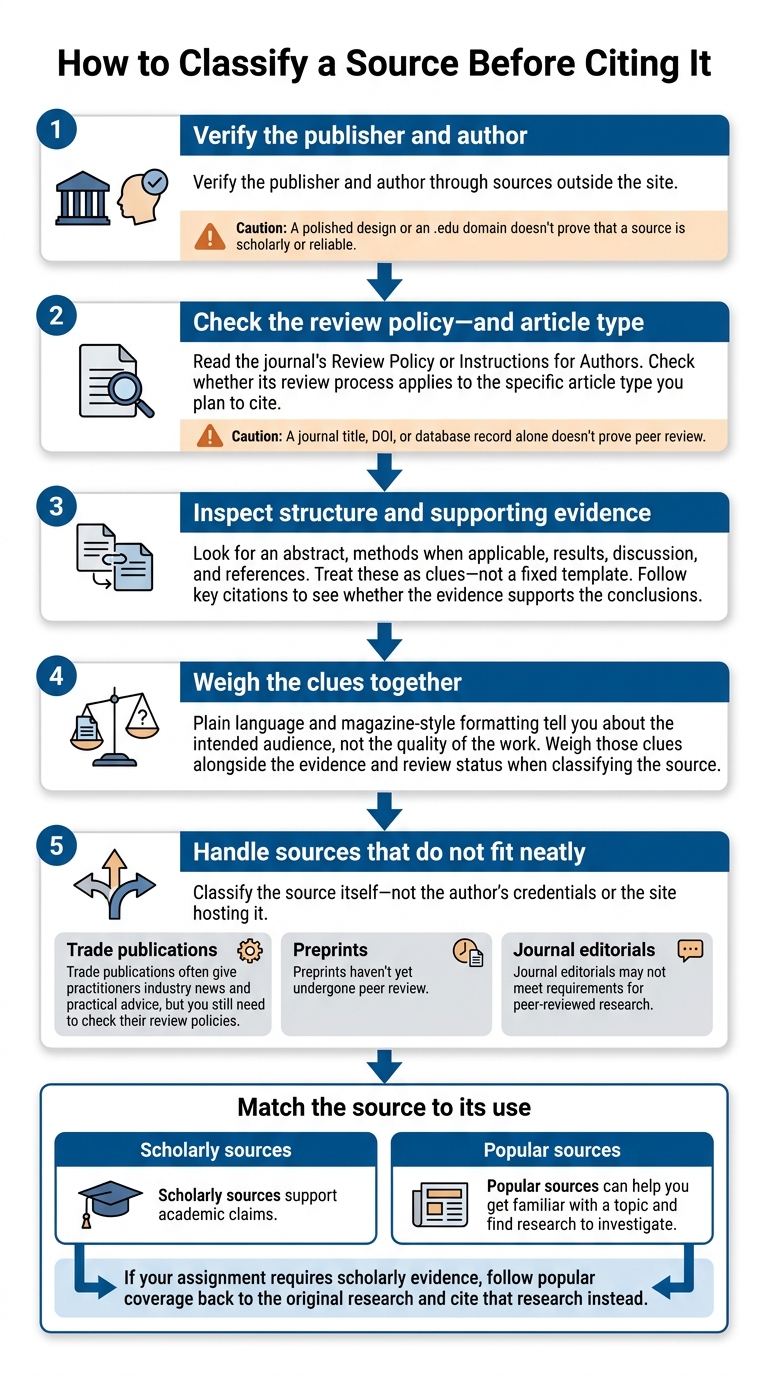
How to Classify a Source Before Citing It
Before you cite a source, use the journal-vs-magazine examples above to check what kind of source you’re working with.
Check the Publisher, Author, and Review Policy
Verify the publisher and author through sources outside the site. A polished design or an .edu domain doesn’t prove that a source is scholarly or reliable.
Read the journal’s Review Policy or Instructions for Authors. Check whether its review process applies to the specific article type you plan to cite. A journal title, DOI, or database record alone doesn’t prove peer review.
Check the Research Structure and Supporting Evidence
Look for an abstract, methods when applicable, results, discussion, and references. Treat these as clues - not a fixed template. Follow key citations to see whether the evidence supports the conclusions.
Plain language and magazine-style formatting tell you about the intended audience, not the quality of the work. Weigh those clues alongside the evidence and review status when classifying the source.
Classify Sources That Do Not Fit Neatly
Classify the source itself - not the author’s credentials or the site hosting it. Trade publications often give practitioners industry news and practical advice, but you still need to check their review policies. Preprints haven’t yet undergone peer review, and journal editorials may not meet requirements for peer-reviewed research.
If your assignment requires scholarly evidence, follow popular coverage back to the original research and cite that research instead. Scholarly sources support academic claims, while popular sources can help you get familiar with a topic and find research to investigate.
Conclusion: Match Sources to Your Research Needs
Use the cues from the examples above to classify a source, weighing several indicators together. Scholarly status tells you the source type - not its quality. Popular sources can still provide useful context and point you toward studies.
Use Scholarly Research for Academic Claims
Use scholarly research for central arguments, literature reviews, theoretical frameworks, research findings, and statistical claims. Follow your assignment’s peer-review requirements, but also check the study’s methods, relevance, and publication date. Before relying on a finding, check the article page for corrections or retractions.
Use Popular Sources for Background and Leads to Studies
Popular sources like Psychology Today can help you learn terminology, get background information, and find studies. Before citing any research findings, check each claim against the original study. Make sure the study’s conclusions support the popular article’s interpretation.
FAQs
Can I use a popular article as a primary source?
Popular articles usually aren’t primary research sources, but they can help you learn about a topic, follow current events, and gather background information.
If your instructor requires evidence-based research or peer-reviewed literature, use scholarly sources to support your arguments. You can use both: popular sources to get started and scholarly sources for evidence that backs up your claims.
What if I can’t verify an article’s peer-review status?
If you can’t confirm an article’s peer-review status, don’t treat it as scholarly or peer-reviewed. Check the author’s credentials and institutional affiliation. Look for an abstract, citations, and formal, discipline-specific language. These clues can help, but none confirms peer review on its own.
Try locating the journal with a peer-reviewed filter. If its status remains unclear, use the article only for general background - not as academic evidence.
How should I handle conflicting scholarly findings?
Use the SIFT method to weigh conflicting findings. Check the authors’ credentials and institutional affiliations, look for agreement among reputable researchers, and trace claims back to the original studies and their methods. Then examine each study’s logic, internal consistency, and possible biases to judge which findings have the strongest support from the evidence.


