
Secondary Sources: Definition and 15 Examples (and How They Differ From Primary)
Secondary sources analyze, interpret, or combine primary evidence. To classify a source, check how it supports the research question: an original study provides primary evidence; a review of studies offers secondary analysis.
This guide covers 15 source types:
- History textbooks
- Scholarly review articles
- Systematic reviews
- Meta-analyses
- Biographies
- Historical monographs
- Literary criticism
- Scholarly book reviews
- Encyclopedia entries
- Research-based documentaries
- Legal commentaries
- Policy analyses
- Art criticism
- Music criticism
- News analyses
The label depends on use - not format or quality. A biography usually offers secondary analysis, but it becomes primary evidence when the book itself is being studied. Encyclopedia entries are usually tertiary, and some sources mix original material with analysis.
Before citing, check the author, methods, references, and publication date. Cite secondary authors for their interpretations, and consult the original material when a claim depends on its exact wording or findings.
"What is a Secondary Source?": A Shapiro Library Short
sbb-itb-f7d34da
What Is a Secondary Source?
A secondary source analyzes, interprets, or combines primary evidence. Primary sources provide original evidence; secondary sources explain what it means for your research question. To tell them apart, look at what the author uses as evidence.
Check the author’s purpose and references to earlier work. Are they presenting new evidence or examining evidence from others? Comparisons, critiques, and efforts to bring earlier findings together can point to a secondary source.
Publication date may offer a clue, but it doesn’t determine the source type. Your research question - not the source’s format - guides how you classify it. Use a work as a secondary source when you need its interpretation, or as a primary source when the work itself is your evidence. The next section shows how this difference works in practice.
Primary vs. Secondary Sources
Primary sources provide original evidence. Secondary sources explain or synthesize that evidence.
| Feature | Primary sources | Secondary sources |
|---|---|---|
| Purpose | Provide firsthand evidence or original data. | Interpret or synthesize primary evidence. |
| Relationship to evidence | Directly address the research question with evidence. | Sit one step removed from the original evidence. |
| Typical forms | Diaries, speeches, original data, research studies, and artworks. | Textbooks, biographies, review articles, and literary criticism. |
| Research uses | Support original analysis and provide direct testimony. | Offer context and interpretation. |
A source’s category can change depending on how you use it. The rules also vary by field:
In the sciences, original research articles are primary sources; in literature, creative works can serve as primary sources.
The research question - not peer review or publication date - determines the source type.
A peer-reviewed original study is primary; a peer-reviewed review article is secondary.
Before citing a source, check who wrote it, its purpose, its limits, and the evidence behind it. Apply these rules to sort the 15 examples that follow.
How Your Research Question Determines Source Type
Primary vs. Secondary Sources: How Your Research Question Changes the Label
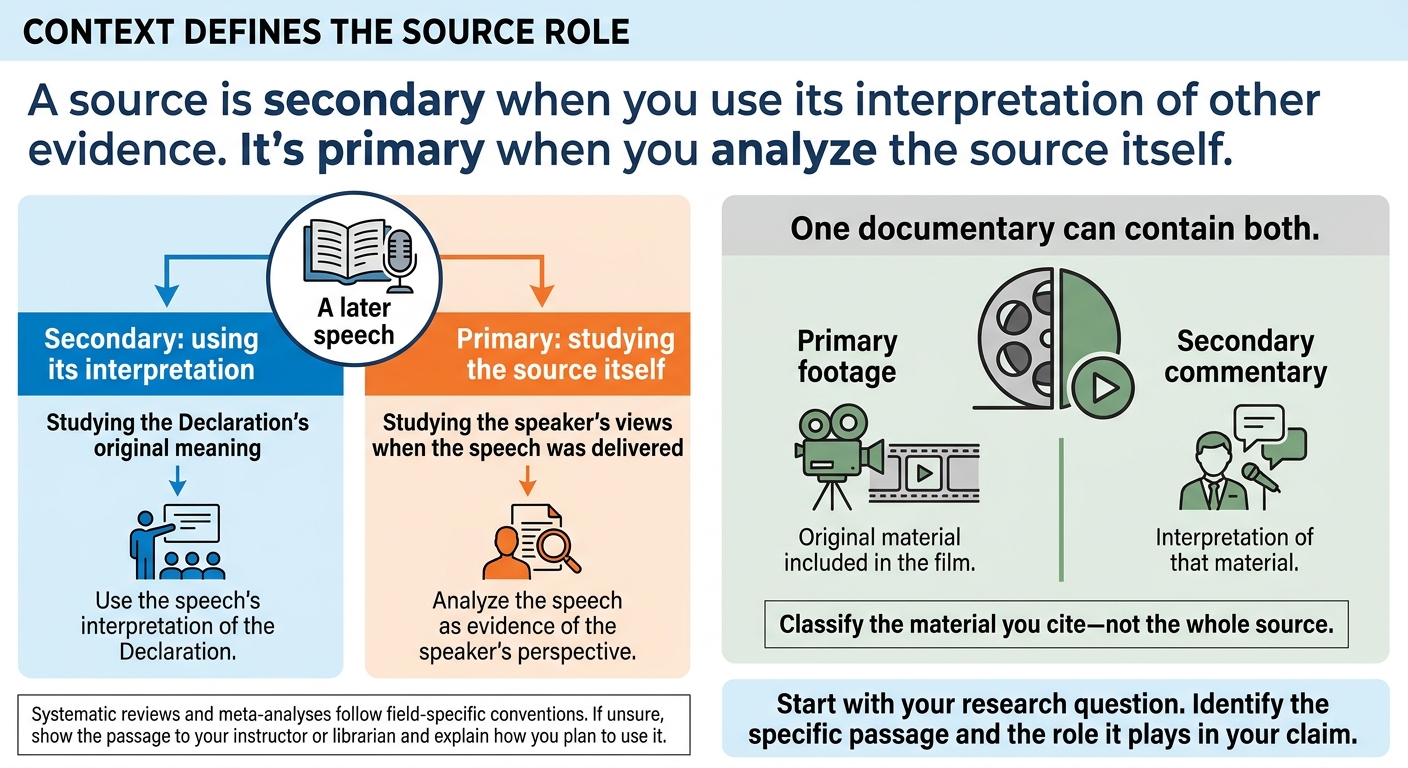
A source is secondary when you use its interpretation of other evidence. It’s primary when you analyze the source itself. Studying an author’s language, assumptions, or perspective makes the source primary evidence. Using it to explain another document makes it secondary.
A later speech is secondary for studying the Declaration’s original meaning, but primary for studying the speaker’s views when the speech was delivered.
Classify the material you cite - not the whole source.
A documentary can contain both primary footage and secondary commentary.
In your notes, name the part that supports your claim instead of giving everything one label. The examples below show how this works across disciplines.
Systematic reviews and meta-analyses follow field-specific conventions. If you’re unsure how to classify a passage, show it to your instructor or librarian and explain how you plan to use it. Apply this test to the source types that follow.
1. History Textbooks
History textbooks turn historical evidence and scholarship into overviews for students. They are secondary sources because they bring together and explain primary evidence, making them a clear starting point for identifying secondary sources.
Diaries, letters, government records, photographs, speeches, census data, and eyewitness accounts are primary evidence; a textbook organizes that evidence instead of presenting it directly.
But a source’s role depends on your research question. For research on education, the textbook itself is primary evidence. It can show how historical narratives were presented, whose voices were included or left out, and how the curriculum reflected its era.
Use a textbook to get your bearings, then follow its references. If it reproduces a letter or photograph, find the original when possible to recover its context. Apply the same test to the next example: does the source explain evidence, or does it serve as evidence itself?
2. Scholarly Review Articles
Scholarly review articles bring together existing studies, compare theories, and show where researchers agree or disagree. Systematic reviews and meta-analyses take a more structured approach to this work.
The difference comes down to what each article reports: original research presents new data, methods, or findings, while a review summarizes what those studies show.
To use a review for background or to find research gaps, check the abstract for its purpose and the body for comparisons between studies. Look for gaps in any “future directions” section, too. Before making claims about specific results, follow the references back to the original studies.
A review is a secondary source when you use its synthesis, but a primary source when you analyze the review itself. For instance, you might study how it shows scholars framing or debating a topic during a particular period.
3. Systematic Reviews
A systematic review uses a documented search and selection process to bring together existing evidence on a focused question. That sets it apart from a general review article. For topic research, it’s a secondary source; the underlying studies are primary sources. Its source type depends on whether you cite its findings or study how the review was conducted.
Before using one, check its search coverage and inclusion criteria. Which databases did the authors search? What dates did they cover? These details help you decide whether the review includes the evidence your paper needs.
Look at the risk-of-bias assessments, too. A documented search doesn’t make every included study reliable. The review should assess bias and give weaker studies less weight.
When you research review methods, the review itself becomes primary evidence. Its search methods, selection decisions, and reporting are what you analyze.
4. Meta-Analyses
A meta-analysis statistically combines effect estimates from comparable studies. It counts as secondary research because it brings together existing results rather than collecting new data.
A systematic review may describe study findings in words; a meta-analysis combines them statistically. This difference helps you decide whether to cite the pooled estimate or the studies behind it.
Before citing a pooled result, check that the studies address the same question and measure the same outcome. Use the meta-analysis for the combined finding, and check the original studies for details about data collection.
For methods research, the meta-analysis itself becomes primary evidence. In that case, examine its pooling method, inclusion rules, and model choice - not its combined result.
5. Biographies
Biographies are usually secondary sources because they draw on primary records to tell and interpret a person’s life story. They help readers understand context, meaning, and the person’s place in history.
Autobiographies are primary sources. Letters, diaries, and other firsthand records also provide source material for biographies. Use a biography for interpretation, but turn to the original record when you need exact wording or a firsthand perspective.
A biography becomes primary evidence when you study the book itself, the author’s perspective, or how the subject’s portrayal has changed over time. This same test - how the source relates to your research question - applies to historical monographs, which often combine a synthesis of existing sources with original analysis.
6. Historical Monographs
A historical monograph is a secondary source when it interprets primary evidence in depth. This scholarly book focuses on a specific historical topic. Unlike a textbook, it examines one subject closely.
The author uses primary sources to build an argument.
These sources may include archival records, newspapers, artifacts, and firsthand accounts.
Original research alone does not make a monograph a primary source. A book with new findings is still secondary when you use it to explain the historical events it analyzes.
But the book’s role changes when you study historiography: how historians’ interpretations develop over time. In that case, the monograph becomes primary evidence of its author’s argument and methods. The same research-question test applies to literary criticism, which treats texts as objects of interpretation.
7. Literary Criticism
Literary criticism is a secondary source when it analyzes or interprets poems, novels, and plays. The literary text itself provides the primary evidence.
Scholarly criticism makes an argument rather than simply summarizing a work. Critics often use a framework to guide their reading:
Examples include feminist, psychoanalytic, or Marxist theory.
The framework shapes which details a critic focuses on and how they explain the text.
Criticism becomes primary evidence when the criticism itself is your subject.
In reception studies or the history of criticism, critical essays become primary evidence of readers’ responses or critical methods.
For your paper, identify the critic’s main claim and framework. Then check how well textual evidence supports the argument. Follow the bibliography to see how the argument connects to other scholarship.
Scholarly book reviews take a similar approach to interpretation, but they evaluate a published book rather than the literary work itself.
8. Scholarly Book Reviews
Book reviews and literary criticism both interpret texts. But scholarly book reviews also judge a published book’s value to its field.
Scholarly book reviews assess a book’s argument, evidence, methods, and contribution to its field. A review is a secondary source when you use it to evaluate the reviewed book.
The book itself may be a primary or secondary source:
A diary, novel, or original research report is primary; a historical monograph, biography, or textbook is usually secondary.
Use reviews to understand a book’s argument and standing in its field, while keeping the reviewer’s perspective in mind.
When you study how scholars received a book rather than what the book says, the review becomes primary evidence. This applies to research on academic or publication reception.
9. Encyclopedia Entries
Unlike the previous examples, encyclopedia entries are reference tools, not argumentative scholarship. They summarize established knowledge by drawing on primary and secondary sources. Most are tertiary sources, though some classroom guides classify them as secondary sources because they synthesize scholarship.
Use them for quick background, definitions, and references to stronger primary or secondary sources. Before citing an entry, check your instructor’s requirements.
An encyclopedia entry can also serve as a primary source if you study the entry itself as evidence of how people understood or described a topic at the time of publication. For that purpose, use the edition published during the period you’re studying - not a later revision.
10. Research-Based Documentaries
Unlike encyclopedia entries, documentaries pair explanations with primary material. Research-based documentaries are usually secondary sources because they select and interpret that material to tell a story. Editing, narration, and source selection shape the interpretation. A documentary can provide background, but it doesn’t replace the original evidence.
Classify the documentary based on what you cite: its argument or the primary material it includes.
Documentaries often include primary material such as archival footage or original interviews, sometimes preserving material otherwise hard to access.
When you need exact wording or full context, quote the original material rather than the clip. The film’s choice and sequence of clips may support its argument.
In research on public memory, the documentary itself becomes primary evidence: its narration, omissions, and editing reveal how events were remembered, interpreted, or memorialized when it was released.
11. Legal Commentaries
Legal commentaries are secondary sources because they explain and assess the law rather than create it. Law review articles and treatises interpret statutes, regulations, judicial opinions, constitutional provisions, and legal doctrines. To support a statement about a legal rule, cite the underlying statute, case, or regulation.
Legislation and judicial opinions are primary legal materials that can carry binding or persuasive authority. Commentary, by contrast, is not binding authority. Use it to find the controlling authorities, then cite those authorities for your legal claims.
If your paper studies legal scholarship itself, commentary becomes primary evidence of legal reasoning - not binding legal authority. Its arguments can show how legal scholars or practitioners understood the law at the time. The same source-question test applies to policy writing: it can serve as secondary analysis or primary evidence, depending on how you use it.
12. Policy Analyses
Like legal commentaries, policy analyses explain policy rather than create it. They usually count as secondary sources because they interpret and combine evidence to evaluate a policy or propose solutions.
That evidence can include legislation, administrative records, meeting minutes, government datasets, public comments, and original program evaluations.
Check the methods section before classifying the report. New surveys, interviews, or program evaluations within it count as primary research, while the surrounding analysis remains secondary. Interpretation alone doesn’t make the underlying evidence primary.
If you’re studying advocacy or policy debate, the report itself becomes primary evidence of how the institution frames the issue. Use it to document the institution’s position, not policy outcomes. The same test applies to the next examples, where interpretation and evidence can overlap.
13. Art Criticism
As with the other examples, classification depends on how you use the source. Art criticism is a secondary source when it interprets artworks, exhibitions, artists, or visual culture. The artwork provides the primary evidence; criticism explains its meaning. This distinction matters when you use criticism to understand a work rather than study the criticism itself.
Artist statements and letters are primary sources when your question concerns intent or context.
That same criticism becomes primary evidence when you study reception. A contemporary review records how a critic responded to the work and the meanings they assigned to it.
When taking notes, keep the critic’s interpretation separate from the evidence they cite.
14. Music Criticism
Like art criticism, music criticism is a secondary source when you use it to interpret the music itself. It evaluates recordings, performances, or compositions, drawing on primary evidence such as scores, recordings, live performances, artist interviews, and concert programs to assess technique, context, and artistic merit.
A review becomes primary evidence when you study reception. It documents a critic’s response and can show the period’s values, aesthetic standards, and debates.
For reception studies, check the review’s date and distinguish reactions at release from later reassessments. When analyzing the music itself, compare the critic’s claims with the score or recording.
15. News Analyses
News analyses are secondary sources when you use them to interpret primary material, not as firsthand evidence. Primary material includes firsthand reporting, interviews, official statements, eyewitness accounts, photographs, and video. This distinction also applies to news pieces that combine reporting and commentary.
For articles that mix reporting and analysis, treat the reported facts or direct testimony as primary material. The framing is secondary interpretation.
If you’re studying media framing, public debate, or journalism rather than the event itself, the article becomes primary evidence of framing. In that case, examine its language, perspective, and framing.
How to Choose Secondary Sources for Your Paper
Start with your research question. What evidence does the source use, and what interpretation does it add? Once you confirm that it fits your question, check whether it’s reliable, current, and useful.
Check the author, evidence, and publication venue. Look for subject expertise and clear citations. Does the author explain how they selected the evidence and how it supports their conclusions? Check affiliations and conflicts of interest, too. Treat these as reasons to read closely, not as proof of quality.
Match the publication date to your field and assignment. Then use the source to find stronger evidence and competing interpretations.
Secondary sources can help you identify key concepts, historical context, and scholarly debates. Follow their reference lists to find primary material, and note where scholars disagree.
Read and cite the original evidence when your claim depends on it. Make sure its wording, context, and findings support your point. Cite secondary authors for their own interpretations. If you can’t access the original, follow your style guide’s rules for indirect citations. Don’t imply you read material you haven’t consulted.
Use the decision table below to choose whether to cite the source, quote it, or trace its claims back to the original evidence.
Decision Table: How to Use Your Source
A source can fit more than one category. Use this table to classify it based on how you use it.
| Decision | When to use it | Next step |
|---|---|---|
| Use as secondary | You need an interpretation, analysis, or summary of existing research. | Review the analysis and check that the cited evidence supports it. |
| Use as primary | The source itself is your evidence, or you're studying its creation, perspective, or limits. | Assess its authorship, date, purpose, audience, bias, and limits. |
| Follow field conventions | The category depends on context, or your field has specific standards for evidence. | Check the exact passage, assignment rules, and field conventions. |
Treat context-dependent sources carefully: encyclopedia entries are usually tertiary, legal materials are primary when you cite the law itself, and original research articles are primary for findings but secondary when you use them to summarize earlier studies.
If you're unsure, classify the specific passage you plan to cite, rather than the source as a whole.
Conclusion
Across these 15 examples, secondary sources interpret evidence, explain scholarly debates, and add context. Use them to sharpen your argument - not replace it. What matters is how you use the source.
Assess a secondary source by its author, method, and evidence, not just its label. Use primary evidence to support your claims and secondary analysis to add context and interpretation.
A source is secondary when you use it for interpretation; it is primary when you study the source itself. Match each source to the role your research question requires.
FAQs
How many secondary sources should my paper include?
There’s no set number of sources to use. The right amount depends on your research question, argument, and assignment requirements. Use secondary sources to provide scholarly context, background, and support for your analysis.
In general, prioritize primary sources for original evidence, such as raw data or firsthand testimony. If you’re unsure what’s expected, ask your instructor or school library for guidance.
What if two secondary sources disagree?
Secondary sources often disagree. That’s a normal part of academic work: they present different interpretations and arguments, not a single, objective truth. Those differences help you understand uncertainty and the range of scholarly views on your topic.
Weigh each argument against the primary evidence. Decide which arguments have stronger support, then use the debate to shape and support your own analysis.
Can I write a paper using only secondary sources?
Yes, depending on your research goals and your instructor’s expectations. Secondary sources offer expert insight, context, and scholarly analysis. They’re useful for bringing together, interpreting, or discussing existing scholarship.
Academic standards, such as APA Style, generally favor primary sources for original evidence and raw data. Ask your instructor or librarian about the required balance of primary and secondary sources.


