ACS Citation Guide for Chemistry Papers (With Examples)
ACS style is simple once you know 2 things: pick 1 of 3 in-text systems, and match every citation to a reference entry. If you’re writing a chemistry paper, lab report, thesis, or manuscript, this is the rule that matters most.
Here’s the short version:
- You can use superscript numbers, italic numbers in parentheses, or author–date
- You must use the same system from start to finish
- In numbered systems, sources are numbered by first appearance
- If you cite the same source again, use the same number
- Journal references need items like authors, article title, journal abbreviation, year, volume, pages, and DOI
- Books, book chapters, and websites each follow a different pattern
- Website entries should include an access date like July 20, 2026 when no DOI is given
- A last review should catch common errors like mixed systems, wrong punctuation, and renumbered sources
In other words: ACS is less about hard rules to memorize and more about staying consistent. Once I choose the citation system and format each source type the right way, the rest is mostly detail-checking.
Here’s a quick comparison of the 3 in-text systems:
| System | Example | Where it goes |
|---|---|---|
| Superscript numbers | Reported before.^1 | After punctuation |
| Italic numbers in parentheses | Reported before (1). | Before punctuation |
| Author–date | Reported before (Smith, 2024). | Before punctuation |
If you want a fast way to review ACS style, focus on these 4 checks: citation system, numbering, source format, and consistency.
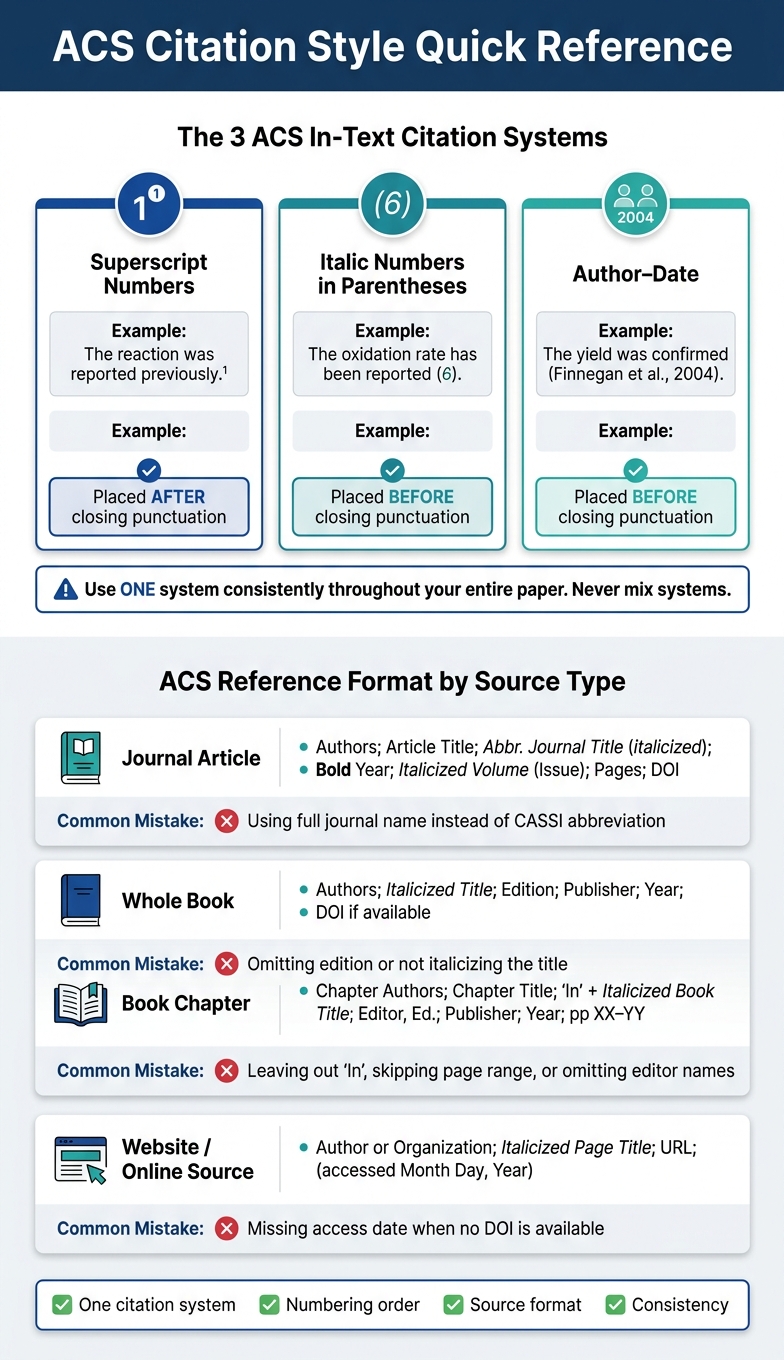
ACS Citation Style: 3 In-Text Systems & 4 Source Formats at a Glance
How to use ACS in-text citations correctly

Superscript numbers, italic numbers in parentheses, and author–date formats
ACS allows three main in-text citation styles, and the big difference is where the citation goes in relation to punctuation.
Superscript numbers come after the closing punctuation. Italic numbers in parentheses and author–date citations go before the closing punctuation.
| Citation System | Sentence Example | Punctuation Placement |
|---|---|---|
| Superscript Numbers | The reaction was reported previously.¹ | After closing punctuation |
| Italic Numbers | The oxidation rate has been reported (6). | Before closing punctuation |
| Author–Date | The yield was confirmed at 94% (Finnegan et al., 2004). | Before closing punctuation |
If you mention the author's name in the sentence itself, put the citation right after the name. For example: Rakita¹ states that... or Rakita (2004) states that...
For the author–date style, the author count changes the format:
- Two authors: (Rakita and Smith, 2004)
- Three or more authors: (Finnegan et al., 2004)
After placement, the next thing to get right is numbering, especially when a source shows up more than once or when you cite several sources together.
Citation order, repeated sources, and citing specific parts of a source
In the two numbered styles, you assign source numbers in the order they first appear, starting with 1. If you cite that same source later, use the same number again rather than giving it a new one.
When you cite more than one source at the same spot, list the numbers in ascending order. For example: ¹˒³˒⁵⁻⁷ or (1, 3, 5–7). It keeps the citation short and easy to read.
Sometimes you need to point readers to one part of a source, not the whole thing. In that case, add the detail next to the citation, such as "as shown in Figure 1 of ref 5" or "Reference 10, p 45."
The citation style you choose also affects the reference list. Numbered styles use the order of first appearance in the paper. The author–date style uses alphabetical order by the first author's last name.
sbb-itb-f7d34da
How to cite in ACS Style?
ACS reference formats for journal articles, books, chapters, and websites
Now let’s put those reference-list rules into practice by source type. In ACS style, the format changes based on what you’re citing, not just the citation system you picked.
How to format journal article references in ACS style
For a journal article, use this order: author(s), article title, abbreviated journal title, year, volume, issue, page range, and DOI. List multiple authors with the surname first, then initials, and separate each author with semicolons.
Example:
Tan, G. Y.; Das, M.; Keum, H.; Bellotti, P.; Daniliuc, C.; Glorius, F. Photochemical single-step synthesis of β-amino acid derivatives from alkenes and (hetero)arenes. Nat. Chem. 2022, 14 (10), 1174−1184. DOI: 10.1038/s41557-022-01008-w
A few details matter here. Use semicolons between authors, italicize the journal title and volume, and put the issue number in parentheses right after the volume.
For journal abbreviations, ACS follows the Chemical Abstracts Service Source Index (CASSI). So you should use the CASSI form instead of the full journal name. One-word journal titles like Science or Nature stay as they are.
If the paper was published online before volume or page numbers were assigned, use the ACS ASAP label and include an access date.
Books and book chapters use a different setup.
How to format book and book chapter references in ACS style
Whole books and chapters from edited books do not use the same pattern.
For a whole book, use this order: authors, italicized title, edition if needed, publisher, and year.
Atkins, P. Concepts in Physical Chemistry, 2nd ed.; Royal Society of Chemistry, 2024. DOI: 10.1039/9781837674244
For a chapter in an edited book, add the chapter title, the word "In", the book title, the editor’s name, the publisher, the year, and the page range.
Schmitz, C.; Cremmans, K.; Bissadi, G. Application of machine learning algorithms for use in material chemistry. In Computational and Data-Driven Chemistry Using Artificial Intelligence: Fundamentals, Methods and Applications; Akitsu, T., Ed.; Elsevier, 2022; pp 161–192. DOI: 10.1016/B978-0-12-822249-2.00001-3
Here’s the side-by-side difference:
| Element | Whole Authored Book | Chapter in Edited Book |
|---|---|---|
| Chapter title | Omitted | Required, in roman type |
| "In" before book title | Not used | Required |
| Editor names | Omitted | Required |
| Page range | Optional | Required |
For online sources, the access date becomes the main detail when no DOI is available.
How to format website and online source references in ACS style
Use the table below for website references. Include an access date when no DOI exists. The access date uses U.S. style - month, day, year - like (accessed July 20, 2026).
Guidelines for Chemical Laboratory Safety in Academic Institutions. American Chemical Society, Committee on Chemical Safety, Task Force for Safety Education Guidelines, 2016. https://www.acs.org/content/dam/acsorg/about/governance/committees/chemicalsafety/publications/acs-safety-guidelines-academic.pdf (accessed July 20, 2026)
If a DOI is available, use it. If not, use the URL.
Use this table as a quick check for the required parts and the mistakes people make most often:
| Source Type | Required Elements | Common Mistakes |
|---|---|---|
| Journal Article | Authors; Title; Abbr. J. Year, Vol (Issue), Pages; DOI | Using the full journal title instead of a CASSI abbreviation; forgetting to bold the year or italicize the volume |
| Book | Authors; Italicized Title, Edition; Publisher, Year | Omitting the edition when it is needed; not italicizing the title |
| Book Chapter | Chapter authors; Chapter title; In Book Title; Editor, Ed.; Publisher, Year; pp XX–YY | Leaving out "In"; skipping the page range; omitting editor names |
| Website | Author or organization; Page Title; Website name if different; URL; (accessed Month Day, Year) | Leaving out the access date; not italicizing the page title |
Applying ACS style with Sourcely
Once you know the source formats, Sourcely can help you find chemistry sources and pull the details ACS asks for. After the rules are set, the next job is simple: gather the right source data.
Finding chemistry sources and pulling ACS citation details with Sourcely
When you paste in your draft or describe your research focus, Sourcely helps you spot where your paper needs support. That matters because ACS formatting can be picky. A missing DOI, a cut-off author list, or an incomplete page range can throw off your reference list.
Sourcely’s export options give you a structured starting point, so you don’t have to track down every field by hand. Before you lock in an entry, check that journal titles match your required format and that long author lists follow the long-author rule the same way each time.
Use those fields to build citations faster and with fewer formatting mistakes.
A simple ACS citation workflow for lab reports and manuscripts
Start with the draft, then use Sourcely to fill the citation gaps. Write your lab report or manuscript, mark the claims or background statements that need literature support, and search those gaps with Sourcely. Then review the metadata it returns and format each source in your chosen in-text style.
| Writing Task | ACS Requirement | How Sourcely Helps |
|---|---|---|
| Literature Search | Relevant peer-reviewed chemistry sources | Finds relevant chemistry sources |
| Metadata Collection | Accurate author names, years, DOIs, publishers, and URLs | Extracts ACS citation fields |
| In-Text Citation | Consistent superscript, parenthetical, or author-date citations | Flags claims that need sources |
| Reference List | Bold years, italic volumes, and complete page ranges | Exports data for ACS formatting |
Once your sources are assigned, build the reference list in citation order or alphabetically for author-date, apply the formatting rules covered earlier, and do a final pass to check consistency across all entries.
Sourcely plans for U.S. students and researchers
Sourcely offers paid plans for U.S. students and researchers.
Common ACS citation mistakes and a final review checklist
ACS citation mistakes that often appear in chemistry papers
After you format your citations, do one last pass. This is where small errors tend to sneak in.
One of the biggest problems is mixing in-text citation systems. If you start with superscript numbers, stick with superscript numbers. If you use italic numbers in parentheses or author–date, use that same format all the way through. Switching systems in the same paper is incorrect.
Another slip-up is giving a repeat source a new number. If a paper first appears as reference 4, it stays reference 4 every time you cite it later in the manuscript.
Author formatting causes trouble, too. In ACS style, authors are separated with semicolons, not commas. So Smith, J.; Doe, R. is right, while Smith, J., Doe, R. is not. The author list should also end with a period. For in-text citations, use et al. for sources with more than two authors. In the reference list, name up to 10 authors before et al.
The errors that show up most often are mixed citation systems, renumbered repeat sources, and punctuation that changes from one reference entry to the next.
Final ACS checklist before you submit
Use this list as a last-minute scan before you turn in the paper:
- One in-text system throughout - superscript numbers, italic numbers in parentheses, or author–date; never mix them
- Every in-text citation has a matching reference entry - no orphaned numbers and no missing entries
- Repeated sources keep their original number - check the full document to make sure
- Year is bolded, volume is italicized, issue is in parentheses - for example, 2023, 14 (3), 1174–1184
- Authors are separated by semicolons, and the author list ends with a period - list up to 10 authors before
et al. - Use a DOI instead of a URL when the source has one - format it as
DOI: 10.1021/... - Website entries include an access date - for example,
(accessed July 20, 2026) - Journal titles are formatted consistently throughout the reference list
FAQs
Which ACS citation system should I choose?
Choose the ACS citation system that fits your professor’s rules or the publication guidelines you’re using. ACS gives you three in-text citation options: superscript numbers, numbers in parentheses, and author-date.
If you use a numerical system, list your references in the order the sources appear in the text. If you use author-date, arrange the references alphabetically by the author’s last name. If you can, check with your instructor first.
How do I cite a source with missing page numbers or no DOI?
If a journal article doesn’t have page numbers, use the article number or e-location number if one is listed.
For early publications that don’t yet have a volume, issue, or page range, use Article ASAP and add the access date.
If a digital source has no DOI, include the URL and put the access date in parentheses.
For books, page numbers are optional when you cite the entire work. But if you’re pointing to a specific section, include the page numbers.
What should I check before submitting an ACS-style paper?
Before you submit, make sure you’ve used one ACS-approved in-text citation style all the way through. Every in-text citation should match an entry in the References list, and that list should begin on a new page.
If you’re using numbered citations, check that the numbers appear in the order each source first shows up in the paper. Then give each reference a careful once-over for:
- a hanging indent
- correct punctuation
- complete bibliographic details
- any extra rules your professor wants you to follow
It’s a small check, but it can save you from easy formatting mistakes.