APA Block Quotes: When and How to Quote a Full Paragraph
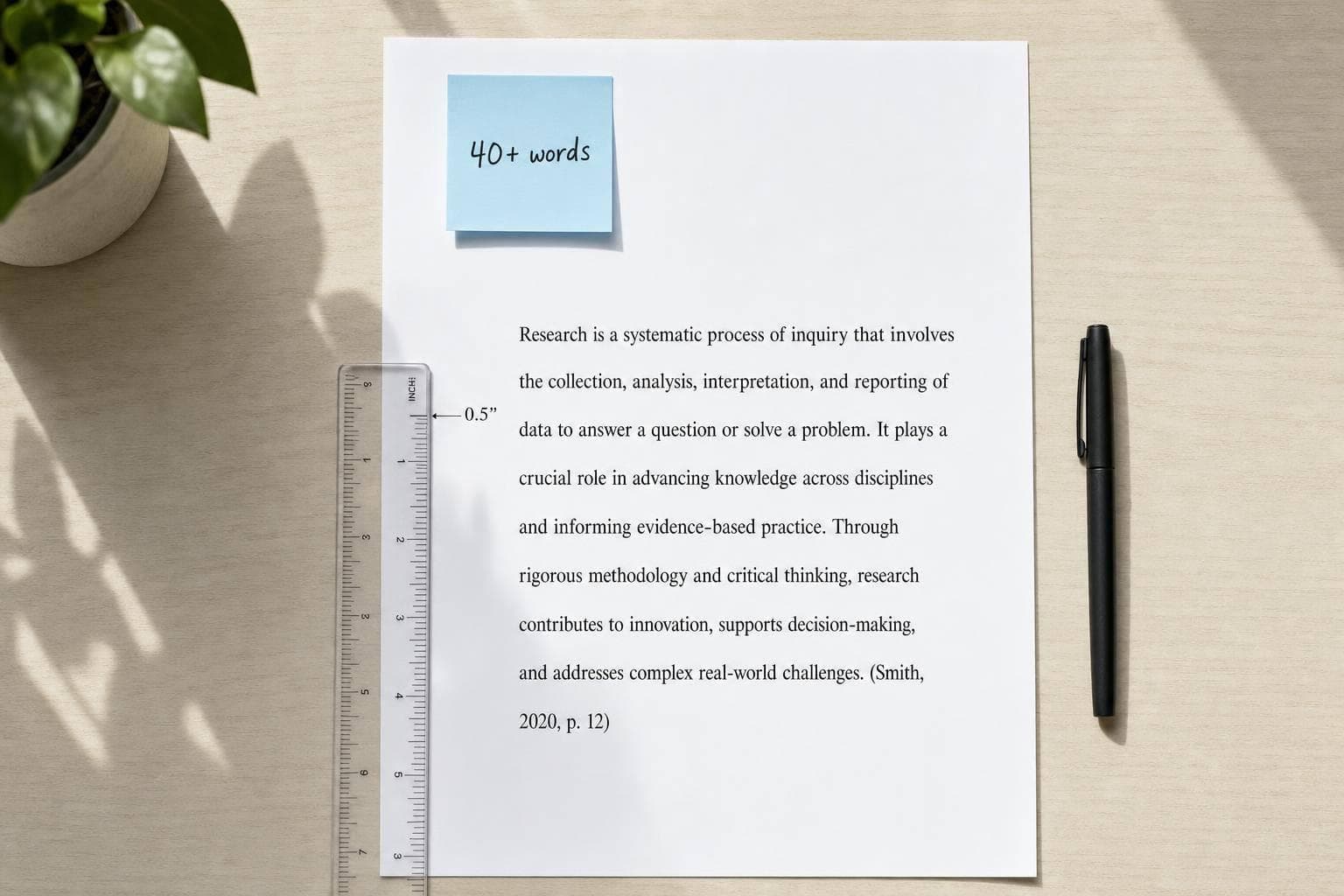
If a quote has 40 words or more, I format it as an APA block quote. If it has 39 words or fewer, I keep it in the sentence with quotation marks.
Here’s the whole rule set in plain English:
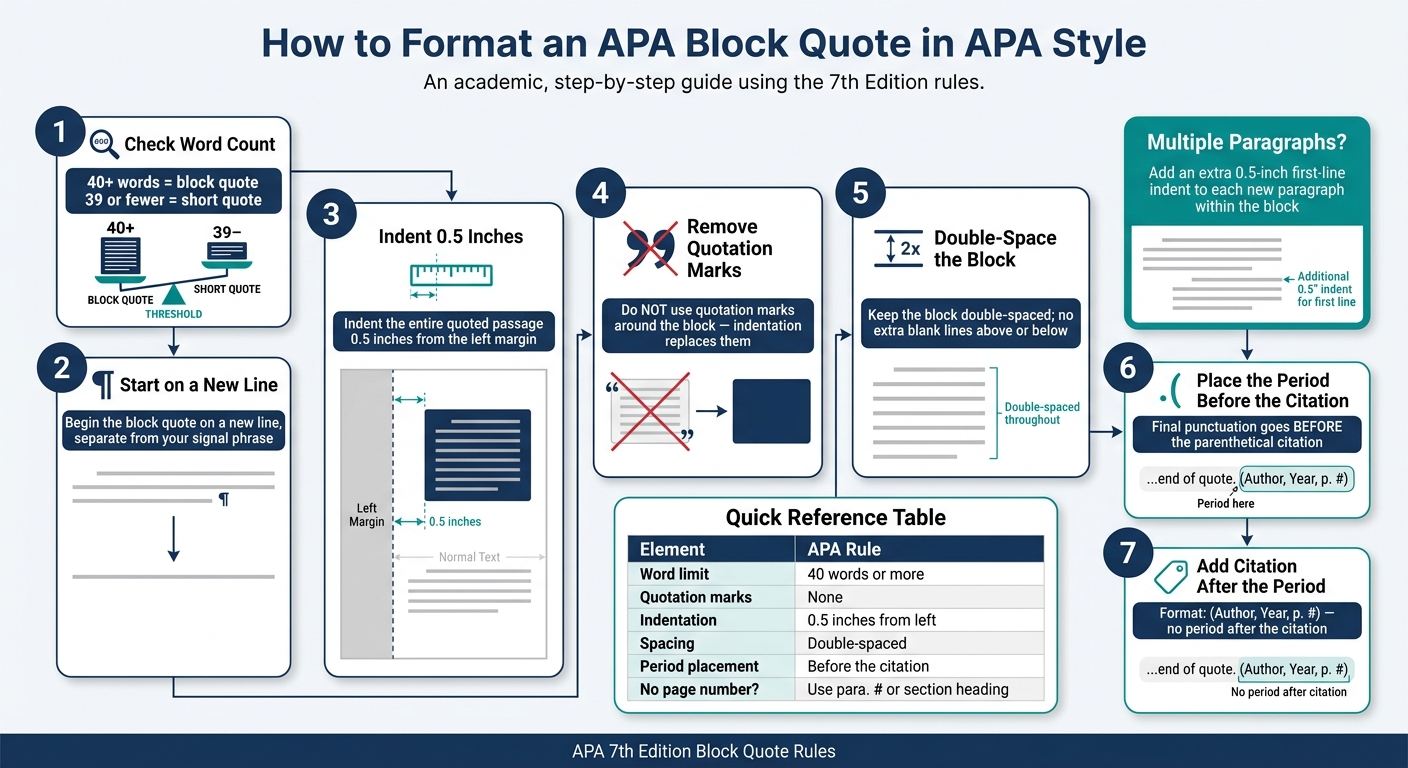
- 40+ words = block quote
- 39 or fewer = short quote
- A block quote starts on a new line
- I indent the whole quote 0.5 inches
- I do not use quotation marks around the block
- I keep it double-spaced
- In APA, the period comes before the citation
- If there are no page numbers, I use paragraph numbers or section headings
- If I quote more than one paragraph, I add an extra 0.5-inch first-line indent to each new paragraph
That’s the part most people miss: paragraph length does not decide the format - word count does. So even a full paragraph stays a short quote if it has only 35 words.
I’d also keep one more rule in mind: just because a passage can be a block quote doesn’t mean I should use it. If the exact wording is not doing special work - like a legal line, a policy statement, a technical definition, or a line for literary analysis - I’d usually paraphrase instead.
A fast example:
- Short quote: under 40 words, in quotation marks
- Block quote: 40+ words, indented, no quotation marks, citation after the final period
| Item | APA rule |
|---|---|
| Word limit | 40 words or more |
| Quote marks | None for block quotes |
| Indent | 0.5 inches from the left |
| Spacing | Double-spaced |
| Citation spot | After the final punctuation |
| No page number? | Use para. or a section heading |
Bottom line: I use block quotes for long direct quotes when the source’s exact words matter, and I make sure the format matches APA rules line by line.
How to properly format a block quote: APA 7th style
sbb-itb-f7d34da
When to Use a Block Quote Instead of a Short Quote
A passage hitting 40 words doesn’t automatically mean it should become a block quote. It only means the passage can be set off that way. The bigger test is simple: does the exact wording matter? If it does, a block quote may make sense. If not, a paraphrase will usually do the job better.
When to Quote a Full Paragraph vs. When to Paraphrase
Before you drop in a long quotation, pause and ask one thing: Would paraphrasing this passage remove something important? If the answer is no, paraphrase it.
Use block quotes when the exact language carries weight, such as:
- legal, historical, or policy wording
- literary analysis
- exact technical definitions
Paraphrasing helps keep the paper in your own voice.
How Signal Phrases Connect Block Quotes to Your Argument
Every block quote needs a signal phrase. That’s the lead-in sentence that names the source and sets up the quotation. In many cases, the signal phrase ends with a colon. After the quote, add at least one sentence of your own analysis so the reader sees how the quoted material supports your point.
"Do not let a quotation make your argument for you. Your explanation should be the most important part." - Justice Institute of British Columbia
The quote should back up your point, not stand in for it.
How to Format an APA Block Quote Step by Step
How to Format an APA Block Quote: Step-by-Step Guide
Once a passage meets the block-quote threshold, format it like this.
Indentation, Spacing, and Quotation Mark Rules
Start the block quote on a new line. Then indent the full passage 0.5 inches from the left margin. Keep the quote double-spaced, with no extra space before or after it. Use the same font and font size as the rest of your paper.
Don't put quotation marks around the block quote itself. If the source text includes quotation marks, keep those marks inside the quoted passage.
Where to Place the Citation in an APA Block Quote
In APA style, the period goes before the parenthetical citation. After that citation, do not add another period.
Example of a Full-Paragraph Block Quote from a Journal Article or Book
Here’s an example from a journal article:
Researchers have studied how people talk to themselves:
Inner speech is a paradoxical phenomenon. It is an experience that is central to many people's everyday lives, and yet it presents considerable challenges to any effort to study it scientifically. Nevertheless, a wide range of methodologies and approaches have combined to shed light on the subjective experience of inner speech and its cognitive and neural underpinnings. (Alderson-Day & Fernyhough, 2015, p. 957)
Use this layout as your model when formatting a block quote.
| Formatting Element | Rule |
|---|---|
| Start | New line, separate from the signal phrase |
| Indentation | 0.5 inches from the left margin |
| Quotation marks | None around the block; double marks only for quotes within the source |
| Spacing | Double-spaced, same as the rest of the paper |
| Period placement | After the last sentence of the quote |
| Citation | After the period: (Author, Year, p. #) |
| Period after citation | None |
How to Handle Multiple Paragraphs and Other Special Cases
Once you have the basic block quote format in place, two situations tend to trip people up: quotes with more than one paragraph and sources that don't include page numbers.
How to Format a Block Quote with More Than One Paragraph
If your block quote has two or more paragraphs, indent the first line of each new paragraph 0.5 inches farther than the rest of the block.
Keep the whole block double-spaced. Also, don't add extra blank lines before or after it.
If page numbers aren't available, use the source's next-best location marker.
How to Cite Sources Without Page Numbers
When a source doesn't include page numbers, use other location markers, such as paragraph numbers, section headings, or both.
| Source Type | Location Marker Example | Citation Format |
|---|---|---|
| Webpage with no headings | Paragraph number | (Author, Year, para. 4) |
| Document with headings | Section name or shortened heading in quotes, combined with paragraph if needed | (Author, Year, Discussion section) or (Author, Year, Results section, para. 3) |
One thing to avoid: don't use Kindle location numbers instead of page numbers. If the source has no usable page or section marker, cite the closest marker you can find, such as a paragraph number or section heading.
Common APA Block Quote Mistakes to Avoid
A few mistakes show up again and again:
- Don't put quotation marks around the block.
- Put the final punctuation before the citation.
- If you're quoting more than one paragraph, add the extra first-line indent to each new paragraph.
- If you cut words from the middle of a quote, use an ellipsis (...), but never put one at the very start or end of the block.
That last point is easy to miss. APA lets you shorten a quoted passage, but the edit should stay clean and not change the meaning.
Conclusion: A Quick Checklist for Getting APA Block Quotes Right
APA block quotes follow one core rule: direct quotations of 40 words or more should be set as block quotes. If you're doing a final pass before submitting, use this checklist to catch the small stuff.
- Word count: Make sure the passage has at least 40 words.
- Quotation marks: Block quotes do not use quotation marks. The indentation does that job.
- Indentation: Indent the full block 0.5 inches from the left margin.
- Spacing: Double-space the block, with no extra blank lines above or below.
- Citation position: Put the parenthetical citation after the final punctuation mark, not before it.
- Locator: Use page numbers when you have them. If not, use paragraph numbers or section headings.
If you're still hunting for sources or checking page numbers, Sourcely can help. It helps students find quotable passages from academic sources, check metadata like page numbers and author details, and keep APA references organized when you need to verify quotations and APA details fast.
FAQs
Do I count the citation in the 40-word limit?
No. The in-text citation does not count toward the 40-word limit when you decide whether to use a block quote.
Only the quoted text counts. If the quote itself reaches 40 words, format it as a block quote and place the citation after the final punctuation mark.
Can I use a block quote in the middle of a paragraph?
Yes. A block quote can appear in the middle of a paragraph.
Even though it starts on a new line and is indented 0.5 inches from the left margin, it doesn't automatically end your paragraph. You can keep your analysis or explanation going after the quote unless the quoted passage already finishes your point.
What if my source has no page numbers or headings?
If your source doesn’t include page numbers, add another locator to help readers find the quoted passage. The most common choice is para. followed by the paragraph number, like para. 2.
If that information is available, you can also use a chapter number, a section heading, or a mix of these. Put the locator in the parenthetical citation after the block quote’s final punctuation.